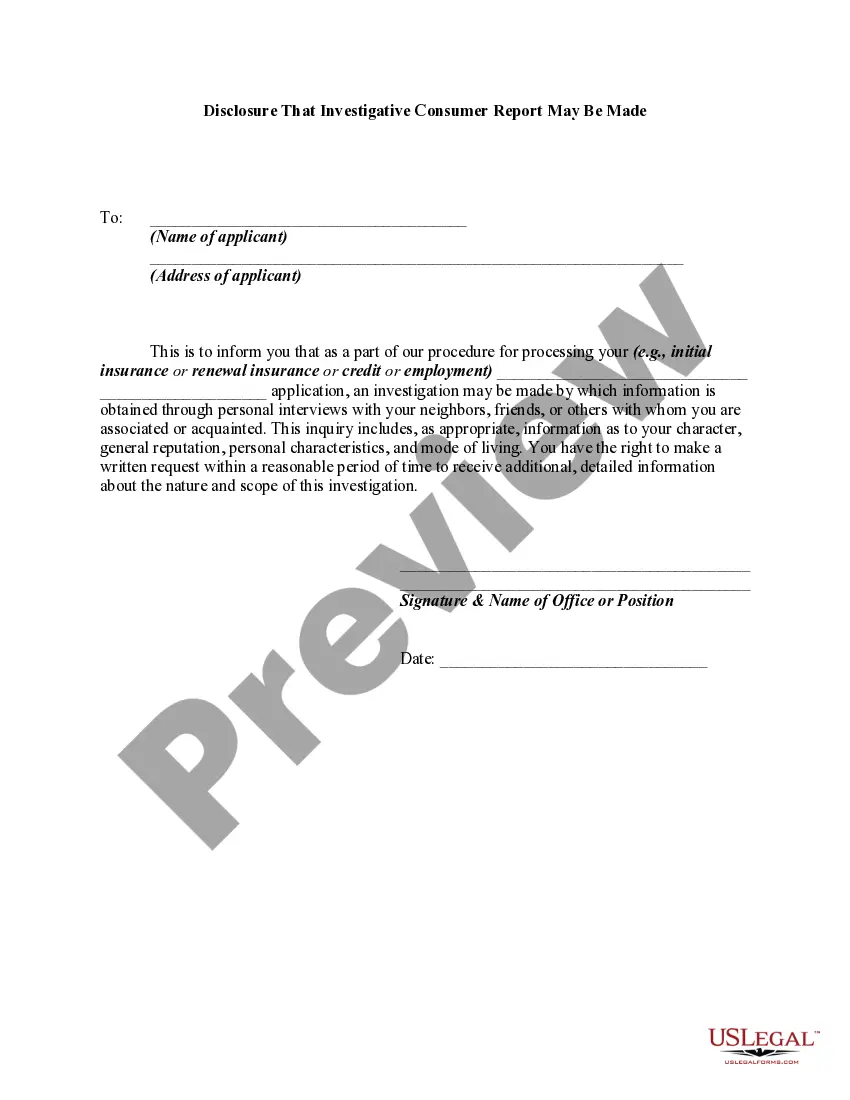
Disclosure That Investigative Consumer Report May Be Made
What this document covers
The Disclosure That Investigative Consumer Report May Be Made is a legal document that informs consumers when an investigative report about them is being prepared. This form is essential for complying with the Fair Credit Reporting Act, ensuring that consumers are made aware of the nature of the investigation and their rights. It serves as a notification mechanism distinct from standard credit reports, focusing on in-depth personal insights from interviews rather than just credit history.
Key components of this form
- Name and address of the applicant.
- Type of application (insurance, credit, employment, etc.).
- Statement indicating an investigation may take place.
- Details about information sources such as friends or neighbors.
- The consumer's right to request additional information.
- Signature and date field for acknowledgment.
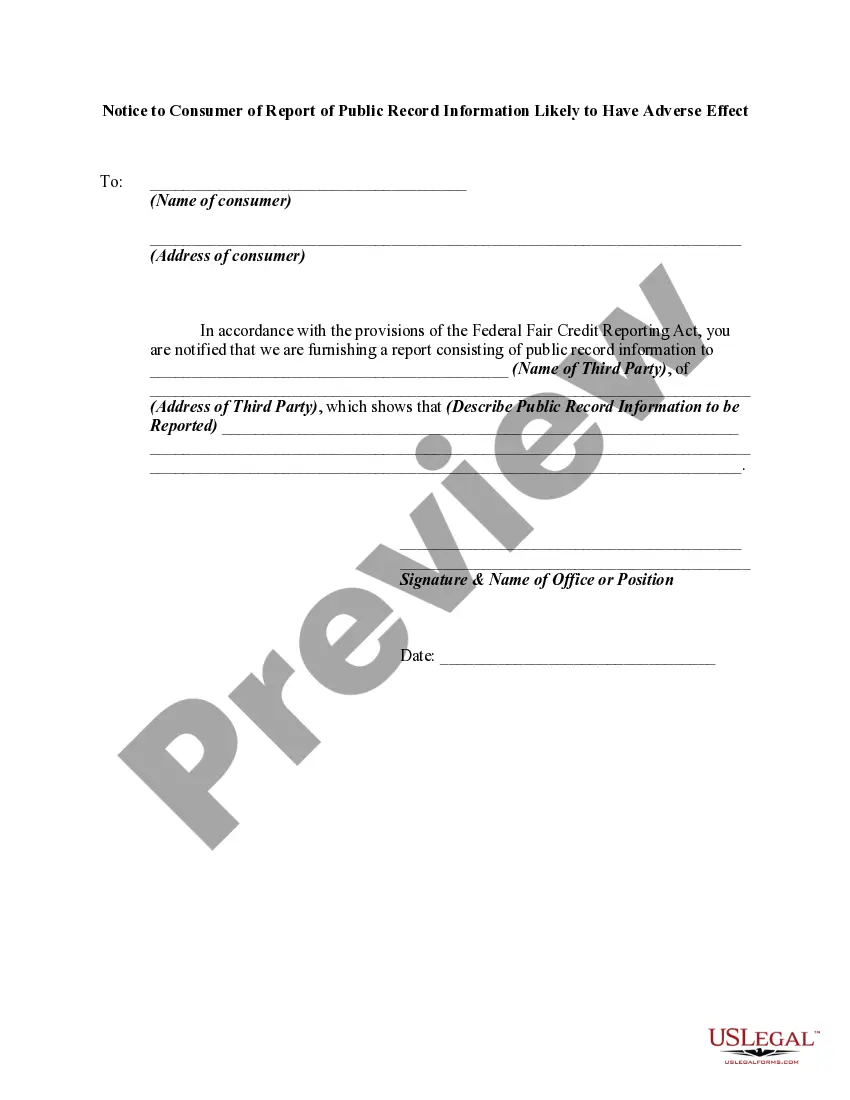
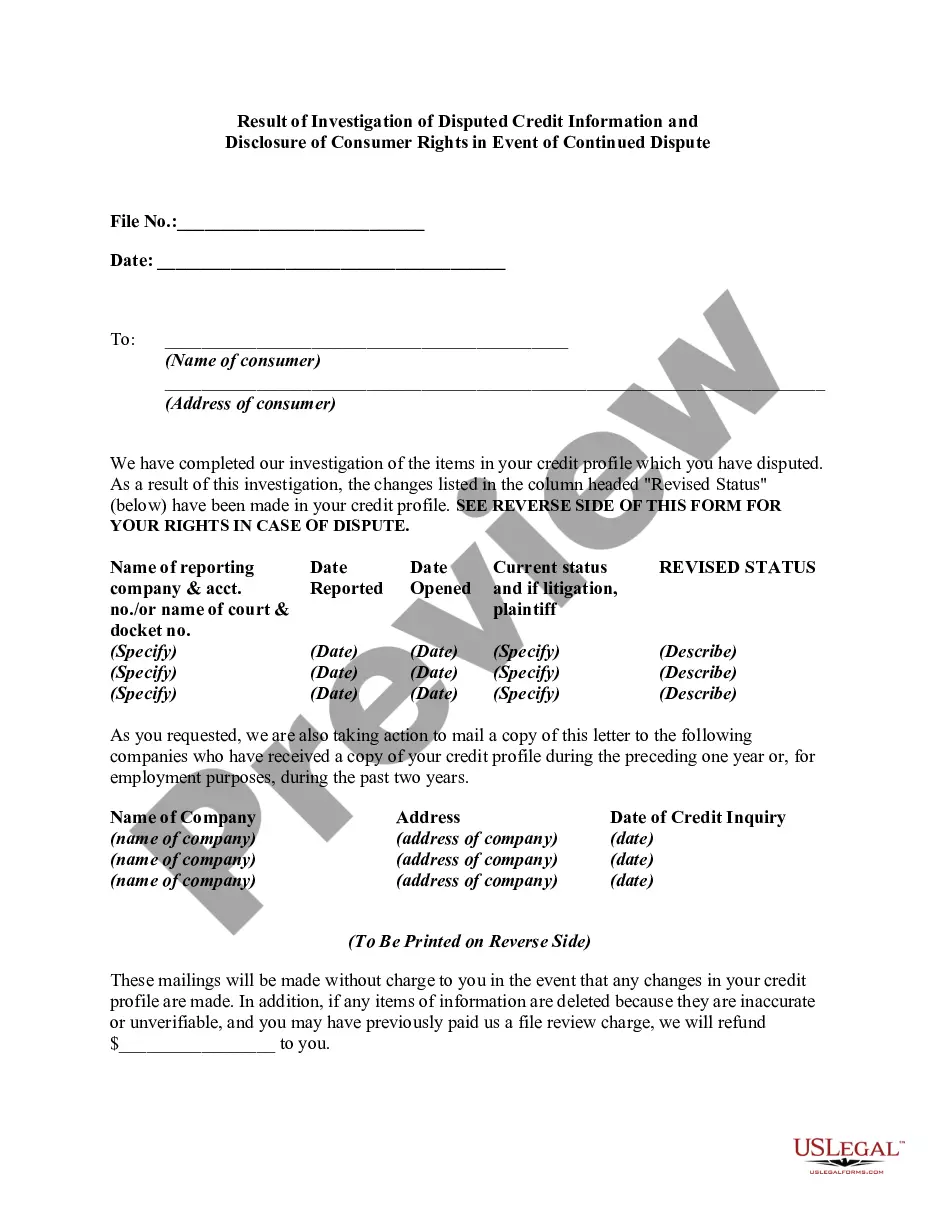
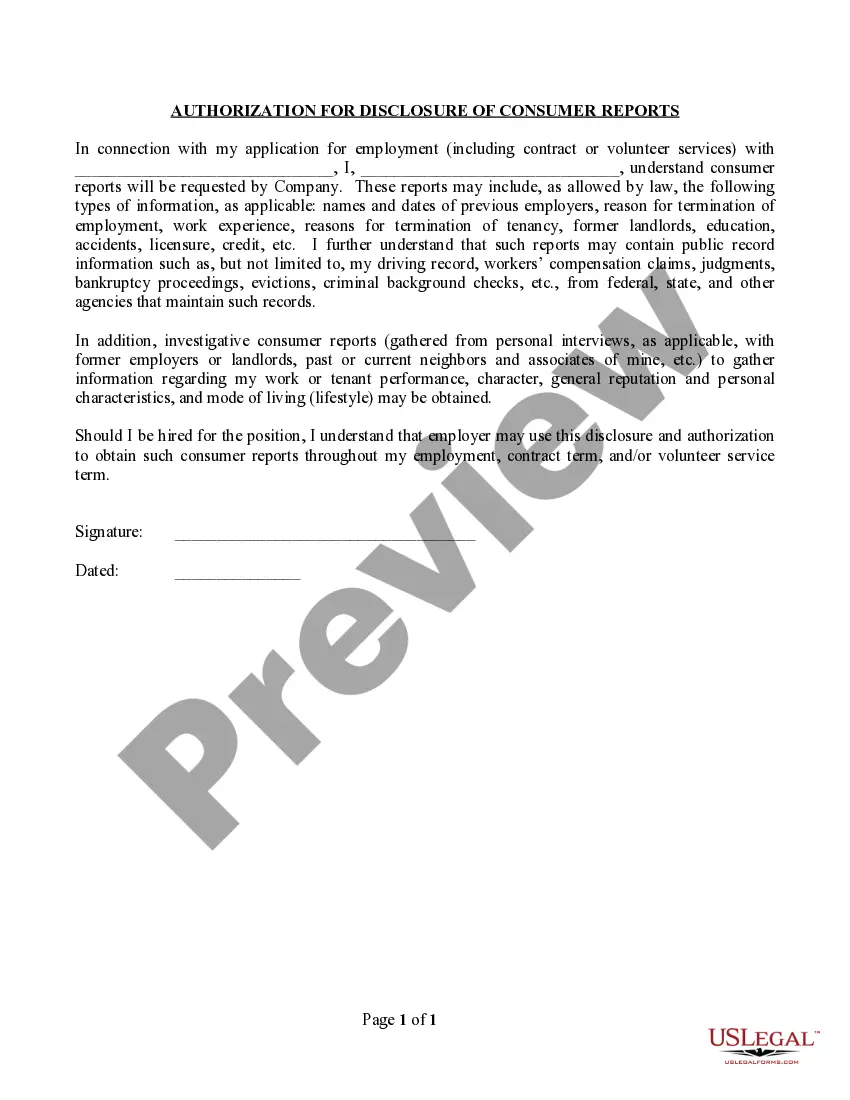
When this form is needed
This form should be used when a business or organization intends to obtain an investigative consumer report for purposes related to insurance, credit applications, or employment verification. If you are an employer or lender, using this form ensures that you adhere to legal requirements, including informing the consumer about the investigation process.
Intended users of this form
- Employers conducting background checks on potential hires.
- Lenders evaluating applicants for credit or loans.
- Insurance companies processing applications for coverage.
- Any organization that requires a deeper assessment of a consumer's background.
How to prepare this document
- Enter the name and address of the applicant at the top of the form.
- Specify the type of application being submitted (insurance, credit, or employment).
- Include the statement indicating that an investigative consumer report may be obtained.
- Make sure to inform the applicant about their rights to request further details regarding the investigation.
- Have the authorized individual sign and date the document to confirm the disclosure was made.
Notarization guidance
This form does not typically require notarization unless specified by local law. Always check your jurisdictionâs requirements to ensure compliance.
Get your form ready online
Our built-in tools help you complete, sign, share, and store your documents in one place.
Make edits, fill in missing information, and update formatting in US Legal Forms—just like you would in MS Word.
Download a copy, print it, send it by email, or mail it via USPS—whatever works best for your next step.
Sign and collect signatures with our SignNow integration. Send to multiple recipients, set reminders, and more. Go Premium to unlock E-Sign.
If this form requires notarization, complete it online through a secure video call—no need to meet a notary in person or wait for an appointment.
We protect your documents and personal data by following strict security and privacy standards.

Make edits, fill in missing information, and update formatting in US Legal Forms—just like you would in MS Word.

Download a copy, print it, send it by email, or mail it via USPS—whatever works best for your next step.

Sign and collect signatures with our SignNow integration. Send to multiple recipients, set reminders, and more. Go Premium to unlock E-Sign.

If this form requires notarization, complete it online through a secure video call—no need to meet a notary in person or wait for an appointment.

We protect your documents and personal data by following strict security and privacy standards.
Avoid these common issues
- Failing to provide the form within three days of requesting the report.
- Not including all required disclosures about the nature of the investigation.
- Neglecting to inform the consumer of their right to request additional details.
- Omitting signatures or dates, which can lead to legal issues.
Benefits of completing this form online
- Convenience of immediate access and download from any location.
- Editability features that allow customization to specific needs.
- Reliability with forms drafted by licensed attorneys.
Legal use & context
- The form complies with the Fair Credit Reporting Act regulations.
- It establishes transparency and protects consumer rights during investigations.
- Proper use can strengthen the validity of employment and lending practices.
What to keep in mind
- The form is crucial for businesses obtaining investigative consumer reports.
- Consumers must be informed within three days after the report is requested.
- It highlights the consumer's rights regarding the investigation process.
Looking for another form?
Form popularity
FAQ
Common violations of the FCRA include: Creditors give reporting agencies inaccurate financial information about you. Reporting agencies mixing up one person's information with another's because of similar (or same) last name or social security number. Agencies fail to follow guidelines for handling disputes.
Notified the applicant or employee and got their permission to get a consumer report; complied with all of the FCRA requirements; and.
A consumer disclosure is the long version of your credit report that contains all credit inquiries and suppressed information not found in your standard credit report, as well as the normal credit report records of balances, payment history, personal information, etc.
A consumer report is a collection of documents that may include credit reports, criminal and other public records such as bankruptcy filings, and records of civil court procedures and judgments. Increasingly, these records also include your activity on social media, such as Twitter and Facebook.
The federal Fair Credit Reporting Act (FCRA) promotes the accuracy, fairness, and privacy of information in the files of. consumer reporting agencies.
Background. Under section 609 of the FCRA, a consumer reporting agency must, upon a consumer's request, disclose to the consumer information in the consumer's file.
(e) The term "investigative consumer report" means a consumer report or portion thereof in which information on a consumer's character, general reputation, personal characteristics, or mode of living is obtained through personal interviews with neighbors, friends, or associates of the consumer reported on or with
Nearly all background checks include a criminal-history check, based on information supplied by the candidate, including their Social Security number. Criminal background checks will reveal felony and misdemeanor criminal convictions, any pending criminal cases, and any history of incarceration as an adult.
(f) The term "consumer reporting agency" means any person which, for monetary fees, dues, or on a cooperative nonprofit basis, regularly engages in whole or in part in the practice of assembling or evaluating consumer credit information or other information on consumers for the purpose of furnishing consumer reports to