Acceptance of Claim and Report of Past Experience with Debtor
What this document covers
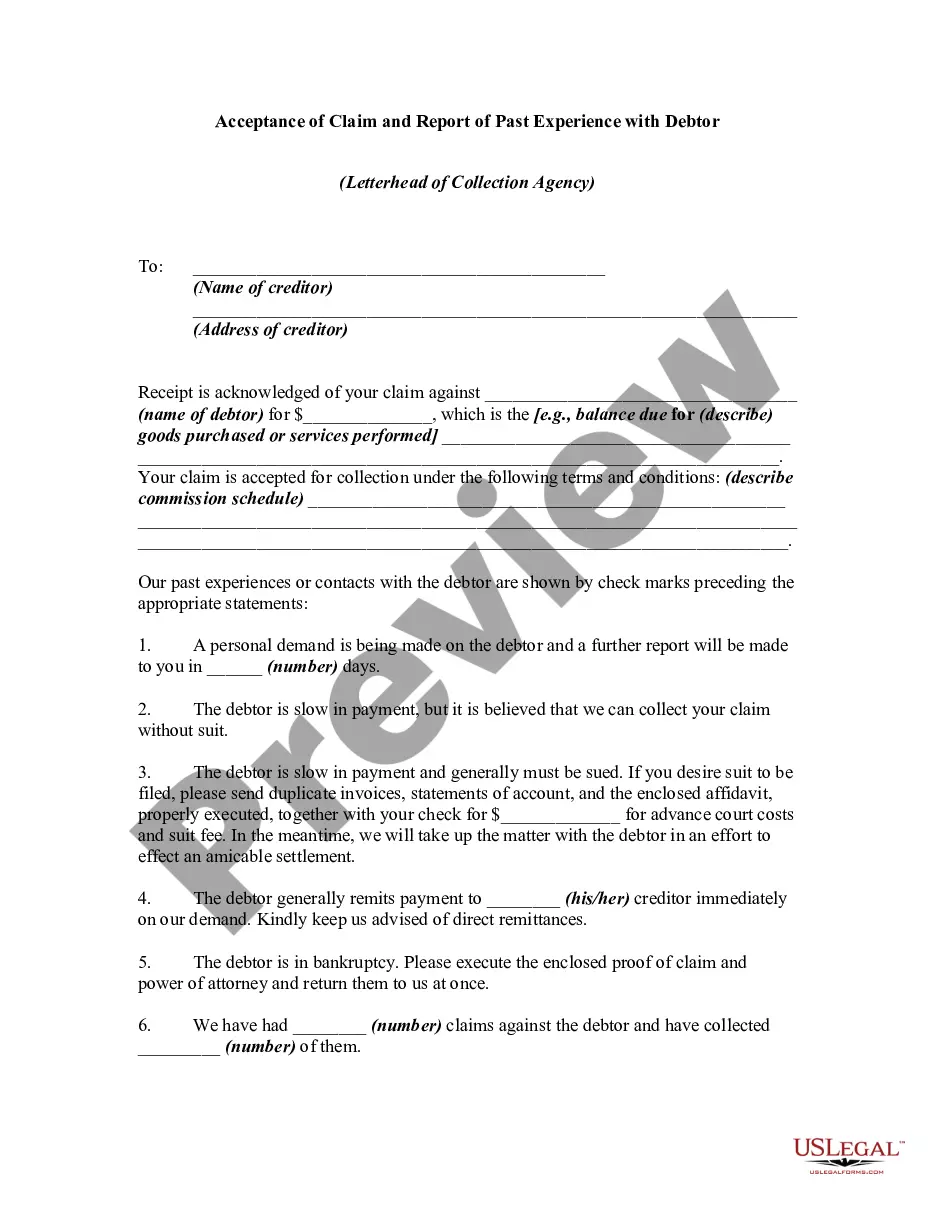
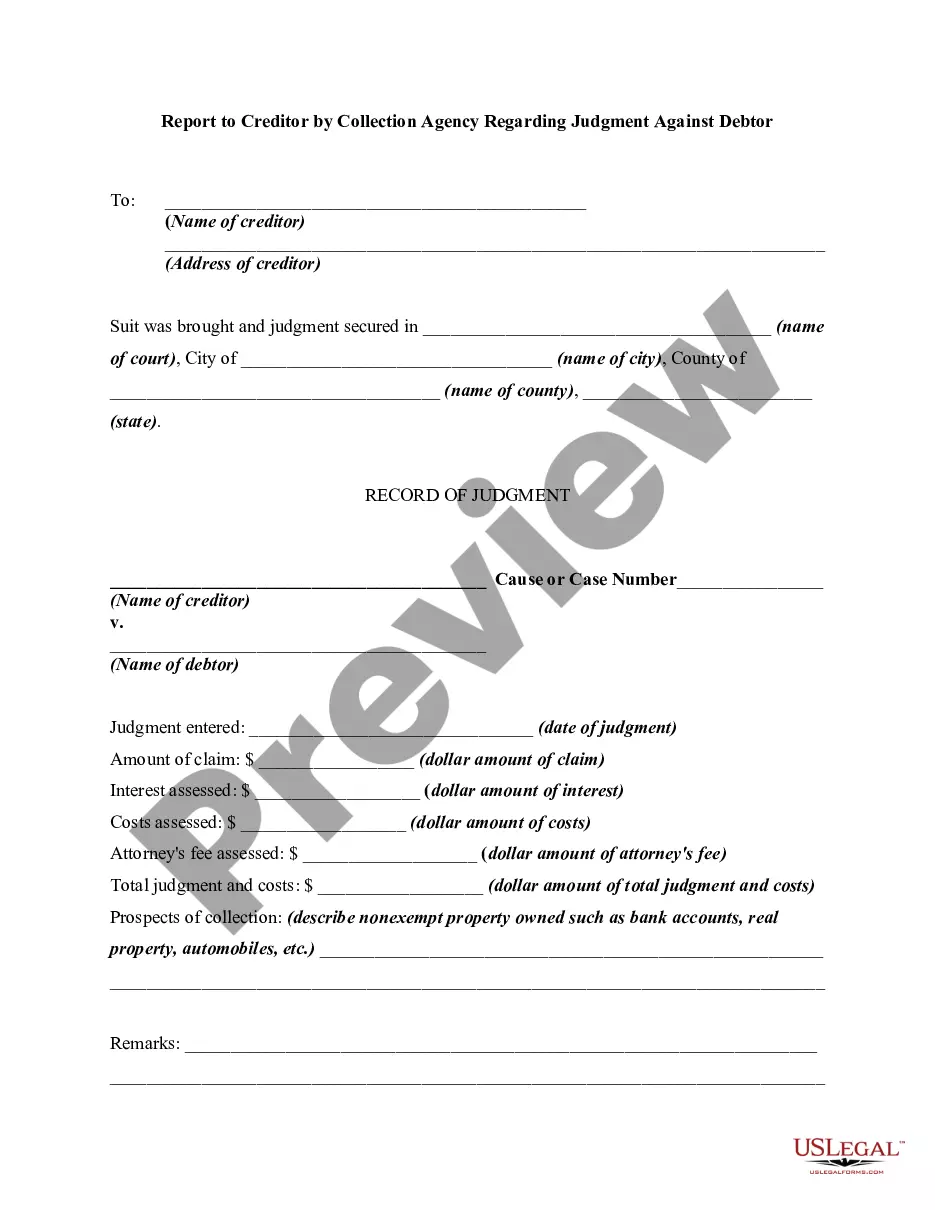
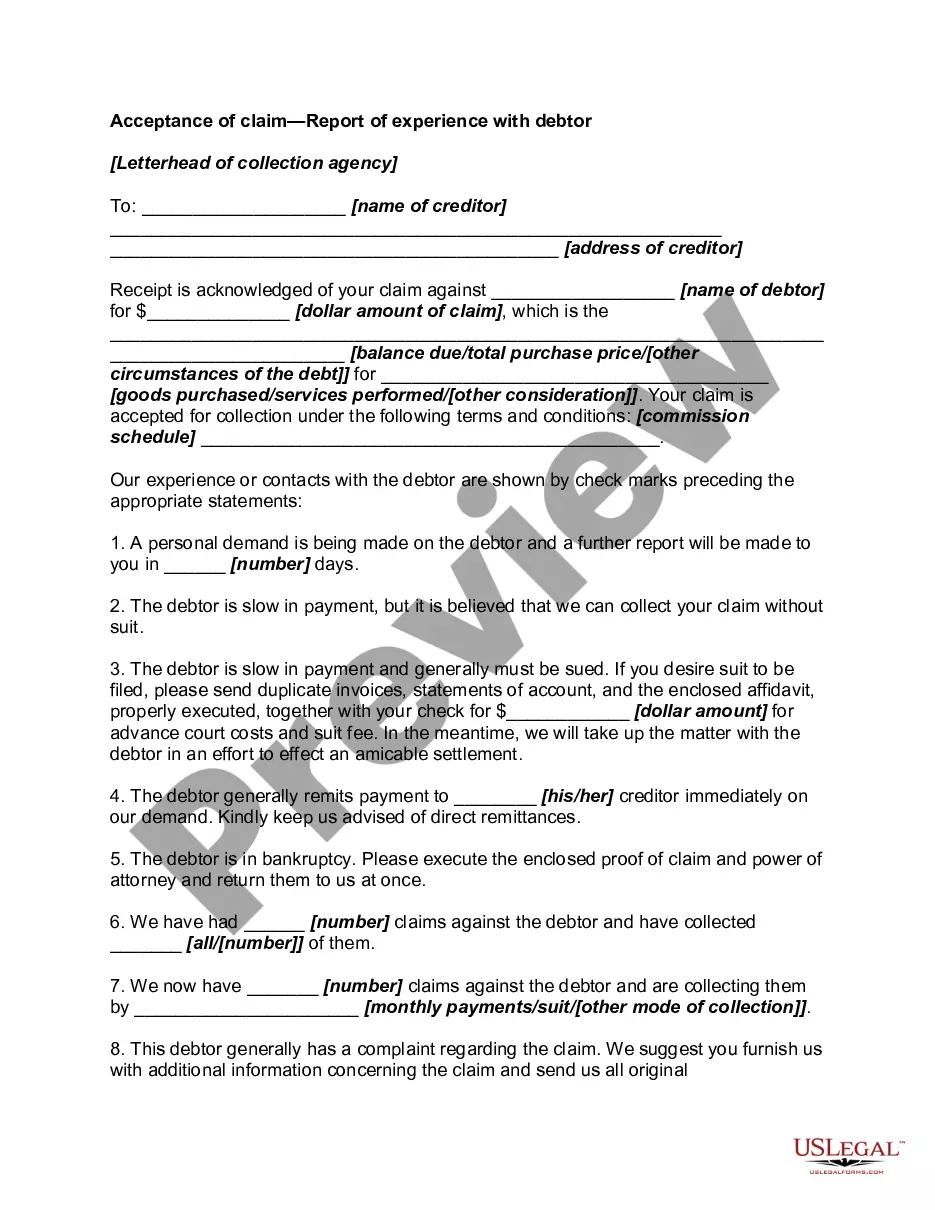
The Acceptance of Claim and Report of Past Experience with Debtor is a legal document used by collection agencies to acknowledge receipt of a creditor's claim against a debtor. This form serves to formally accept a claim for collection and outlines the agency's previous experiences or strategies in dealing with the debtor. It differs from other collection forms by not requiring specific legal language, as long as the essential information is clearly conveyed.
What’s included in this form
- Letterhead of the collection agency
- Name and address fields for the creditor and debtor
- Details of the claim being accepted, including amounts and services rendered
- Terms and conditions regarding the collection commission schedule
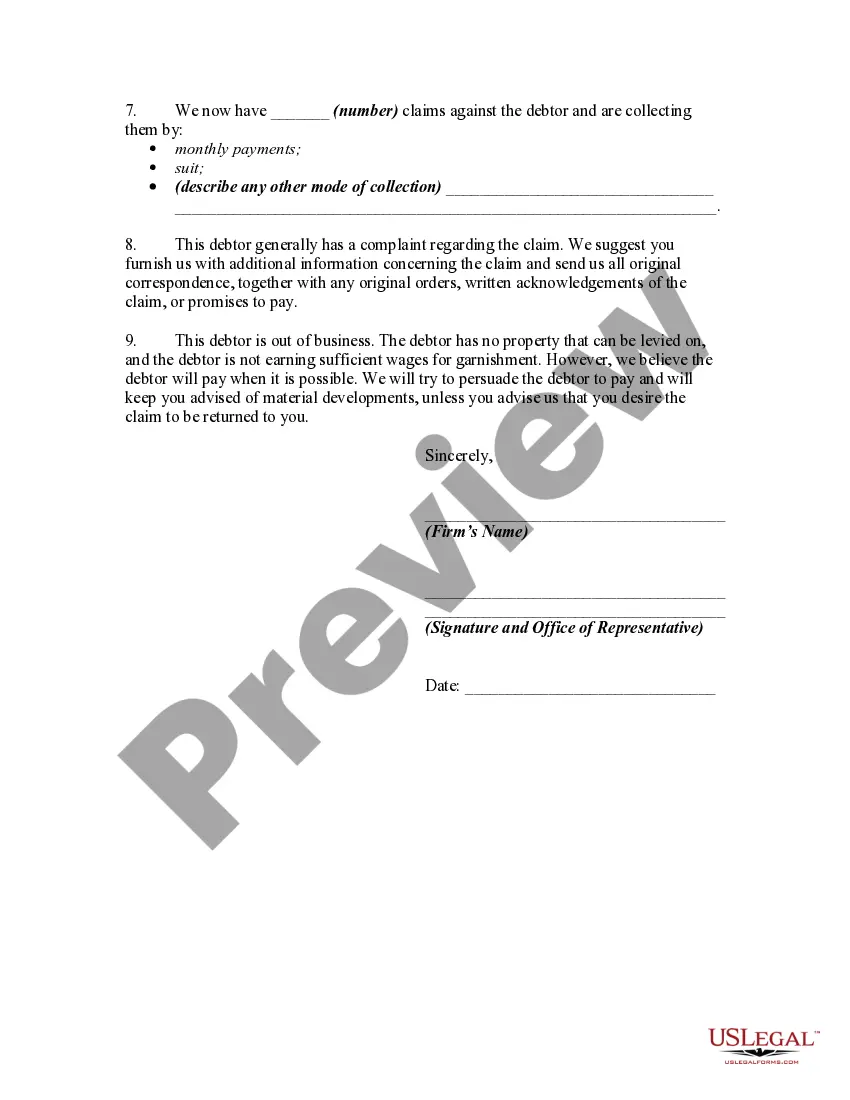
- Checklist for past experiences with the debtor, providing insights into collection strategies
- Signature line for the representative of the collection agency with date

When to use this form
This form should be used when a creditor has placed a claim for collection with a collection agency and expects a response regarding the collection efforts. It is particularly useful in situations where the debtor has a history of delayed payments or requires further strategies for recovery, including possible legal action or bankruptcy proceedings.
Who this form is for
This form is intended for:
- Collection agencies tasked with recovering debts on behalf of creditors
- Creditors seeking to formalize the process of accepting a claim for collection
- Businesses that have previously dealt with a debtor and wish to outline their collection experience
Instructions for completing this form
- Identify the creditor's name and address in the designated fields.
- Enter debtor information, including the name and details of the claim.
- Specify the amount owed and describe the nature of goods or services provided.
- Outline the commission schedule and any terms associated with the claim.
- Review the checklist regarding past experiences with the debtor and mark the appropriate statements.
- Have a representative of the collection agency sign the form and include the date.
Notarization requirements for this form
Notarization is generally not required for this form. However, certain states or situations might demand it. You can complete notarization online through US Legal Forms, powered by Notarize, using a verified video call available anytime.
Get your form ready online
Our built-in tools help you complete, sign, share, and store your documents in one place.
Make edits, fill in missing information, and update formatting in US Legal Forms—just like you would in MS Word.
Download a copy, print it, send it by email, or mail it via USPS—whatever works best for your next step.
Sign and collect signatures with our SignNow integration. Send to multiple recipients, set reminders, and more. Go Premium to unlock E-Sign.
If this form requires notarization, complete it online through a secure video call—no need to meet a notary in person or wait for an appointment.
We protect your documents and personal data by following strict security and privacy standards.

Make edits, fill in missing information, and update formatting in US Legal Forms—just like you would in MS Word.

Download a copy, print it, send it by email, or mail it via USPS—whatever works best for your next step.

Sign and collect signatures with our SignNow integration. Send to multiple recipients, set reminders, and more. Go Premium to unlock E-Sign.

If this form requires notarization, complete it online through a secure video call—no need to meet a notary in person or wait for an appointment.

We protect your documents and personal data by following strict security and privacy standards.
Mistakes to watch out for
- Failing to include accurate details of the debtor and the claim amount.
- Not marking the past experience checklist adequately, leading to unclear strategies.
- Omitting the signature of the representative, invalidating the form.
- Neglecting to specify terms and conditions for collection, which could lead to miscommunication.
Benefits of using this form online
- Convenience of completing the form from any location at any time.
- Editability allows for adjustments and accuracy before final submission.
- Reliability of using professionally drafted templates by licensed attorneys.
Legal use & context
- The form acts as an acknowledgment of the creditor's claim and outlines collection strategies.
- It helps ensure transparency between creditors and collection agencies regarding debtor interactions.
- Failure to complete the form correctly may result in disputes or legal complications.
What to keep in mind
- The Acceptance of Claim and Report of Past Experience with Debtor aids in formalizing the debt collection process.
- Proper completion of the form is essential for effective communication and legal compliance.
- Understanding the state-specific requirements can ensure the form is valid and enforceable.
- Utilizing this form online offers convenience and access to expertly drafted materials.
Looking for another form?
Form popularity
FAQ
Chapter 11 creditors are not required to file a Proof of Claim because the debtor is required to file a Schedule of Assets and Liabilities.If it is not filed, the Bankruptcy Court will consider the customer's Schedule of Liabilities as accurate and make any distributions accordingly.
§101 (5). A claim may be secured or unsecured. A proof of claim is a form used by the creditor to indicate the amount of the debt owed by the debtor on the date of the bankruptcy filing. The creditor must file the form with the clerk of the same bankruptcy court in which the bankruptcy case was filed.
Under the bankruptcy procedural rules, and except as otherwise provided under those rules, an unsecured creditor must file a proof of claim in order for the unsecured creditor's claim to be allowed.
In Chapter 7, a creditor can file a late claim and the result is the claim is subordinated to timely filed claims. 11 U.S.C. §726(a)(3).at 1193 (However, a secured creditor, who does not wish to participate in a Chapter 13 plan or who fails to file a timely proof of claim, does not forfeit its lien.)
Form 410 provides the official proof of claim. A creditor will need to identify itself and state the debtor's name, the case number, the type of claim, the nature of the debt, and the amount of the debt.They are not required to accept it, though, so a creditor should go through the formal process if possible.
A proof of claim filed by a creditor supersedes a claim filed by the debtor or trustee only if it is timely filed within the 90 days allowed under Rule 3002(c).Under that provision, the debtor or trustee may file proof of a claim if the creditor fails to do so in a timely fashion.
Why Would a Creditor Not File a Proof of Claim?A creditor might not file a proof of claim in your bankruptcy if: you have a no-asset Chapter 7 bankruptcy (meaning you don't have any property the bankruptcy trustee can distribute to your creditors, so they won't get paid) you owe the creditor a very small sum, or.
If one creditor fails to file a timely proof of claim, the amount the debtor must pay is reduced dollar-for-dollar. Not having to pay that debt can result in a lower monthly plan payment, a shorter plan, or both.