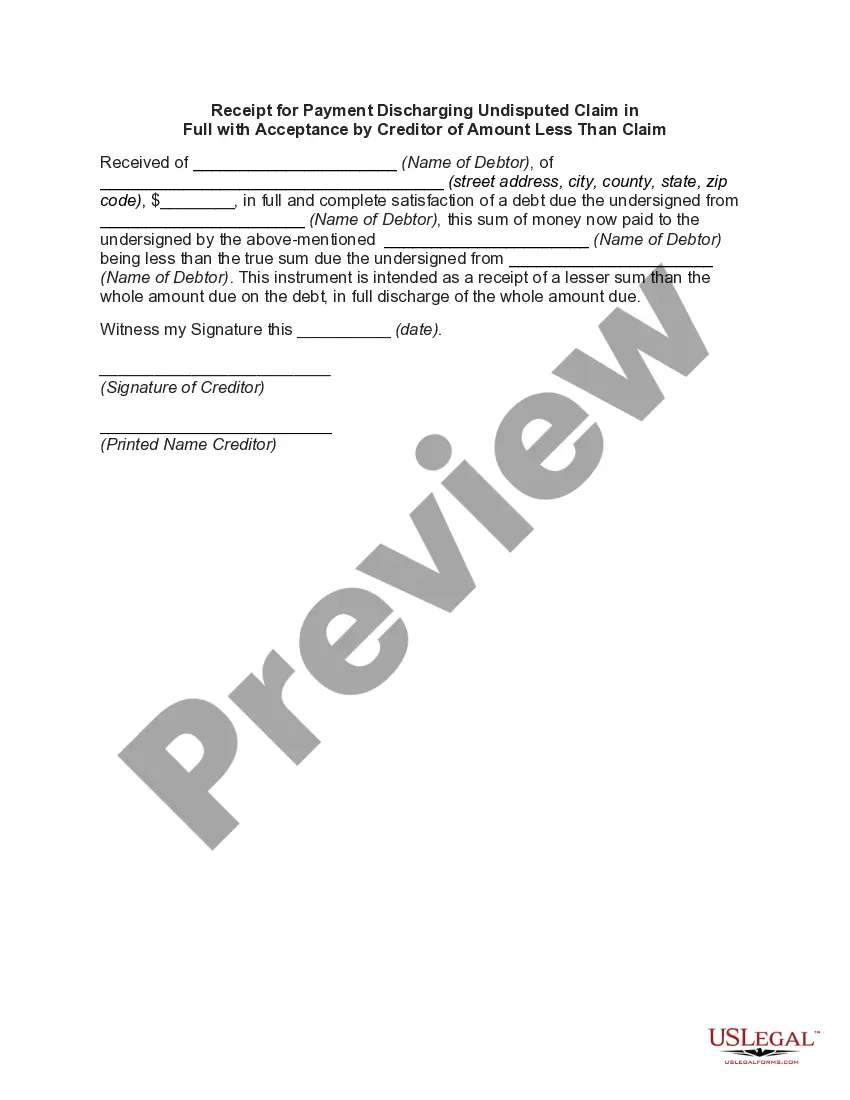
Receipt for Payment Discharging Undisputed Claim in Full with Acceptance by Creditor of Amount Less Than Claim
Overview of this form
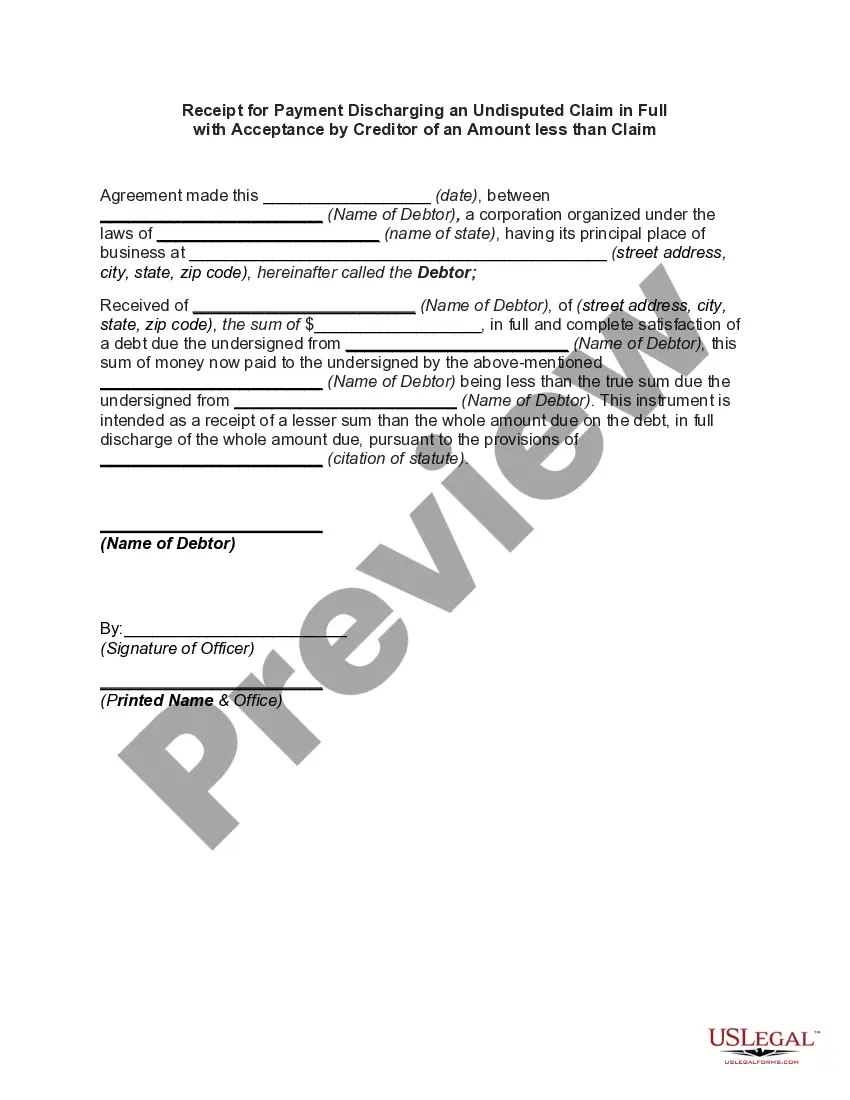
The Receipt for Payment Discharging Undisputed Claim in Full with Acceptance by Creditor of Amount Less Than Claim is a legal document used to acknowledge the payment of a debt that is less than the total amount due. This form serves to release the debtor from further obligations concerning that specific debt, thereby providing legal protection for both parties. It differs from other receipts or agreements by specifically addressing situations where the creditor agrees to accept a lesser payment to satisfy a claim.
Key parts of this document
- Name and address of the debtor
- Amount of payment received
- Name of the creditor receiving the payment
- Statement confirming the payment discharges the full debt
- Date of the transaction
- Signature and printed name of the creditor

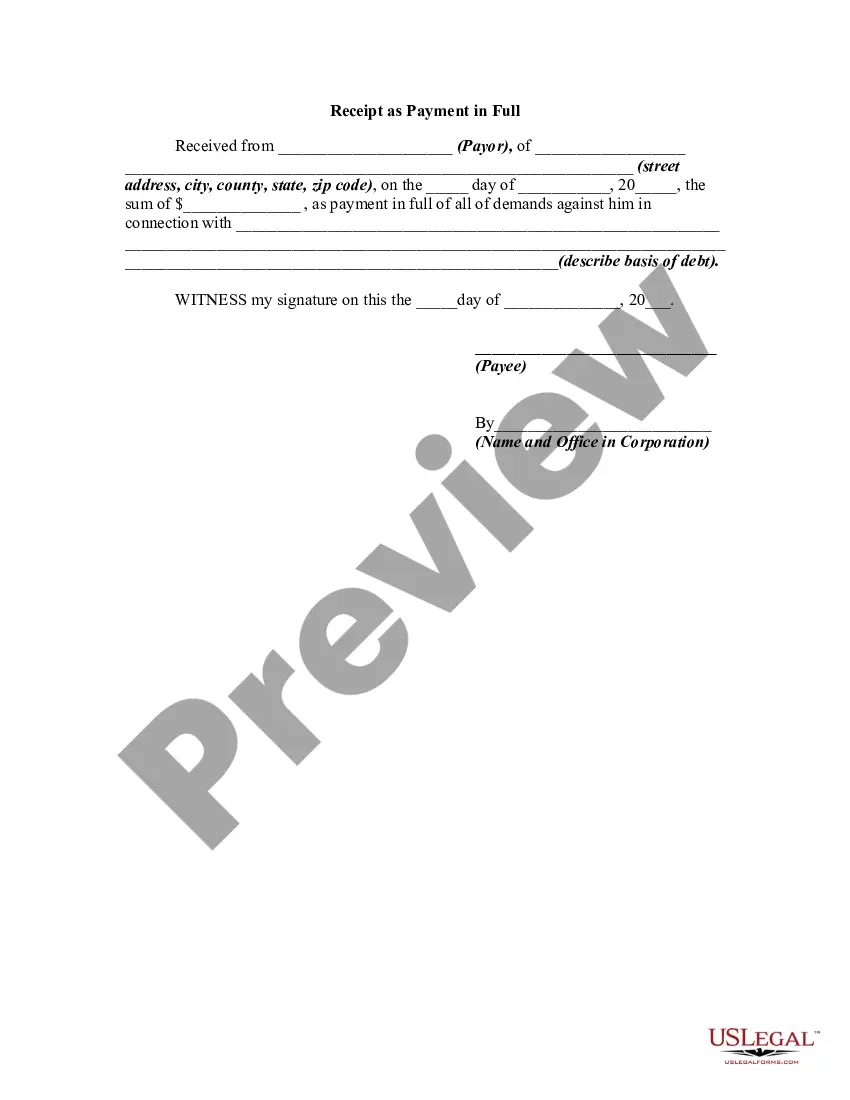
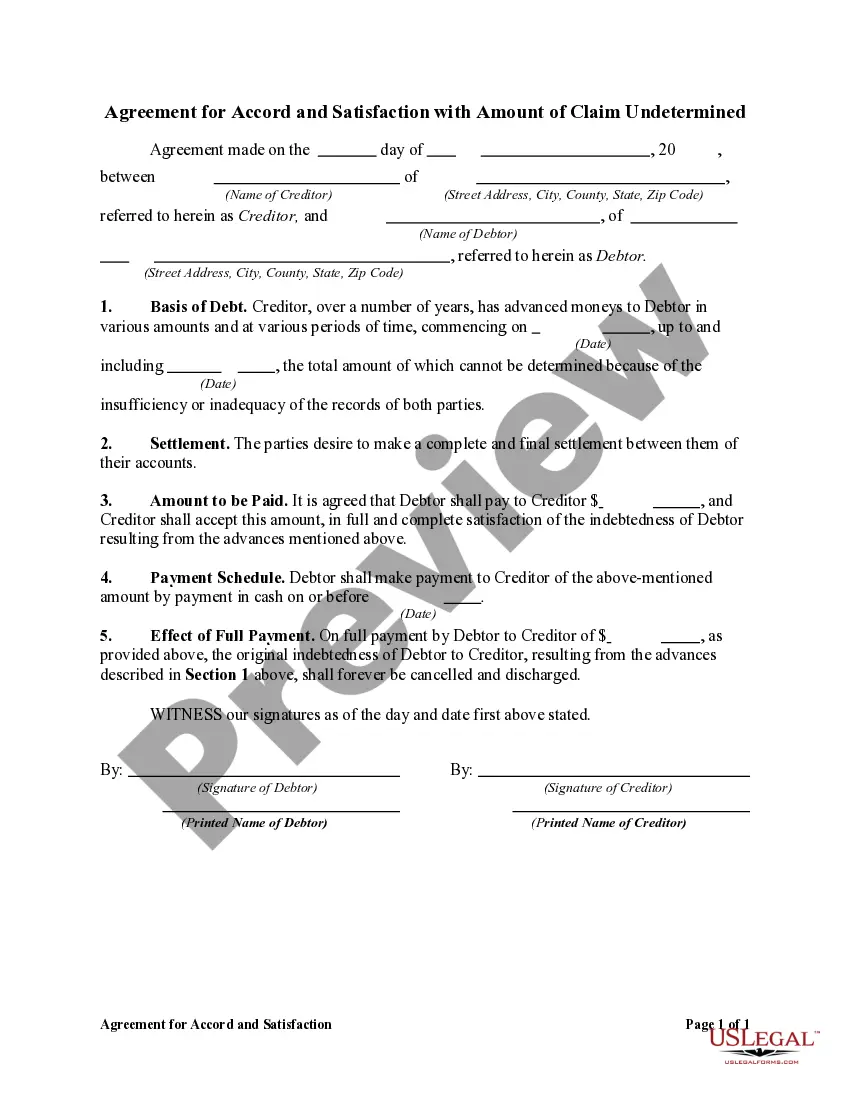
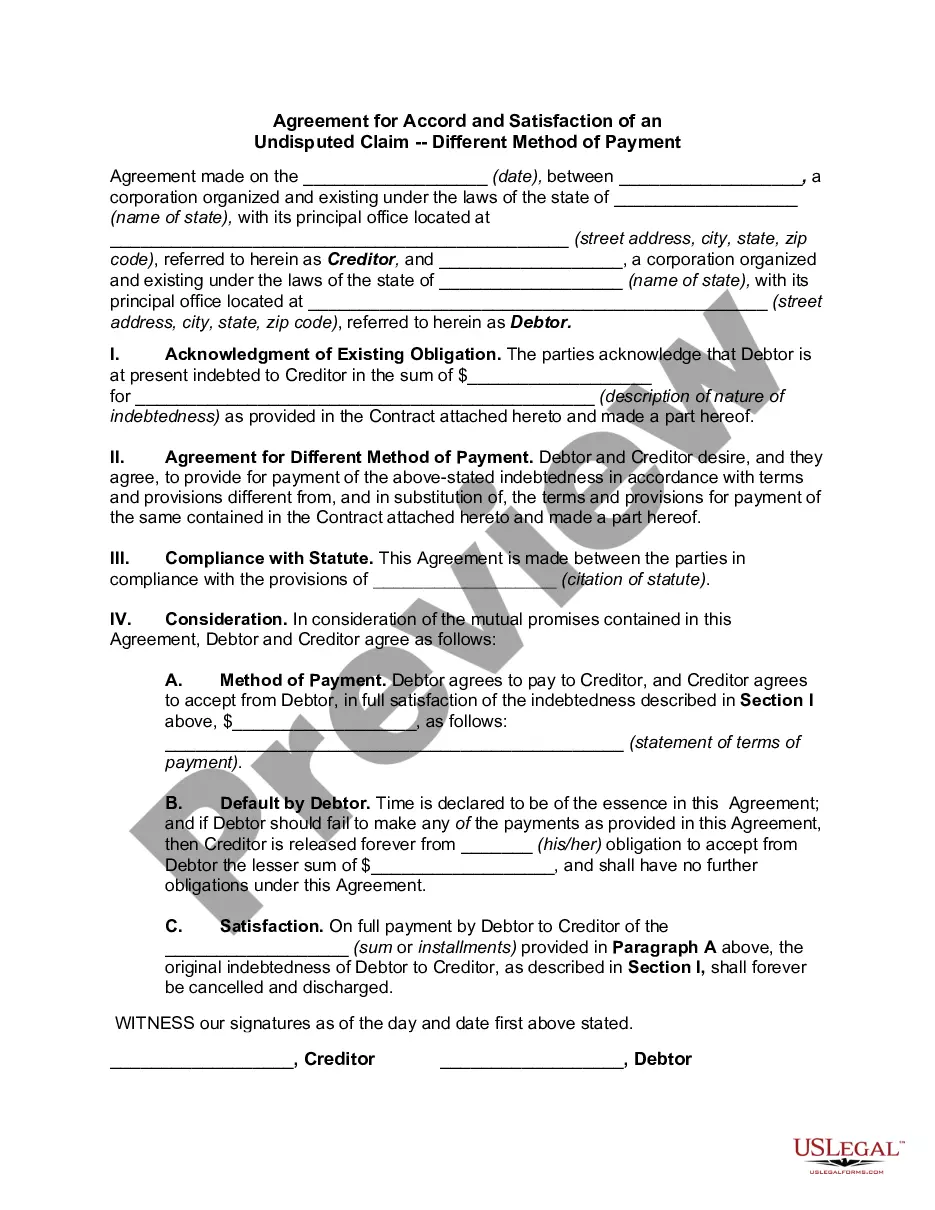
When this form is needed
This form should be used when a debtor wishes to settle a debt with a creditor for an amount that is less than the total claim. It is particularly useful when both parties agree to a settlement amount, and the creditor wants to officially acknowledge the discharge of the remaining balance. Common scenarios include resolving disputes or financial hardships that prevent full payment.
Who should use this form
- Creditors who are accepting a payment that is less than the total owed
- Debtors who want to ensure they have proof of payment and debt discharge
- Individuals involved in informal debt settlements
- Businesses seeking to formalize settlement arrangements with clients
How to prepare this document
- Identify the parties involved by filling in the names and addresses of both debtor and creditor.
- Specify the amount of payment being received, which is less than the total claim.
- Clearly state that the payment discharges the full debt associated with the claim.
- Add the date of the transaction to confirm when the payment was made.
- Have the creditor sign and print their name to authenticate the document.
Notarization guidance
This form does not typically require notarization unless specified by local law. Always check your state requirements to confirm if notarization is necessary.
Get your form ready online
Our built-in tools help you complete, sign, share, and store your documents in one place.
Make edits, fill in missing information, and update formatting in US Legal Forms—just like you would in MS Word.
Download a copy, print it, send it by email, or mail it via USPS—whatever works best for your next step.
Sign and collect signatures with our SignNow integration. Send to multiple recipients, set reminders, and more. Go Premium to unlock E-Sign.
If this form requires notarization, complete it online through a secure video call—no need to meet a notary in person or wait for an appointment.
We protect your documents and personal data by following strict security and privacy standards.

Make edits, fill in missing information, and update formatting in US Legal Forms—just like you would in MS Word.

Download a copy, print it, send it by email, or mail it via USPS—whatever works best for your next step.

Sign and collect signatures with our SignNow integration. Send to multiple recipients, set reminders, and more. Go Premium to unlock E-Sign.

If this form requires notarization, complete it online through a secure video call—no need to meet a notary in person or wait for an appointment.

We protect your documents and personal data by following strict security and privacy standards.
Common mistakes
- Failing to specify the amount of payment received.
- Not including the name and address of the debtor.
- Omitting the date of the transaction.
- Not having the creditor sign the form, which makes it invalid.
Benefits of using this form online
- Convenient access to legal documentation without the need for an attorney.
- Editable templates allow personalization to fit specific scenarios.
- Instant downloadable forms enhance efficiency in managing financial agreements.
- Reliable legal language crafted by licensed attorneys ensures compliance.
Looking for another form?

Form popularity
FAQ
Something bargained for and received by a promisor from a promisee. Common types of consideration include real or personal property, a return promise, some act, or a forbearance. Consideration or a valid substitute is required to have a contract.
By contrast, a payment "in full and final settlement" can usually be interpreted as an offer to settle a dispute on terms that, in exchange for the sum tendered, the creditor will give up the rest of its claim.
To apply an accord and satisfaction concept, there must be a genuine conflict that is settled by an engagement of parties with the intention to compromise. Under this procedure, both debtor and creditor are agreed to exchange something in settlement of the claim.
Accord and satisfaction- the agreement under which one of the parties undertakes to give or perform, and the other to accept, in satisfaction, the amount of the debt must be in dispute.covenant not to sue- the parties substitute a contractual obligation for some other type of legal action based on a valid claim.
No. The creditor can argue that, even if it agreed to settle the claim, the agreement is not binding. However, the creditor may be estopped from claiming the balance.
The agreement by which the original obligation is discharged is the accord, and the discharge of the substituted obligation is the satisfaction. A contract can be discharged by the same process which created it, that is, by mutual agreement.
If a debtor makes a written or verbal statement saying that they are making payment to you in full and final settlement of the debt, or words to that effect, and that payment is less than the debt owed, care needs to be taken as you could inadvertently lose your legal right to pursue the balance of the debt.
An accord and satisfaction is a substitute contract for settlement of a debt by some alternative other than full payment. The consideration for an accord is often the resolution of a disputed claim.
Definition. An agreement (accord) between two contracting parties to accept alternate performance to discharge a preexisting duty between them and the subsequent performance (satisfaction) of that agreement.