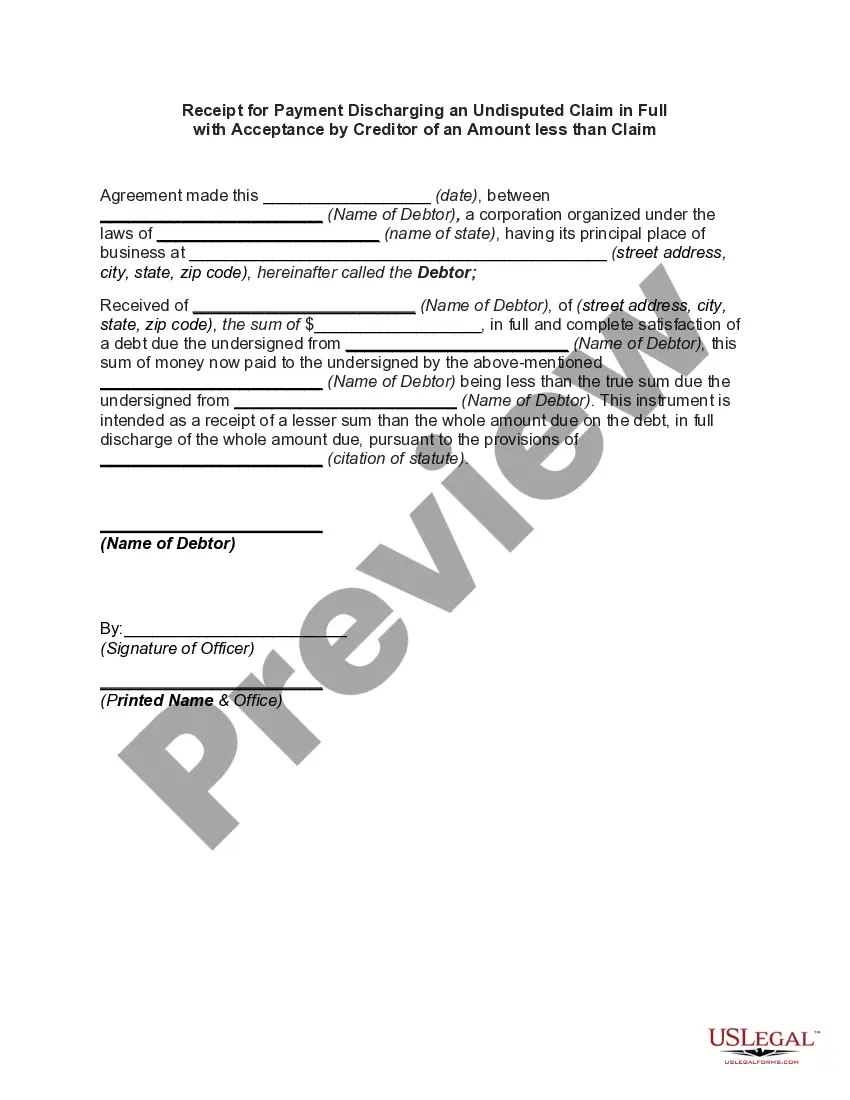
Receipt for Payment Discharging an Undisputed Claim in Full with Acceptance by Creditor of an Amount less than Claim
Understanding this form
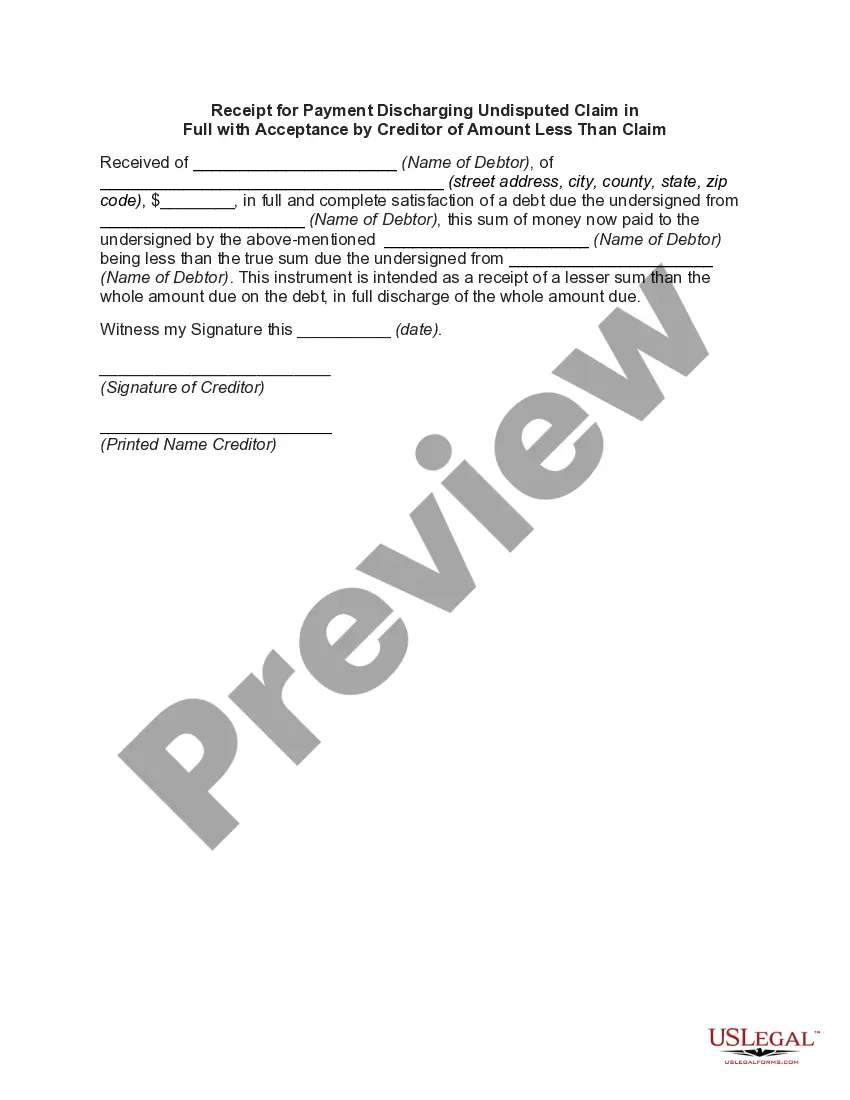
The Receipt for Payment Discharging an Undisputed Claim in Full with Acceptance by Creditor of an Amount less than Claim is a legal document used when a creditor agrees to accept a lesser amount than the total debt to settle the obligation completely. This form serves to officially acknowledge the payment received and discharges the debtor from any further liability regarding that specific claim. Unlike other receipt forms, this one is specifically designed for scenarios where the creditor accepts less than the owed amount, ensuring clarity in debt resolution.
What’s included in this form
- Date of agreement
- Name and contact information of the debtor
- Amount received by the creditor
- Statement confirming the discharge of the debt
- Signature of the creditor's representative
- Printed name and title of the creditor's representative
Situations where this form applies
This form is typically used in situations where a debtor is unable to pay the full amount of a claim, and the creditor agrees to accept a lesser payment as full satisfaction of the debt. It is useful in various contexts, such as business contracts, personal loans, or any situation where a debt is acknowledged but not paid in full. This ensures that both parties have a clear record of the agreement to prevent future disputes.
Intended users of this form
- Creditors who have settled a debt for less than the full amount
- Corporations involved in debt discharge agreements
- Individuals looking to formalize an agreement on paid debt
- Debtors who wish to confirm their debt has been satisfied
Instructions for completing this form
- Enter the date of the agreement at the specified location.
- Fill in the name and principal address of the debtor.
- Specify the amount being accepted by the creditor as full satisfaction.
- Include the citation of the applicable statute supporting this agreement.
- Have the authorized officer of the creditor sign and print their name and title.
Does this form need to be notarized?
This form does not typically require notarization unless specified by local law. Always check your stateâs regulations to confirm whether notarization is needed to ensure the legal validity of the document.
Get your form ready online
Our built-in tools help you complete, sign, share, and store your documents in one place.
Make edits, fill in missing information, and update formatting in US Legal Forms—just like you would in MS Word.
Download a copy, print it, send it by email, or mail it via USPS—whatever works best for your next step.
Sign and collect signatures with our SignNow integration. Send to multiple recipients, set reminders, and more. Go Premium to unlock E-Sign.
If this form requires notarization, complete it online through a secure video call—no need to meet a notary in person or wait for an appointment.
We protect your documents and personal data by following strict security and privacy standards.

Make edits, fill in missing information, and update formatting in US Legal Forms—just like you would in MS Word.

Download a copy, print it, send it by email, or mail it via USPS—whatever works best for your next step.

Sign and collect signatures with our SignNow integration. Send to multiple recipients, set reminders, and more. Go Premium to unlock E-Sign.

If this form requires notarization, complete it online through a secure video call—no need to meet a notary in person or wait for an appointment.

We protect your documents and personal data by following strict security and privacy standards.
Common mistakes to avoid
- Failing to specify the full amount due versus the settled amount.
- Not including all required signatures from the creditor's representatives.
- Neglecting to enter the date of the agreement.
- Omitting the relevant statute citation that governs the agreement.
- Using incorrect or outdated form versions that do not comply with current laws.
Benefits of using this form online
- Easy to access and download, saving time and effort.
- Editable templates allow customization to unique circumstances.
- Drafted by licensed attorneys to ensure legal compliance.
- Instant availability without the need for physical office visits.
Looking for another form?




Form popularity
FAQ
Under most state law, a valid and satisfaction requires four elements as a minimum, usually, (1) proper subject matter, (2) competent parties, (3) meeting of the minds of the parties and (4) adequate consideration.
And satisfaction is a settlement of an unliquidated debt. For example, a builder is contracted to build a homeowner a garage for $35,000. The contract called for $17,500 prior to starting construction, to disburse $10,000 during various stages of construction, and to make a final payment of $7,500 at completion.
Cashing a check marked ?payment in full? will likely discharge the debtor's obligation entirely, under the legal doctrine of ? and satisfaction.? Tendering of a check marked ?payment in full? or ?paid in full? is an offer to settle the debt of an amount different than what the parties' contract says.
And satisfaction is a settlement of an unliquidated debt. For example, a builder is contracted to build a homeowner a garage for $35,000. The contract called for $17,500 prior to starting construction, to disburse $10,000 during various stages of construction, and to make a final payment of $7,500 at completion.
Usually, and satisfaction deals with a debtor's offer of payment and a creditor's acceptance of a lesser amount than the creditor originally claimed to be owed. It is a method of discharging a claim by settlement of the claim and performing the new agreement.
And satisfaction refers to the agreement () between two contracting parties to accept alternate performance to discharge a pre-existing duty between them and the subsequent performance (satisfaction) of that agreement.
And satisfaction occurs when a business tries to get its full asking price for goods or services sold to a consumer, who in turn asserts he or she is not obligated to pay the full price billed because of a defect or breach of warranty relating to the goods and services.
Beware checks with "Payment in Full," "Full and Final Settlement" or similar language is written in the memo field or endorsement area. When these checks are cashed, they are very often binding and can eliminate your rights to recover under contract or the mechanics lien laws.