Award Agreement
What this document covers
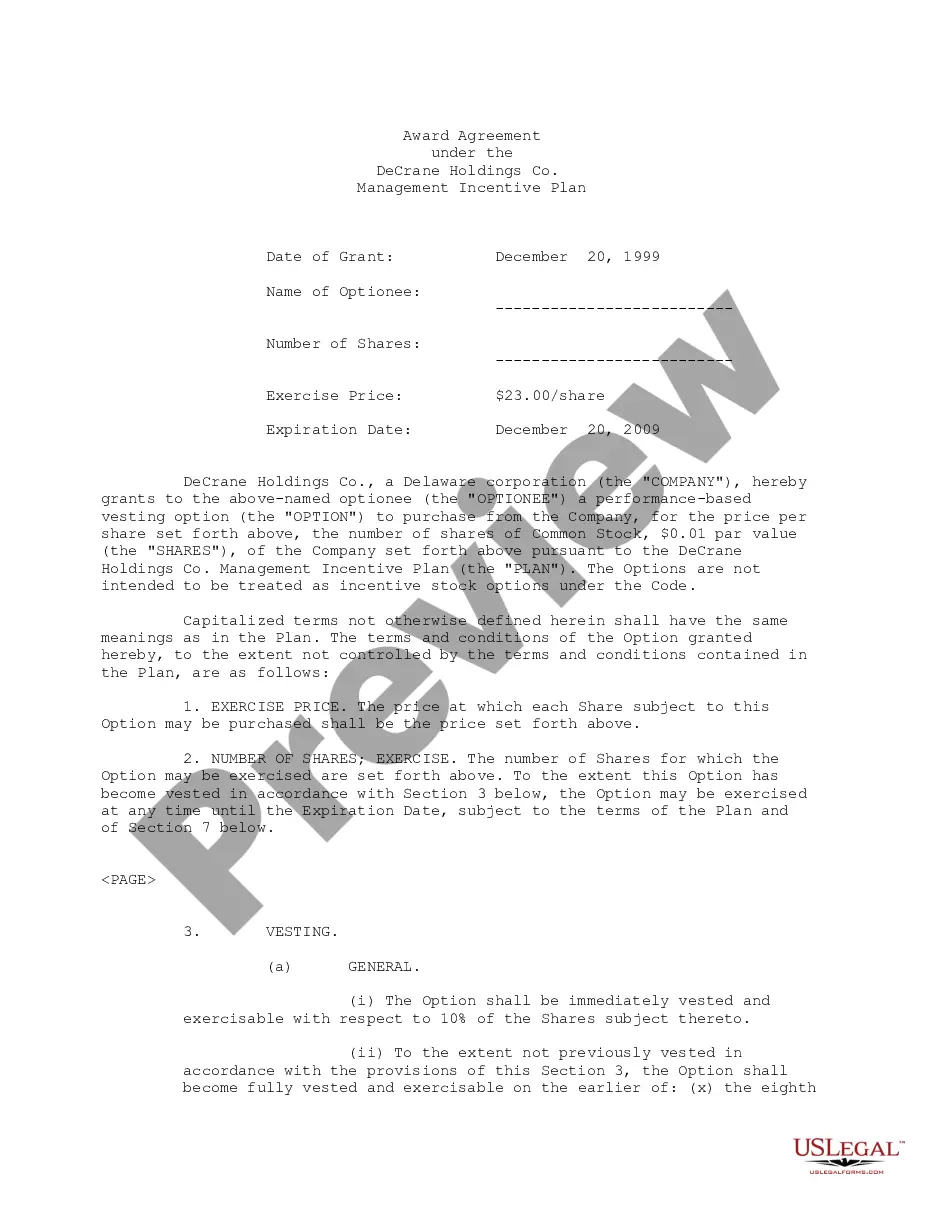
The Award Agreement is a legal document used to grant stock options to an individual under a management incentive plan. This specific agreement outlines the terms of performance-based vesting options for shares of DeCrane Holdings Company. Unlike general stock option agreements, this form includes stipulations on performance conditions and vesting schedules that are necessary for the option to be exercised.
Form components explained
- Details of the parties involved, including the Company and the Optionee.
- Grant date and the number of shares associated with the option.
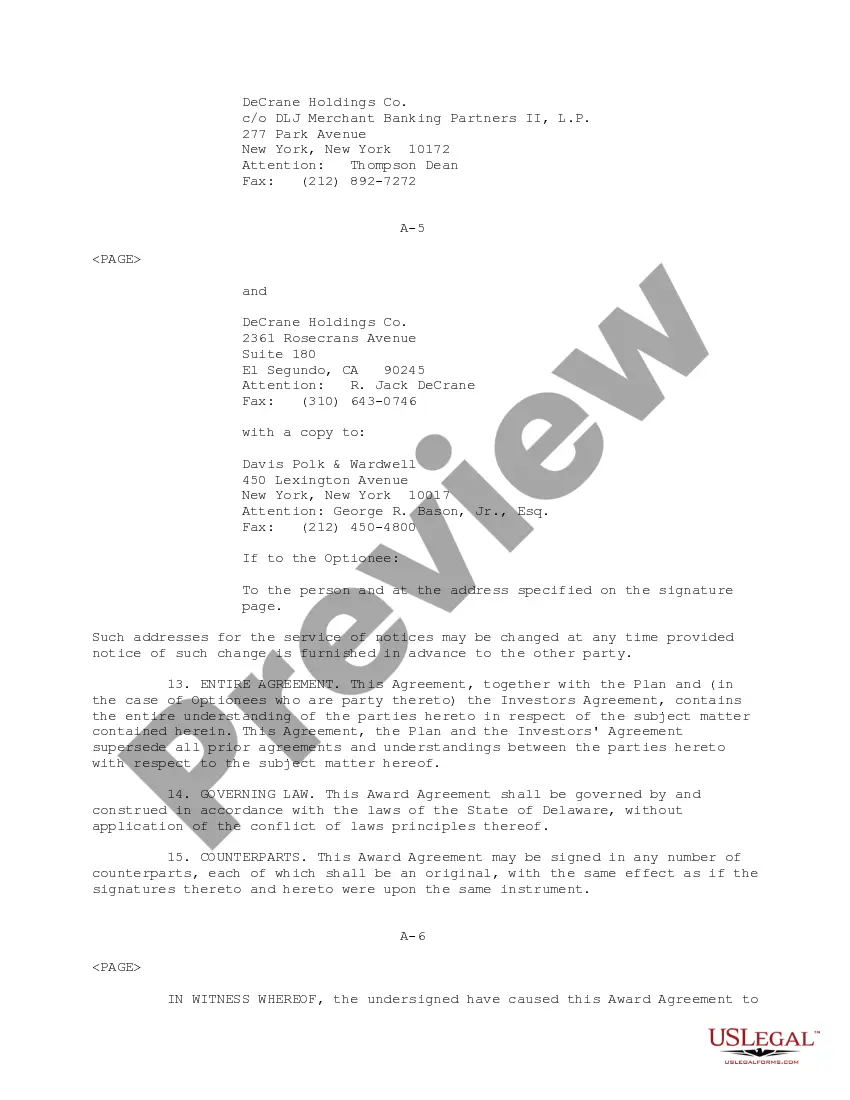
- Exercise price per share and the option's expiration date.
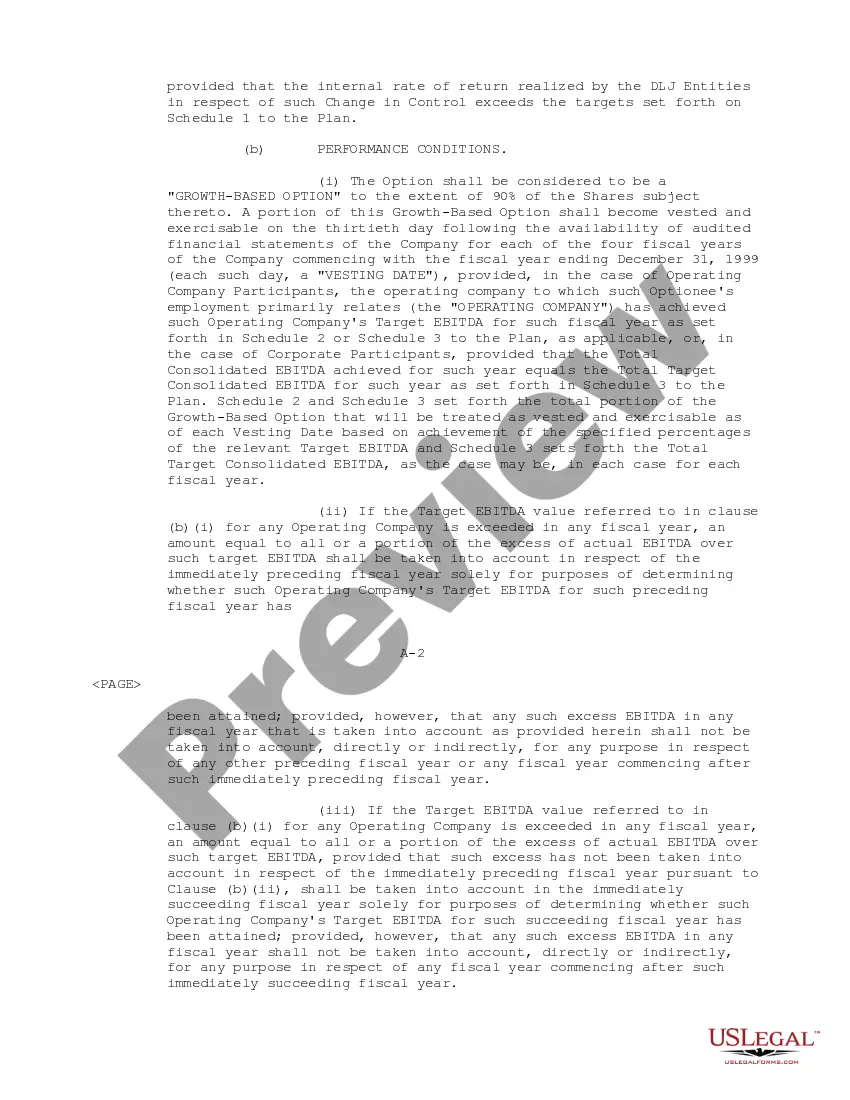
- Vesting conditions related to performance metrics and employment status.
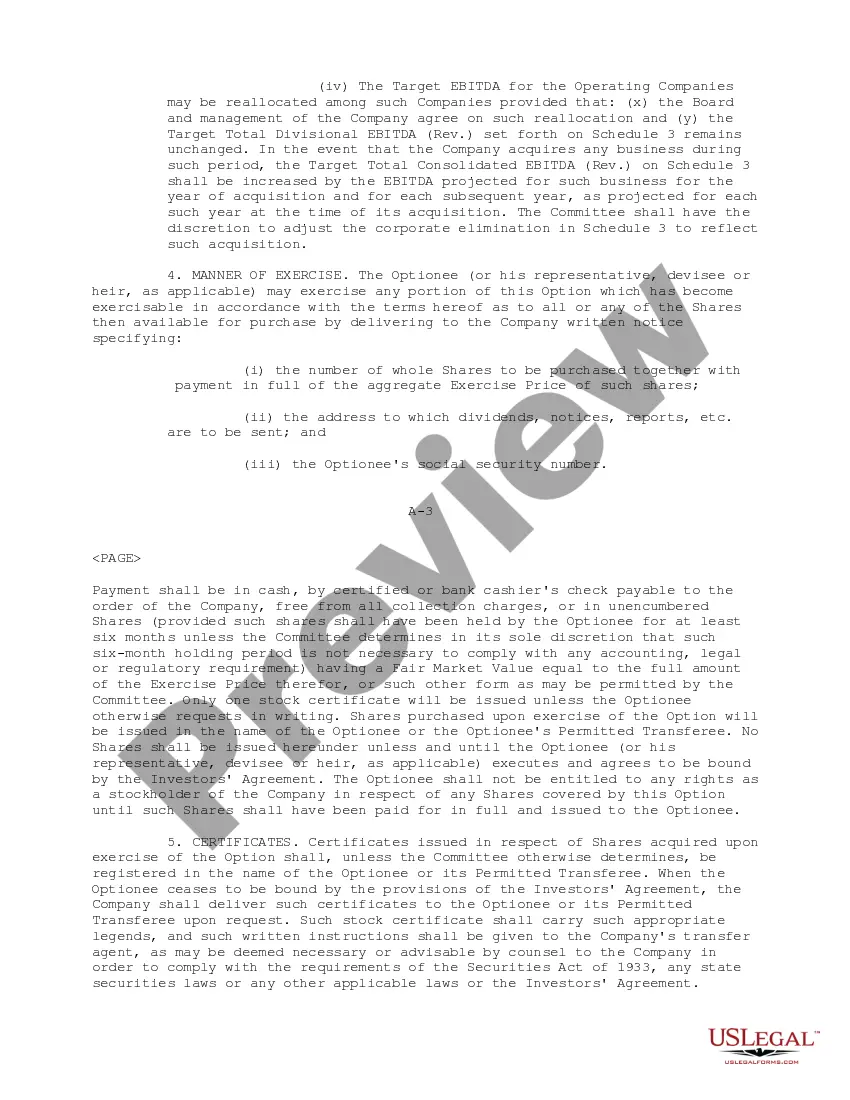
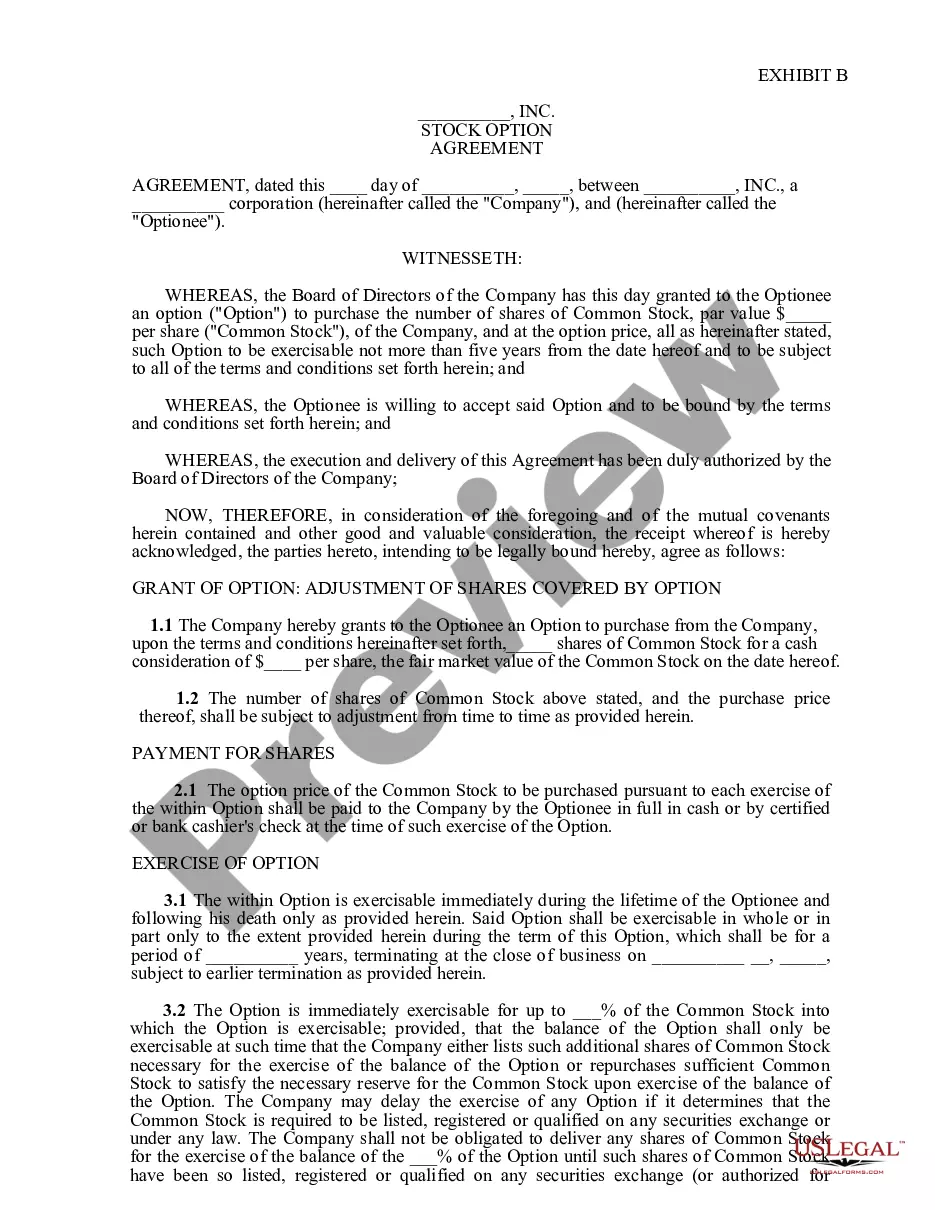
- Specifications on how to exercise the option, including payment instructions.
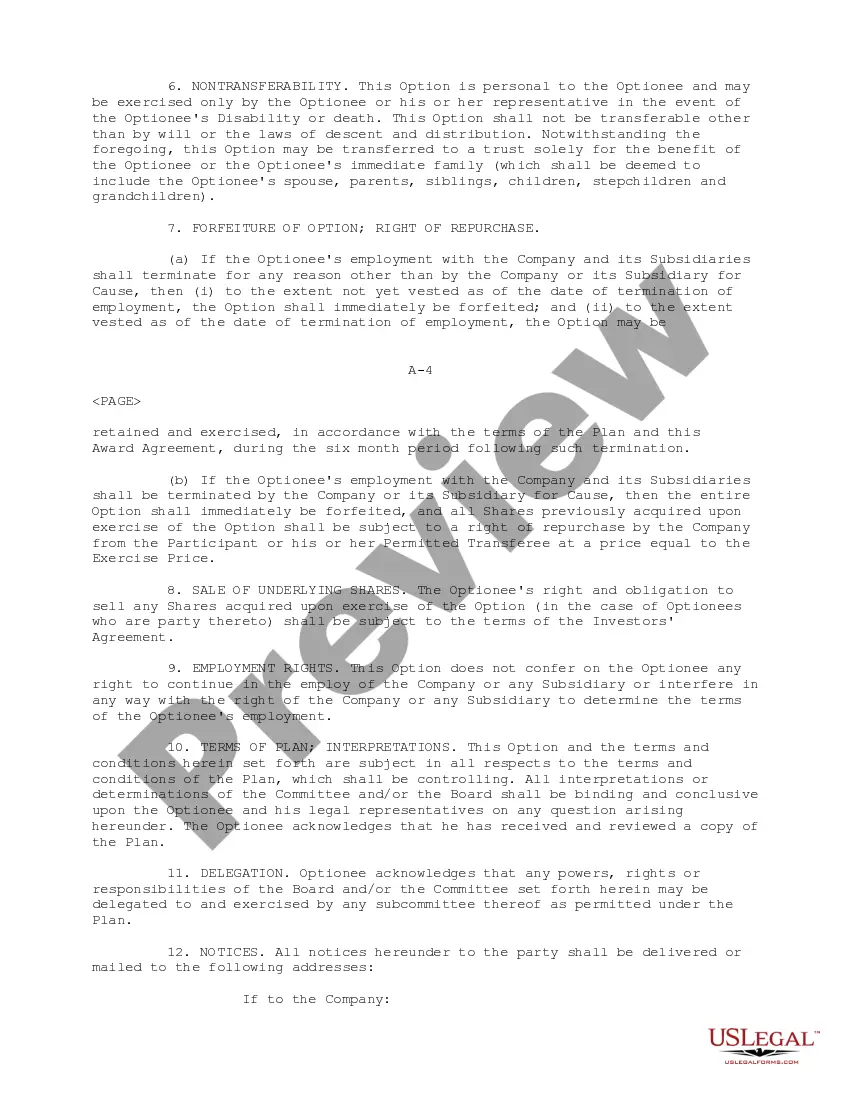
- Terms regarding transferability and forfeiture of the option.
Common use cases
This Award Agreement should be used when a company wants to incentivize key employees by granting them options to purchase company shares based on performance metrics. It is particularly useful for businesses aiming to attract and retain top talent by aligning employee interests with company growth goals.
Intended users of this form
- Employers seeking to motivate and compensate employees through stock options.
- Key employees or executives eligible for performance-based share options.
- Companies implementing a management incentive plan to boost company performance.
Instructions for completing this form
- Identify the parties: Enter the name of DeCrane Holdings Company and the specific Optionee.
- Specify the grant date: Fill in the date of grant, which is December 20, 1999.
- Enter the number of shares: State how many shares the optionee is entitled to purchase.
- Fill out the exercise price per share: This should reflect $23.00 per share as listed.
- Provide the expiration date: Confirm this date is December 20, 2009.
- Review vesting conditions: Ensure that all performance-based criteria are clearly outlined for understanding.
Does this document require notarization?
This form usually doesn’t need to be notarized. However, local laws or specific transactions may require it. Our online notarization service, powered by Notarize, lets you complete it remotely through a secure video session, available 24/7.
Get your form ready online
Our built-in tools help you complete, sign, share, and store your documents in one place.
Make edits, fill in missing information, and update formatting in US Legal Forms—just like you would in MS Word.
Download a copy, print it, send it by email, or mail it via USPS—whatever works best for your next step.
Sign and collect signatures with our SignNow integration. Send to multiple recipients, set reminders, and more. Go Premium to unlock E-Sign.
If this form requires notarization, complete it online through a secure video call—no need to meet a notary in person or wait for an appointment.
We protect your documents and personal data by following strict security and privacy standards.

Make edits, fill in missing information, and update formatting in US Legal Forms—just like you would in MS Word.

Download a copy, print it, send it by email, or mail it via USPS—whatever works best for your next step.

Sign and collect signatures with our SignNow integration. Send to multiple recipients, set reminders, and more. Go Premium to unlock E-Sign.

If this form requires notarization, complete it online through a secure video call—no need to meet a notary in person or wait for an appointment.

We protect your documents and personal data by following strict security and privacy standards.
Common mistakes
- Failing to specify the number of shares correctly, which can lead to disputes later.
- Not understanding the vesting conditions and performance metrics required for options to become exercisable.
- Neglecting to follow the specific instructions for exercising the option, particularly regarding payment methods.
Why use this form online
- Convenience of instant download and easy access to essential legal documentation.
- Editability allows customization to meet specific company requirements.
- Reliability ensured by documents drafted by licensed attorneys to reflect current legal standards.
Legal use & context
- The agreement must comply with the terms of the underlying Management Incentive Plan.
- Performance-based options have specific legal implications tied to employment status and company performance metrics.
- Failure to meet the terms may result in the forfeiture of options or shares.
Looking for another form?
Form popularity
FAQ
When an employee is not covered by an award or agreement they are considered to be award and agreement free. Award and agreement free employees may have an employment contract. They are also entitled to at least the: national minimum wage.
The main difference between a Modern Award and an EA is that EAs only apply to the employees of one particular organisation. They are tailored to suit that particular business and employees are negotiated internally and then approved by the FWC. Modern Awards are standardised and non-negotiable.
After a job offer letter is accepted by the prospective employee and the employer, it becomes a legally binding contract.
Employment Contracts and Awards the Interrelation A contract cannot take away the rights of employee which are a part of their minimum legal entitlements. Thus, these standards will continue to apply and override any employment contract in place which provides lesser entitlements than the applicable award or NES.
Depending on the circumstances, an employer can issue a new employment contract that refers to the correct award and then seek the employee's agreement to the new contract (although an employee's agreement may not diminish potential back pay obligations).
An award is an enforceable document containing minimum terms and conditions of employment in addition to any legislated minimum terms. In general, an award applies to employees in a particular industry or occupation and is used as the benchmark for assessing enterprise agreements before approval.
So what is the main difference between the two? The main difference between a Modern Award and an EA is that EAs only apply to the employees of one particular organisation. They are tailored to suit that particular business and employees are negotiated internally and then approved by the FWC.
Pay rates and the method of payment. Working hours and overtime. Conditions. Meal breaks. Holidays and leave of various types. Loading and allowances. Special rates for dangerous or piece work. Employment, grievance and termination procedures.
A breach of an award could be sued for both statutory penalty and contractual damages. On this view, awards could only override the terms of a contract of employment where those terms were inconsistent with those of the award(2).