General Form of License Agreement Regarding Right to use Real Property
What is this form?
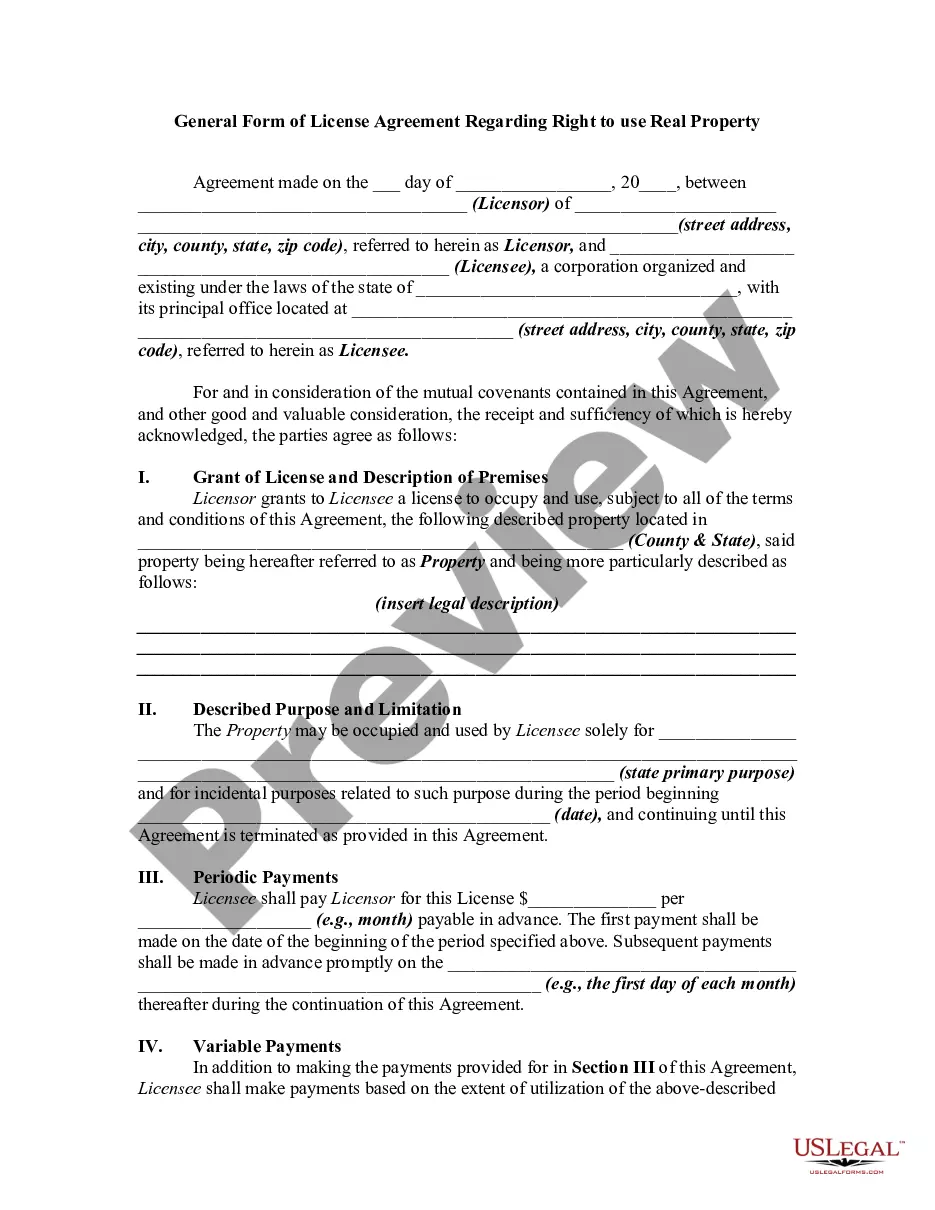
The General Form of License Agreement Regarding Right to Use Real Property allows a Licensor to grant a Licensee permission to use their property under specific terms. This agreement provides a legal framework for the temporary use of real estate, differentiating it from a lease, which confers more substantial rights to the tenant.
Key parts of this document
- Agreement Date: The date when the agreement is formed.
- Parties Involved: Identification of the Licensor and Licensee, including their addresses.
- Property Description: Detailed description of the real estate being licensed.
- Use Purpose: Explanation of the specific use permitted for the property.
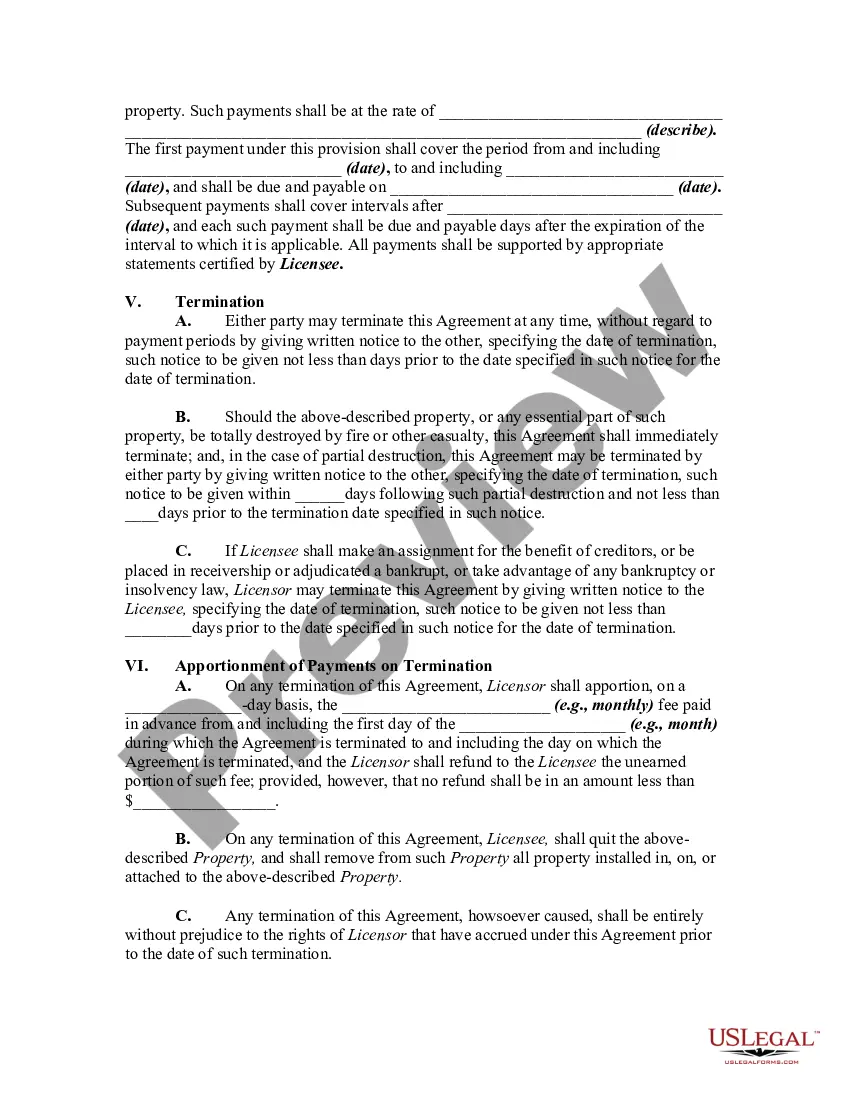
- Payment Terms: Stipulated fixed and variable payments, along with payment schedules.
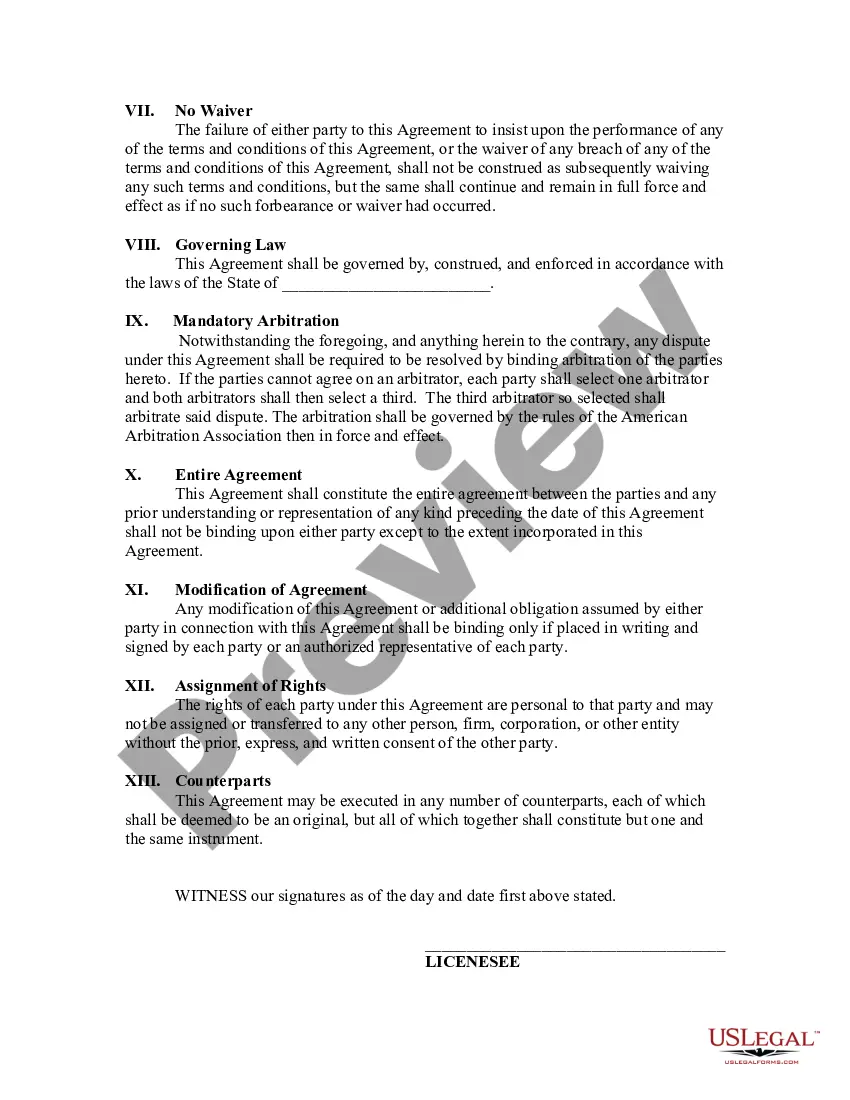
- Termination Clause: Conditions under which either party can terminate the agreement.
- Governing Law: Jurisdiction that governs the Agreement.
When to use this form
This form is useful in scenarios where one party needs to use another party's property without transferring ownership. Common examples include allowing a business to operate on private land, permitting construction on a property, or hosting events. This agreement is vital to ensure clarity about permissions and responsibilities, particularly when the property owner sells their estate, as the license will typically remain in effect until termination.
Who needs this form
Ideal users of this form include:
- Property owners who want to allow others to use their land temporarily.
- Businesses needing to utilize space for specific purposes, such as events or installations.
- Individuals or companies seeking permission to use property without a lease.
How to complete this form
Follow these steps to complete the General Form of License Agreement:
- Identify the parties: Enter the names and addresses of the Licensor and Licensee.
- Specify the property: Provide a detailed legal description of the real estate.
- Define the purpose: State the specific reason for using the property.
- Set the payment terms: Fill in the payment amounts, frequencies, and due dates.
- Include termination conditions: Specify how either party may end the agreement.
Does this document require notarization?
This form does not typically require notarization unless specified by local law. It is advisable to consult local regulations to confirm if notarization is needed for your specific situation.
Get your form ready online
Our built-in tools help you complete, sign, share, and store your documents in one place.
Make edits, fill in missing information, and update formatting in US Legal Forms—just like you would in MS Word.
Download a copy, print it, send it by email, or mail it via USPS—whatever works best for your next step.
Sign and collect signatures with our SignNow integration. Send to multiple recipients, set reminders, and more. Go Premium to unlock E-Sign.
If this form requires notarization, complete it online through a secure video call—no need to meet a notary in person or wait for an appointment.
We protect your documents and personal data by following strict security and privacy standards.

Make edits, fill in missing information, and update formatting in US Legal Forms—just like you would in MS Word.

Download a copy, print it, send it by email, or mail it via USPS—whatever works best for your next step.

Sign and collect signatures with our SignNow integration. Send to multiple recipients, set reminders, and more. Go Premium to unlock E-Sign.

If this form requires notarization, complete it online through a secure video call—no need to meet a notary in person or wait for an appointment.

We protect your documents and personal data by following strict security and privacy standards.
Typical mistakes to avoid
- Failing to clearly define the property and its permitted uses, which can lead to misunderstandings.
- Not specifying payment terms accurately, including amounts and due dates.
- Neglecting to include required signatures from both parties, making the agreement unenforceable.
- Overlooking termination clauses, which can lead to complications if either party wishes to exit the agreement prematurely.
Benefits of completing this form online
- Convenience: Easily fill out and download the form online without needing to visit a lawyer.
- Editability: Customize the agreement according to specific terms that suit the situation.
- Reliability: The forms are drafted by licensed attorneys with legal expertise.
Quick recap
- This form establishes a license to use real property, not a lease.
- Clearly outline all terms, including property description and payment obligations.
- Ensure all parties clearly understand the conditions for termination.
- Utilizing a legal form can help prevent disputes and misunderstandings.
Looking for another form?
Form popularity
FAQ
An example of a licensing agreement is a contract between the copyright holders of software and another company, allowing the latter to use the computer software for their daily business operations.
Do your homework. Before you begin negotiating, you need to understand your licensee's business. Start with a term sheet. Manage your expectations. Be patient. Have a win-win attitude. Don't lose your sense of humor. Remember to hold something back. Put yourself in their shoes.
An example of a licensing agreement is a contract between the copyright holders of software and another company, allowing the latter to use the computer software for their daily business operations.
A Copyright License Agreement is a contract under which a copyright owner allows another person or company to use their copyrighted material in one way or another: to reprint it, or distribute it, to use it for a specified amount of time, and more.
A license agreement is a business contract between two parties. The licensor (the seller of the license) owns the asset being licensed and the licensee (the buyer) pays for the right to use the license. The licensee pays royalties to the owner in exchange for the right to sell the product or use the technology.
Exclusive or non-exclusive. In an exclusive license, the intellectual property holder is licensing the work only to one person, for that particular use/territory. Territory. Use. Attribution. Derivative works. Confidentiality. Time frame. Termination.
The 3 P's of collegiate licensing are protection, promotion, and profit.
Copyrights give the copyright owner exclusive rights over their original works. While not all works are copyrightable, a few examples of copyrightable materials include movies, literary works, live performances, sound recordings, radio broadcasts, and even software.
Download a template for a licensing agreement. Choose your role as the licensor or licensee. Define the license(s) in the agreement. Decide whether the license is exclusive or not. Settle the matter of fees and payment schedule. Add a renewal date and rules.