Letter Notifying Postal Authorities of Identity Theft
About this form
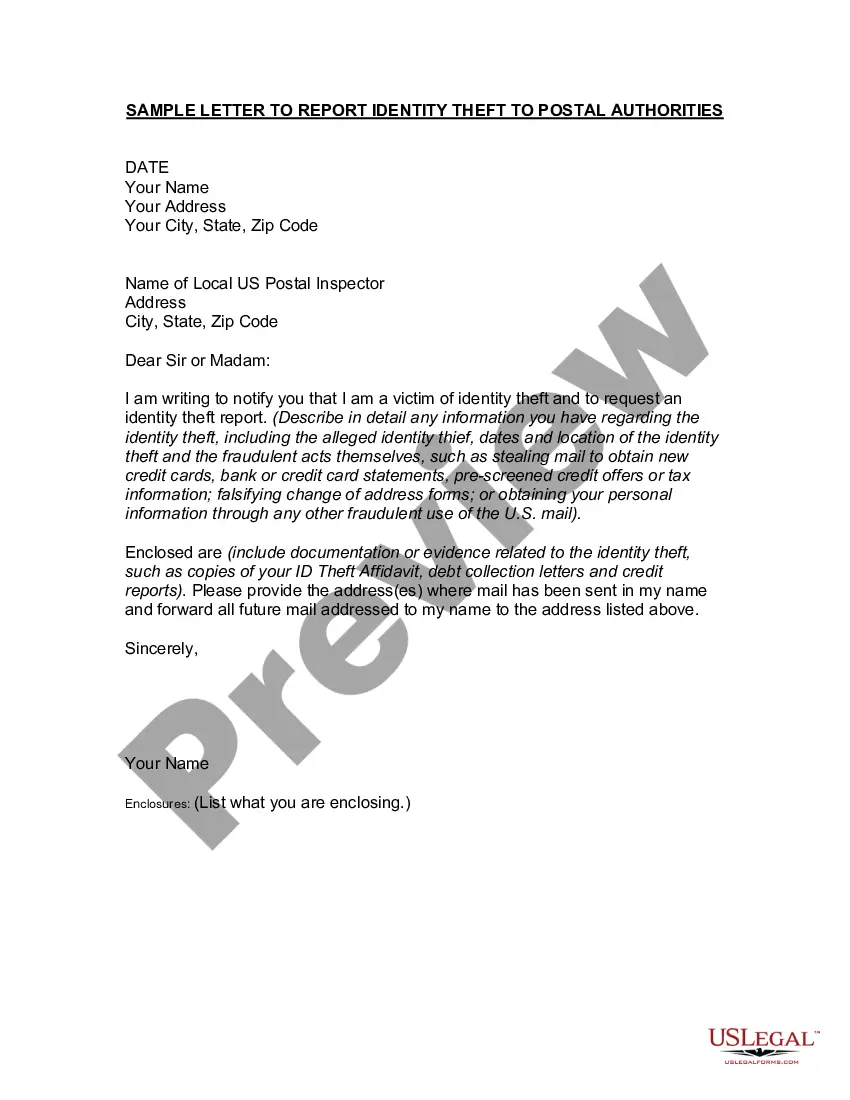
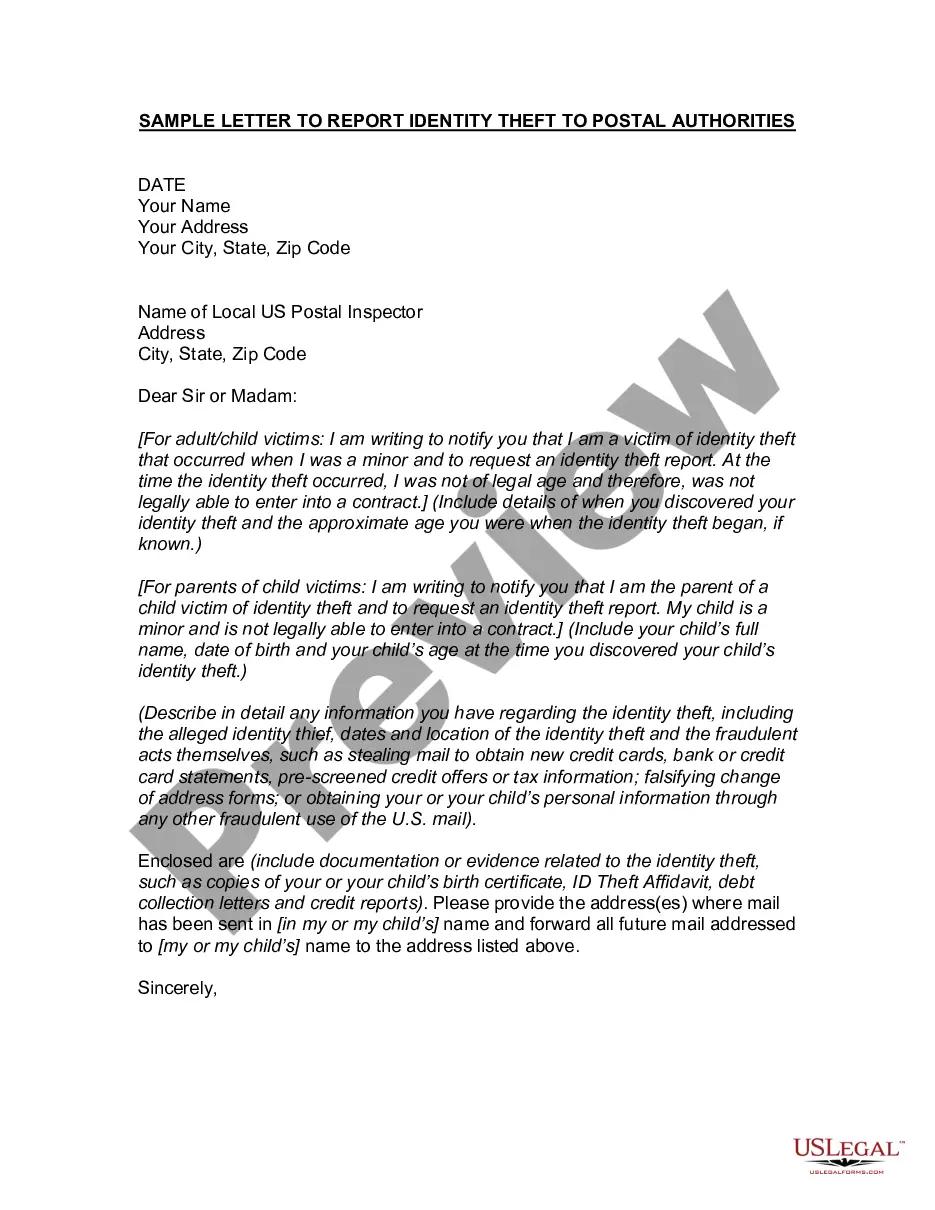
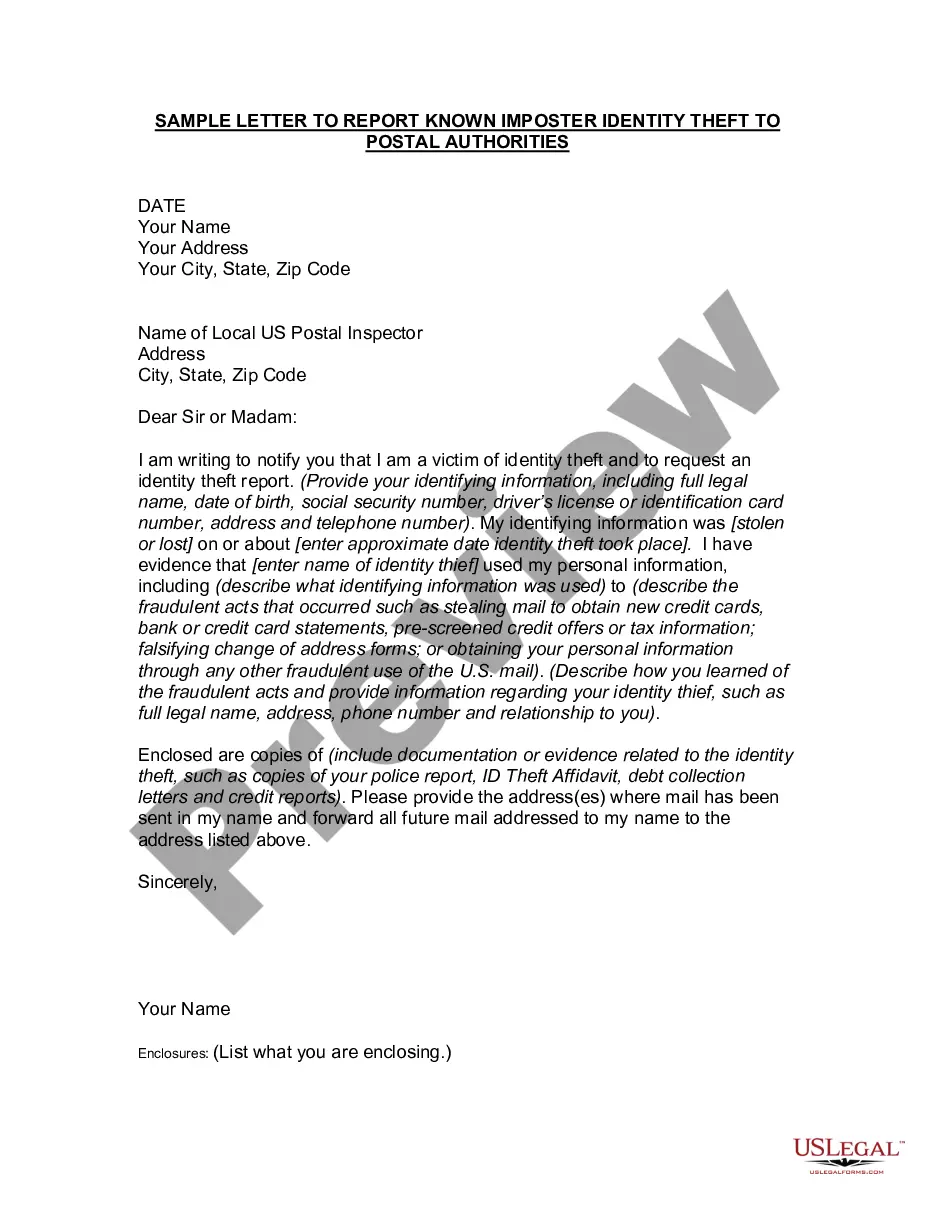
The Letter Notifying Postal Authorities of Identity Theft is a legal document that allows victims of identity theft to formally inform the local U.S. Postal Inspector about misuse of their identity in relation to the U.S. mail. This letter serves to request an identity theft report, specify fraudulent activities, and ask for future mail to be redirected to the victimâs current address. Unlike other identity theft forms, this letter specifically targets postal-related issues and communicates directly with postal authorities.
Key components of this form
- Date of the notification.
- Your personal information, including name and address.
- Name and address of the local U.S. Postal Inspector.
- A detailed description of the identity theft incident.
- Request for an identity theft report.
- List of enclosures to support your claim.
When to use this document
You should use the Letter Notifying Postal Authorities of Identity Theft in situations where you have been a victim of identity theft involving your mail. This includes instances where someone has stolen your mail to open new accounts, change your address without permission, or gain access to your personal and financial information. It is essential to notify the authorities promptly to mitigate further issues and seek assistance in recovering from identity theft.
Who this form is for
- Individuals who believe they have been victims of identity theft involving the U.S. mail.
- Anyone who has had their personal information used fraudulently to obtain goods, services, or financial benefits.
- Victims needing to formally request an identity theft report from postal authorities.
How to complete this form
- Write the date at the top of the letter.
- Fill in your name and address as the sender.
- Enter the name and address of the local U.S. Postal Inspector.
- Detail the identity theft incident, including specific fraudulent activities.
- List any enclosures you are including with your letter for reference.
- Sign the letter and make sure it is clear and concise.
Does this document require notarization?
This form does not typically require notarization unless specified by local law.
Get your form ready online
Our built-in tools help you complete, sign, share, and store your documents in one place.
Make edits, fill in missing information, and update formatting in US Legal Forms—just like you would in MS Word.
Download a copy, print it, send it by email, or mail it via USPS—whatever works best for your next step.
Sign and collect signatures with our SignNow integration. Send to multiple recipients, set reminders, and more. Go Premium to unlock E-Sign.
If this form requires notarization, complete it online through a secure video call—no need to meet a notary in person or wait for an appointment.
We protect your documents and personal data by following strict security and privacy standards.

Make edits, fill in missing information, and update formatting in US Legal Forms—just like you would in MS Word.

Download a copy, print it, send it by email, or mail it via USPS—whatever works best for your next step.

Sign and collect signatures with our SignNow integration. Send to multiple recipients, set reminders, and more. Go Premium to unlock E-Sign.

If this form requires notarization, complete it online through a secure video call—no need to meet a notary in person or wait for an appointment.

We protect your documents and personal data by following strict security and privacy standards.
Common mistakes
- Failing to provide complete details about the identity theft incident.
- Not attaching supporting documents or evidence.
- Neglecting to send the letter to the correct local U.S. Postal Inspector.
- Using unclear or vague language in the description.
Why use this form online
- Convenient access to legally drafted templates for immediate use.
- Editable file format allows users to customize the letter to fit their specific situation.
- Reliable and professional guidance ensures accuracy and compliance with legal requirements.
Legal use & context
- This form serves as an official notification to the Postal Inspector about identity theft incidents.
- It can help in creating a track record of the identity theft for further legal actions or disputes with creditors.
- While submission of this form is important, it does not guarantee immediate resolution of identity theft issues.
What to keep in mind
- The letter serves as formal notification to postal authorities regarding identity theft.
- It is crucial to provide detailed descriptions and supporting documents.
- Using this form promptly can help mitigate further identity theft issues.
Looking for another form?







Form popularity
FAQ
Under California law, you can report identity theft to your local police department. Ask the police to issue a police report of identity theft. Give the police as much information on the theft as possible. One way to do this is to provide copies of your credit reports showing the items related to identity theft.
Contact one of the three credit reporting agencies (Transunion, Equifax, or Experian). After a few days, check with the other two credit bureaus to verify that they've received the fraud alert as well.
Go to your local police office with: A copy of your FTC Identity Theft Report. Tell the police someone stole your identity and you need to file a report. Ask for a copy of the police report. You may need this to complete other steps.
Contact one credit bureau. Ask it to put a fraud alert on your credit report. The credit bureau will explain that you can get a free credit report and other rights you have. Mark your calendar. The fraud alert stays on your report for one year.
Under California law, you can report identity theft to your local police department. Ask the police to issue a police report of identity theft. Give the police as much information on the theft as possible. One way to do this is to provide copies of your credit reports showing the items related to identity theft.
Identity theft often occurs when a person gains access to sensitive personal information from printed records you get in the mail that reveal your full name, address, phone number, or Social Security number. It's enough to open a new account or take over an existing one.
If you find that your credit card number was stolen or your Social Security number was used to file a fraudulent tax return, your first instinct may be to call the police.If you need that, use a non-emergency number, rather than 911, to make your report.
Analyze Your Situation. Place a Fraud Alert with a National Credit Reporting Agency (CRA) Check Your Financial Accounts. Check Your Computer for Viruses. Secure Your Proof of Identity. File a Complaint with the Federal Trade Commission (FTC) File a Police Report. Keep a Record of Your Actions.
Notify affected creditors or banks. Put a fraud alert on your credit report. Check your credit reports. Freeze your credit. Report the identity theft to the FTC. Go to the police. Remove fraudulent info from your credit report.