Sale of Business - Noncompetition Agreement - Asset Purchase Transaction
What is this form?
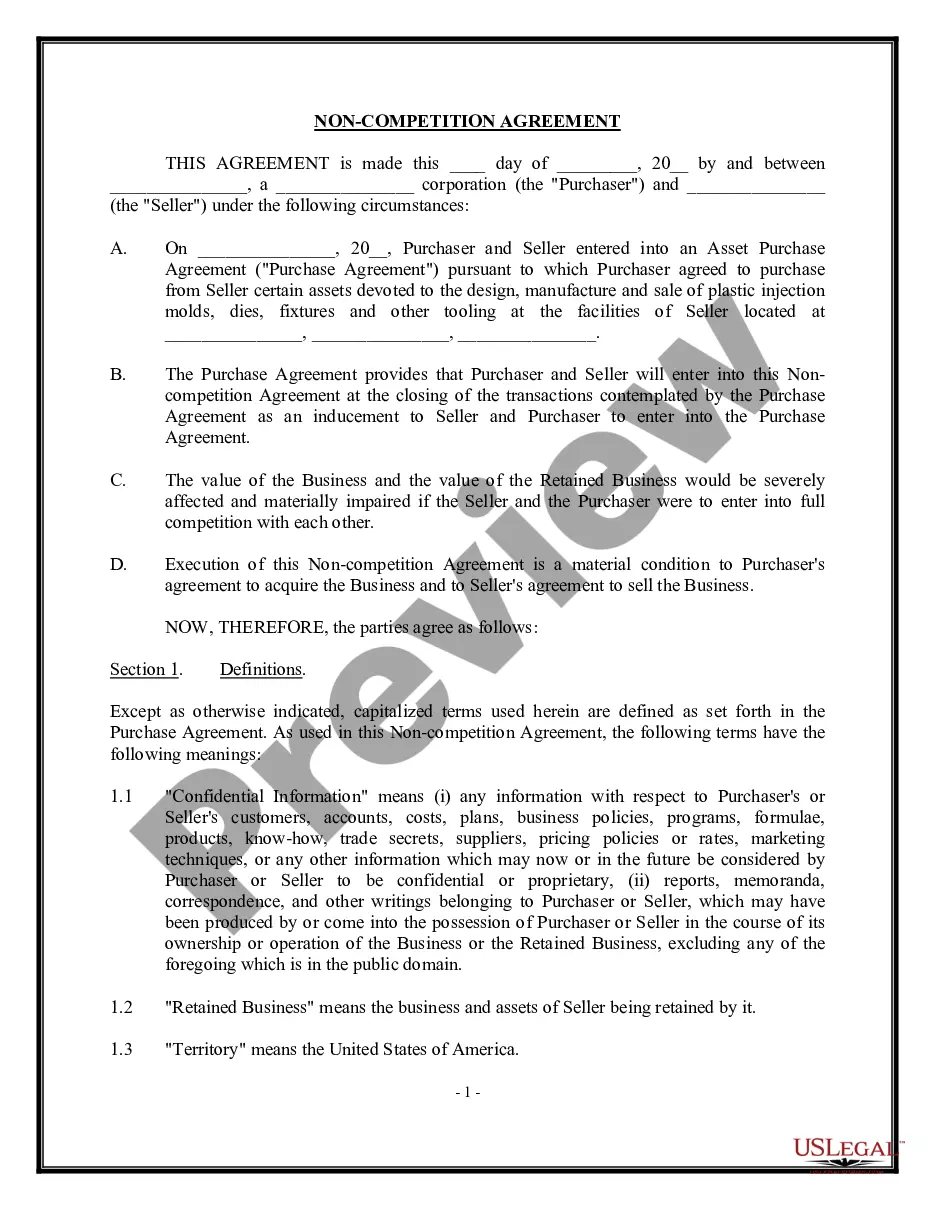
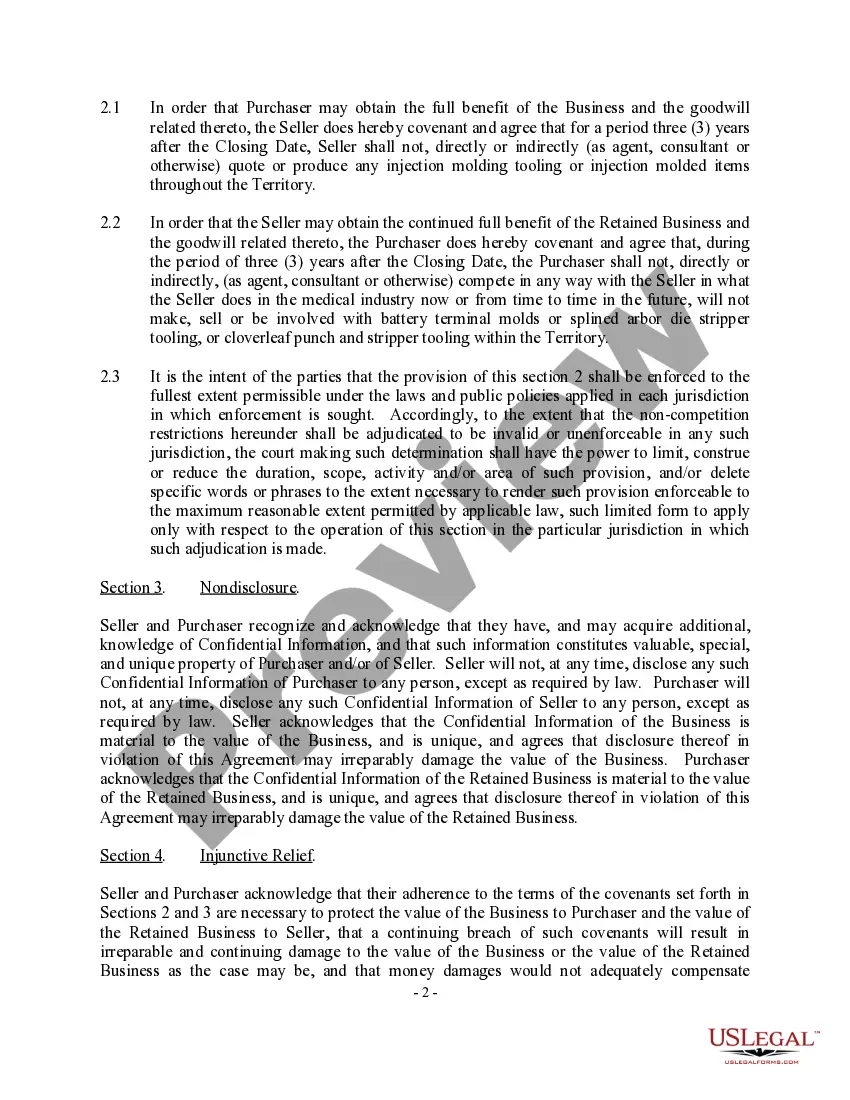
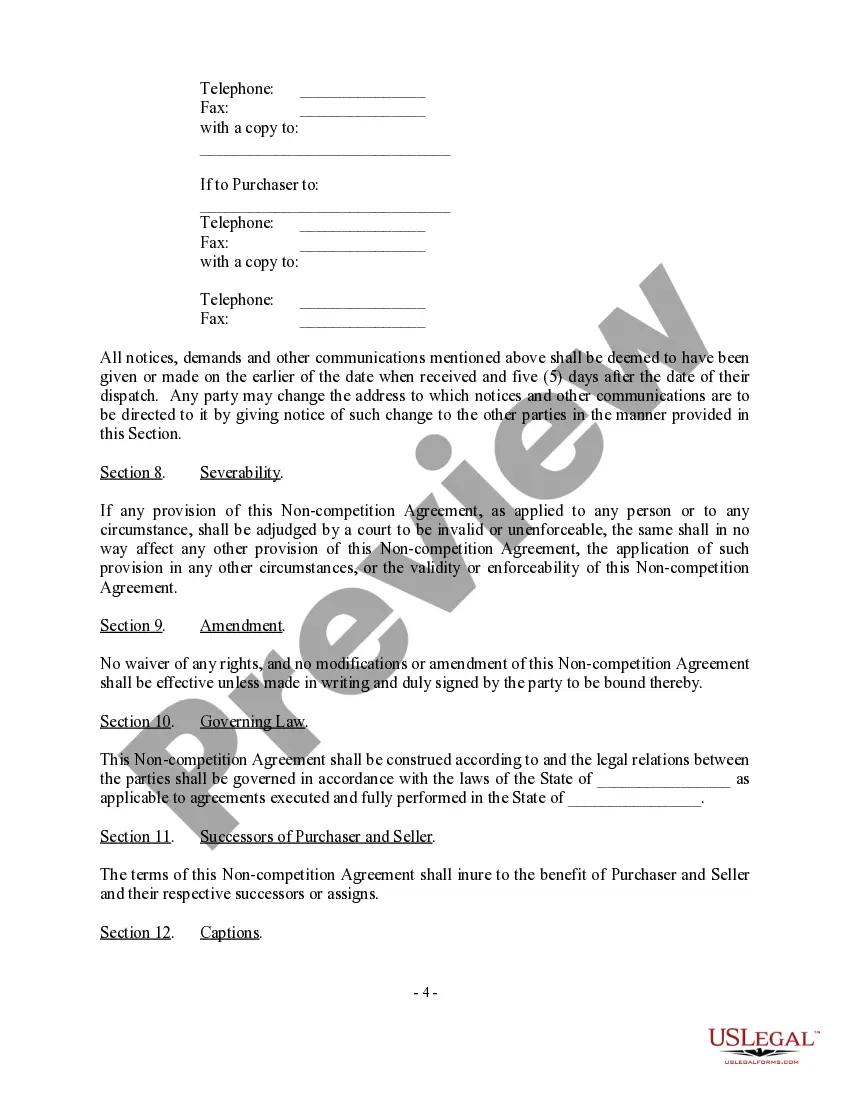
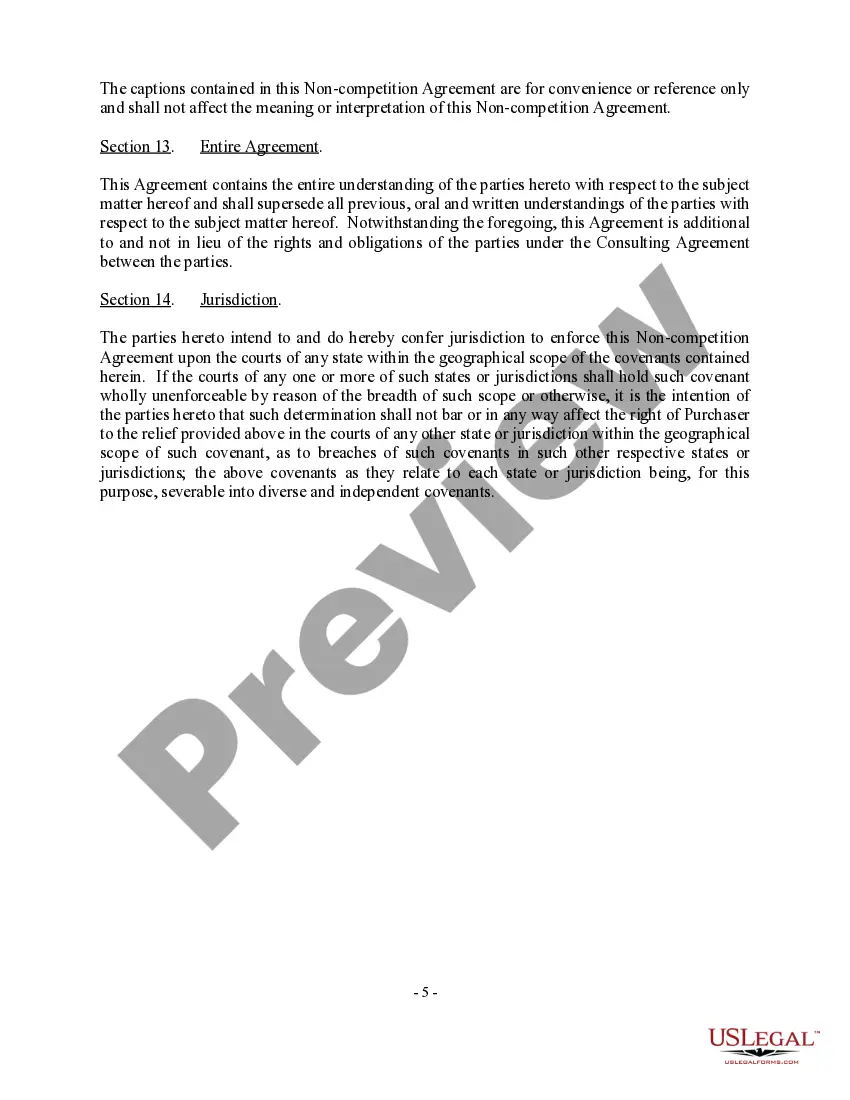
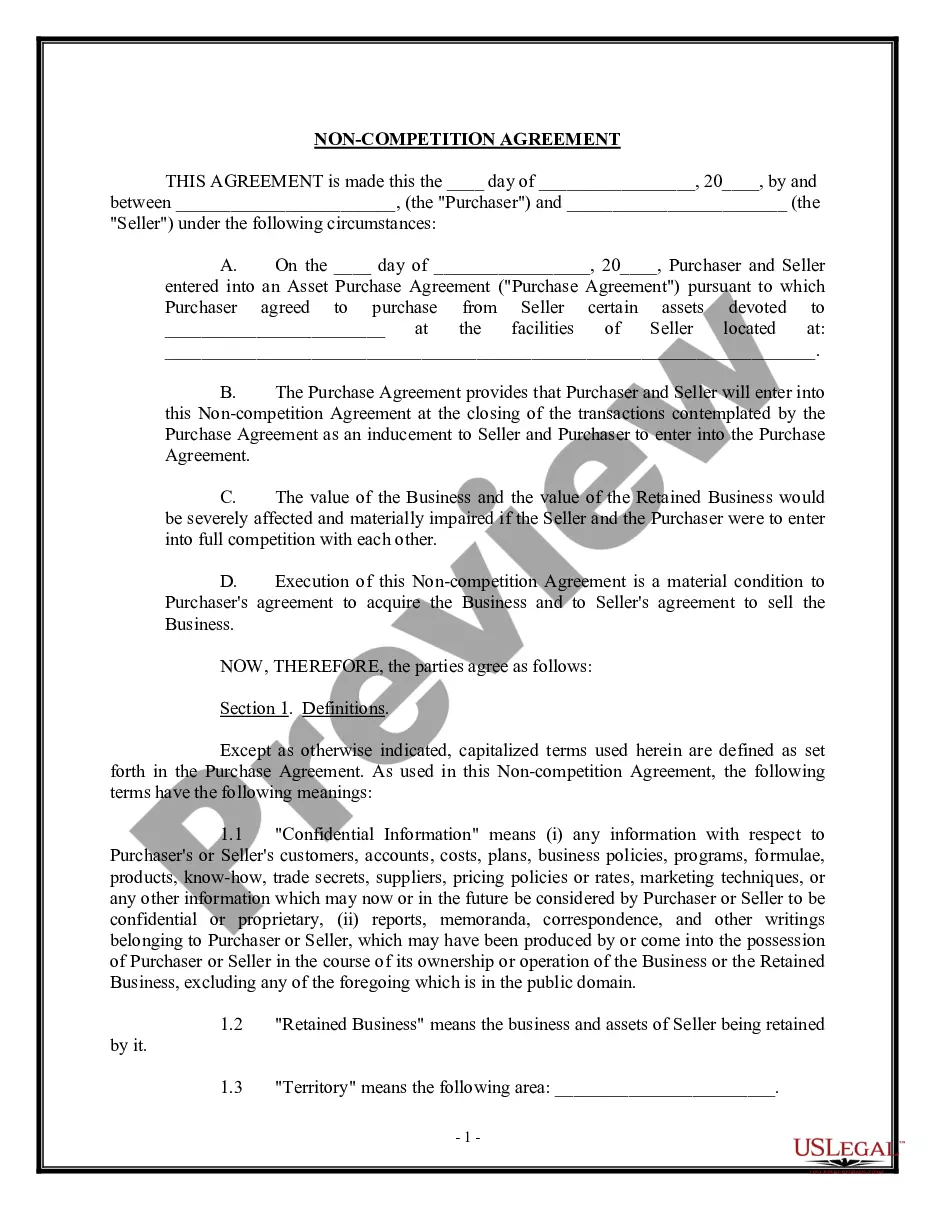
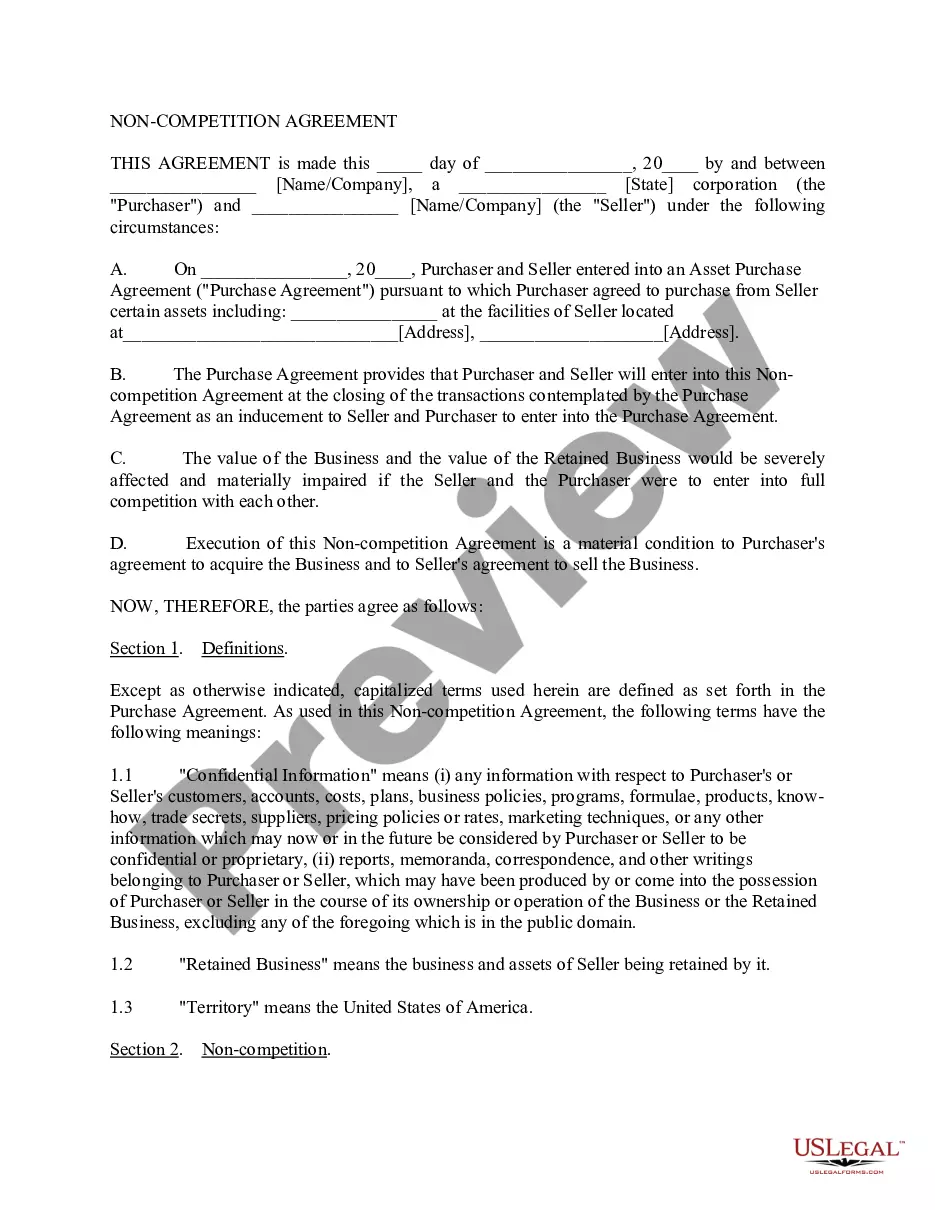
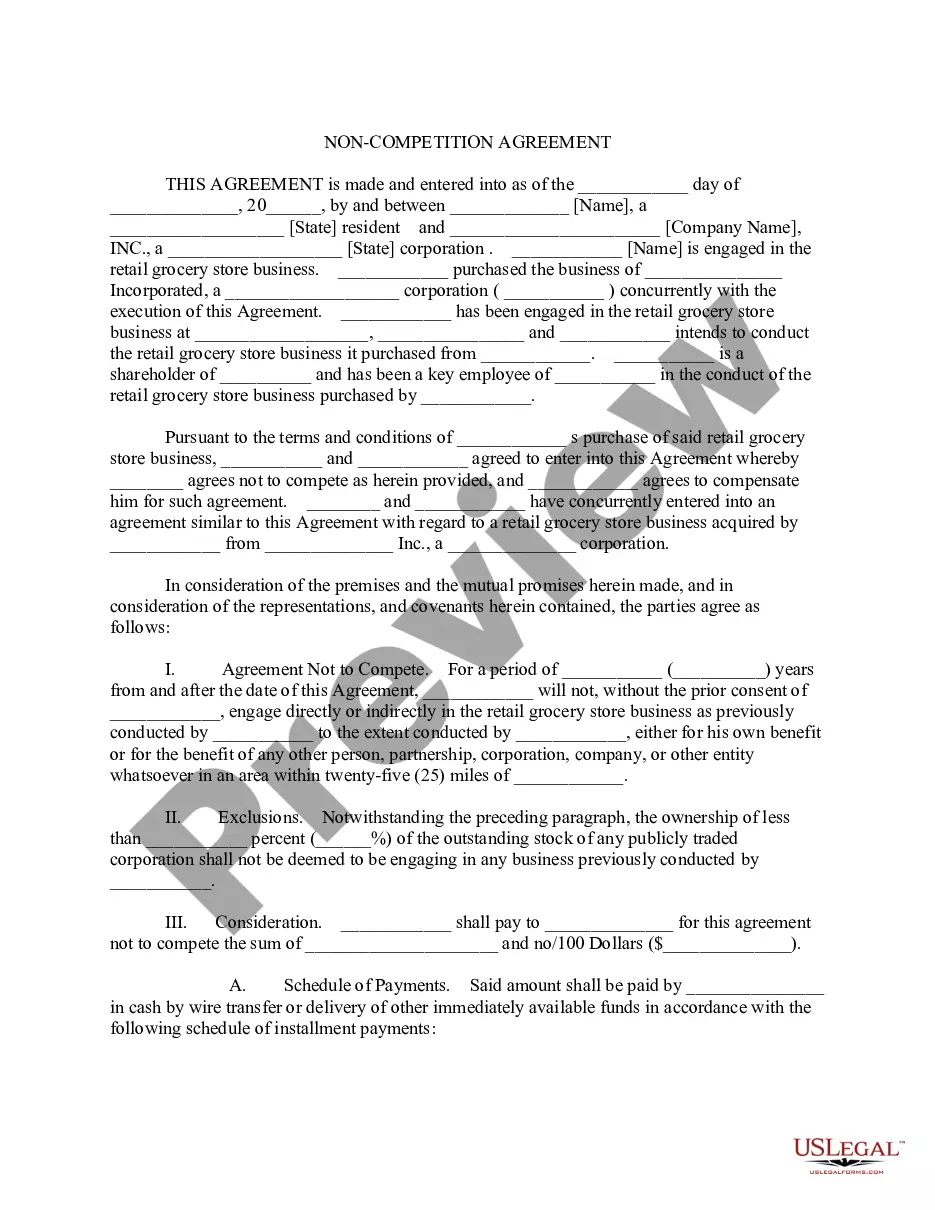
This form is a Sale of Business Noncompetition Agreement designed for asset purchase transactions. It outlines the terms under which the seller agrees not to compete with the purchaser in specific markets for a defined period. Unlike other agreements, this document prioritizes the protection of confidential information and business goodwill, creating a clear boundary for both parties to avoid conflicts after the business sale.
Key parts of this document
- Identification of parties involved in the agreement (Purchaser and Seller).
- Definition of key terms such as "Confidential Information," "Retained Business," and "Territory."
- Details regarding the duration and scope of the non-competition clause.
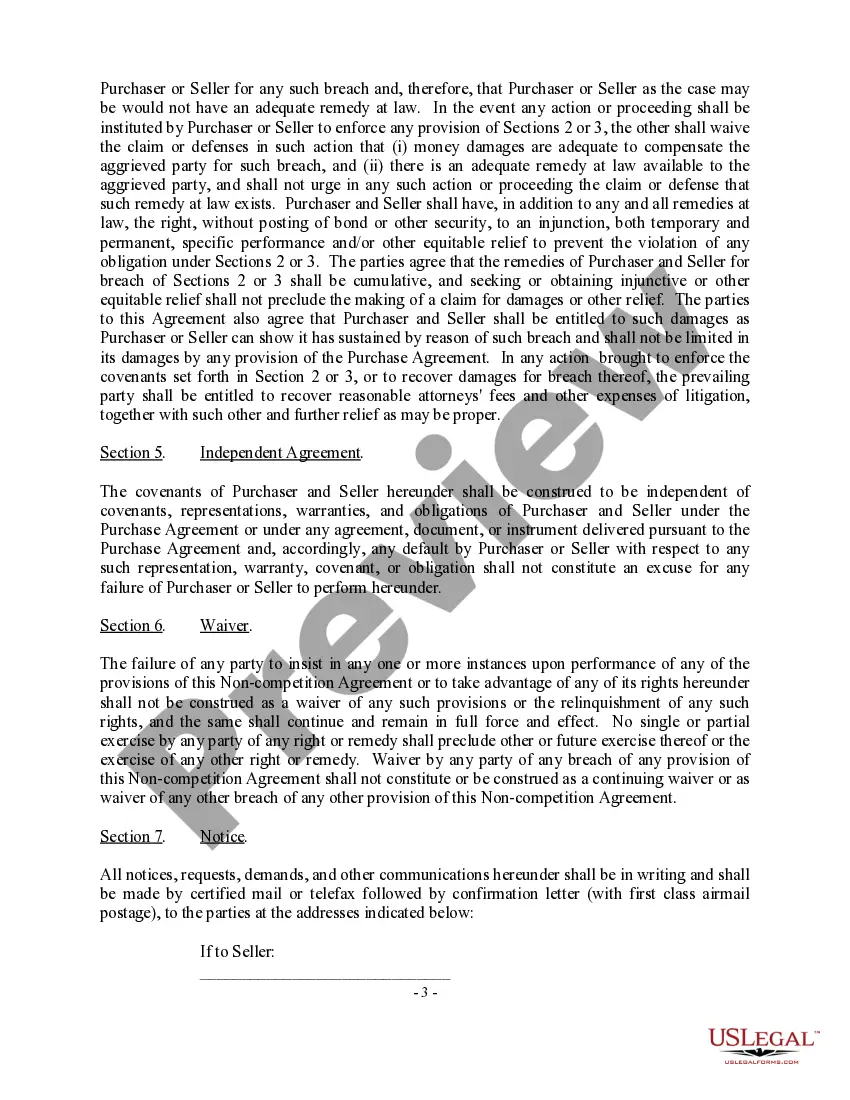
- Provisions concerning the nondisclosure of confidential information.
- Information about legal remedies in case of non-compliance.

Common use cases
This form should be used when a business is sold through an asset purchase transaction, where the buyer and seller want to ensure that the seller does not engage in direct competition after the sale. It is vital in industries where team members possess sensitive information that could undermine the business's value if disclosed or improperly utilized.
Who can use this document
- Business owners selling their company who wish to protect their business assets.
- Purchasers who want to prevent sellers from starting a competing business.
- Legal professionals advising clients on sale agreements and nondisclosure terms.
How to complete this form
- Identify the parties involved by entering the names of the Purchaser and Seller.
- Specify the date of the asset purchase agreement.
- Define the non-competition period and geographic territory covered.
- Outline the confidential information that must not be disclosed.
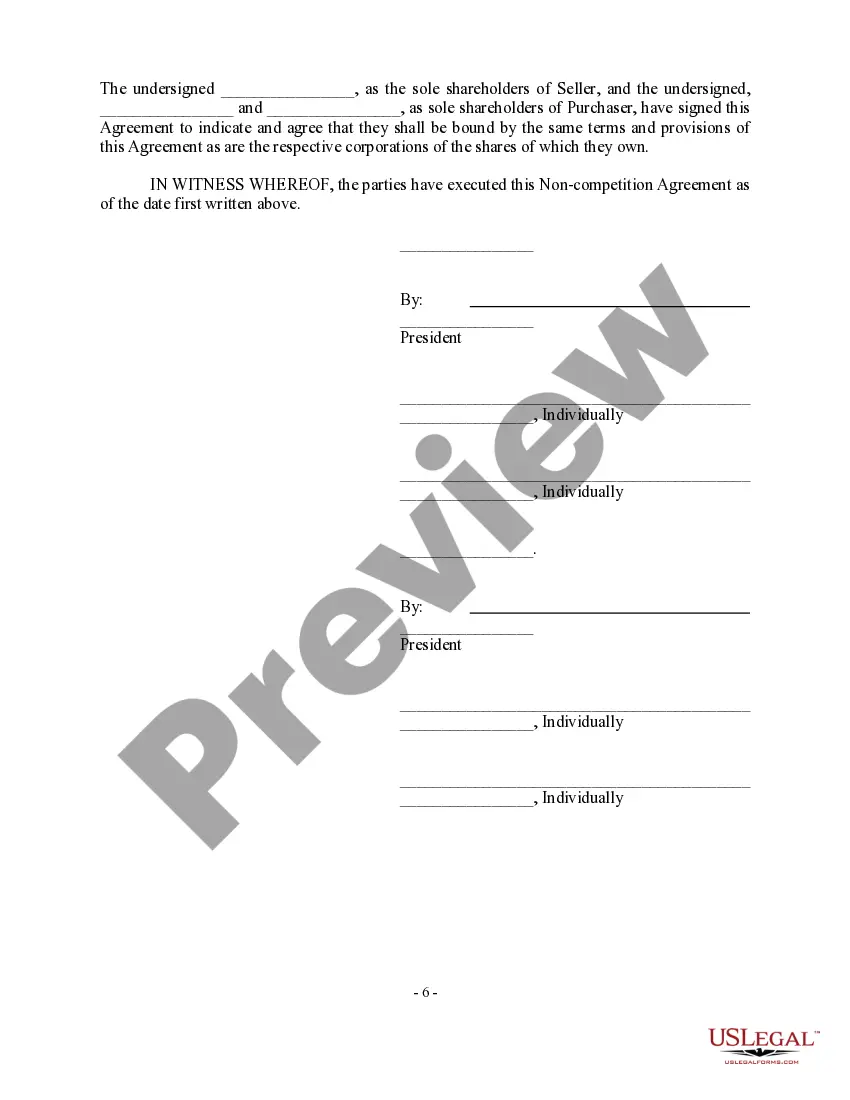
- Ensure that all parties sign the agreement to indicate their acceptance of the terms.
Notarization requirements for this form
This form does not typically require notarization unless specified by local law. However, it is advisable to check if your state mandates notarization for this type of agreement to ensure its enforceability.
Get your form ready online
Our built-in tools help you complete, sign, share, and store your documents in one place.
Make edits, fill in missing information, and update formatting in US Legal Forms—just like you would in MS Word.
Download a copy, print it, send it by email, or mail it via USPS—whatever works best for your next step.
Sign and collect signatures with our SignNow integration. Send to multiple recipients, set reminders, and more. Go Premium to unlock E-Sign.
If this form requires notarization, complete it online through a secure video call—no need to meet a notary in person or wait for an appointment.
We protect your documents and personal data by following strict security and privacy standards.

Make edits, fill in missing information, and update formatting in US Legal Forms—just like you would in MS Word.

Download a copy, print it, send it by email, or mail it via USPS—whatever works best for your next step.

Sign and collect signatures with our SignNow integration. Send to multiple recipients, set reminders, and more. Go Premium to unlock E-Sign.

If this form requires notarization, complete it online through a secure video call—no need to meet a notary in person or wait for an appointment.

We protect your documents and personal data by following strict security and privacy standards.
Common mistakes to avoid
- Failing to clearly define the duration of the non-competition clause.
- Omitting specific confidential information that needs protection.
- Having incomplete or incorrect party identification, which can invalidate the agreement.
Benefits of using this form online
- Convenience of immediate download and access.
- Editable templates that allow customization to fit specific circumstances.
- Reliability of forms drafted by licensed attorneys to ensure legal compliance.
Legal use & context
- This noncompetition agreement is enforceable in most jurisdictions as long as its terms are reasonable in scope and duration.
- Courts may modify excessively broad non-competition agreements to make them enforceable.
- Parties should be aware of local laws that may impact the enforceability of noncompetition clauses.
What to keep in mind
- The Sale of Business - Noncompetition Agreement protects the business value and confidential information.
- Both buyer and seller are bound by non-competition and nondisclosure clauses.
- Accuracy in completion and clarity of terms are essential for enforceability.
Looking for another form?

Form popularity
FAQ
In most cases, the court will rule in favor of the agreement if the employer can meet certain conditions. This is true regardless of the reason the employee left the company. However, not all non-compete agreements are fully enforceable under the law.
If a business has a major change in ownership, (the sale of a business, for example), part of the terms of the sale may be the assignment of the contract to the new owner.As part of the buy/sell process, a new contract may be substituted for a previous contract, with the agreement of both parties.
These will include the purchase price, of course, and bills of sale, assignment and assumption agreements, intellectual property assignments, real property transfer documents and so on, as well as any legal opinions, employment agreements, escrow agreement and other ancillary documents.
The U.S. Court of Appeals for the Eighth Circuit issued a decision in July 2016 stating that a non-compete agreement could be enforced by a company that bought all the assets of the employer.
Non-Compete Unaffected if Company Maintains ExistenceIf the acquisition is a stock purchase and the acquired company (we'll call it Company B) maintains a separate existence, the non-compete is unaffected. Company B will still be around to enforce the Agreement.
Voiding a non-compete contract is possible in certain circumstances. For instance, if you can prove that you never signed the contract, or if you can demonstrate that the contract is against the public interest, you may be able to void the agreement.
Provisions of an APA may include payment of purchase price, monthly installments, liens and encumbrances on the assets, condition precedent for the closing, etc. An APA differs from a stock purchase agreement (SPA) where company shares, title to assets, and title to liabilities are also sold.
Once the basic terms of the asset sale are agreed, the buyer's solicitor will normally draft the contact of sale. These legal agreements are usually complex and will need to be reviewed by the seller and their solicitor and any amendments agreed between both parties.
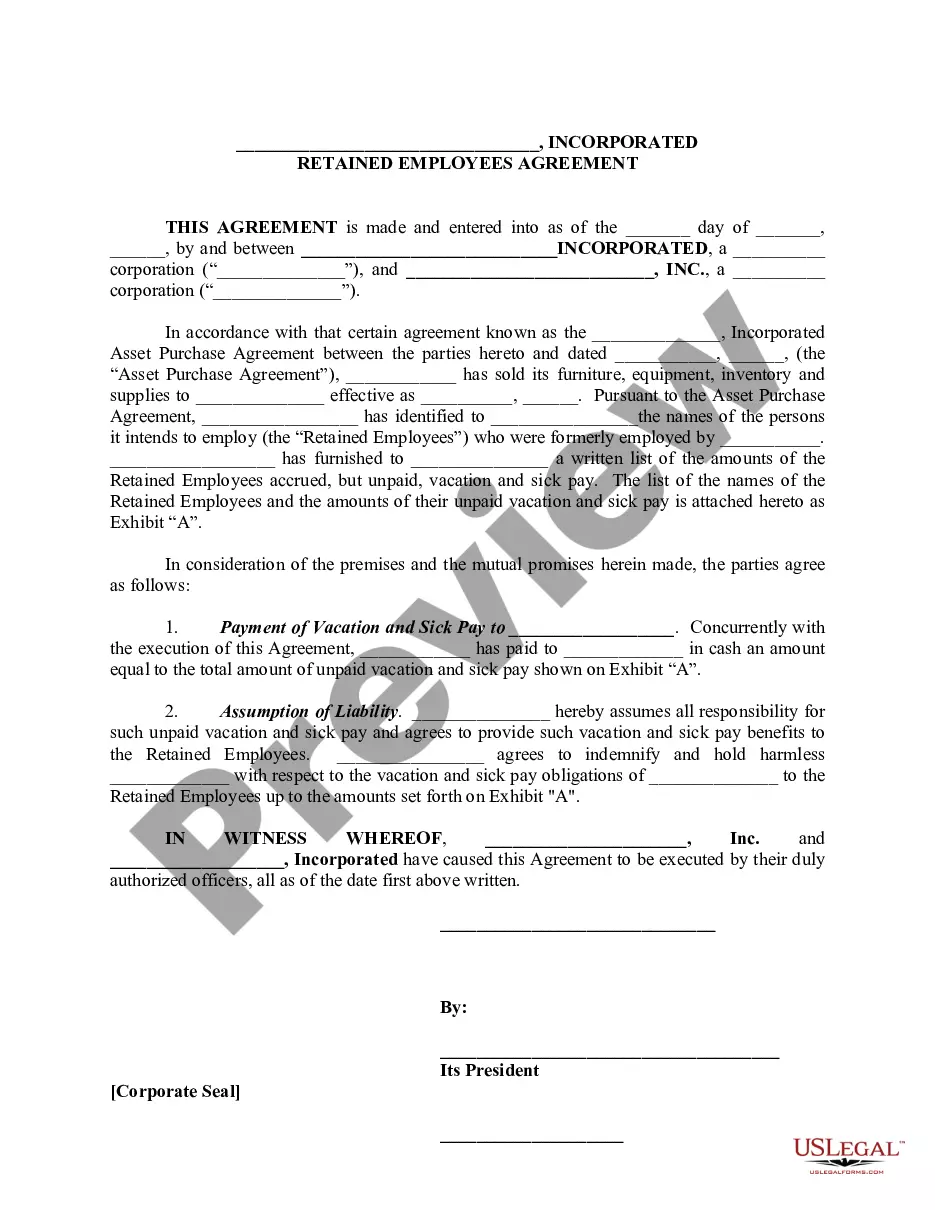
An asset purchase agreement or APA is a legally binding document that outlines the terms and conditions of the purchase and sale of some or all of a company's assets.