General Notice of the Filing of an Affidavit
Understanding this form
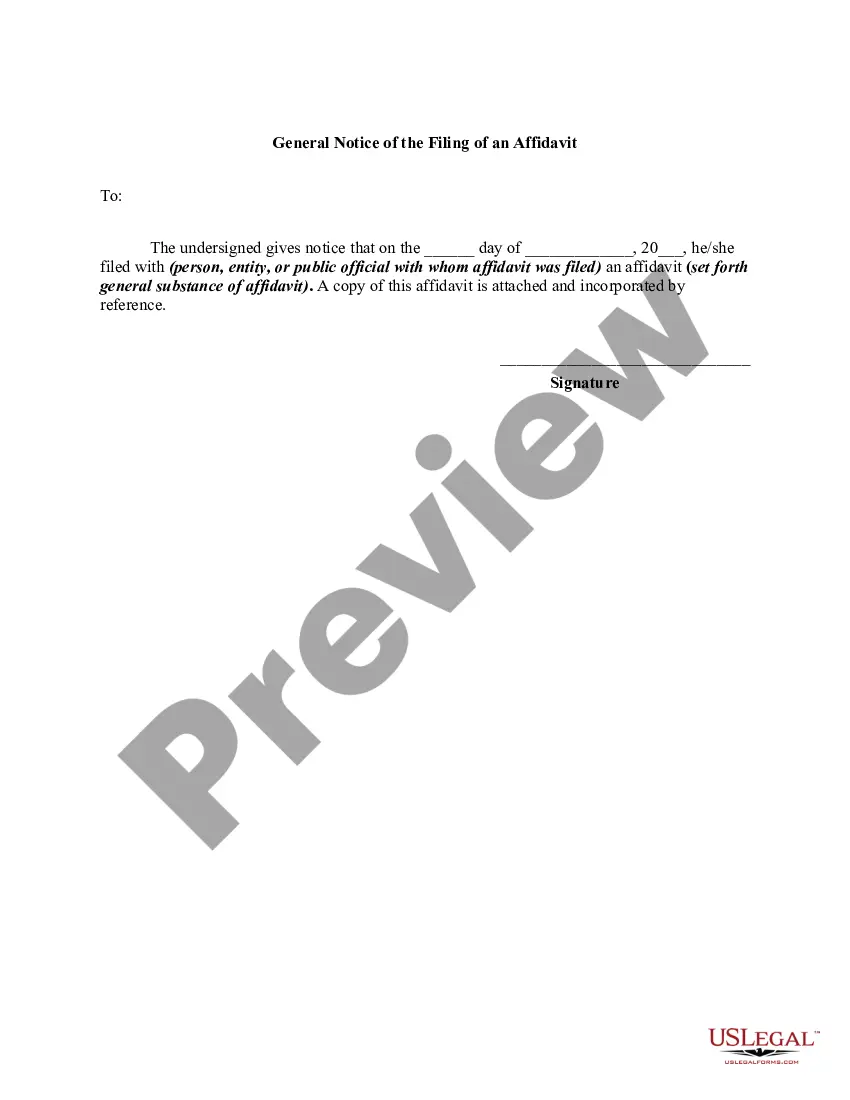
The General Notice of the Filing of an Affidavit is a legal document that serves to inform interested parties that an affidavit has been filed with a designated individual, organization, or public official. This notice is essential for ensuring that parties involved are aware of the affidavit's existence and content, distinguishing it from other legal documents that may not serve the same notification purpose.
Key components of this form
- Date of filing: Indicates when the affidavit was submitted.
- Filing recipient: Specifies the person, entity, or public official with whom the affidavit was filed.
- Substance of affidavit: Provides a brief summary of the affidavit content.
- Signature: Confirms the identity of the person giving the notice.
When to use this document
This form is typically used when an individual needs to officially notify other parties that an affidavit has been filed. This could be necessary in various situations, such as legal proceedings, property disputes, or any scenario where sworn statements are pertinent. Using this notice helps maintain transparency and ensures that all relevant parties are informed accordingly.
Who can use this document
- Individuals who have filed an affidavit and need to notify interested parties.
- Attorneys representing clients in legal matters involving affidavits.
- Businesses or organizations that must inform stakeholders about an affidavit.
Steps to complete this form
- Identify the date when the affidavit was filed.
- Specify the name of the person, entity, or public official who received the affidavit.
- Summarize the general substance of the affidavit in a clear manner.
- Attach a copy of the affidavit to the notice.
- Sign the notice to validate it.
Does this form need to be notarized?
Notarization is required for this form to take effect. Our online notarization service, powered by Notarize, lets you verify and sign documents remotely through an encrypted video session, available 24/7.
Get your form ready online
Our built-in tools help you complete, sign, share, and store your documents in one place.
Make edits, fill in missing information, and update formatting in US Legal Forms—just like you would in MS Word.
Download a copy, print it, send it by email, or mail it via USPS—whatever works best for your next step.
Sign and collect signatures with our SignNow integration. Send to multiple recipients, set reminders, and more. Go Premium to unlock E-Sign.
If this form requires notarization, complete it online through a secure video call—no need to meet a notary in person or wait for an appointment.
We protect your documents and personal data by following strict security and privacy standards.

Make edits, fill in missing information, and update formatting in US Legal Forms—just like you would in MS Word.

Download a copy, print it, send it by email, or mail it via USPS—whatever works best for your next step.

Sign and collect signatures with our SignNow integration. Send to multiple recipients, set reminders, and more. Go Premium to unlock E-Sign.

If this form requires notarization, complete it online through a secure video call—no need to meet a notary in person or wait for an appointment.

We protect your documents and personal data by following strict security and privacy standards.
Common mistakes
- Failing to include the date of filing.
- Not attesting to the affidavit copy attached.
- Omitting the name of the recipient or filing authority.
Why complete this form online
- Convenience: Download and complete from your home or office.
- Editability: Customize the form easily to fit your specific needs.
- Reliability: Forms are drafted by licensed attorneys to ensure legal accuracy.
Legal use & context
- This notice serves as an official record of filing, which may be required in litigation.
- Failure to provide notice may affect the rights of interested parties in legal proceedings.
Main things to remember
- The General Notice of the Filing of an Affidavit is crucial for notifying interested parties about an affidavit.
- Ensure all fields are accurately filled to maintain the validity of the notice.
- Consult local statutes to determine if notarization is necessary.
Looking for another form?

Form popularity
FAQ
A general affidavit is a sworn statement of fact, written by an affiant who has personal or special knowledge of a specific matter. An affidavit is always signed under oath, in the presence of a notary public, in order to confirm the veracity of the statement.
After your affidavit has been filed, the court clerk will give your case file to the judge for review.The judgment will state that it is a default judgment and it will be signed and dated by the judge. The court clerk will mail copies of the judgment to you and the defendant.
I ____ (Applicant Name as per id proof), residing at _______(Address as per address proof) do solemnly affirm and stated as under: I am _____ and my name _______, appearing on the enclosed ID proof, is single name. My father's name is ________________.
Create a title for the affidavit. The initial step for writing a sworn testimony is crafting a relevant title. Write a state of identity. Design a statement of truth. Outline the facts. Restate the statement of truth.
Step 1: Decide what the title of your affidavit will be. Step 2: Put the name and personal background information of the person giving the information in the first paragraph. Step 3: Write an opening sentence in the first person tense. Step 4: Make an outline of the information given or state the facts of the case.
Full name of the deponent and their signature. Statement indicating whether the affidavit has been sworn or not. Date and place where the affidavit is being signed. Designation and full name of the Notary or Magistrate (person attesting the affidavit)
Title the affidavit. First, you'll need to title your affidavit. Craft a statement of identity. The very next section of your affidavit is what's known as a statement of identity. Write a statement of truth. State the facts. Reiterate your statement of truth. Sign and notarize.
An affidavit is a written statement that is notarized.The information in an affidavit must be first-hand information. It cannot be second-hand information or speculation. Affidavits can be written in your own handwriting or typed.
1Title the affidavit. First, you'll need to title your affidavit.2Craft a statement of identity. The very next section of your affidavit is what's known as a statement of identity.3Write a statement of truth.4State the facts.5Reiterate your statement of truth.6Sign and notarize.