Power of Attorney Revocation
Understanding this form
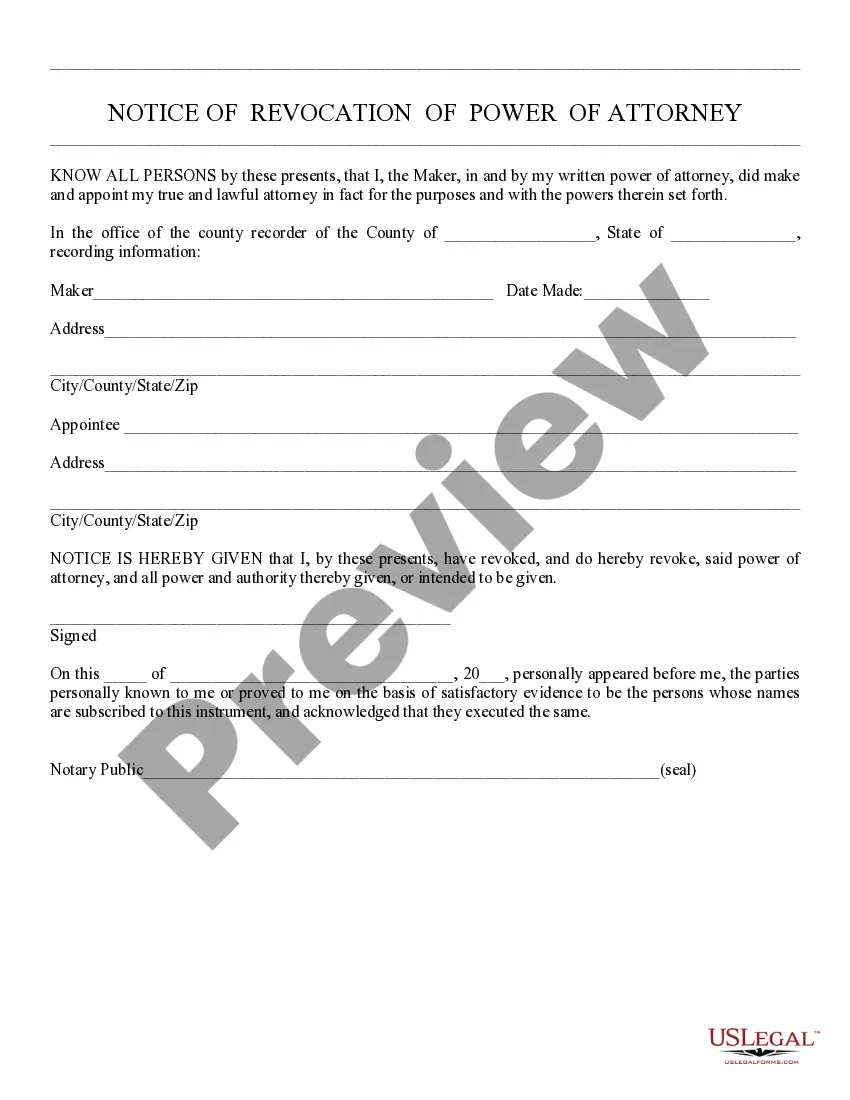
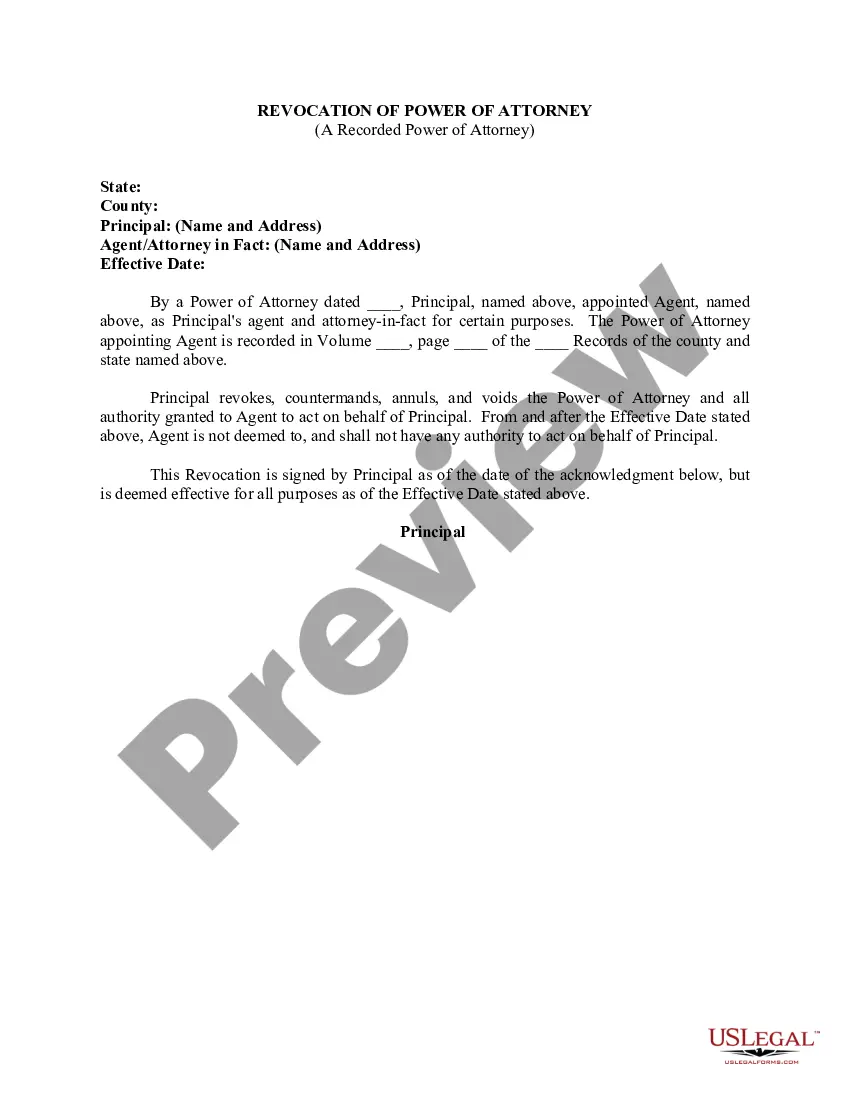
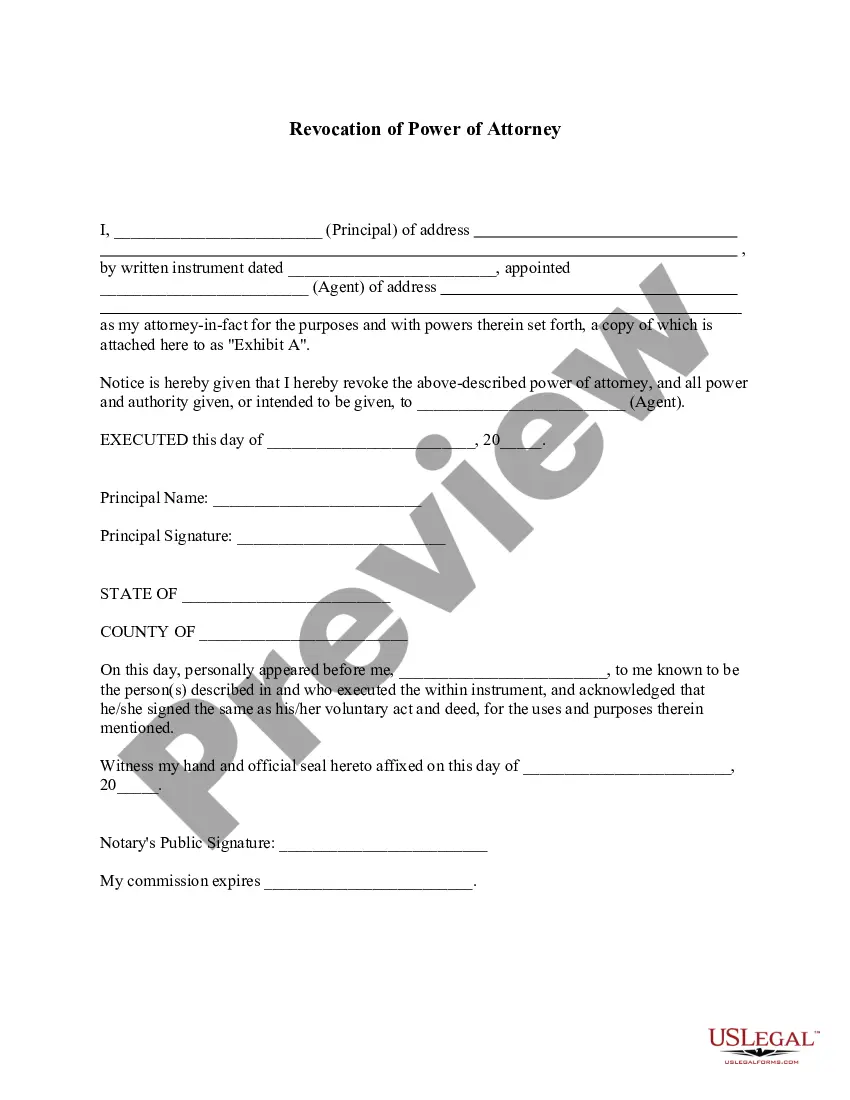
The Power of Attorney Revocation form is a legal document that formally rescinds any authority previously granted to an attorney-in-fact. Unlike a Power of Attorney, which permits someone to act on your behalf, a revocation specifies that this power is no longer valid. This form is essential for ensuring that your legal representation accurately reflects your current wishes and interests.
Main sections of this form
- Maker's information: Includes the full name and address of the person revoking the power of attorney.
- Appointee's information: Details about the person who was previously granted power of attorney.
- Revocation statement: A clear declaration that the previously granted authority is hereby revoked.
- Date and signature: The date when the revocation is signed, along with the Maker's signature.
- Notarization space: An area for a notary public's signature and seal, affirming the identity of the Maker.
Situations where this form applies
This form should be used when you have decided to revoke a previously granted Power of Attorney. Situations may include changes in personal circumstances, such as a falling out with the appointee, a change in your health status, or if you've appointed a new attorney to act on your behalf. By completing this form, you ensure that the previous appointee no longer has any authority to act in your stead.
Who needs this form
- Individuals who wish to revoke an existing Power of Attorney.
- Those who have appointed an attorney-in-fact and want to change that arrangement.
- Anyone looking to clarify their current legal representation and remove previous authorities.
Steps to complete this form
- Identify the Maker: Enter your full name and address as the person revoking the power.
- Provide appointee details: Fill in the name and address of the attorney-in-fact you are revoking authority from.
- Write the revocation statement: Clearly state that you are revoking the power of attorney.
- Sign and date the document: Ensure you sign on the designated line and include the date of signing.
- Obtain notarization: If required, sign in the presence of a notary public, who will complete their section of the form.
Notarization requirements for this form
To make this form legally binding, it must be notarized. Our online notarization service, powered by Notarize, lets you verify and sign documents remotely through an encrypted video session.
Get your form ready online
Our built-in tools help you complete, sign, share, and store your documents in one place.
Make edits, fill in missing information, and update formatting in US Legal Forms—just like you would in MS Word.
Download a copy, print it, send it by email, or mail it via USPS—whatever works best for your next step.
Sign and collect signatures with our SignNow integration. Send to multiple recipients, set reminders, and more. Go Premium to unlock E-Sign.
If this form requires notarization, complete it online through a secure video call—no need to meet a notary in person or wait for an appointment.
We protect your documents and personal data by following strict security and privacy standards.

Make edits, fill in missing information, and update formatting in US Legal Forms—just like you would in MS Word.

Download a copy, print it, send it by email, or mail it via USPS—whatever works best for your next step.

Sign and collect signatures with our SignNow integration. Send to multiple recipients, set reminders, and more. Go Premium to unlock E-Sign.

If this form requires notarization, complete it online through a secure video call—no need to meet a notary in person or wait for an appointment.

We protect your documents and personal data by following strict security and privacy standards.
Mistakes to watch out for
- Failing to provide complete information for both the Maker and the appointee.
- Not including the date of signing, which is essential for the validity of the revocation.
- Neglecting to have the document notarized if required by state laws.
- Using vague language instead of clearly stating that the power of attorney is revoked.
Benefits of completing this form online
- Convenience: Download and complete the form from the comfort of your home.
- Editability: Easy to modify the document according to your specific needs.
- Reliability: Forms are drafted by licensed attorneys to ensure they meet legal standards.
What to keep in mind
- The Power of Attorney Revocation form is essential for officially canceling a prior power of attorney.
- Accurate completion and notarization are crucial for ensuring the revocation is legally recognized.
- This form is useful in various life changes where previous authorizations need to be withdrawn.
Looking for another form?
Form popularity
FAQ
Unless the power of attorney states otherwise, and they usually don't, a revocation of a POA must be made in writing. A verbal revocation may not be enough.A revocation will reference the existing POA and the current attorney-in-fact and revoke the document and the powers granted.
If for any reason, you become unhappy with the person you have appointed to make decisions for you under a durable power of attorney, you may revoke the power of attorney at any time.
After you make a power of attorney, you can revoke it at any time, as long as you are of sound mind. But to make the revocation legally effective, you must carefully follow all the procedures set out in this section.
"In case you forget to mention when and under what circumstances your power of attorney can be revoked, and if the power of attorney does not state it is irrevocable, then the power of attorney can be revoked if you execute a document cancelling it.
In other words, a Revocation of Power of Attorney is written confirmation that a principal (the person who appointed power in a Power of Attorney) no longer wants or needs their attorney-in-fact (the person who was appointed power in a Power of Attorney, sometimes called an agent or donor) to act on their behalf.
Until an attorney-in-fact's powers are properly revoked, they can continue to legally act for the principal. To cancel a Power of Attorney, the principal can create a document called a Revocation of Power of Attorney or create a new Power of Attorney that indicates the previous Power of Attorney is revoked.
The Principal can override either type of POA whenever they want. However, other relatives may be concerned that the Agent (in most cases a close family member like a parent, child, sibling, or spouse) is abusing their rights and responsibilities by neglecting or exploiting their loved one.
You can end your lasting power of attorney ( LPA ) yourself - if you have mental capacity to make that decision. You need to send the Office of the Public Guardian ( OPG ) both: the original LPA. a written statement called a 'deed of revocation'
If you're mentally competent and no longer wish to have someone appointed as your power of attorney, you can cancel it by submitting a formal revocation form, as well as notifying the individual and other relevant third parties, in writing. You may want to cancel your power of attorney for several reasons.