Obtain S Corporation Status - Corporate Resolutions Forms
About this form
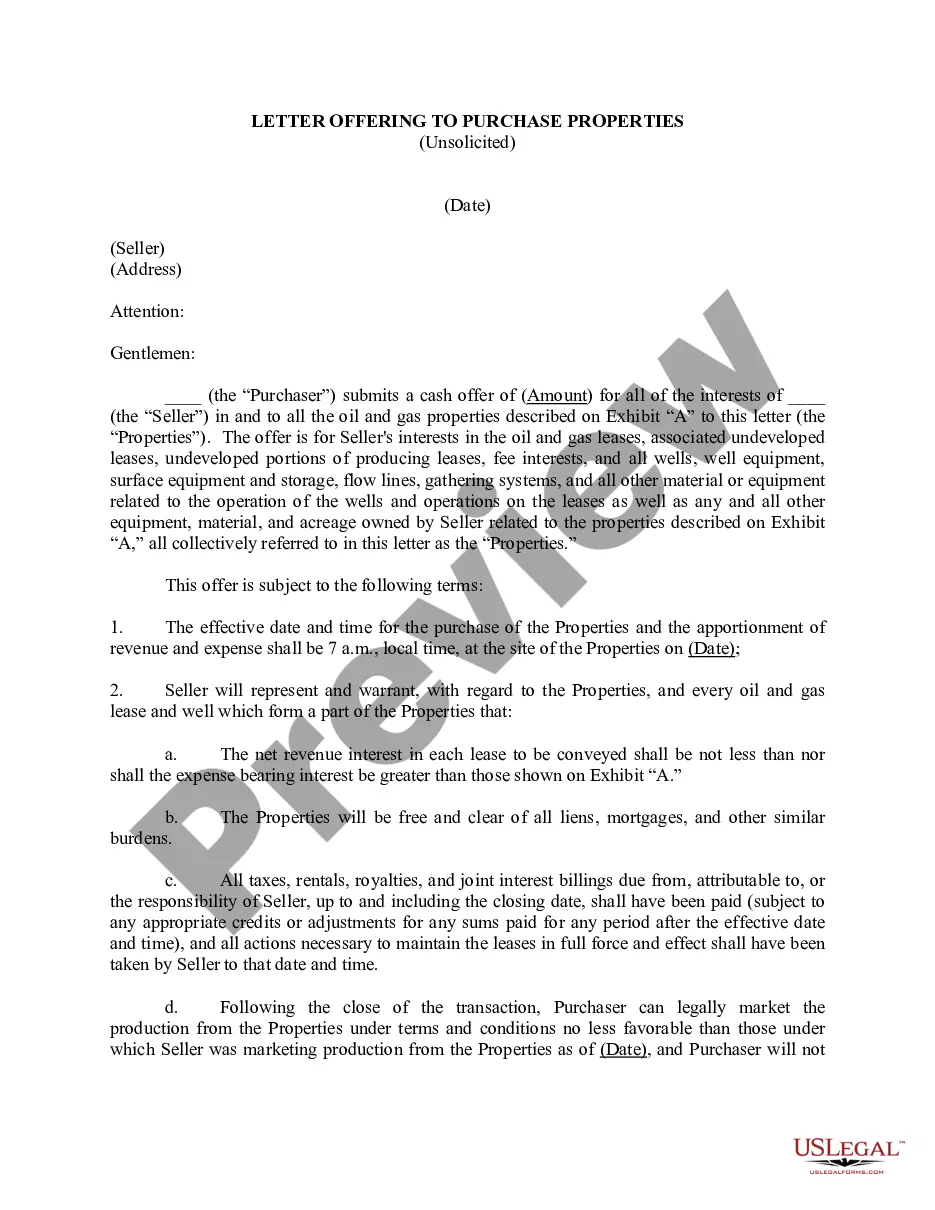
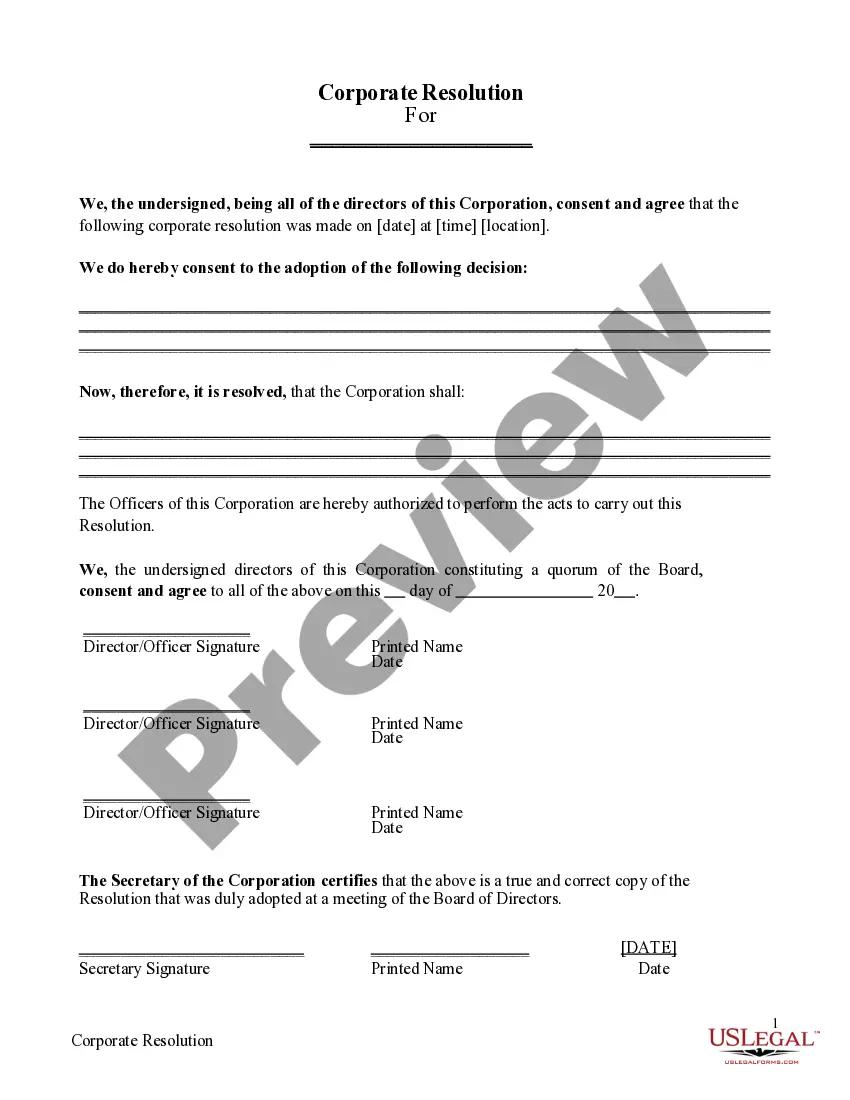
The Obtain S Corporation Status Corporate Resolutions Form is a legal document used by a corporation to formally elect to be treated as an S Corporation under the Internal Revenue Code and applicable state tax laws. This form is essential for corporations seeking to change their tax designation to benefit from pass-through taxation while maintaining limited liability for shareholders. It distinguishes itself from other corporate resolutions by focusing specifically on the election for S Corporation treatment, ensuring compliance with both federal and state regulations.
Main sections of this form
- Corporate name and identification details.
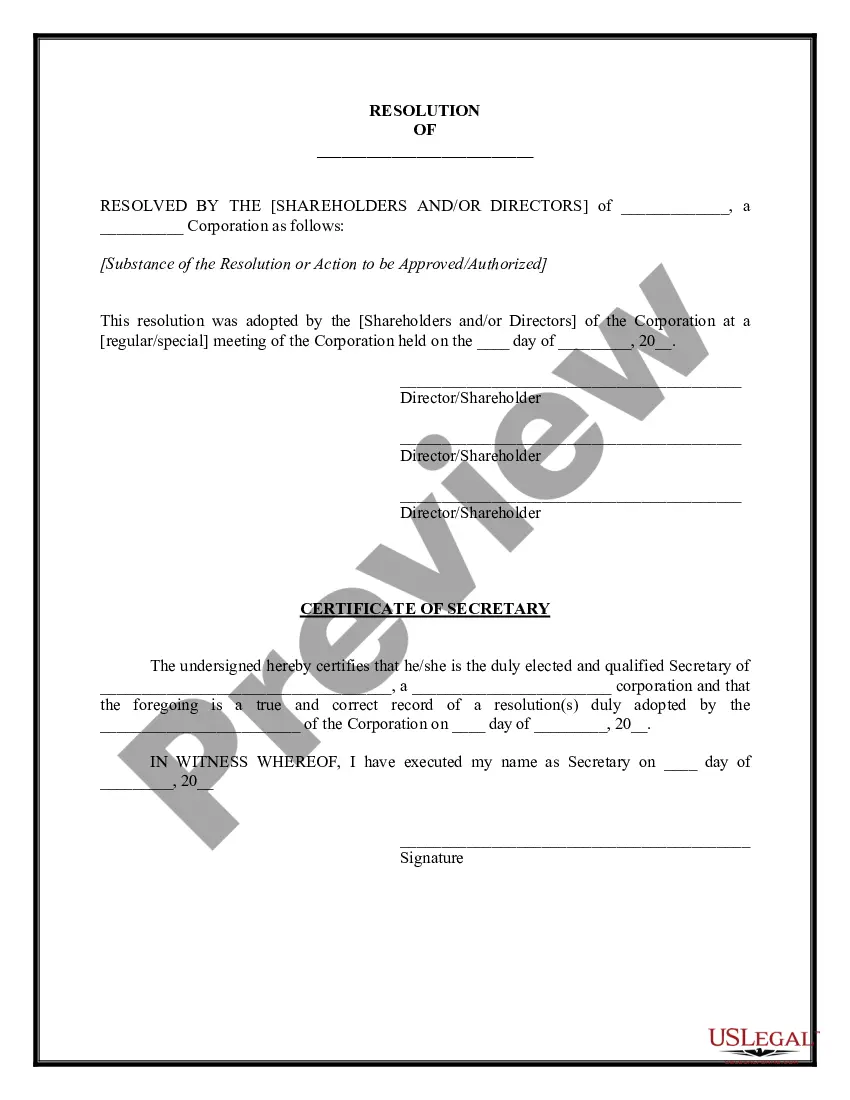
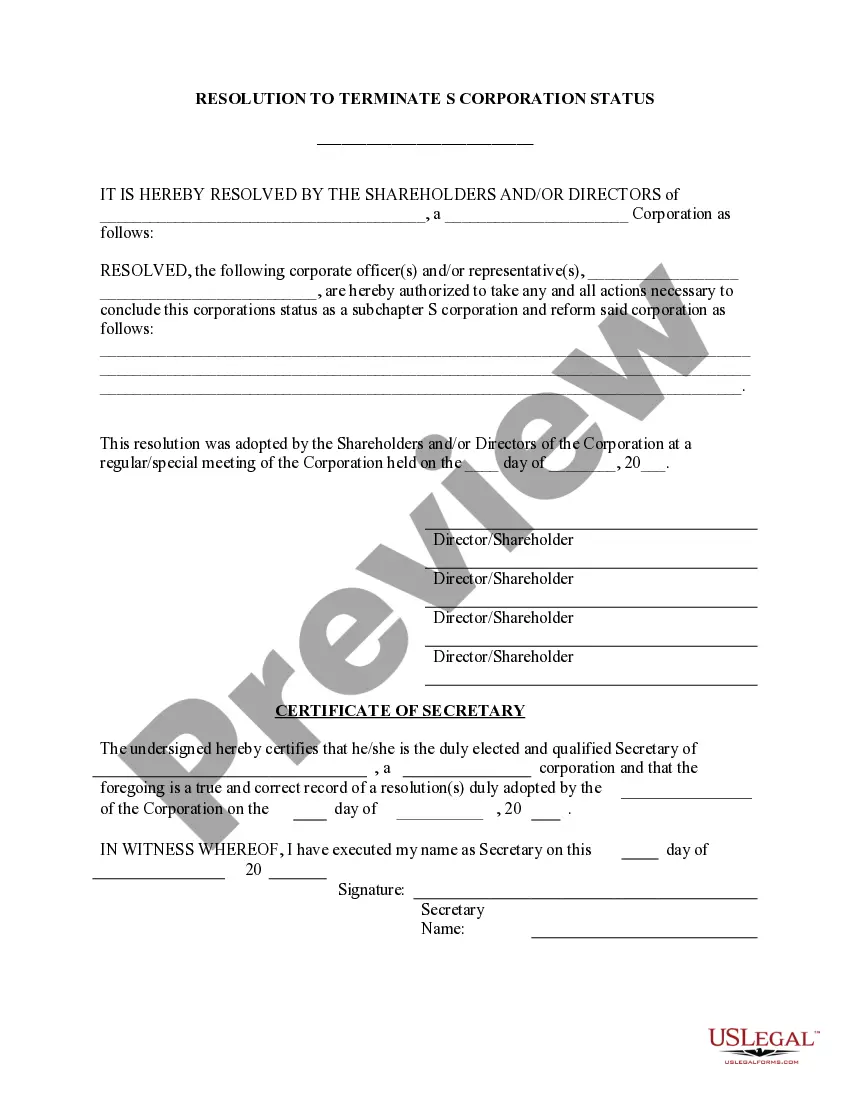
- Resolution to elect S Corporation status, including references to the Internal Revenue Code.
- Authorization clauses for corporate officers to take necessary actions.
- Ratification of pre-existing actions pertaining to the S Corporation status.
- Certification by the corporate Secretary confirming the resolution's validity.



Situations where this form applies
This form should be used when a corporation decides to change its tax classification to an S Corporation. Common scenarios include when a corporation wants to take advantage of pass-through taxation benefits or when the corporation's shareholders prefer a tax structure that avoids double taxation of corporate income. It is particularly pertinent when significant changes in corporate structure or ownership occur, necessitating a new tax status election.
Intended users of this form
- Corporate officers who need to approve the election for S Corporation status.
- Shareholders interested in changing the tax treatment of the corporation.
- Small business owners looking to optimize tax obligations.
- Corporations meeting the eligibility requirements for S Corporation status under IRS guidelines.
Instructions for completing this form
- Enter the legal name of the corporation at the top of the form.
- Specify the state tax code relevant to the corporationâs jurisdiction.
- Include the date of the resolution and the names of the Directors who are adopting the resolution.
- Have the Secretary of the corporation certify the resolution with their signature and date.
- Ensure all officers authorized to act on behalf of the corporation sign where required.
Does this form need to be notarized?
This form does not typically require notarization unless specified by local law. However, certain states may have additional requirements for signatures or filings, so it is advisable to check local regulations to ensure compliance.
Get your form ready online
Our built-in tools help you complete, sign, share, and store your documents in one place.
Make edits, fill in missing information, and update formatting in US Legal Forms—just like you would in MS Word.
Download a copy, print it, send it by email, or mail it via USPS—whatever works best for your next step.
Sign and collect signatures with our SignNow integration. Send to multiple recipients, set reminders, and more. Go Premium to unlock E-Sign.
If this form requires notarization, complete it online through a secure video call—no need to meet a notary in person or wait for an appointment.
We protect your documents and personal data by following strict security and privacy standards.

Make edits, fill in missing information, and update formatting in US Legal Forms—just like you would in MS Word.

Download a copy, print it, send it by email, or mail it via USPS—whatever works best for your next step.

Sign and collect signatures with our SignNow integration. Send to multiple recipients, set reminders, and more. Go Premium to unlock E-Sign.

If this form requires notarization, complete it online through a secure video call—no need to meet a notary in person or wait for an appointment.

We protect your documents and personal data by following strict security and privacy standards.
Common mistakes
- Failing to include all necessary corporate details, such as the full legal name and state attachment.
- Not ratifying prior actions related to the S Corporation election, which can lead to legal complications.
- Neglecting to secure the necessary approvals from all shareholders or directors.
- Omitting the certification from the Secretary which could invalidate the document.
Benefits of completing this form online
- Convenience of immediate access to downloadable templates.
- Editability allows customization to fit specific corporate needs.
- Reliability of attorney-drafted forms ensuring legal compliance and robustness.
- Time-saving with instant document generation, foreseeing additional legal procedures.
Key takeaways
- The Obtain S Corporation Status - Corporate Resolutions form is essential for corporations seeking to change their tax treatment.
- Proper completion and submission lead to potential tax benefits for shareholders.
- Understanding state-specific requirements and ensuring all signatures are included is crucial for validity.
Looking for another form?









Form popularity
FAQ
One major advantage of an S corporation is that it provides owners limited liability protection, regardless of its tax status. Limited liability protection means that the owners' personal assets are shielded from the claims of business creditorswhether the claims arise from contracts or litigation.
Is an S Corp or LLC better? That is a bit of a misguided question. An LLC is a legal entity only and must choose to pay tax either as an S Corp, C Corp, Partnership, or Sole Proprietorship. Therefore, for tax purposes, an LLC can be an S Corp, so there is really no difference.
Specifically, S corporation shareholders must be individuals, specific trusts and estates, or certain tax-exempt organizations (501(c)(3)). Partnerships, corporations, and nonresident aliens cannot qualify as eligible shareholders.
The C corporation is the standard (or default) corporation under IRS rules. The S corporation is a corporation that has elected a special tax status with the IRS and therefore has some tax advantages. Both business structures get their names from the parts of the Internal Revenue Code that they are taxed under.
Generally, taxes are considered the biggest and most important difference between these two types of corporations. C-corps are subject to the corporate tax rate, whereas S-corps allow for pass-through taxationmeaning business profits and losses are reported on the owners' personal income tax returns.
An S-corp is not a business entity like an LLC, sole proprietorship, partnership or corporation.An LLC is a matter of state law, while an S-corp is a matter of federal tax law. In an LLC, members must pay self-employment taxes, which are Social Security and Medicare taxes, directly to the IRS.
Call the IRS Business Assistance Line at 800-829-4933. The IRS can review your business file to see if your company is a C corporation, S corporation, partnership, single-member LLC, or sole proprietor based on any elections you may have made and the type of income tax returns you file.