Complaint For Employment or Workplace Discrimination and Sexual Harassment - Title VII Civil Rights Act
Overview of this form
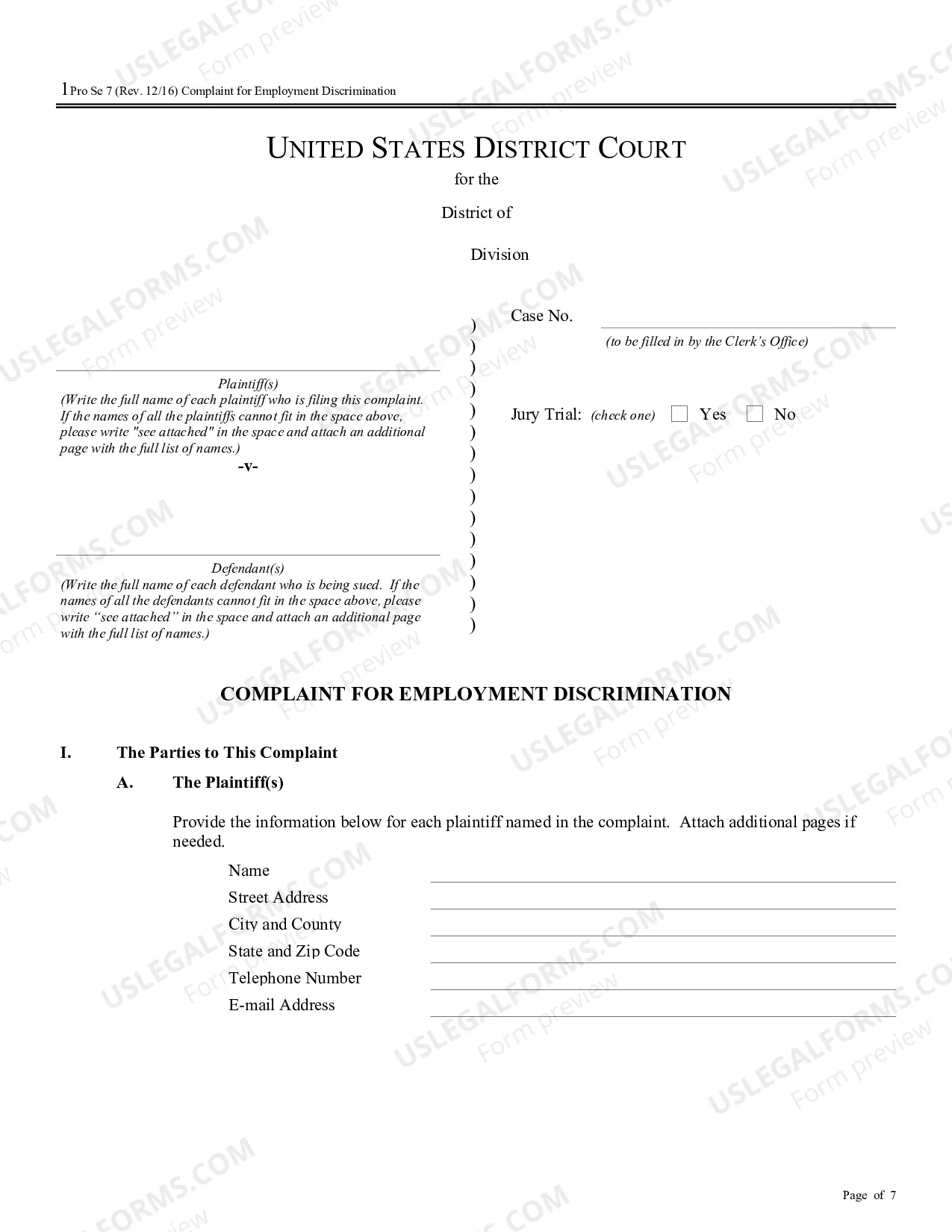
The Complaint For Employment or Workplace Discrimination and Sexual Harassment under Title VII of the Civil Rights Act is a legal document used by an employee (the plaintiff) to formally allege that their employer has engaged in discriminatory practices and sexual harassment. This form allows the plaintiff to seek compensation for damages, including punitive damages and attorney fees. It is essential for individuals who have faced workplace discrimination or harassment to understand their rights and the legal tools available to them.
Form components explained
- Identification of the court where the complaint is filed.
- Details about the plaintiff, including name and residence.
- Information about the defendants, including employer details.
- Allegations of employment discrimination and sexual harassment.
- Documentation of prior actions taken, such as EEOC charges and the Right to Sue letter.
- The request for damages, including actual and punitive damages.




Situations where this form applies
You should use this form if you believe you have been a victim of employment discrimination or sexual harassment based on your race, color, religion, sex, or national origin. This form is appropriate when you have already filed a charge with the Equal Employment Opportunity Commission (EEOC) and have received a Right to Sue letter, indicating you have the legal grounds to proceed with a lawsuit against your employer.
Who should use this form
- Individuals who have experienced workplace discrimination or sexual harassment.
- Employees who have filed a complaint with the EEOC and received a Right to Sue letter.
- Those seeking to recover damages, including lost wages and emotional distress, due to unlawful actions by their employer.
How to complete this form
- Identify the court and division where the complaint will be filed.
- Complete the plaintiff's details, including name, address, and residency.
- Fill in the names and details of the defendants, including their registered agent if applicable.
- Clearly state the allegations of discrimination and harassment, referencing the attached EEOC documents.
- Outline the damages sought, specifying both actual and punitive damages.
- Sign and date the complaint, ensuring all required fields are completed properly.
Is notarization required?
In most cases, this form does not require notarization. However, some jurisdictions or signing circumstances might. US Legal Forms offers online notarization powered by Notarize, accessible 24/7 for a quick, remote process.
Get your form ready online
Our built-in tools help you complete, sign, share, and store your documents in one place.
Make edits, fill in missing information, and update formatting in US Legal Forms—just like you would in MS Word.
Download a copy, print it, send it by email, or mail it via USPS—whatever works best for your next step.
Sign and collect signatures with our SignNow integration. Send to multiple recipients, set reminders, and more. Go Premium to unlock E-Sign.
If this form requires notarization, complete it online through a secure video call—no need to meet a notary in person or wait for an appointment.
We protect your documents and personal data by following strict security and privacy standards.

Make edits, fill in missing information, and update formatting in US Legal Forms—just like you would in MS Word.

Download a copy, print it, send it by email, or mail it via USPS—whatever works best for your next step.

Sign and collect signatures with our SignNow integration. Send to multiple recipients, set reminders, and more. Go Premium to unlock E-Sign.

If this form requires notarization, complete it online through a secure video call—no need to meet a notary in person or wait for an appointment.

We protect your documents and personal data by following strict security and privacy standards.
Typical mistakes to avoid
- Failing to include all relevant defendants in the complaint.
- Not attaching the required EEOC documents, such as the Right to Sue letter.
- Overlooking local rules that may require specific formatting or language.
- Allowing for errors in basic information such as names or addresses.
Advantages of online completion
- Convenience of downloading and completing the form at your own pace.
- Editability allows for quick changes and customizations as needed.
- Access to forms drafted by licensed attorneys, ensuring legal compliance and reducing the risk of errors.
Looking for another form?


Form popularity
FAQ
Currently, EEOC has enforcement responsibility for the following federal employment discrimination laws: Title VII of the Civil Rights Act of 1964 (Title VII), which makes it illegal to discriminate against a person on the basis of race, color, religion, sex, or national origin.
Title VII prohibits employment discrimination based on race, color, religion, sex and national origin. The Civil Rights Act of 1991 (Pub. L.
You can file a formal job discrimination complaint with the EEOC whenever you believe you are: Being treated unfairly on the job because of your race, color, religion, sex (including pregnancy, gender identity, and sexual orientation), national origin, disability, age (age 40 or older) or genetic information; or.
A job discrimination complaint may be filed by mail or in person at the nearest EEOC office. You can find the closest EEOC office by calling the EEOC at 1-800-669-4000, or by going to the EEOC's Field Office List and Jurisdiction Map and selecting the office closest to you.
You can file a formal job discrimination complaint with the EEOC whenever you believe you are: Being treated unfairly on the job because of your race, color, religion, sex (including pregnancy, gender identity, and sexual orientation), national origin, disability, age (age 40 or older) or genetic information; or.
Charges may be filed in person, by mail or by telephone by contacting the nearest EEOC office. If there is not an EEOC office in the immediate area, call toll free 800-669-4000 or 800-669-6820 ( TDD ) for more information.
Under the laws enforced by EEOC, it is illegal to discriminate against someone (applicant or employee) because of that person's race, color, religion, sex (including gender identity, sexual orientation, and pregnancy), national origin, age (40 or older), disability or genetic information.
Answer. You don't have to hire a lawyer to file a charge of harassment with the Equal Employment Opportunity Commission (EEOC).If you want to file a lawsuit against your employer for harassment, you have to file a charge with the EEOC or a state agency first.
You also may file a complaint with the EEOC, at www.eeoc.gov, or your local human rights agency. Note that you must file your charge as early as 180 days after the last act of harassment against you, so do not delay. You do not need an attorney to file a charge.