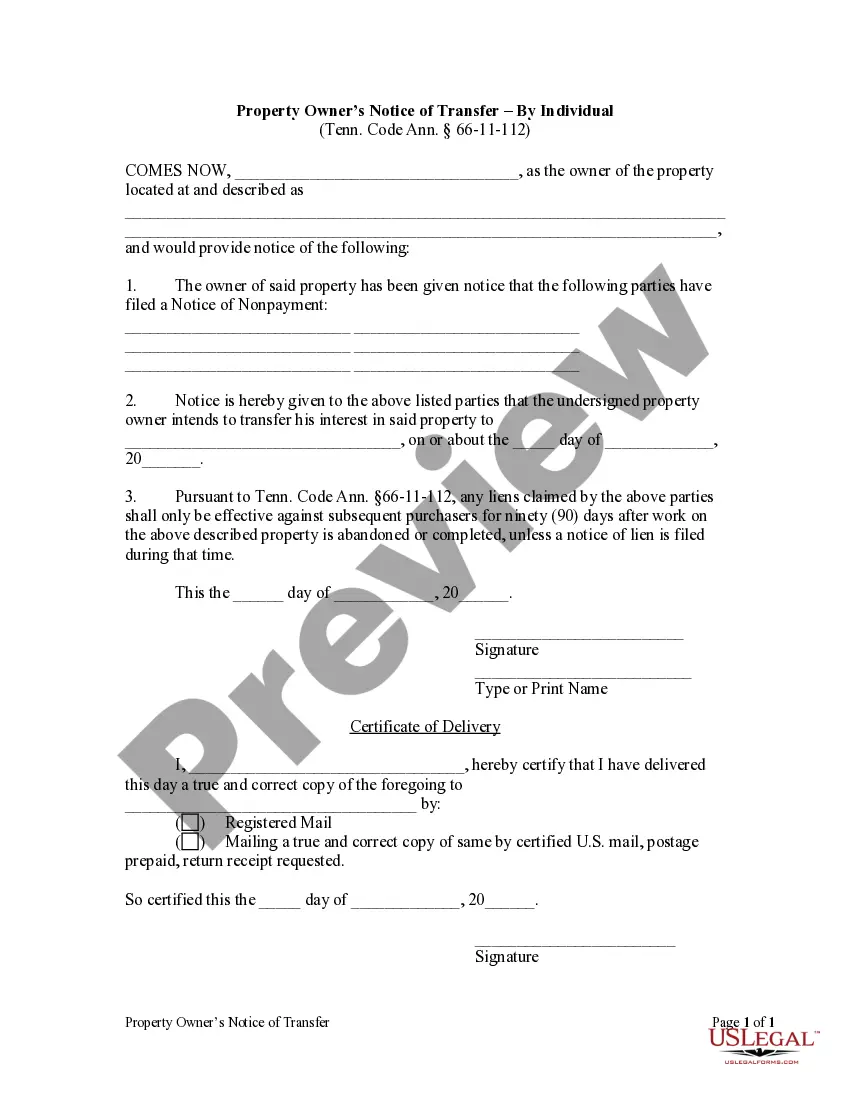
Tennessee Owner's Notice of Transfer - Individual
About this form
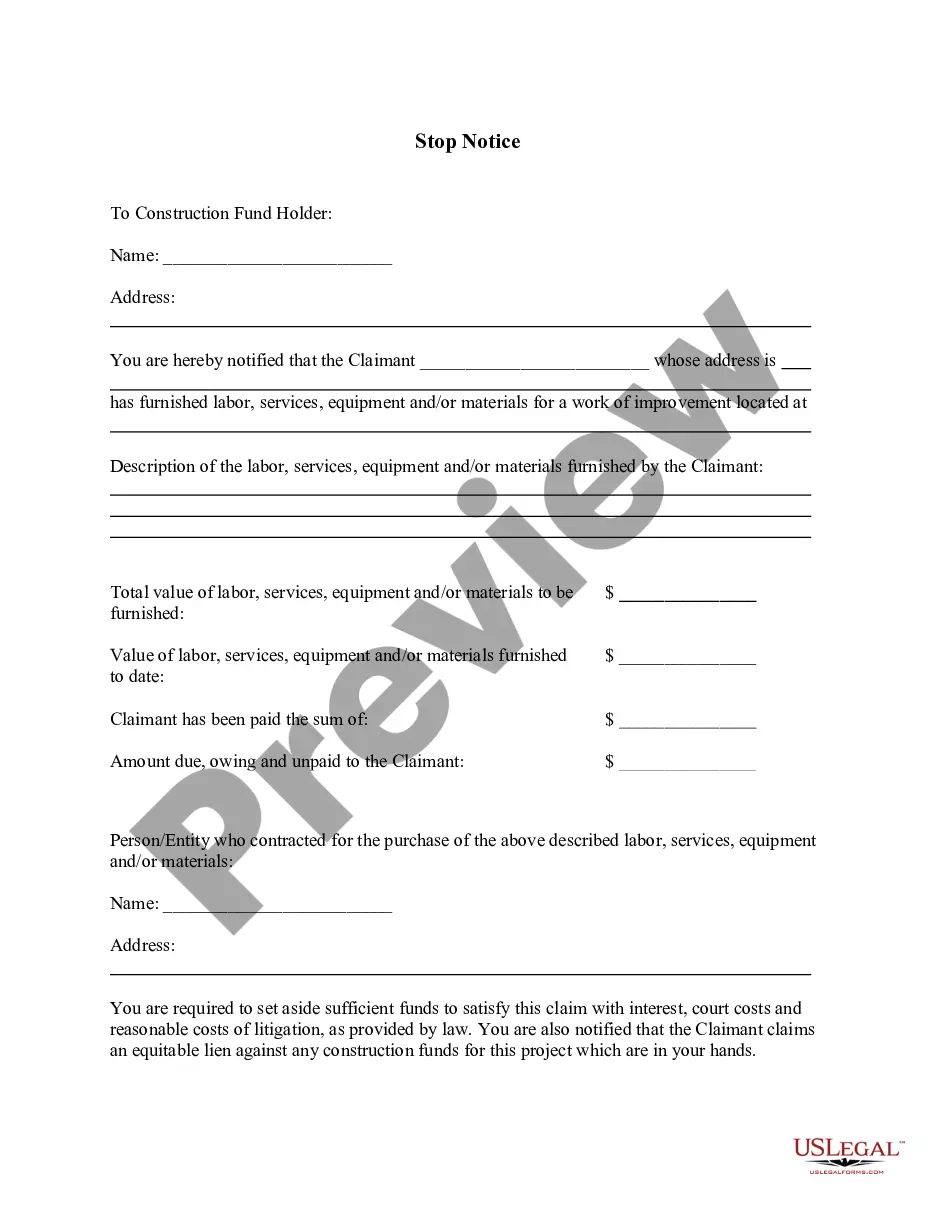
The Owner's Notice of Transfer - Individual is a legal document that informs lien claimants of a property owner's intent to transfer interest in their property. This form helps protect the integrity of any existing liens by notifying impacted parties, ensuring they're aware of upcoming changes that could affect their claims. Unlike other notification forms, this one is specifically intended for individual property owners transferring their interests and outlines the necessity of notifying lien holders within a designated time frame.
Key parts of this document
- Property owner's details: Information about the individual transferring the property.
- Property description: A detailed description of the property subject to transfer.
- Notice of nonpayment: List of parties who have filed notice of nonpayment regarding the property.
- Transfer details: Date and recipient of the ownership transfer.
- Lien information: Clarification on the effectiveness of any liens after the property transfer.

When to use this document
This form should be used when a property owner intends to transfer their interest in a property and needs to notify any lien claimants. It is particularly important when there are existing claims of nonpayment from contractors or suppliers related to the property. Filing this notice within the required timeframe protects both the property owner and the lien claimants from potential disputes post-transfer.
Who this form is for
- Individual property owners planning to sell or transfer their property.
- Real estate investors who are managing properties with existing liens.
- Contractors or suppliers who have filed a notice of nonpayment against the property.
How to complete this form
- Identify the property owner: Enter the full name of the individual transferring the property.
- Enter property details: Describe the property including location and any identifying features.
- List lien claimants: Provide details of all parties who have filed a notice of nonpayment.
- Specify the transfer information: Indicate the name of the person or entity receiving the property and the intended date of transfer.
- Sign and date the document: The property owner must sign and date the notice to validate it.
Notarization guidance
This form does not typically require notarization unless specified by local law. However, having it notarized can add an additional layer of authenticity and may be preferred in certain transactions.
Get your form ready online
Our built-in tools help you complete, sign, share, and store your documents in one place.
Make edits, fill in missing information, and update formatting in US Legal Forms—just like you would in MS Word.
Download a copy, print it, send it by email, or mail it via USPS—whatever works best for your next step.
Sign and collect signatures with our SignNow integration. Send to multiple recipients, set reminders, and more. Go Premium to unlock E-Sign.
If this form requires notarization, complete it online through a secure video call—no need to meet a notary in person or wait for an appointment.
We protect your documents and personal data by following strict security and privacy standards.

Make edits, fill in missing information, and update formatting in US Legal Forms—just like you would in MS Word.

Download a copy, print it, send it by email, or mail it via USPS—whatever works best for your next step.

Sign and collect signatures with our SignNow integration. Send to multiple recipients, set reminders, and more. Go Premium to unlock E-Sign.

If this form requires notarization, complete it online through a secure video call—no need to meet a notary in person or wait for an appointment.

We protect your documents and personal data by following strict security and privacy standards.
Mistakes to watch out for
- Failing to notify all lien holders: Ensure all parties listed have been properly notified.
- Missing deadlines: Submit the notice within the required timeframe to maintain its validity.
- Inaccurate property descriptions: Provide clear and correct property details to avoid future disputes.
Benefits of using this form online
- Immediate access: Download and complete the form at your convenience.
- Editability: Easily fill in and modify details as needed before finalizing.
- Reliability: Forms are created and reviewed by licensed attorneys to ensure legal compliance.
Main things to remember
- Use this form to notify lien claimants of your intent to transfer property ownership.
- Ensure accuracy and completeness to avoid future legal issues.
- Understand the importance of timely notification to maintain the validity of any liens.
Looking for another form?




Form popularity
FAQ
Get a properly assigned title and Odometer Disclosure Statement from the previous owner. Bring the paperwork to your local county clerk's office. Provide proof of ID and residency. A copy of your current registration if you are transferring current license plates to the new car.
In order to convey any real property or an interest in property in Tennessee, the deed must be in writing, acknowledged by the grantor, and registered in the county where the property is located. The Annotated Code of Tennessee allows for the transfer of real property through the usage of a variety of deeds.
Retrieve your original deed. Get the appropriate deed form. Draft the deed. Sign the deed before a notary. Record the deed with the county recorder. Obtain the new original deed.
It is possible to transfer the ownership of a property to a family member as a gift, meaning no money exchanges hands. This differs to a Transfer of Equity, where the owner remains on the title and simply adds someone else to it.
In order to convey any real property or an interest in property in Tennessee, the deed must be in writing, acknowledged by the grantor, and registered in the county where the property is located. The Annotated Code of Tennessee allows for the transfer of real property through the usage of a variety of deeds.
Tennessee deed forms convey interest in property from one party (the Grantor) to another (the Grantee). The documents can be prepared by anyone as long as the required information is written in the deed as outlined in § 66-5-103.
Tennessee does not allow real estate to be transferred with transfer-on-death deeds.
Two of the most common ways to transfer property in a divorce are through an interspousal transfer deed or quitclaim deed. When spouses own property together, but then one spouse executes an interspousal transfer or a quitclaim deed, this is known as transmutation.
Both a certificate of title and a deed are written documents that are used to provide proof of ownership.While the certificate of title is an opinion of status and doesn't guarantee ownership, the deed is a document used when there is a transfer of property from a seller to a buyer.