South Dakota Final Notice of Forfeiture and Request to Vacate Property under Contract for Deed
What this document covers
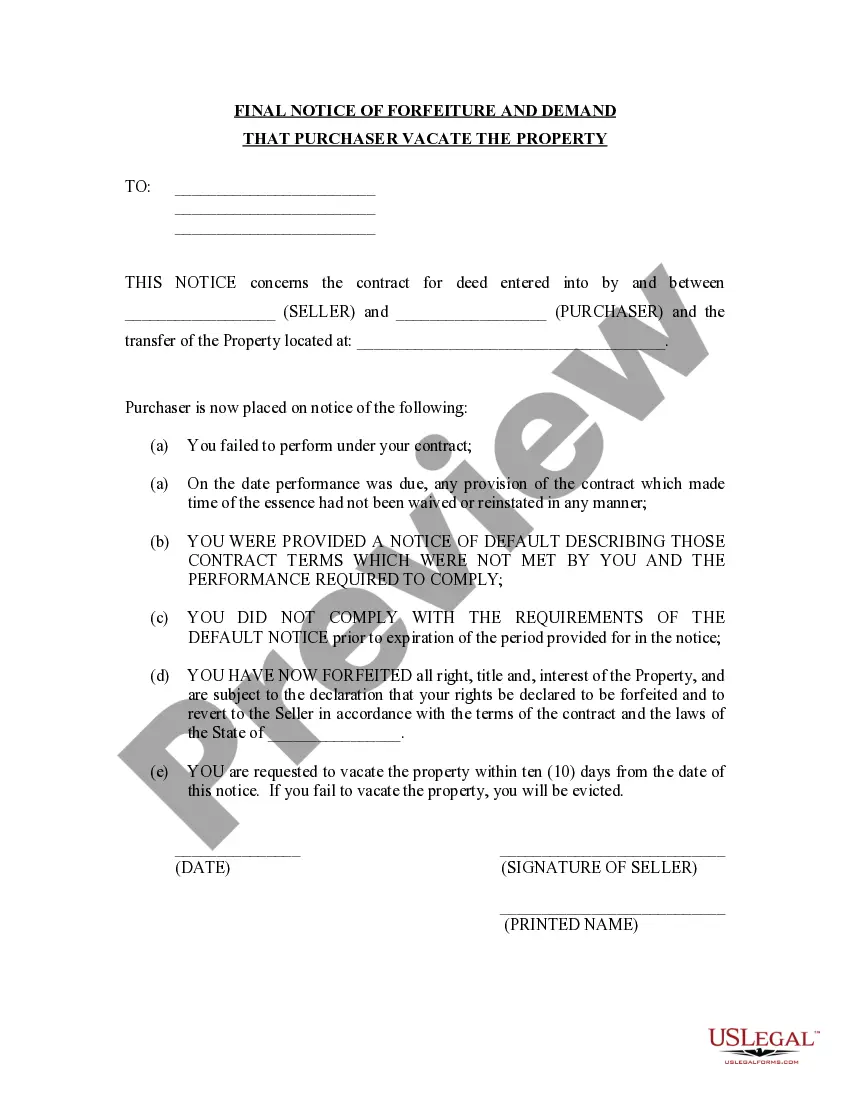
The Final Notice of Forfeiture and Request to Vacate Property under Contract for Deed is a legal document that officially informs the buyer that the seller has chosen to terminate the contract for deed due to non-compliance with its terms. Unlike other notices, this document indicates that all past payments are forfeited and outlines the consequences of continuing to occupy the property, which may include legal action by the seller.
Main sections of this form
- Notification of contract termination: Clearly states that the contract for deed is canceled.
- Forfeiture of payments: Indicates that all past payments made by the purchaser are now forfeited.
- Consequences of occupancy: Details the potential legal actions that may be taken if the purchaser remains on the property.
- Confirmation of prior notices: Acknowledges that earlier default notices have been issued and that compliance was not met.
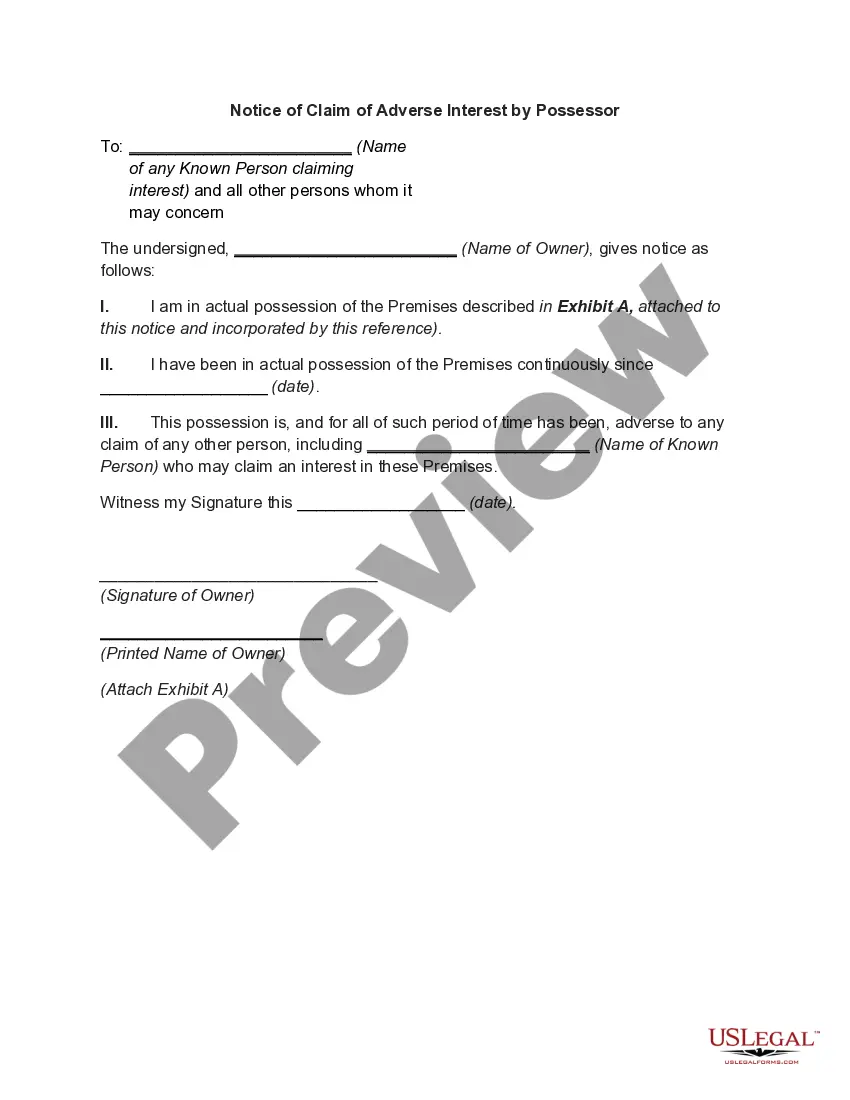
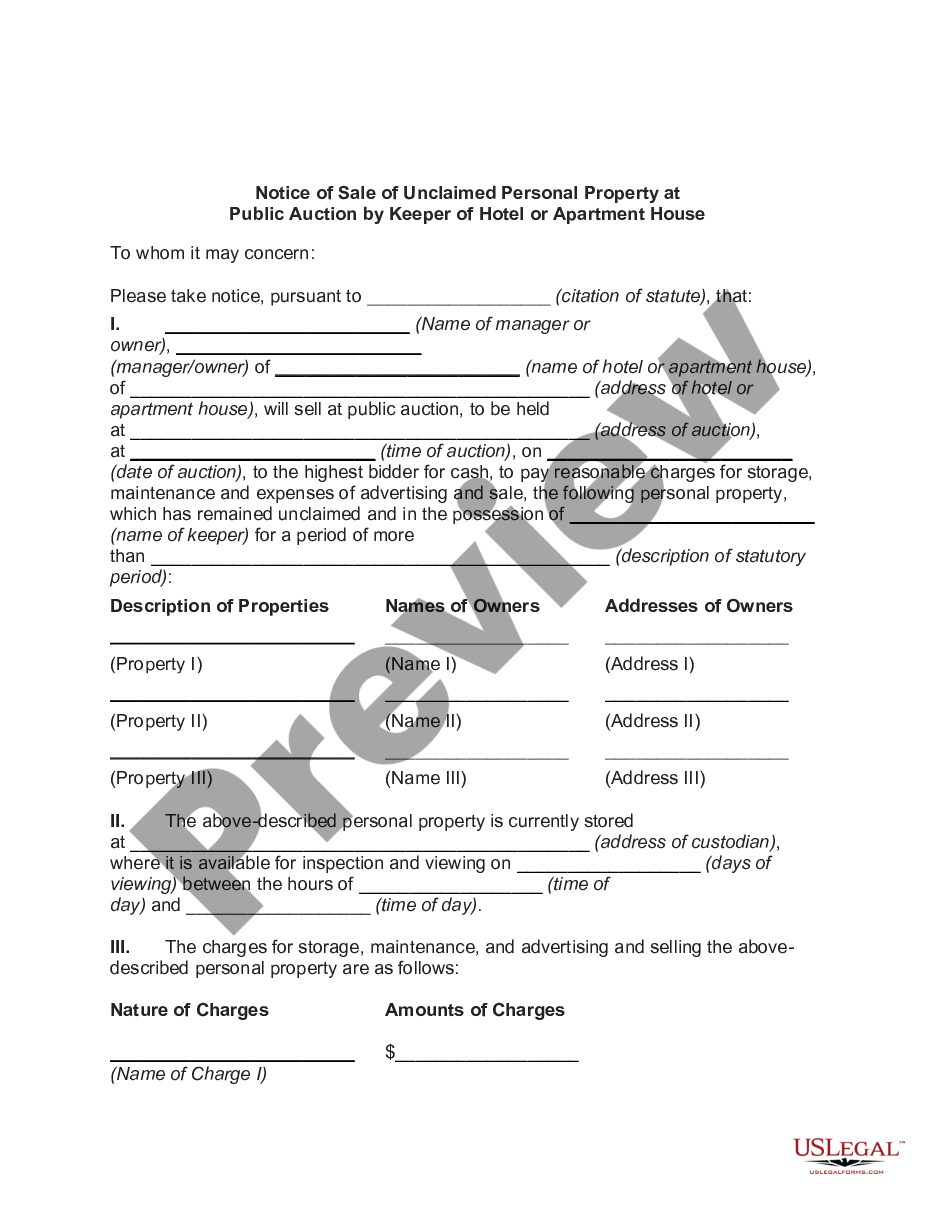
Common use cases
This form should be used when a seller has provided multiple notices of default to a buyer under a contract for deed and the buyer has failed to comply with the terms outlined in those notices. It signifies the last step before legal action, ensuring the buyer is aware of their obligation to vacate the property due to the forfeiture of the contract.
Who should use this form
- Sellers of property under a contract for deed who need to terminate the agreement.
- Buyers who have received prior notices of default and are at risk of forfeiture of their payments.
- Legal representatives assisting sellers in enforcing the terms of the contract for deed.
How to prepare this document
- Identify the parties: Enter the names of the seller and buyer involved in the contract.
- Specify the property: Provide the address or legal description of the property under the contract for deed.
- Reference prior notices: Include details of previous notices of default that were sent to the buyer.
- Sign and date: Ensure that the seller signs and dates the notice to make it legally binding.
Notarization requirements for this form
To make this form legally binding, it must be notarized. Our online notarization service, powered by Notarize, lets you verify and sign documents remotely through an encrypted video session.
Get your form ready online
Our built-in tools help you complete, sign, share, and store your documents in one place.
Make edits, fill in missing information, and update formatting in US Legal Forms—just like you would in MS Word.
Download a copy, print it, send it by email, or mail it via USPS—whatever works best for your next step.
Sign and collect signatures with our SignNow integration. Send to multiple recipients, set reminders, and more. Go Premium to unlock E-Sign.
If this form requires notarization, complete it online through a secure video call—no need to meet a notary in person or wait for an appointment.
We protect your documents and personal data by following strict security and privacy standards.

Make edits, fill in missing information, and update formatting in US Legal Forms—just like you would in MS Word.

Download a copy, print it, send it by email, or mail it via USPS—whatever works best for your next step.

Sign and collect signatures with our SignNow integration. Send to multiple recipients, set reminders, and more. Go Premium to unlock E-Sign.

If this form requires notarization, complete it online through a secure video call—no need to meet a notary in person or wait for an appointment.

We protect your documents and personal data by following strict security and privacy standards.
Avoid these common issues
- Failing to provide sufficient notice before sending this final notice.
- Not including all required details about the property or the prior notices.
- Omitting signatures or dates, which may invalidate the form.
Why use this form online
- Convenient access: Download and complete forms at your own pace.
- Editability: Modify the form to fit your specific situation without the hassle of printing multiple drafts.
- Reliability: Use professionally drafted legal templates that are designed for compliance.
Key takeaways
- The Final Notice of Forfeiture is essential for sellers wanting to cancel a contract for deed.
- Properly completing the form can help ensure legal compliance and facilitate eviction if necessary.
- Understanding local laws is critical before using this form.
Looking for another form?
Form popularity
FAQ
While a buyer can legally back out of a home contract, there can be consequences for doing so. For example, you can lose your earnest money, which could amount to thousands of dollars or more. That is unless your reason for pulling out of the deal is stipulated in your contract.
A disadvantage to the seller is that a contract for deed is frequently characterized by a low down payment and the purchase price is paid in installments instead of one lump sum.The legal fees and time frame for this process will be more extensive than a standard Power of Sale foreclosure.
The buyer should record the contract for deed with the county recorder where the land is located and does so normally within four months after the contract is signed, though the time may vary depending on state law.
Monetary Damages If the Seller decides to breach the contract and keep their home, they may do so, but the court may order the Buyer receive money for the resulting breach. Generally, the money owed to Buyer may include reimbursing the Buyer with: The buyer's temporary housing costs.
If a seller defaults, he must return all deposits, plus added reasonable expenses, to the buyer. The other party may also seek to compel the erring party to complete the deal under specific performance. From a buyer's point of view, it is advisable to get the sale agreement registered.
Contact the other party and ask whether they are willing to negotiate the cancellation of the contract. Offer the other party an incentive to cancel the contract for deed.
Step 1: Notice is Posted. Step 2: Complaint is Filed and Served. Step 3: Answer is Filed. Step 4: Court Hearing and Judgment. Step 5: Execution for Possession is Issued. Step 6: Possession of Property is Returned.
If you want out of a real estate contract and don't have any contingencies available, you can breach the contract.The seller could also decide to sue you for breach of contract. Some real estate contracts have a liquidated damages clause that states the maximum the seller can keep if the buyers breach the contract.
In the first instance, if your deed is not recorded, there is nothing in the public record to stop the seller from conveying the property to another person.The second situation could happen if your seller fails to pay his or her debts and the seller's creditors file liens or judgments against your property.