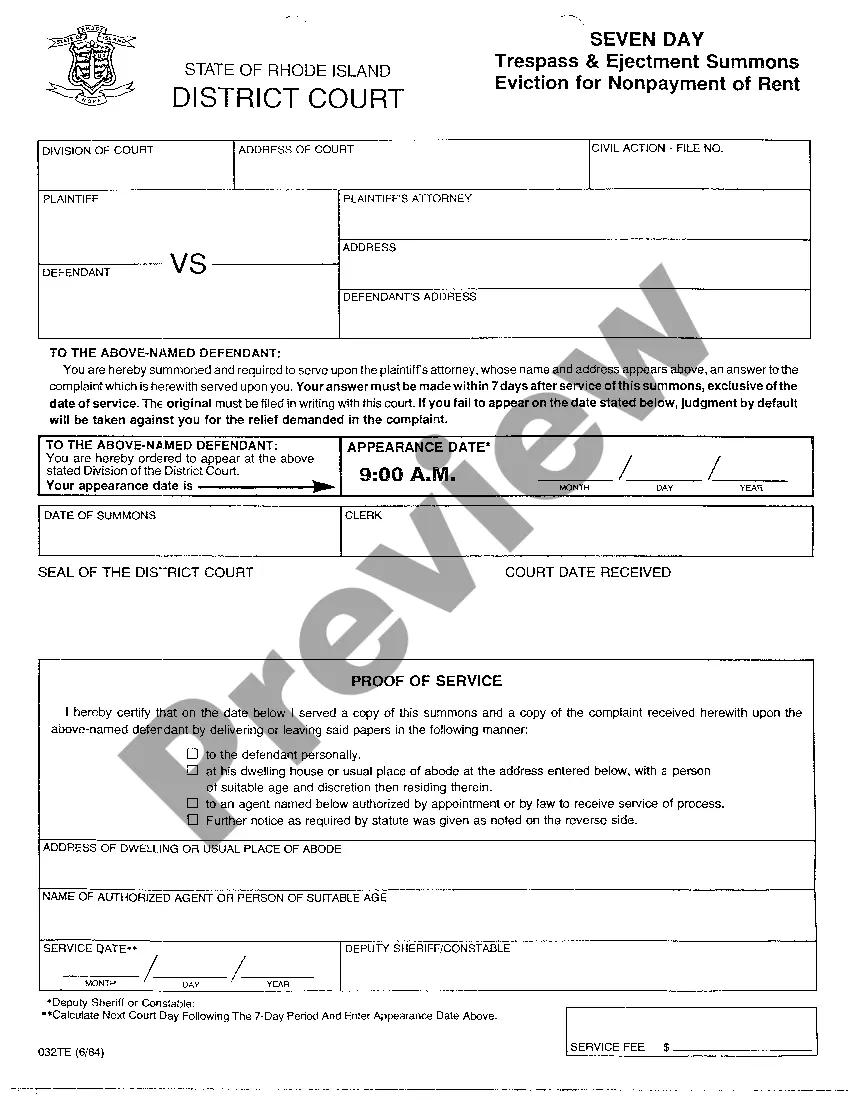
Rhode Island Seven (7) Day Trespass and Ejection Summons of Non-payment of Rent
About this form
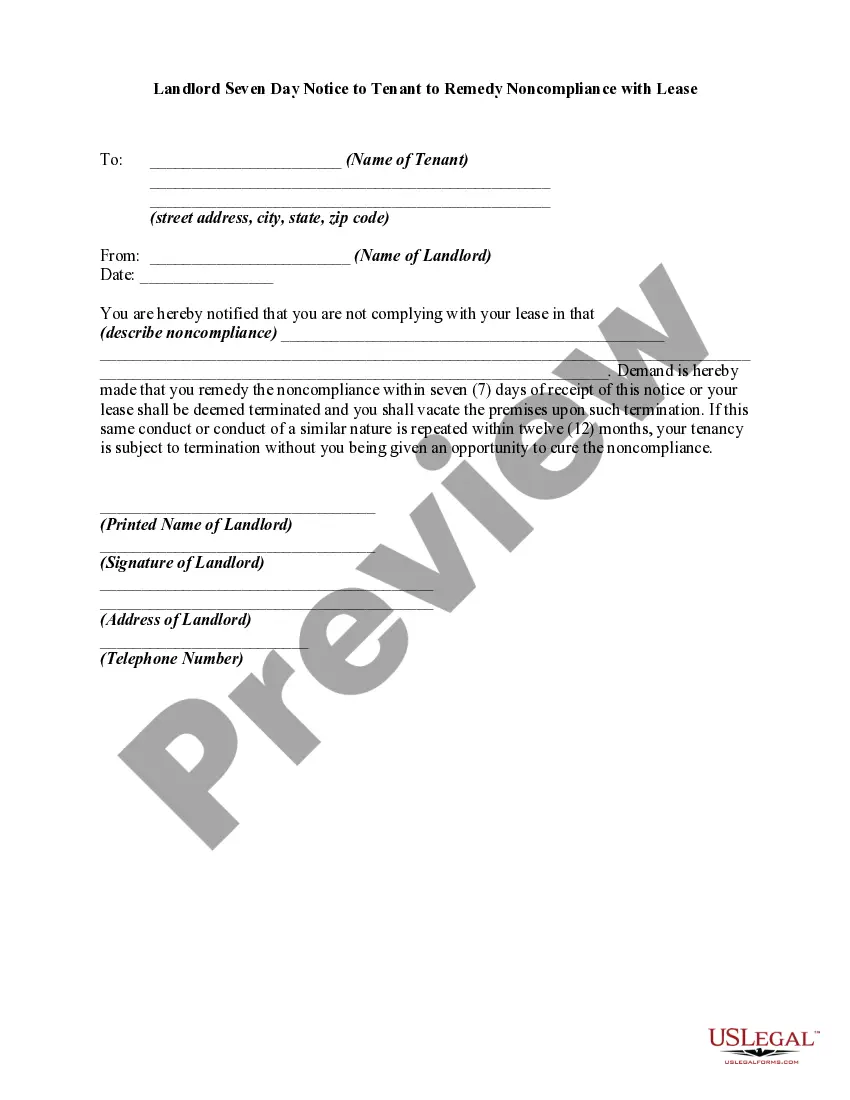
The Seven (7) Day Trespass and Ejection Summons of Non-payment of Rent is a legal document used by landlords to notify a non-residential tenant of an impending eviction action due to unpaid rent. This form serves as a formal summons and is distinct from other eviction notices by specifically addressing the grounds of non-payment. It initiates the eviction process while complying with relevant legal requirements.
What’s included in this form
- Parties involved: Identification of the landlord and the tenant.
- Property details: Describes the non-residential property subject to the eviction.
- Notice of default: Clearly states the reason for eviction as non-payment of rent.
- Summons details: Informs the tenant of their rights and obligations in response to the summons.
- Deadline for response: Specifies how many days the tenant has to respond to the summons.
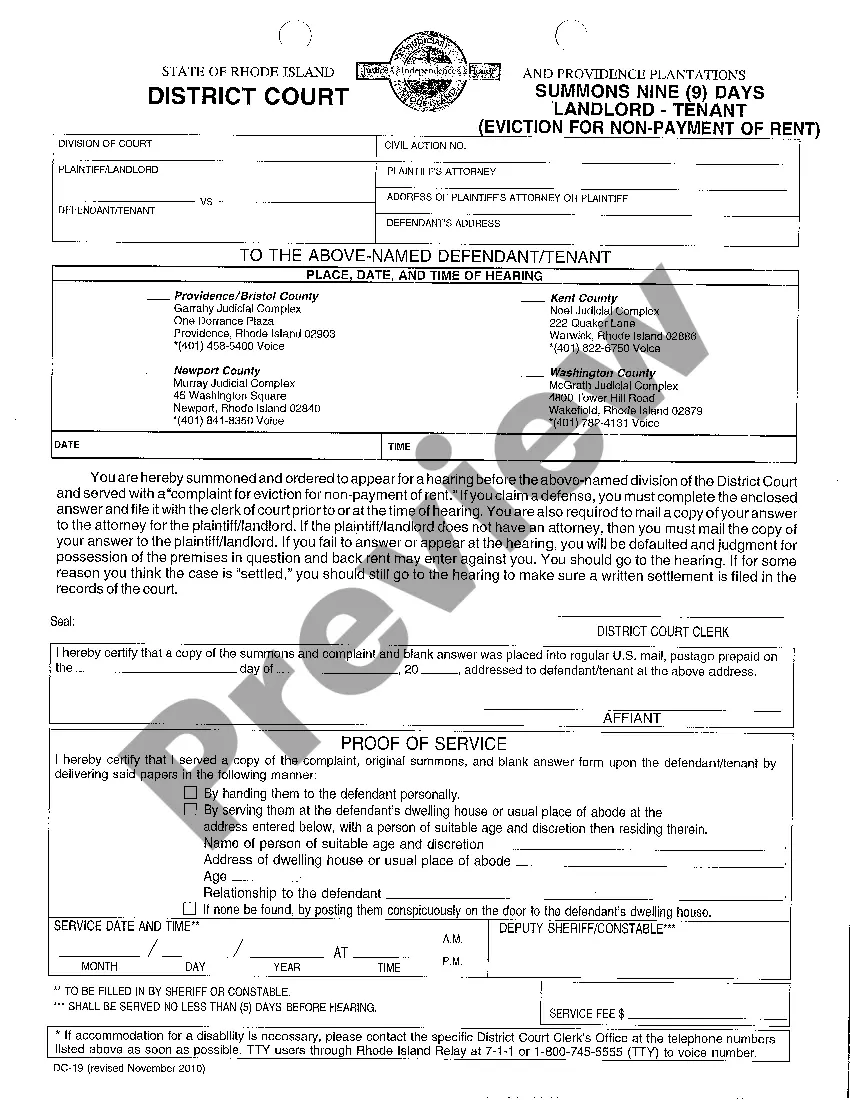
Situations where this form applies
This form is typically used when a non-residential tenant has failed to pay rent within the agreed timeframe. If you, as a landlord, have attempted to collect overdue rent and wish to take legal steps towards eviction, this form is essential. It is a formal way to notify the tenant and to ensure compliance with legal procedures necessary for eviction in cases of non-payment.
Who can use this document
Intended users:
- Landlords of non-residential properties seeking to evict tenants for non-payment of rent.
- Property managers overseeing rental agreements with tenants in commercial spaces.
- Legal representatives assisting landlords in eviction processes.
How to complete this form
Steps to complete the form:
- Identify the parties: Fill in the names and addresses of both the landlord and the tenant.
- Specify the property: Provide the address and description of the non-residential rental property.
- Enter the amounts due: Clearly outline the amount of rent that has not been paid.
- Detail the eviction notice: Indicate that the eviction is due to non-payment of rent and mention the deadline for the tenant's response.
- Sign and date the form: Ensure the landlord or their authorized representative signs and dates the document.
Notarization requirements for this form
This form does not typically require notarization unless specified by local law. It is always advisable to check your specific jurisdiction's requirements for additional validation needs when filing an eviction summons.
Get your form ready online
Our built-in tools help you complete, sign, share, and store your documents in one place.
Make edits, fill in missing information, and update formatting in US Legal Forms—just like you would in MS Word.
Download a copy, print it, send it by email, or mail it via USPS—whatever works best for your next step.
Sign and collect signatures with our SignNow integration. Send to multiple recipients, set reminders, and more. Go Premium to unlock E-Sign.
If this form requires notarization, complete it online through a secure video call—no need to meet a notary in person or wait for an appointment.
We protect your documents and personal data by following strict security and privacy standards.

Make edits, fill in missing information, and update formatting in US Legal Forms—just like you would in MS Word.

Download a copy, print it, send it by email, or mail it via USPS—whatever works best for your next step.

Sign and collect signatures with our SignNow integration. Send to multiple recipients, set reminders, and more. Go Premium to unlock E-Sign.

If this form requires notarization, complete it online through a secure video call—no need to meet a notary in person or wait for an appointment.

We protect your documents and personal data by following strict security and privacy standards.
Common mistakes
Common mistakes to avoid:
- Failing to accurately identify both parties involved in the lease agreement.
- Not providing complete and correct property details.
- Omitting the specific amount of rent owed.
- Neglecting to observe the required notice period prior to eviction.
- Not signing the document before filing.
Why complete this form online
Benefits of using this form online:
- Easy access: Download and fill out the form from the comfort of your own home.
- Editability: Make adjustments as necessary before finalizing the document.
- Time-saving: Quickly create the document you need without extensive legal research.
- Reliability: Forms are drafted by licensed attorneys, ensuring compliance with legal standards.
Quick recap
Key takeaways:
- The Seven (7) Day Trespass and Ejection Summons is crucial for initiating eviction due to non-payment of rent.
- Accurate completion of the form is essential to avoid legal pitfalls.
- Understand and comply with local laws related to eviction procedures.
Looking for another form?
Form popularity
FAQ
The law includes an extension of the CDC moratorium on evictions. The CDC moratorium, which was set to expire on December 31 2020, will now be in effect through January 31 2021. The new law did not change any other terms of the moratorium.
Pursuant to RI law, to evict a month-to-month tenant, a landlord must send a 30 day notice to terminate the month to month tenancy. When the 30 day time period expires, then the landlord or the landlord's Rhode Island eviction lawyer may file a complaint for eviction in Providence District Court.
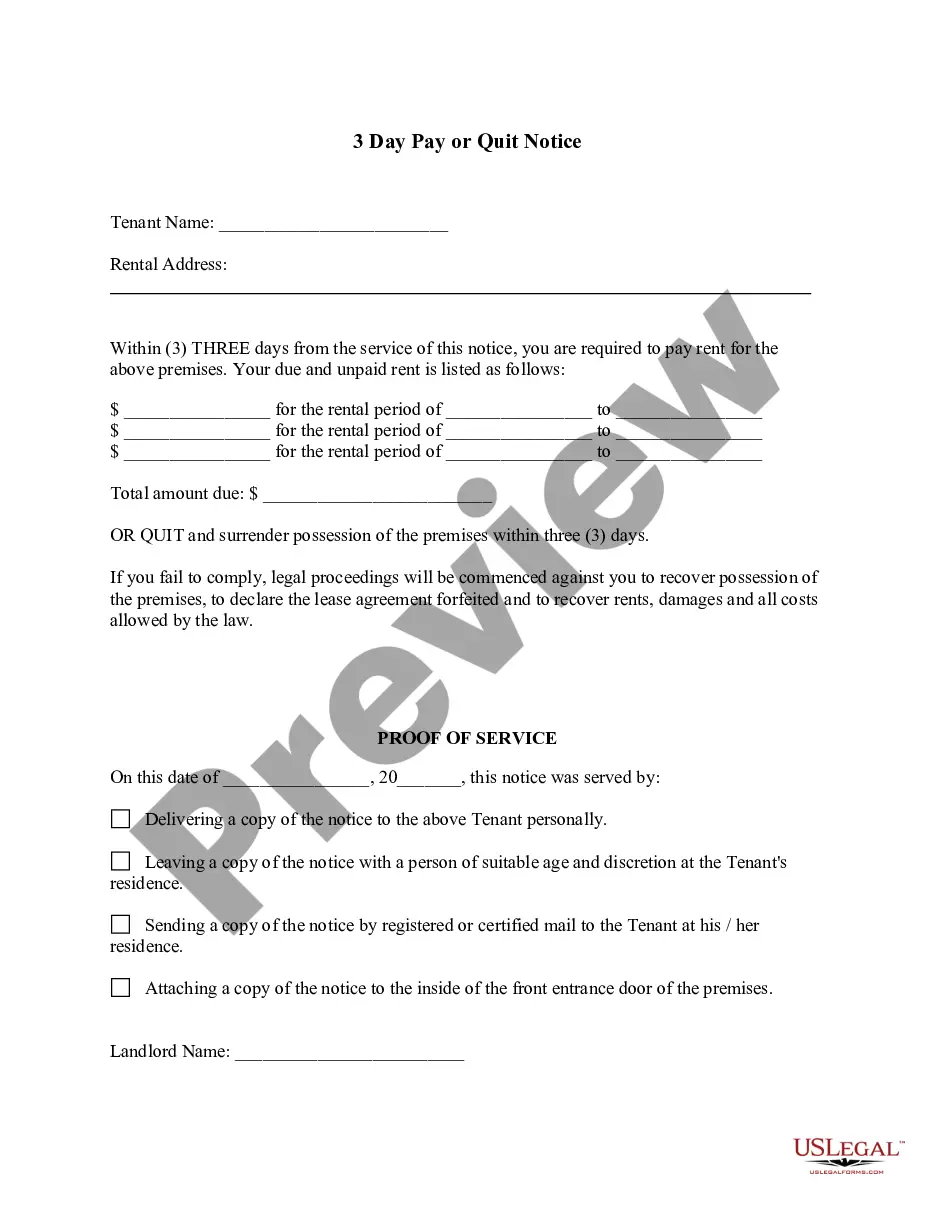
Send a 3-day notice to fix or quit. If the tenant doesn't follow through with a fix, visit your local courthouse and begin a filing for eviction. In some states, you can file to only evict the unauthorized tenant. In others, you'll have the option to evict your tenant as well as the unauthorized occupant.
Eviction can feel difficult and complicated, but it's part of the business of managing rental properties. If a tenant can't pay, you should remove them from your property. Sometimes, it's as simple as asking them to leave. Other times, you'll have to go through the formal eviction process.
A landlord cannot legally evict you without a court order, whether or not you have a lease.) How long does it take for a landlord to evict a tenant? A landlord can evict a tenant only by going through a formal eviction proceeding, which can take a few weeks from start to finish.
Be in writing. be signed and dated by you as the property manager, or by your client. be properly addressed to the tenant. give the day on which the residential tenancy agreement is terminated and by which the tenant is required to vacate. where appropriate, give the grounds or reason for the notice.
Evicting a tenant in Rhode Island can take around 1-4 months, depending on the reason for the eviction. If tenants file an appeal, the process can take longer (read more).
Tell Them The Problem & Consequences. Explain the reason that you want the tenant to go. Offer Them a Way Out. Let the tenant know that you are willing to give them a lump sum of cash in agreement for leaving the property. The Release.