Pennsylvania Bill of Sale for Conveyance of Horse - Horse Equine Forms
Overview of this form
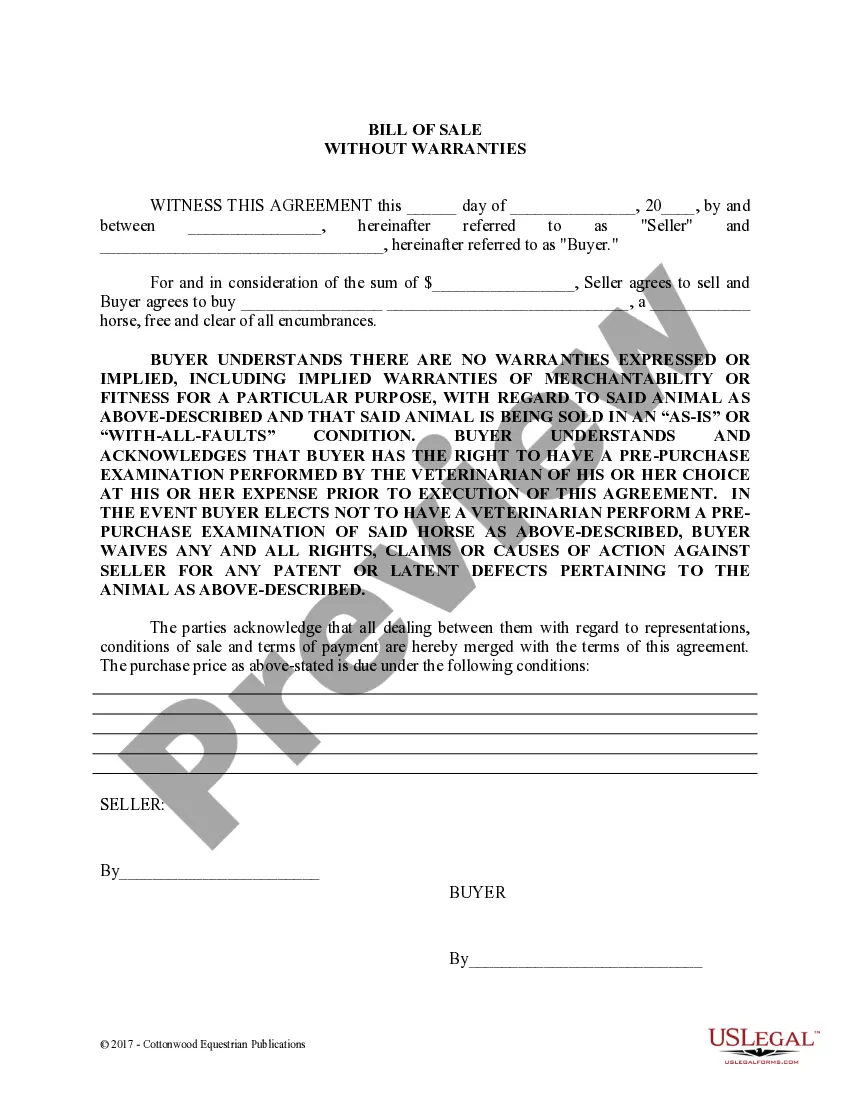
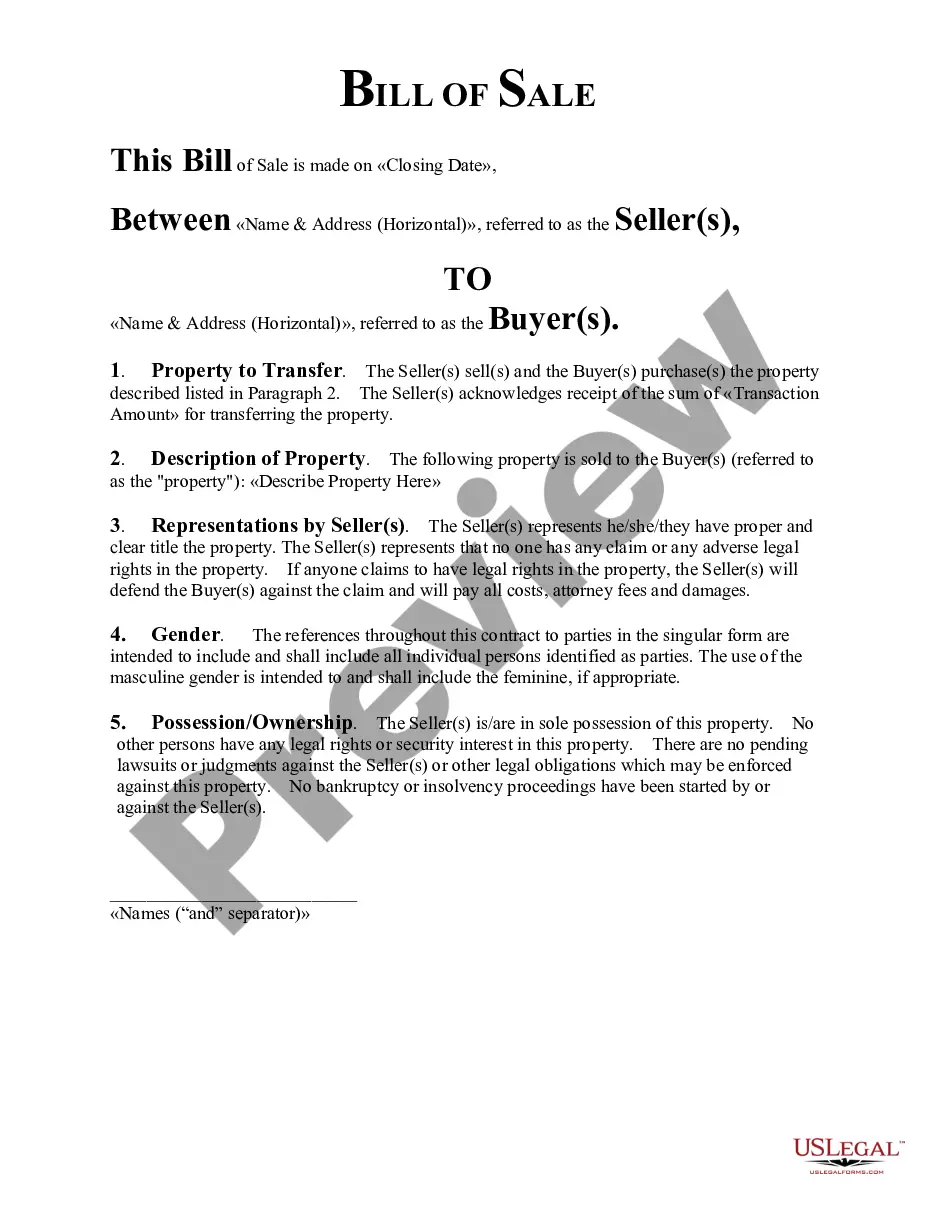
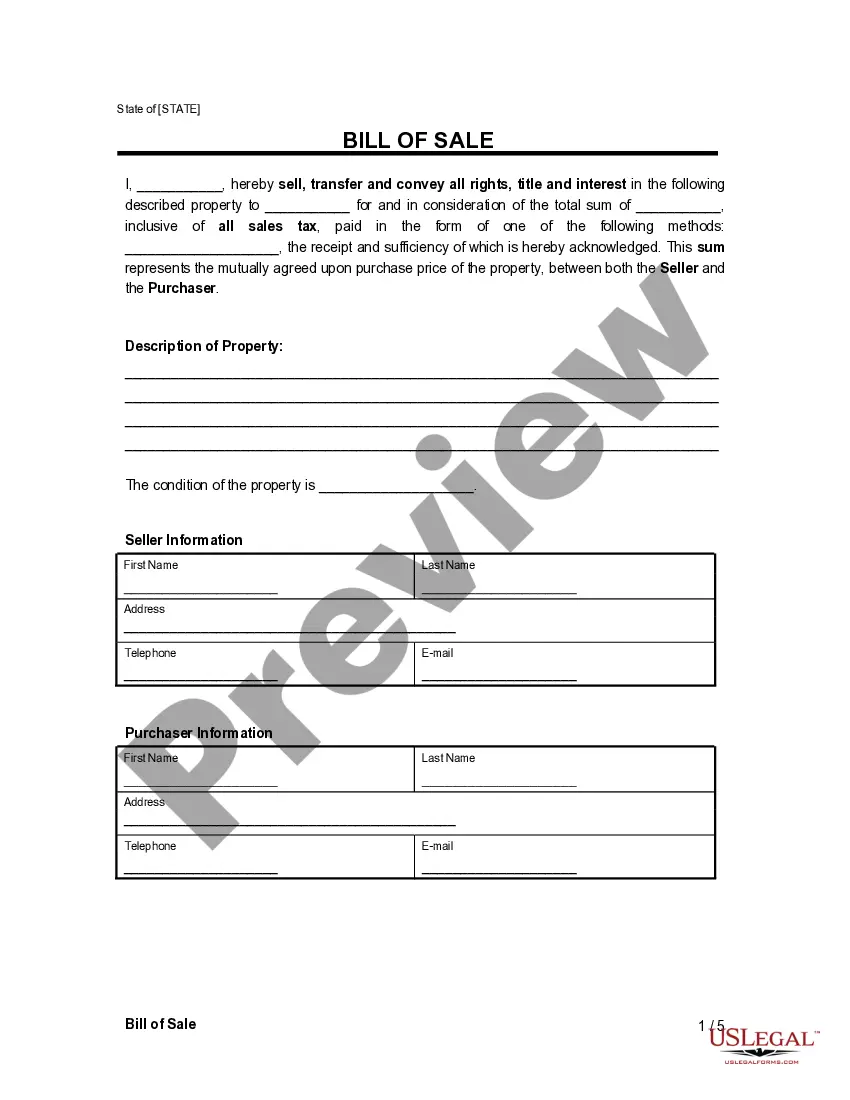
The Bill of Sale for Conveyance of Horse is a legal document that facilitates the sale of a horse from one party to another. This form specifies that the horse is being sold "as is," meaning that the seller provides no warranties regarding the horse's condition. This distinguishes it from other sales agreements which may include guarantees about the animal's health or quality.
What’s included in this form
- Identification of the seller and buyer, including names and addresses.
- Detail of the horse being sold, including breed and any identifying features.
- Purchase price agreed upon by both parties.
- Disclaimer of warranties, emphasizing the sale is "as is" with no implied conditions.
- Buyer's right to a veterinary pre-purchase examination before finalizing the sale.
- Signature lines for both the seller and buyer to validate the agreement.
When to use this document
This form is appropriate for situations where an individual wants to sell a horse without providing any guarantees about its condition. It is ideal for private sales between individuals or where both parties agree to the risks associated with buying a horse without warranties.
Who should use this form
- Individuals who are selling a horse and wish to clearly document the terms of the sale.
- Buyers who understand the risks of purchasing a horse without any warranties or guarantees.
- People in the equine community looking for a straightforward sales process.
How to prepare this document
- Identify the parties involved by entering the names and addresses of the seller and buyer.
- Provide a detailed description of the horse being sold, including breed and any distinguishing features.
- Specify the purchase price for the horse in the designated field.
- Read and verify the disclaimer about the no warranty condition and buyers' rights.
- Have both parties sign and date the form to finalise the sale.
Does this document require notarization?
This form does not typically require notarization unless specified by local law. However, notarization can provide additional credibility to the transaction.
Get your form ready online
Our built-in tools help you complete, sign, share, and store your documents in one place.
Make edits, fill in missing information, and update formatting in US Legal Forms—just like you would in MS Word.
Download a copy, print it, send it by email, or mail it via USPS—whatever works best for your next step.
Sign and collect signatures with our SignNow integration. Send to multiple recipients, set reminders, and more. Go Premium to unlock E-Sign.
If this form requires notarization, complete it online through a secure video call—no need to meet a notary in person or wait for an appointment.
We protect your documents and personal data by following strict security and privacy standards.

Make edits, fill in missing information, and update formatting in US Legal Forms—just like you would in MS Word.

Download a copy, print it, send it by email, or mail it via USPS—whatever works best for your next step.

Sign and collect signatures with our SignNow integration. Send to multiple recipients, set reminders, and more. Go Premium to unlock E-Sign.

If this form requires notarization, complete it online through a secure video call—no need to meet a notary in person or wait for an appointment.

We protect your documents and personal data by following strict security and privacy standards.
Mistakes to watch out for
- Failing to complete all necessary fields, leading to an incomplete agreement.
- Not specifying the horseâs details correctly, which can cause disputes later.
- Forgetting to have both parties sign the document, which is essential for validity.
Why complete this form online
- Convenient access to download the form instantly without needing to visit a lawyer.
- Editable template that can be customized to fit specific circumstances.
- Drafted by licensed attorneys to ensure legal accuracy and reliability.
Legal use & context
- The Bill of Sale serves as proof of ownership transfer in case of future disputes.
- It outlines responsibilities and rights of both parties, ensuring clarity in the sale transaction.
- This form helps in documenting the horse's sale history, which may be beneficial for future resale or registration purposes.
What to keep in mind
- The Bill of Sale for Conveyance of Horse is essential for selling a horse without warranties.
- Ensure all parties understand and acknowledge the "as-is" condition of the horse.
- Documenting the sale protects both buyer and seller by clarifying terms and responsibilities.
Looking for another form?
Form popularity
FAQ
Date of the Sale. Seller's Name & Address. Buyer's Name & Address. Description of Livestock. Number. Color. Kind. Brand. Weight. Health. Vaccinations. Condition. Any other relevant information.
In Pennsylvania, it is not required to have a bill of sale notarized since it is primarily used as a personal record to formerly memorialize a sale of an item.
A bill of sale is the most basic of documents.A bill of sale may also be necessary to prove title to the horse in order to obtain a passport for competition. An agreement of purchase and sale with a form of warranty is found in Appendix (C).
Step 1 Date and Parties. Enter the date in which the document is being created. Step 2 Horse Description. Horse's Name (if named) Step 3 Purchase Price Information. Step 4 Security Deposit. Step 5 Signatures. Step 6 Acknowledgement of Notary Public.
The date of the sale. A description of the car, including its: Year, make and model. The selling price of the car. If the car is a gift or partial gift, you should still create a bill of sale. Warranty information. The full names, addresses and signatures of the buyer and seller.
Name and address of the seller. Name and address of the buyer. Date& time of the purchase. The agreed price for the furniture. The location where the purchase is taking place. Form of payment (is it cash, check, credit card or debit card)
Can a Bill of Sale Be Handwritten? A bill of sale is a legal document that verifies you have sold your car and provides basic information about the vehicle or any other item and the terms of the sale.As, with any legal written document a bill of sale can be handwritten.
Given that horses have clearly been established as 'goods' under the law, the CLRA would clearly apply to the purchase of a horse in California. The CLRA specifically sets forth numerous practices that are deemed unlawful methods of competition, unfair or deceptive acts from which a consumer may seek protection.