Oregon Warning of Default on Residential Lease
Understanding this form
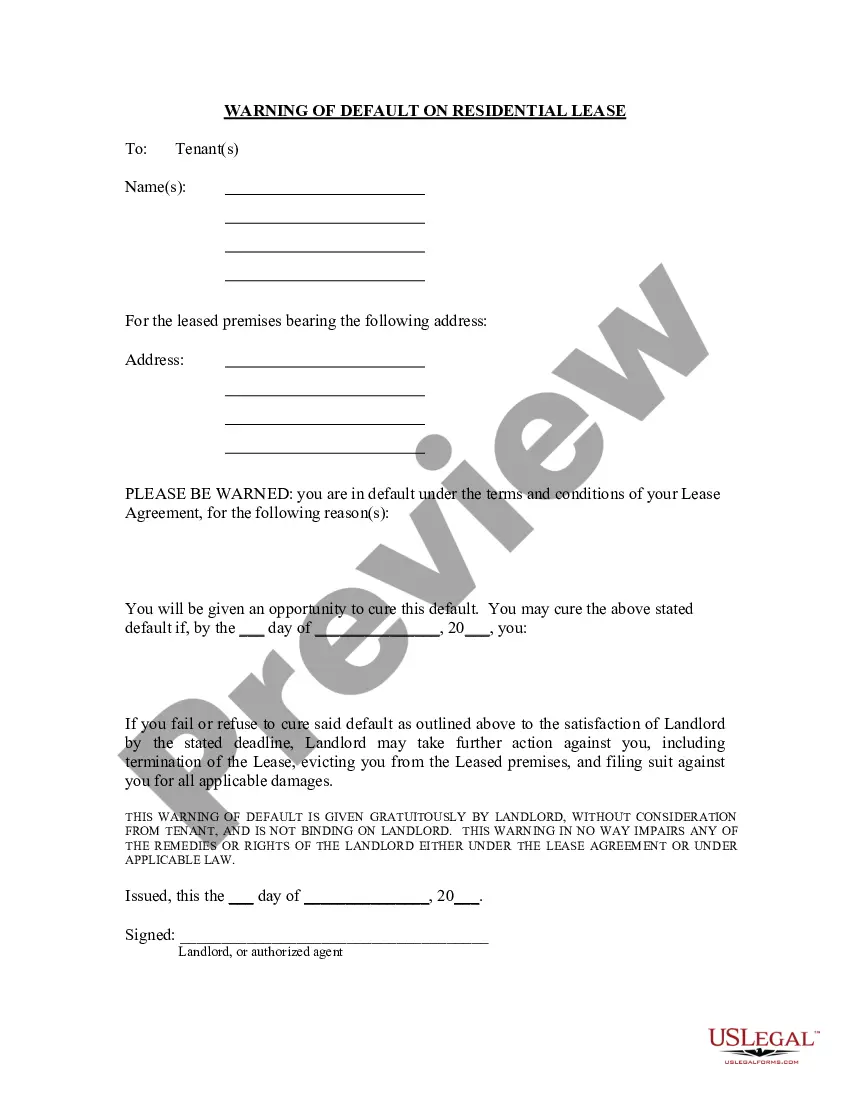
The Warning of Default on Residential Lease is a formal notice from a landlord to a tenant indicating concerns about potential default under a lease agreement. This document serves to address specific issues that may need remedying, providing the tenant with an opportunity to resolve these problems before facing legal consequences. Unlike other forms, this document specifically focuses on notifying tenants about defaults related to their residency, fostering communication and resolution before escalating matters further.
Main sections of this form
- Date of notice issuance.
- Signature line for the landlord or authorized agent.
- Statement of gratuitous nature of the warning.
- Clarification that the notice is not binding on the landlord.
- Affirmation of the landlord's rights under the lease agreement.



When to use this form
This form should be used when a landlord identifies issues that may constitute a default by the tenant under a residential lease. Common situations include late rent payments, failure to maintain the property, or other lease violations. By providing this warning, landlords can formally communicate their concerns and give tenants the chance to rectify the problems before proceeding with further legal action.
Who should use this form
- Residential landlords seeking to communicate lease violations to tenants.
- Property managers acting on behalf of landlords.
- Landlords who want to ensure compliance before initiating eviction proceedings.
Completing this form step by step
- Enter the date the warning is being issued.
- Clearly state the specific lease provisions being violated by the tenant.
- Fill in the tenant's name and address as listed in the lease agreement.
- Include any required remedies the tenant must take to avoid default.
- Ensure the landlord or authorized agent signs the document.
Notarization guidance
This form does not typically require notarization unless specified by local law. Always check your local regulations for any additional requirements regarding residential lease notices.
Get your form ready online
Our built-in tools help you complete, sign, share, and store your documents in one place.
Make edits, fill in missing information, and update formatting in US Legal Forms—just like you would in MS Word.
Download a copy, print it, send it by email, or mail it via USPS—whatever works best for your next step.
Sign and collect signatures with our SignNow integration. Send to multiple recipients, set reminders, and more. Go Premium to unlock E-Sign.
If this form requires notarization, complete it online through a secure video call—no need to meet a notary in person or wait for an appointment.
We protect your documents and personal data by following strict security and privacy standards.

Make edits, fill in missing information, and update formatting in US Legal Forms—just like you would in MS Word.

Download a copy, print it, send it by email, or mail it via USPS—whatever works best for your next step.

Sign and collect signatures with our SignNow integration. Send to multiple recipients, set reminders, and more. Go Premium to unlock E-Sign.

If this form requires notarization, complete it online through a secure video call—no need to meet a notary in person or wait for an appointment.

We protect your documents and personal data by following strict security and privacy standards.
Mistakes to watch out for
- Failing to include the date, which may impact the validity of the notice.
- Not providing enough detail about the lease violations.
- Omitting the signature of the landlord or authorized agent.
- Using vague language that may not clearly convey the issues at hand.
Why complete this form online
- Convenience of instant download and completion from home.
- Editable templates allow for customization to meet specific needs.
- Reliable, attorney-drafted forms ensure legal accuracy.
- Time-saving compared to creating documents from scratch.
Key takeaways
- The Warning of Default is a crucial step in addressing tenant lease violations.
- This form is not legally binding but serves as a formal notification to the tenant.
- Documentation of lease issues can help protect the landlord's rights if further action is needed.
Looking for another form?


Form popularity
FAQ
Oregon Rent RulesOregon has a statewide rent control law that limits the amount of rent increases, bars landlords from raising rent more than once in any 12-month period, and requires landlords to give tenants proper notice before raising rent.
In a month-to-month tenancy, the landlord need only give a 30 Day Termination Notice without any cause for eviction. If the tenant has lived in the property for more than one year, the notice is 60-days. If the property is being sold to someone who plans to live there as a primary residence, it is 30-days.
The tenant must give the landlord notice of their intention to move out within 90 days of the event causing the need to move. The notice must be given to the landlord at least 14 days before the tenant intends to move out.
In landlord-tenant law, default refers to the failure of a tenant to timely pay rent due.In general, the landlord is required to give the tenant notice of the default before bringing eviction proceedings or applying security deposit proceeds to the payment in default.
A landlord can't force you to move out before the lease ends, unless you fail to pay the rent or violate another significant term, such as repeatedly throwing large and noisy parties. In these cases, landlords in Oregon must follow specific procedures to end the tenancy.
In the state of Oregon, if tenants hold over, or stay in the rental unit after the rental term has expired, then the landlord must give tenants notice before evicting them. This can include tenants without a written lease and week-to-week and month-to-month tenants.
Tenant default occurs when a Tenant breaches one of the tenant's covenants in its lease. Tenant default can arise in a number of different ways but will typically be for one of the following: Non-payment of rent or other sums reserved under the lease.
Notice for cause? o Yes. The new law only covers evictions for nonpayment of rent or no cause terminations. A landlord is still allowed to give a tenant a notice based on a violation of the rental agreement.
A no-cause eviction means that your landlord is not giving any reason for the eviction. The notice must clearly state the date that the tenancy will end.