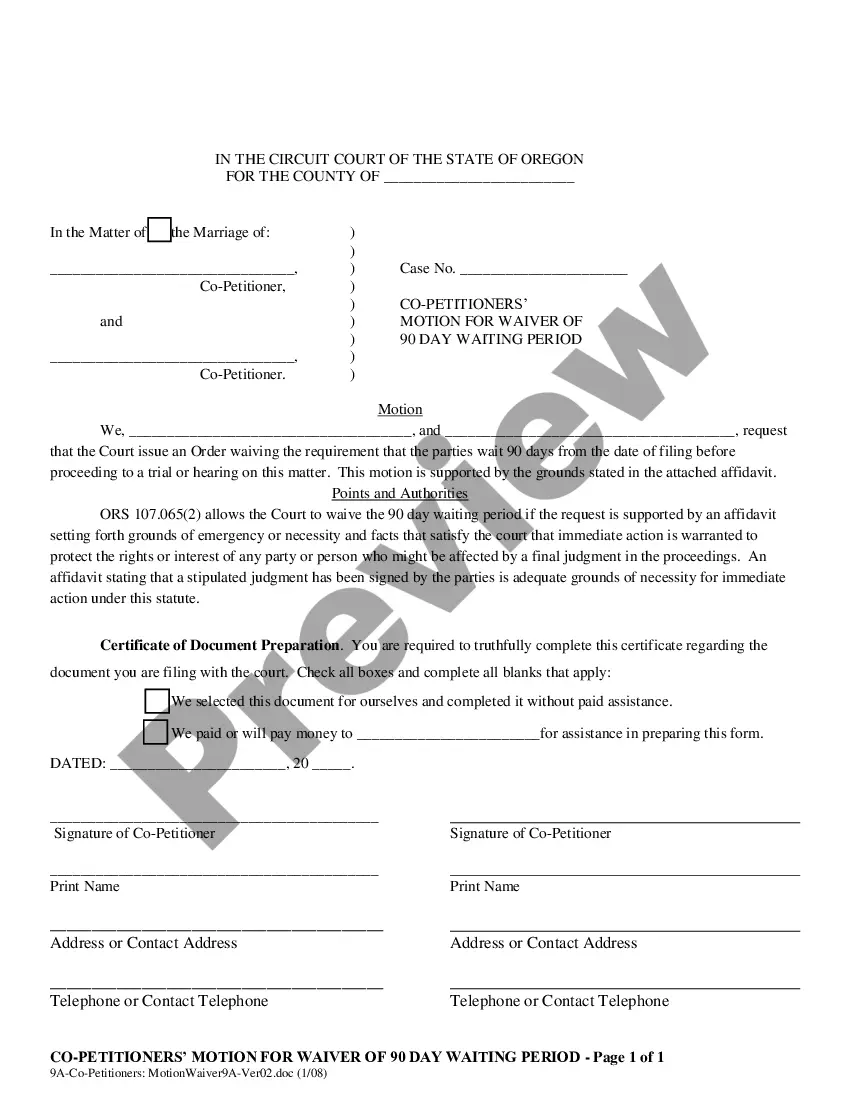
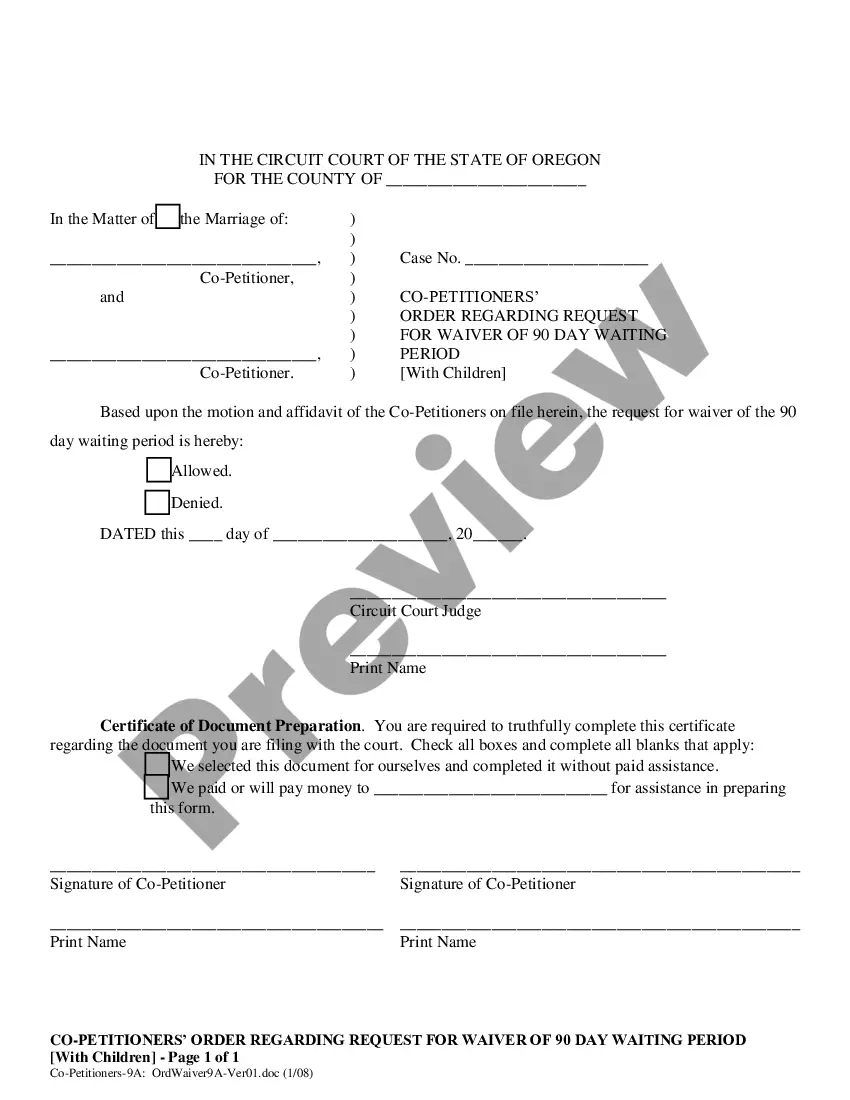
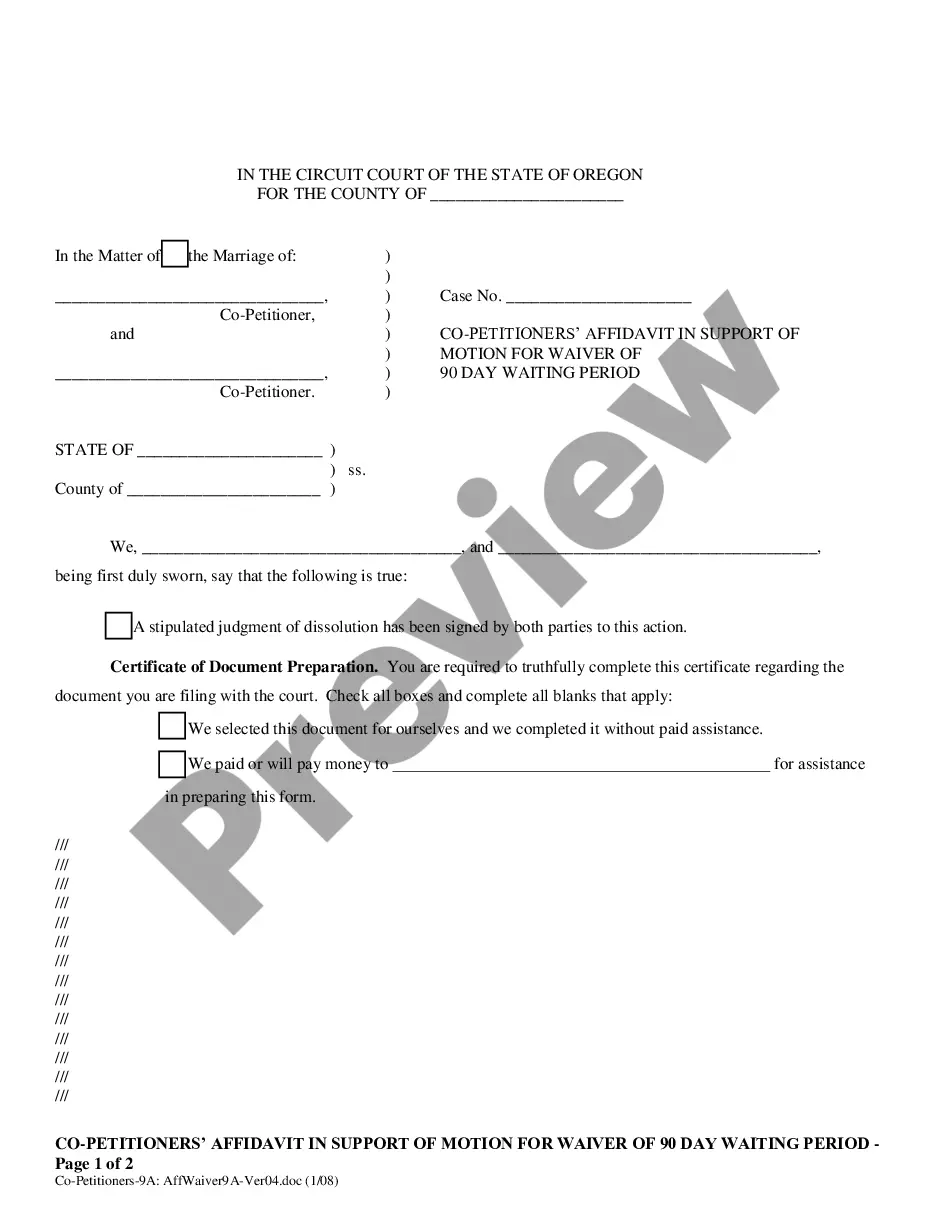
Oregon Co-Petitioners' (with minor children) Motion for Waiver of 90 Day Waiting Period
Understanding this form
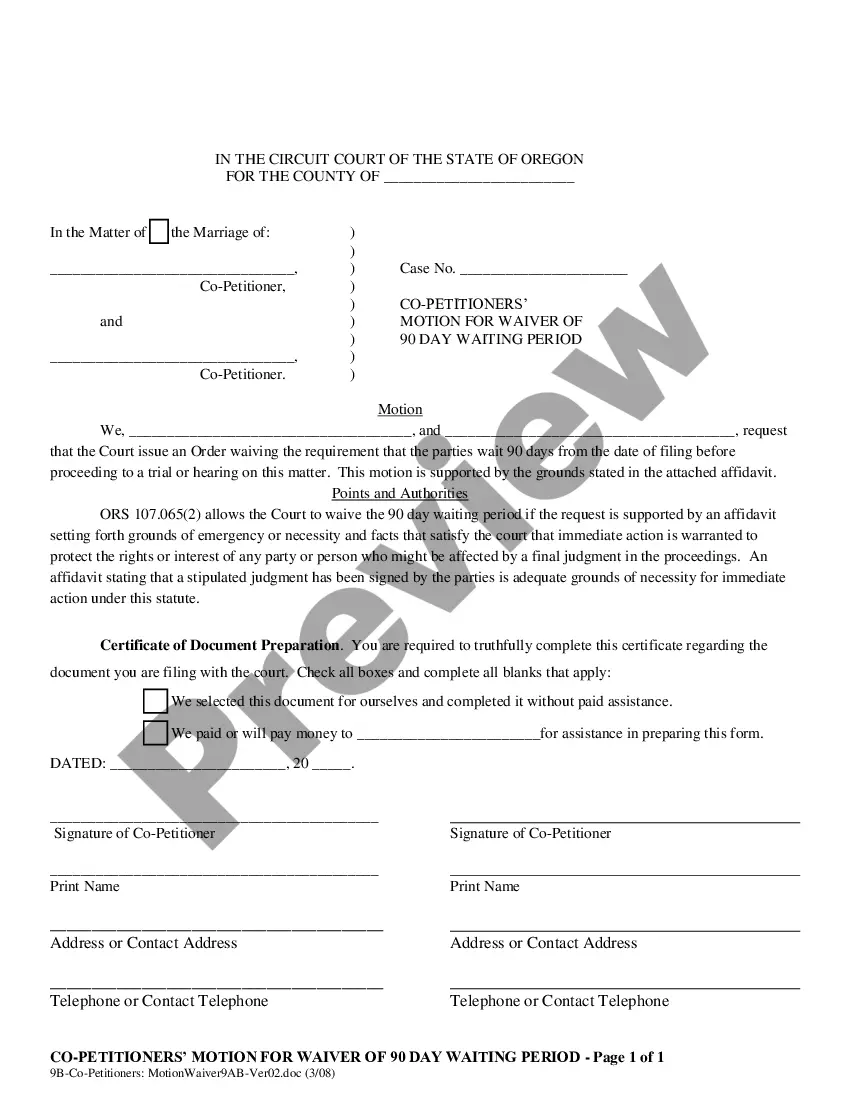
The Co-Petitioners' Motion for Waiver of 90 Day Waiting Period is a legal document that allows co-petitioners in a divorce case with minor children to request the court to bypass the 90-day waiting period typically required before proceeding to trial or hearing. This form is specifically designed for situations deemed as emergencies or when immediate action is necessary to protect the rights of involved parties, ensuring a prompt judicial response in urgent circumstances.
Key parts of this document
- Identification of co-petitioners and the case number.
- A request for the court to waive the 90-day waiting period.
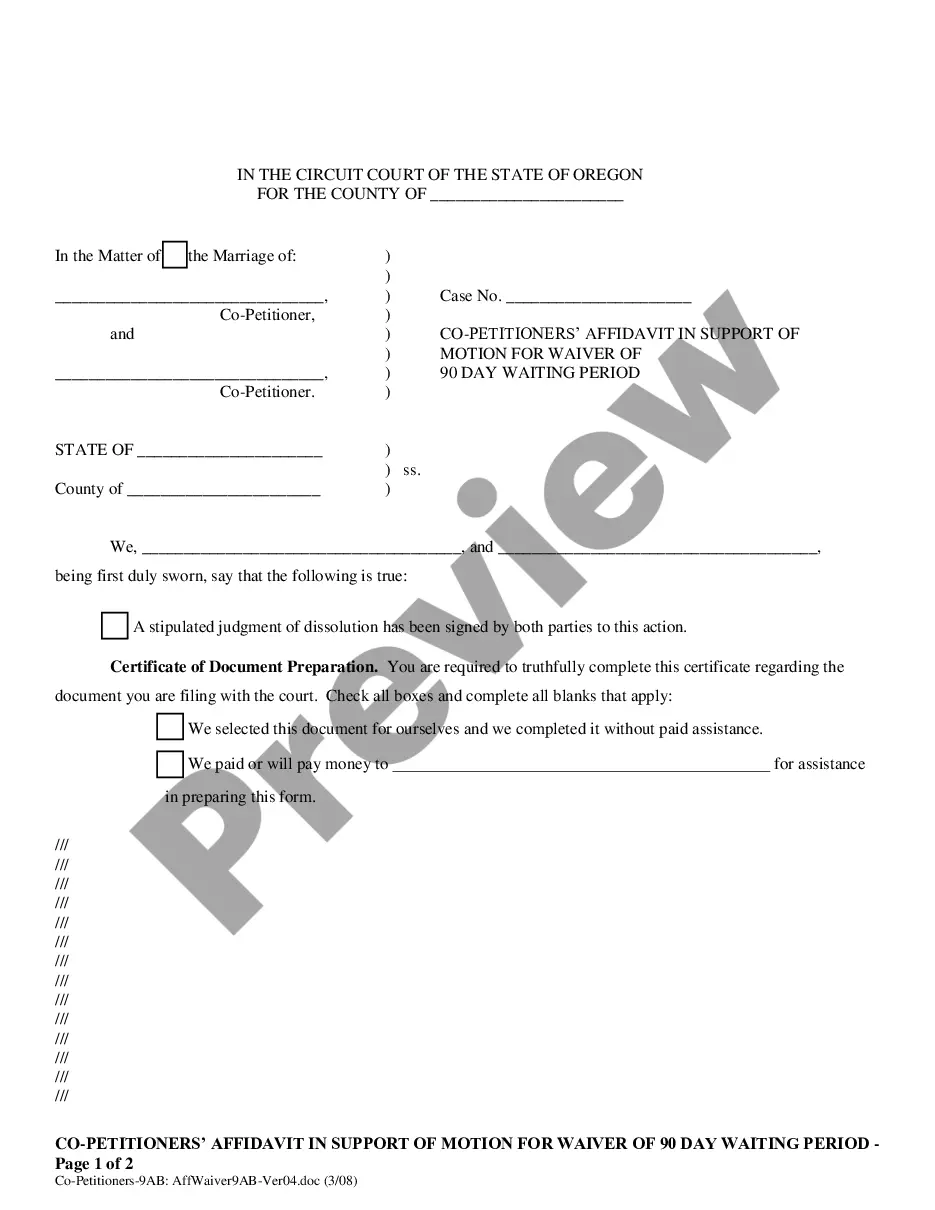
- Supportive grounds stated in an attached affidavit.
- Citation of relevant Oregon statute (ORS 107.065(2)).
- Certificate of Document Preparation confirming assistance, if applicable.
- Signature and contact information for both co-petitioners.
When to use this document
This form should be used when co-petitioners need to expedite their divorce proceedings due to urgent circumstances. Examples include situations where there are safety concerns for minor children or other compelling needs where waiting the standard 90 days would be detrimental.
Who can use this document
- Co-petitioners involved in a divorce with minor children.
- Individuals experiencing urgent circumstances necessitating prompt judicial action.
- Parties who have signed a stipulated judgment and need to proceed without delay.
Instructions for completing this form
- Enter the names of both co-petitioners and the case number at the top of the form.
- Clearly state the request for a waiver of the 90-day waiting period.
- Attach an affidavit detailing the grounds for emergency or necessity.
- Complete the Certificate of Document Preparation accurately.
- Both co-petitioners must sign and provide their contact information.
Notarization guidance
This form does not typically require notarization unless specified by local law. Ensure that you comply with any additional requirements set forth by the court prior to filing.
Get your form ready online
Our built-in tools help you complete, sign, share, and store your documents in one place.
Make edits, fill in missing information, and update formatting in US Legal Forms—just like you would in MS Word.
Download a copy, print it, send it by email, or mail it via USPS—whatever works best for your next step.
Sign and collect signatures with our SignNow integration. Send to multiple recipients, set reminders, and more. Go Premium to unlock E-Sign.
If this form requires notarization, complete it online through a secure video call—no need to meet a notary in person or wait for an appointment.
We protect your documents and personal data by following strict security and privacy standards.

Make edits, fill in missing information, and update formatting in US Legal Forms—just like you would in MS Word.

Download a copy, print it, send it by email, or mail it via USPS—whatever works best for your next step.

Sign and collect signatures with our SignNow integration. Send to multiple recipients, set reminders, and more. Go Premium to unlock E-Sign.

If this form requires notarization, complete it online through a secure video call—no need to meet a notary in person or wait for an appointment.

We protect your documents and personal data by following strict security and privacy standards.
Avoid these common issues
- Failing to provide adequate grounds in the affidavit for the waiver.
- Not including both co-petitioners' signatures.
- Leaving sections of the Certificate of Document Preparation incomplete.
- Incorrectly referencing the case number or other identifying information.
Why use this form online
- Convenient access to legal forms tailored by licensed attorneys.
- Editable templates allow for personal customization to fit specific situations.
- Downloadable format for easy printing and filing.
Looking for another form?






Form popularity
FAQ
Oregon law prohibits a judge from granting a separation order for an unlimited duration. Instead, your separation order will last for a specified period of time, such as six months or a year. Once the separation period has expired, you and your spouse will have to decide whether you want to proceed with a divorce.
In order to have a legally-enforceable separation in Oregon, a petition must be filed with the local county court. A judgment must then be entered. The judgment of separation leaves an otherwise valid marriage in-tact, but allows the parties to live apart.
In a contested divorce the petitioner (plaintiff) petitions the court for a divorce and respondent (defendant) has to respond. When the petition is jointly filed, the spouses are called Co-Petitioners. The husband and wife petition the court together with paperwork that is signed by both parties.
See Question 29 of the Family Law in Oregon booklet or the section on Divorce on this site. A legal separation costs about the same as a divorce. During the first two years it can be changed to a divorce by either person. After two years, you can still get a divorce, but it will be a separate case.
"Petitioner" refers to the party who petitioned the Supreme Court to review the case. This party is variously known as the petitioner or the appellant. "Respondent" refers to the party being sued or tried and is also known as the appellee.
A legal separation may be for a limited or unlimited duration of time. You cannot marry someone else if you are legally separated and not yet divorced. A legal separation proceeding may be changed to a divorce proceeding at a later date.
After the ninety (90) day waiting period, the court is permitted to finalize the divorce ing to the terms agreed upon in the petition for dissolution. If the divorce is contested, then the non-divorcing spouse has thirty (30) days after the divorce is filed, to file a response to the Petition for Dissolution.
Oregon law creates a ?short form? summary dissolution proceeding for people with very simple divorce cases. If you meet all the requirements for a summary dissolution, you can get the forms at the county courthouse or at the court's website.