Oklahoma Claim of Lien by Contractor as Corporation
About this form
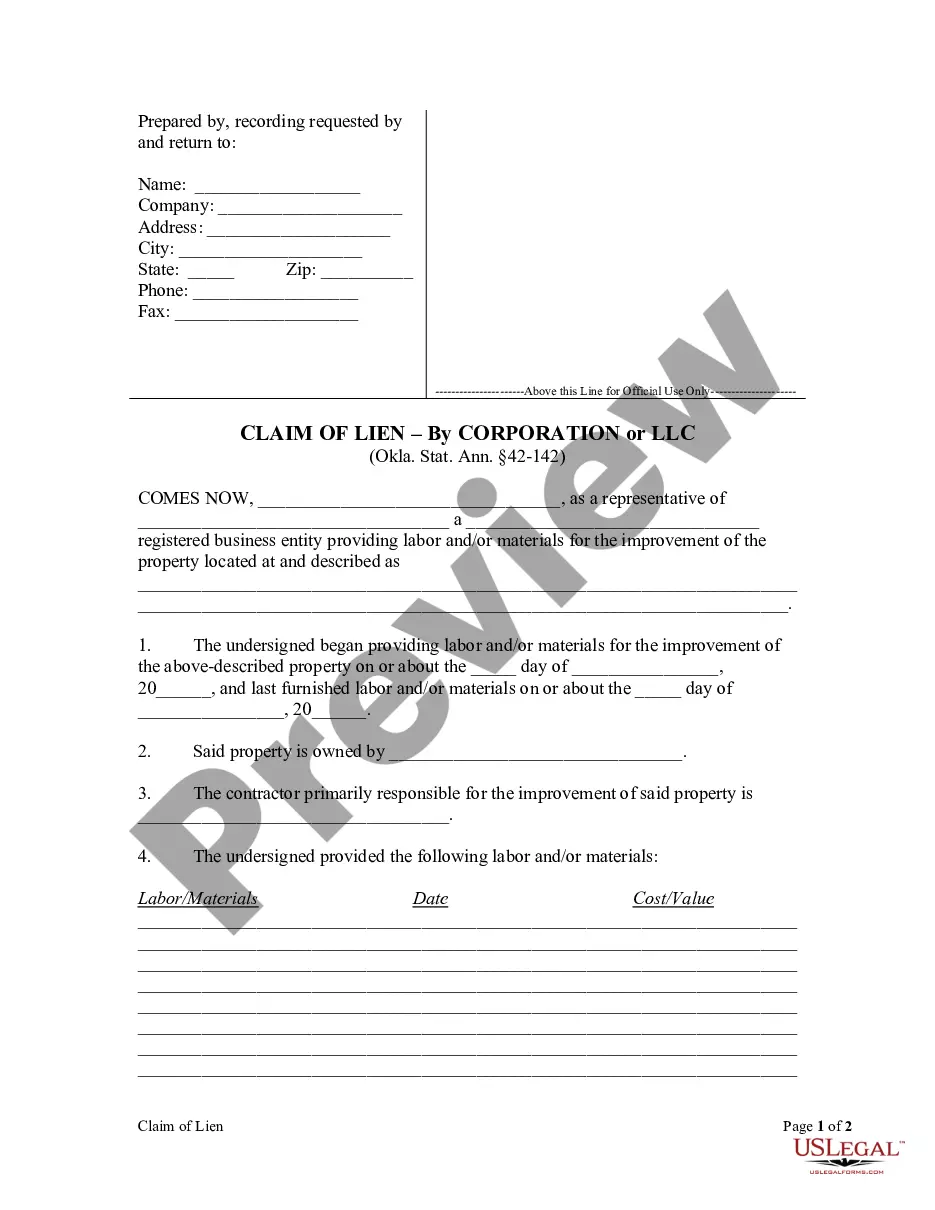
The Claim of Lien by Contractor as Corporation is a legal document that allows contractors acting as corporations to file a lien against a property when they have provided labor, materials, or equipment under a contract. This form differs from similar forms in that it specifically addresses situations where the contractor is a corporation, ensuring that the claims are valid and enforceable under state law. Using this form helps secure payment for contractors by formally asserting their rights over the property in question.
Key components of this form
- Name and contact information of the corporation filing the claim.
- Description of the property where the work was performed.
- Dates when labor or materials were provided.
- Identification of the property owner and the primary contractor responsible for the work.
- A detailed account of the labor and materials provided, including costs.
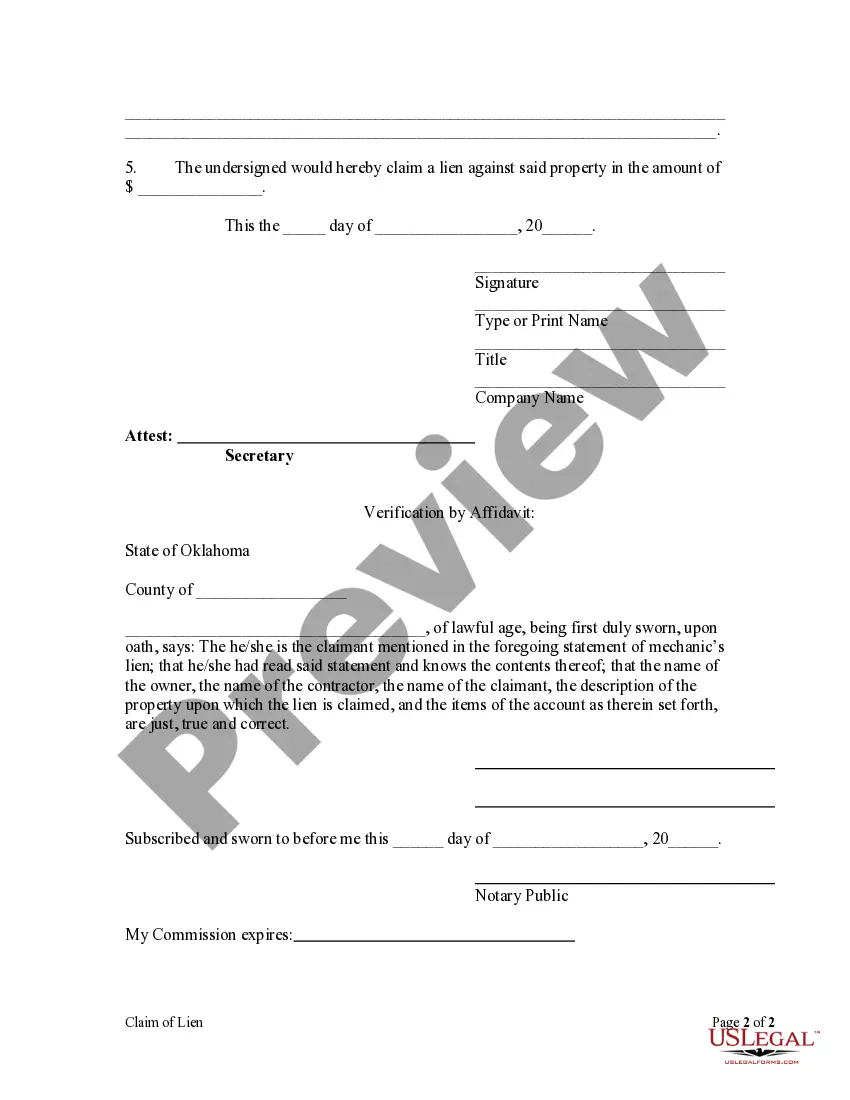
- Verification by affidavit affirming the accuracy of the claim.
When to use this form
This form should be used when a corporation has provided labor or materials for property improvements and has not been compensated for those services. It is typically filed within four months of the last work performed or materials provided, to secure the right to claim against the property and pursue payment effectively.
Who can use this document
This form is intended for:
- Corporations that have provided services or materials for construction or improvement projects.
- Contractors looking to secure a lien to ensure payment from property owners.
- Legal representatives or attorneys handling property improvement claims on behalf of a corporation.
How to prepare this document
- Provide the corporate information, including name, address, and contact details.
- Clearly describe the property involved, including the legal description.
- Include the dates when labor or materials were first and last provided.
- List all labor and materials provided, detailing the cost or value associated with each.
- Indicate the total amount of the lien being claimed.
- Have the form signed and verified by the appropriate corporate representative and a secretary, if applicable.
Is notarization required?
Notarization is required for this form to take effect. Our online notarization service, powered by Notarize, lets you verify and sign documents remotely through an encrypted video session, available 24/7.
Get your form ready online
Our built-in tools help you complete, sign, share, and store your documents in one place.
Make edits, fill in missing information, and update formatting in US Legal Forms—just like you would in MS Word.
Download a copy, print it, send it by email, or mail it via USPS—whatever works best for your next step.
Sign and collect signatures with our SignNow integration. Send to multiple recipients, set reminders, and more. Go Premium to unlock E-Sign.
If this form requires notarization, complete it online through a secure video call—no need to meet a notary in person or wait for an appointment.
We protect your documents and personal data by following strict security and privacy standards.

Make edits, fill in missing information, and update formatting in US Legal Forms—just like you would in MS Word.

Download a copy, print it, send it by email, or mail it via USPS—whatever works best for your next step.

Sign and collect signatures with our SignNow integration. Send to multiple recipients, set reminders, and more. Go Premium to unlock E-Sign.

If this form requires notarization, complete it online through a secure video call—no need to meet a notary in person or wait for an appointment.

We protect your documents and personal data by following strict security and privacy standards.
Typical mistakes to avoid
- Failing to file the claim within the four-month deadline.
- Omitting important details about the labor or materials provided.
- Incorrectly filling out the property description or costs.
- Not having the affidavit verified properly.
Benefits of completing this form online
- Convenience of completing and downloading the form from anywhere at any time.
- Editability allows for easy corrections or updates before filing.
- Reliable templates ensure compliance with legal requirements.
Legal use & context
- Filing a Claim of Lien establishes the right to seek payment from the property owner in the event of non-payment.
- A properly filed lien is a powerful tool that can affect the owner's ability to sell or refinance the property until the debt is resolved.
- Understanding local statutes and regulations surrounding liens is essential for enforceability.
Quick recap
- This form allows contractors as corporations to claim a lien on a property for unpaid labor or materials.
- It must be filed within four months after work completion.
- Ensure all information is accurate and complete to avoid delays or disputes.
Looking for another form?


Form popularity
FAQ
For a Lien only: $10.00 Lien fee plus $1.55 Mail fee. 3. The MLA will stamp and record the date, time and receipt number on the face of the titling documentation and attach one copy of the MV-21-A and one copy of the lien fee receipt.
Filing a construction lien on residential projects requires filing a Notice of Unpaid Balance and Right to File Lien within 90 days of the last day of service. The homeowner must also get a copy of that notice within 10 days of its filing.
A federal tax lien is the government's legal claim against your business assets. The IRS will file a lien, and this happens as a result of tax debt not being paid.By filing a lien, the IRS is marking your business assets bank accounts, building, land, etc.
Even though these states may permit project participants to secure lien rights and claim a mechanics lien even without a written contract, it is generally best practice to have a signed written contract for work provided.
Avoid harassing the people that owe you money. Keep phone calls short. Write letters. Get a collection agency to write demand letters. Offer to settle for less than is due. Hire a collection agency. Small claims court. File a lawsuit.
Any person who performs labor or furnishes material may file a lien on the real estate that received the labor or materials. You must serve a pre-lien notice if the amount is over $10,000. You must serve your pre-lien notice within 75 days. You must file your lien within 120 days.
A contractor's lien (often known as a mechanic's lien, or a construction lien) is a claim made by contractors or subcontractors who have performed work on a property, and have not yet been paid.After all, contractors would rather work out a deal than go through the hassle of filing a lien against your property.
Anyone who makes or causes to make improvements by providing work or materials in Alberta for an owner, contractor or subcontractor may file an Alberta Builders Lien.
When your efforts to collect a bill from a business that owes you money have been unsuccessful, you can place a lien on the assets of the business. As a lienholder, you gain legal rights to the company's property and the authority to sell the property and use the proceeds to repay what is owed to you.