New Hampshire Letter from Landlord to Tenant as Notice to remove unauthorized pets from premises
What is this form?
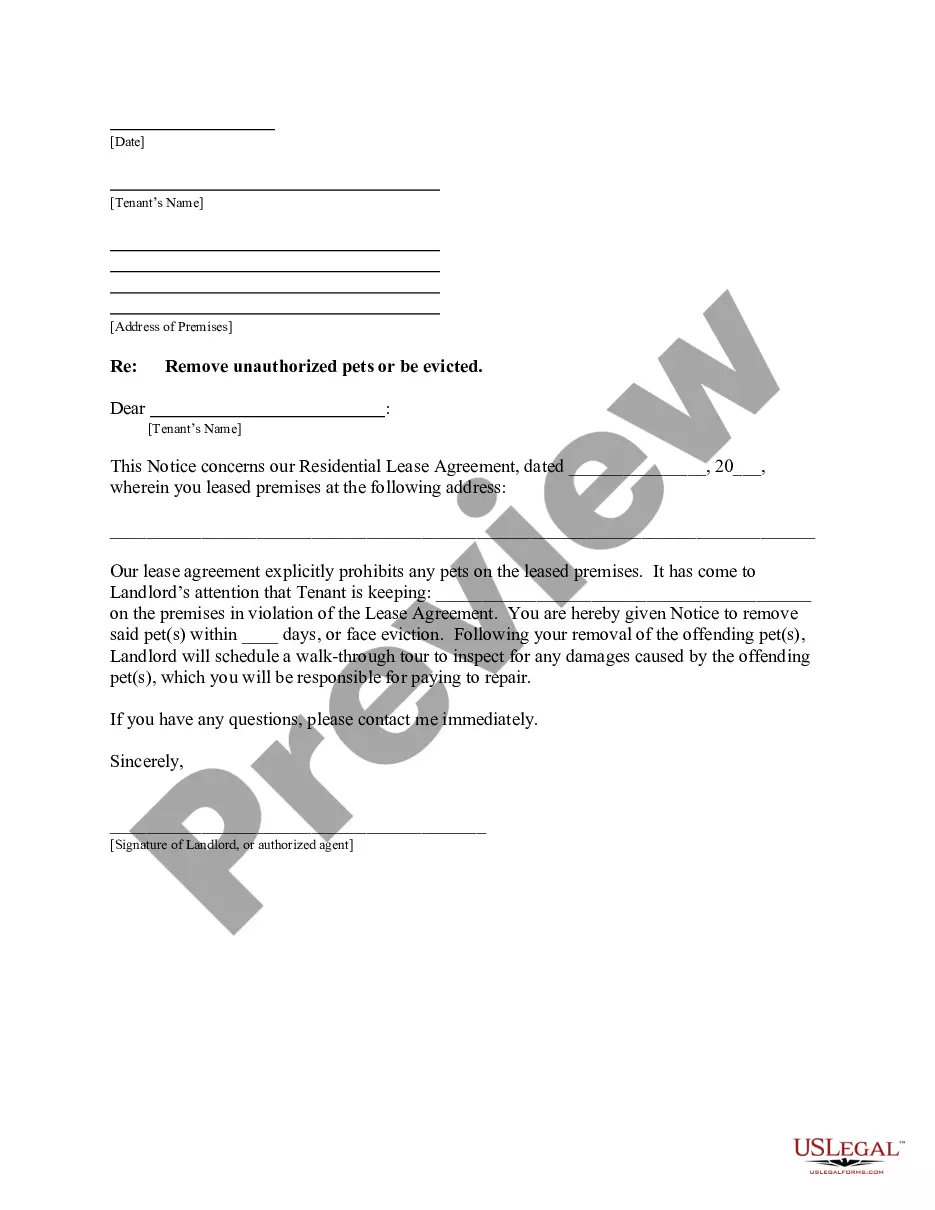
This form serves as a Letter from Landlord to Tenant demanding the removal of unauthorized pets from the leased premises. It acts as a formal notice indicating that the presence of these pets constitutes a breach of the lease agreement. The letter also warns tenants that failure to comply may result in eviction or further legal action. Unlike other landlord-tenant forms, this specific notice focuses solely on unauthorized pets, helping landlords enforce their pet policies effectively.
Main sections of this form
- Date of the residential lease agreement.
- Address of the leased premises.
- Description of the unauthorized pet(s).
- Timeframe for pet removal.
- Information about inspecting for damages caused by the pet(s).
- Contact details for further inquiries.
When to use this form
This form should be used when a landlord becomes aware that a tenant is keeping unauthorized pets in a rental property. It is essential in situations where the lease explicitly prohibits pets, allowing landlords to formally communicate their expectations and the potential consequences of non-compliance. Use this notice to ensure that tenants are appropriately informed and have a clear deadline to address the issue.
Who this form is for
- Landlords who have rental agreements that prohibit pets.
- Property managers overseeing rentals with pet restrictions.
- Real estate professionals managing tenant relations.
- Tenants who may need to understand their rights regarding pet policies.
Completing this form step by step
- Fill in the date of the residential lease agreement.
- Enter the full address of the leased premises.
- Clearly specify the unauthorized pet(s) being kept on the premises.
- Indicate the number of days the tenant has to remove the pet(s).
- Sign the letter as the landlord or authorized agent.
- Consider scheduling a walk-through to inspect for any damages post-removal.
Does this form need to be notarized?
Notarization is not commonly needed for this form. However, certain documents or local rules may make it necessary. Our notarization service, powered by Notarize, allows you to finalize it securely online anytime, day or night.
Get your form ready online
Our built-in tools help you complete, sign, share, and store your documents in one place.
Make edits, fill in missing information, and update formatting in US Legal Forms—just like you would in MS Word.
Download a copy, print it, send it by email, or mail it via USPS—whatever works best for your next step.
Sign and collect signatures with our SignNow integration. Send to multiple recipients, set reminders, and more. Go Premium to unlock E-Sign.
If this form requires notarization, complete it online through a secure video call—no need to meet a notary in person or wait for an appointment.
We protect your documents and personal data by following strict security and privacy standards.

Make edits, fill in missing information, and update formatting in US Legal Forms—just like you would in MS Word.

Download a copy, print it, send it by email, or mail it via USPS—whatever works best for your next step.

Sign and collect signatures with our SignNow integration. Send to multiple recipients, set reminders, and more. Go Premium to unlock E-Sign.

If this form requires notarization, complete it online through a secure video call—no need to meet a notary in person or wait for an appointment.

We protect your documents and personal data by following strict security and privacy standards.
Common mistakes to avoid
- Failing to specify the type of unauthorized pets.
- Not providing a clear timeline for removal.
- Overlooking the need for a formal signature.
- Neglecting to mention potential consequences for non-compliance.
Why complete this form online
- Convenient access to templates that can be downloaded immediately.
- Customization options to fit specific needs and legal requirements.
- Reliability of forms drafted by licensed attorneys.
- Time-saving process without the need to draft documents from scratch.
Legal use & context
- This notice serves as a formal warning about breach of lease terms.
- It establishes a clear timeline and legal basis for any future actions.
- Failure to comply may result in eviction proceedings.
Main things to remember
- This form notifies tenants about unauthorized pets in a legally compliant manner.
- It is essential for landlords to act promptly and document violations.
- Understanding and adhering to state laws can affect the outcomes of lease violations.
Looking for another form?
Form popularity
FAQ
If having a pet is prohibited, as stated in the lease agreement, your landlord does have the right to evict so think very carefully. Sneaking a pet into the apartment may sound like a good idea, but following the terms of the agreement and getting a pet the right way will be more beneficial for you and your pet.
Most landlords are willing to work with their tenants, even if you do break the lease, but some landlords won't. If you're caught sneaking in a pet, your landlord may have the right to evict you. If you're evicted, your landlord may sue you for the remainder of your lease payment.
It is against the law RSA 540-A for a landlord to:Enter your residence without permission, except to make emergency repairs. (You should not refuse your landlord's reasonable request to enter with enough notice); Take any other action to force you out of your home without going through the eviction process.
If your tenants have pets without permission, you can bring eviction proceedings using a Section 8 notice, under the Housing Act 1988, for breach of the tenancy agreement but a judge may reject your case if your wish to restrict pets is deemed unfair.
So, for over 90 percent of landlords, a blanket ban on pets of any kind was included in their contract. If a tenancy agreement included a ban on pets, getting one was reasonable grounds for eviction. This has, in reality, torn families apart, and some have even had to leave their dear pets behind.
If a tenant's pet causes damage, prepare an itemized list of repair costs to explain why you are keeping all or a portion of the pet deposit. Similar to other deposits, if the pet didn't cause any damage, then the tenant must receive their pet deposit back in full.
Indiana. Indiana laws allow landlords to hold on to security deposits for 45 days to give them time to determine any damages caused by tenants. Colorado. Colorado is one of few states that allow landlords to access the rental property without an advance notice requirement. Georgia.
Under the new Model Tenancy Agreement, announced by Housing Minister Rt Hon Christopher Pincher MP, landlords will no longer be able to issue blanket bans on pets.To ensure landlords are protected, tenants will continue to have a legal duty to repair or cover the cost of any damage to the property.
New Hampshire is a fairly landlord-friendly state because there are no rent control policies and the state does not limit certain fees. However, there are relatively strict requirements on the handling of security deposits.