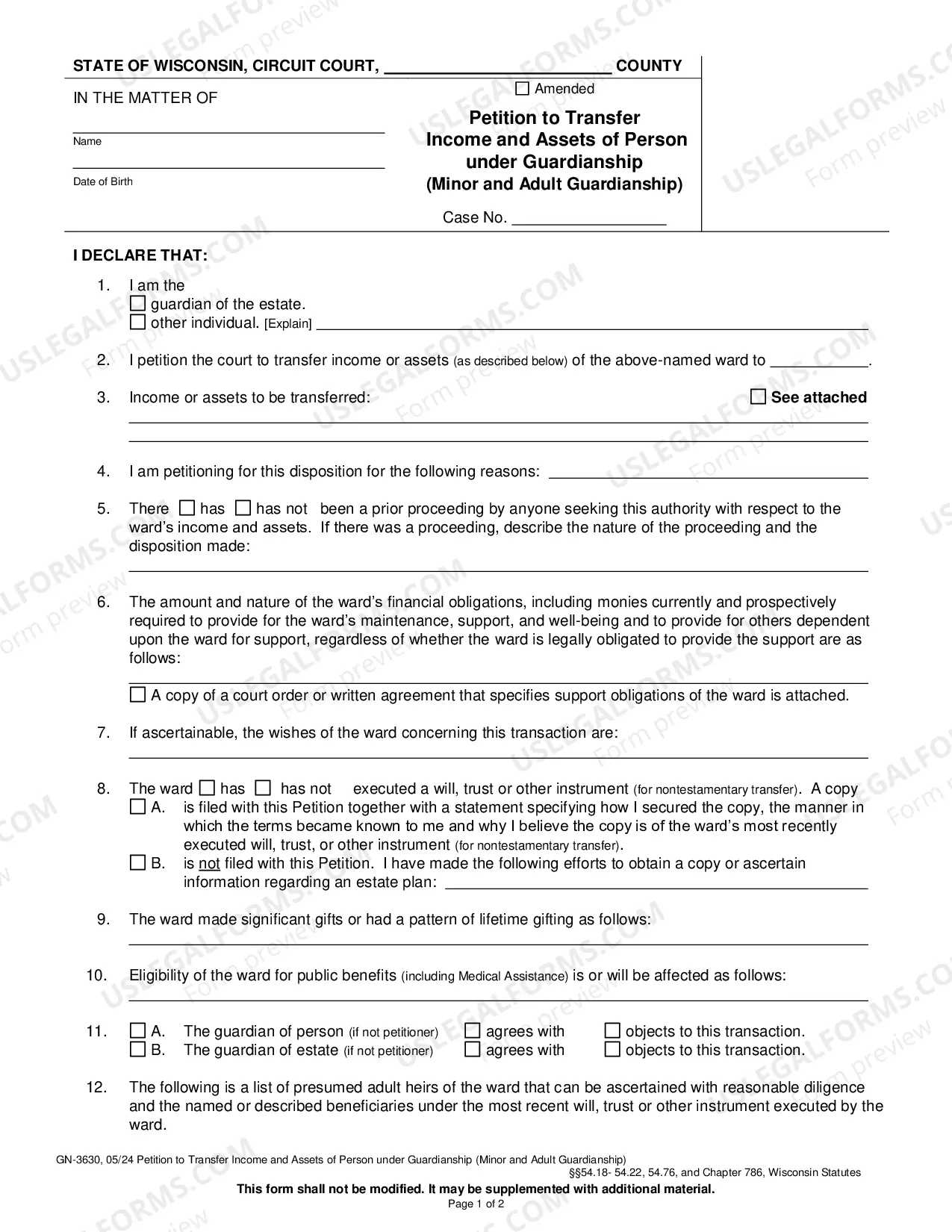
Nebraska Warranty Deed from Husband to Himself and Wife
What is this form?
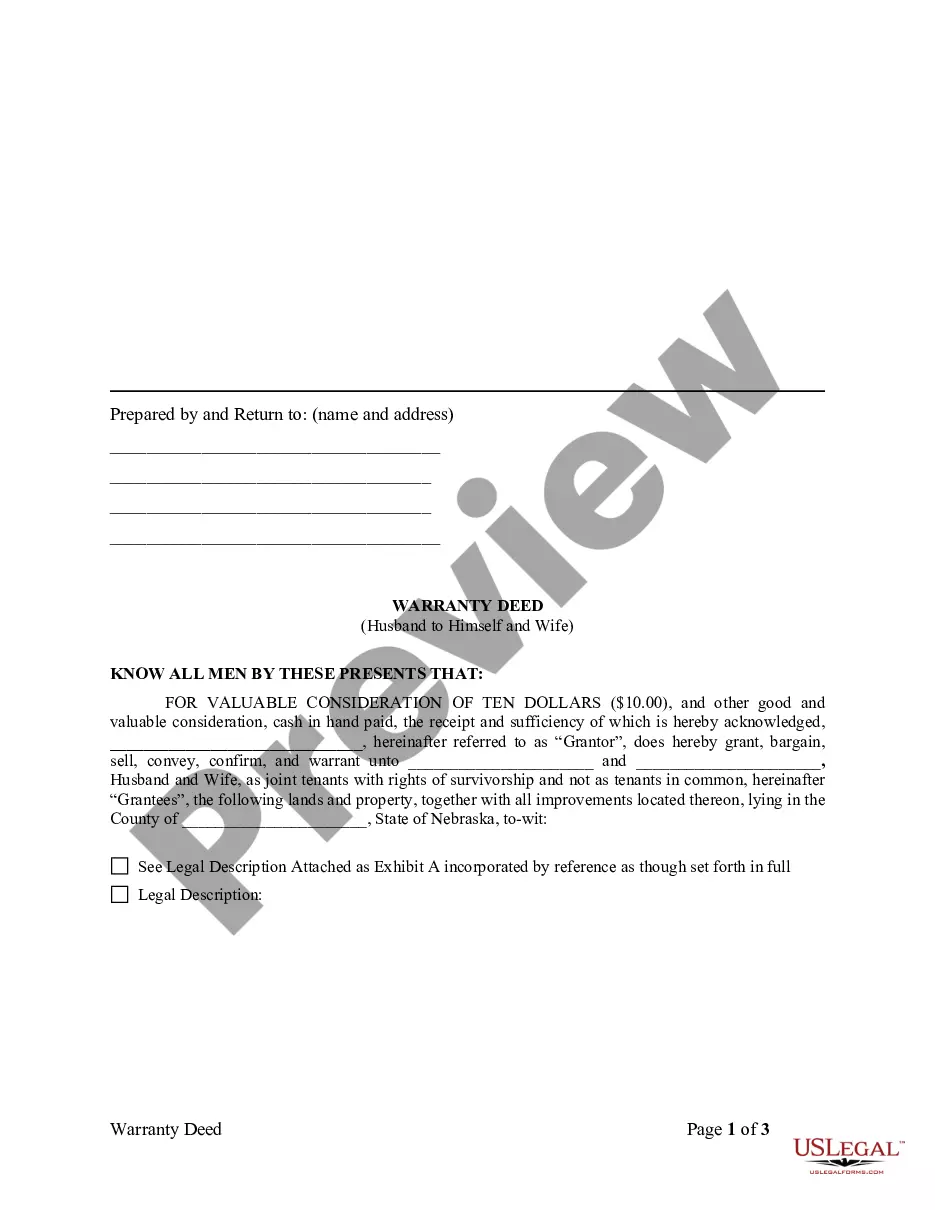
The Warranty Deed from Husband to Himself and Wife is a legal document that facilitates the transfer of property ownership from a husband to himself and his wife. This form ensures that both parties hold the property as joint tenants with rights of survivorship, which means that in the event of one spouse's death, the other automatically becomes the sole owner of the property. This deed protects the interests of both spouses and is compliant with state statutory laws, ensuring a clear and enforceable transfer of ownership.
Main sections of this form
- Identification of the grantor (husband) and grantees (husband and wife).
- Detailed description of the property being transferred.
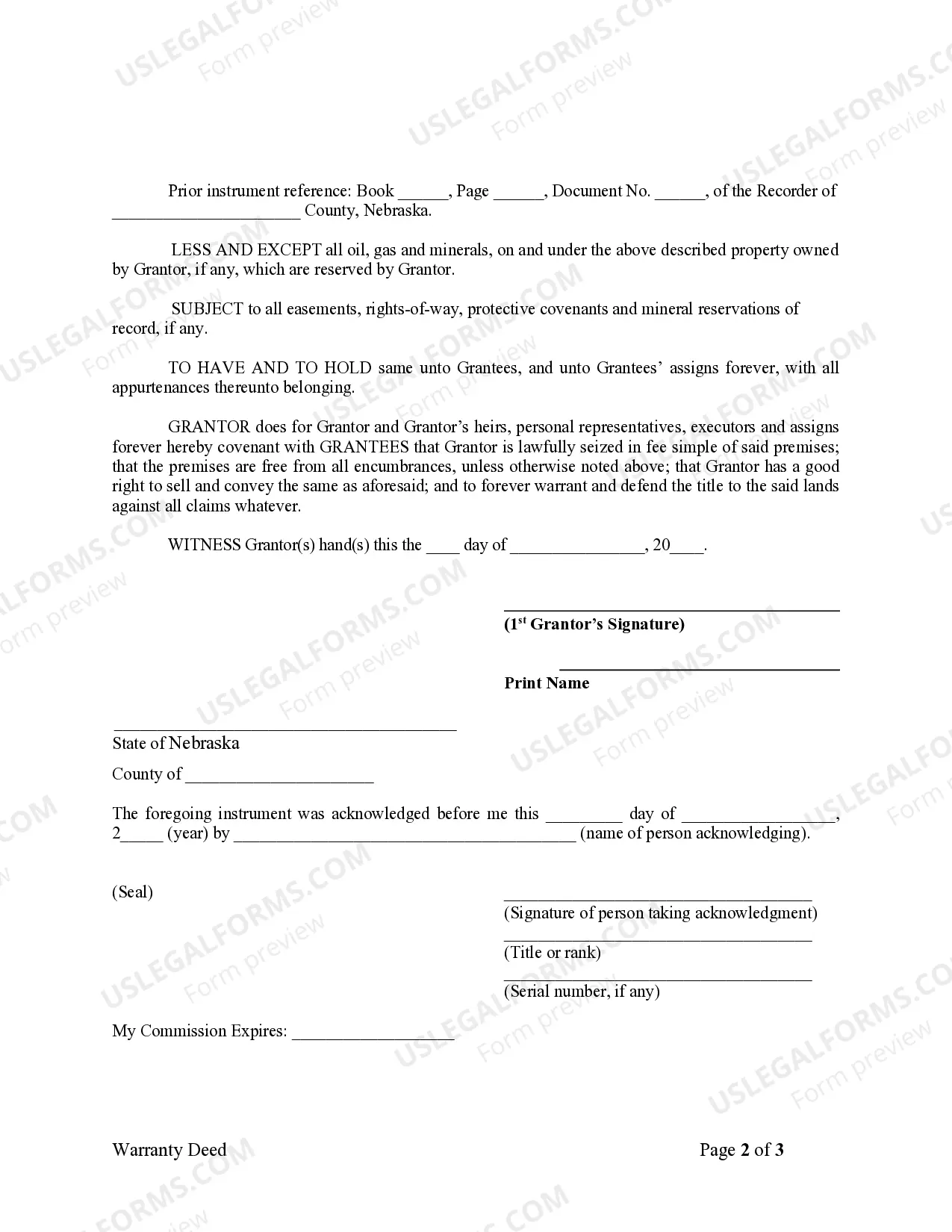
- Statement of covenants and warranties made by the grantor regarding the title.
- Reservation of oil, gas, and mineral rights by the grantor.
- Notary acknowledgment section to validate the document.




Situations where this form applies
This form is useful when a husband wishes to legally transfer real property ownership to himself and his wife, particularly in scenarios where joint ownership is desired. It can be utilized during marriage, in preparation for estate planning, or to simplify property transfer in case of the grantor's death, ensuring that the surviving spouse retains ownership without complications.
Who can use this document
This form is intended for:
- Married couples looking to title property jointly.
- Husbands seeking to secure property for their wives in the event of their passing.
- Individuals preparing for estate planning or property management.
Steps to complete this form
- Identify the parties by entering the names of the grantor and grantees.
- Provide a complete and accurate description of the property being transferred.
- Include any reservations, such as oil, gas, or mineral rights, if applicable.
- Sign the document in the presence of a notary public to validate it.
- Ensure all information is accurate and complete before submitting or recording the deed.
Does this form need to be notarized?
This document requires notarization to meet legal standards. US Legal Forms provides secure online notarization powered by Notarize, allowing you to complete the process through a verified video call, available 24/7.
Get your form ready online
Our built-in tools help you complete, sign, share, and store your documents in one place.
Make edits, fill in missing information, and update formatting in US Legal Forms—just like you would in MS Word.
Download a copy, print it, send it by email, or mail it via USPS—whatever works best for your next step.
Sign and collect signatures with our SignNow integration. Send to multiple recipients, set reminders, and more. Go Premium to unlock E-Sign.
If this form requires notarization, complete it online through a secure video call—no need to meet a notary in person or wait for an appointment.
We protect your documents and personal data by following strict security and privacy standards.

Make edits, fill in missing information, and update formatting in US Legal Forms—just like you would in MS Word.

Download a copy, print it, send it by email, or mail it via USPS—whatever works best for your next step.

Sign and collect signatures with our SignNow integration. Send to multiple recipients, set reminders, and more. Go Premium to unlock E-Sign.

If this form requires notarization, complete it online through a secure video call—no need to meet a notary in person or wait for an appointment.

We protect your documents and personal data by following strict security and privacy standards.
Common mistakes
- Failing to provide a complete property description.
- Omitting the reservation of rights clause when applicable.
- Neglecting to have the document notarized, if required.
- Incorrectly identifying the parties involved in the deed.
Advantages of online completion
- Convenient access to legally drafted documents anytime.
- Edit and customize the form easily to fit specific needs.
- Ensures compliance with legal standards and requirements.
- Saves time by avoiding the need for in-person consultations.
Looking for another form?







Form popularity
FAQ
Discuss the terms of the deed with the new owners. Hire a real estate attorney to prepare the deed. Review the deed. Sign the deed in front of a notary public, with witnesses present. File the deed on public record.
It is also crucial that a spouse know about the loan, even if he or she is not on the mortgage. In general, the spouse must sign a deed of trust, the Truth in Lending and Right to Cancel documents. By signing these documents, they are simply acknowledging the existence of the mortgage.
One of the simplest ways to add your wife to the home title is by using an interspousal deed. You can transfer the property from your sole and separate property to mutual tenancy, such as joint tenants with right of survivorship, with your wife.
If you've recently married and already own a home or other real estate, you may want to add your new spouse to the deed for your property so the two of you own it jointly. To add a spouse to a deed, all you have to do is literally fill out, sign and record a new deed in your county recorder's office.
When it comes to reasons why you shouldn't add your new spouse to the Deed, the answer is simple divorce and equitable distribution. If you choose not to put your spouse on the Deed and the two of you divorce, the entire value of the home is not subject to equitable distribution.
If you are married and your name is not on the title deed, you may have relinquished your ownership right.
Both spouses will need to sign the deed to sell the home. However, if the home is titled as "tenants in common," a spouse can sell his share of the property without the other spouse's consent. Both parties have a separate and distinct interest in the home.
Adding someone to your house deed requires the filing of a legal form known as a quitclaim deed. When executed and notarized, the quitclaim deed legally overrides the current deed to your home. By filing the quitclaim deed, you can add someone to the title of your home, in effect transferring a share of ownership.
In order to transfer ownership of the marital home pursuant to a divorce, one spouse is going to need to sign a quitclaim deed, interspousal transfer deed, or a grant deed, in order to convey the title to the property.