Environmental Provisions
Understanding this form
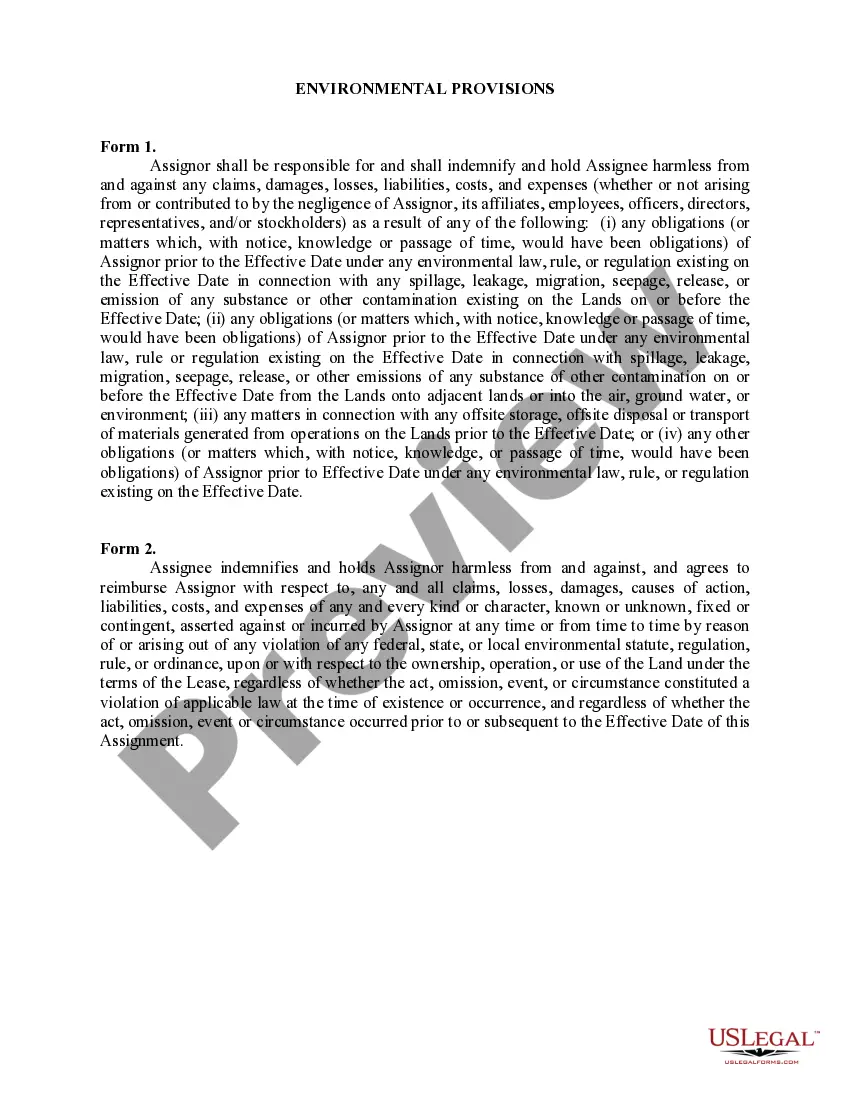
The Environmental Provisions form is a legal document that outlines the responsibilities of the assignor and assignee related to environmental obligations. It primarily ensures that the assignor will indemnify and hold the assignee harmless from any claims or issues arising from environmental contamination or violations prior to the transfer of ownership. This form is particularly important for companies and individuals dealing with real estate transactions that involve land where environmental laws may apply.
What’s included in this form
- Section on assignor's responsibilities regarding environmental issues.
- Indemnification clause protecting the assignee from environmental claims.
- Details on environmental obligations prior to the effective date.
- Provisions on spillage, leakage, and contamination on the land.
- Assignee's obligation to indemnify the assignor for specific claims.
When to use this form
This form should be used during real estate transactions where one party (the assignor) transfers ownership or rights to another party (the assignee) and there are potential environmental liabilities. If the property has been used for activities that may involve contamination, such as industrial operations, this form helps clarify responsibilities to prevent legal disputes related to environmental laws.
Intended users of this form
- Real estate owners looking to transfer property with environmental considerations.
- Business entities that have engaged in operations potentially affecting the environment.
- Legal professionals assisting clients with property transactions involving environmental issues.
- Individuals acquiring property with known past uses that could lead to environmental liabilities.
Steps to complete this form
- Identify the assignor and assignee in the specified fields.
- Clearly define the effective date of the assignment.
- Document any known environmental issues related to the property.
- Include specific indemnification clauses as needed.
- Ensure all parties sign and date the form to finalize the agreement.
Is notarization required?
This form does not typically require notarization to be legally valid. However, some jurisdictions or document types may still require it. US Legal Forms provides secure online notarization powered by Notarize, available 24/7 for added convenience.
Get your form ready online
Our built-in tools help you complete, sign, share, and store your documents in one place.
Make edits, fill in missing information, and update formatting in US Legal Forms—just like you would in MS Word.
Download a copy, print it, send it by email, or mail it via USPS—whatever works best for your next step.
Sign and collect signatures with our SignNow integration. Send to multiple recipients, set reminders, and more. Go Premium to unlock E-Sign.
If this form requires notarization, complete it online through a secure video call—no need to meet a notary in person or wait for an appointment.
We protect your documents and personal data by following strict security and privacy standards.

Make edits, fill in missing information, and update formatting in US Legal Forms—just like you would in MS Word.

Download a copy, print it, send it by email, or mail it via USPS—whatever works best for your next step.

Sign and collect signatures with our SignNow integration. Send to multiple recipients, set reminders, and more. Go Premium to unlock E-Sign.

If this form requires notarization, complete it online through a secure video call—no need to meet a notary in person or wait for an appointment.

We protect your documents and personal data by following strict security and privacy standards.
Avoid these common issues
- Failing to specify the effective date of the transfer.
- Not including all known environmental issues in the documentation.
- Overlooking the need for signatures from both parties.
- Leaving out specific indemnification language relevant to the transaction.
Why use this form online
- Convenient access to legal forms anytime, without the need for in-person visits.
- Editable templates allow users to tailor clauses to their specific needs.
- Reliable legal information drafted by licensed attorneys ensures compliance.
- Easy downloads facilitate immediate use in real estate transactions.
Looking for another form?
Form popularity
FAQ
EIS Requirements The National Environmental Policy Act of 1969 (NEPA) specifies when an environmental impact statement (EIS) must be prepared. NEPA regulations require, among other things, federal agencies to include discussion of a proposed action and the range of reasonable alternatives in an EIS.
What is contained in an environmental impact statement, and who must file one? An environmental impact statement must be filed by a federal agency and it contains a formal analysis for a federal action that with affect the quality of the environment. 10. What major federal statutes regulate air and water pollution?
An Introduction including a statement of the Purpose and Need of the Proposed Action. A description of the Affected Environment. A Range of Alternatives to the proposed action. Alternatives are considered the "heart" of the EIS. An analysis of the environmental impacts of each of the possible alternatives.
Proponent details and Index. Executive Summary of the EIA. Project description and alternatives. Legal considerations and environmental regulations applicable. Description of the physical environment. Description of the biological environment. Description of the socio-economic environment.
An EIS outlines the status of the environment in the affected area, provides a baseline for understanding the potential consequences of the proposed project, identifies positive and negative effects for the environment, and offers alternative actions, including inaction, in relation to the proposed project.
Environmental effects, including. the significance of environmental effects. public comments. mitigation measures and follow-up program requirements. the purpose of the designated project. alternative means of carrying out the designated project.
Keep environmental assessment in perspective. Keep the assessment simple and concentrate on pertinent factors and data. Focus time and effort on the most relevant matters. Don't invest too much, nor too little, time on an assessment.
Summary. The summary presents an overview of the contents of the EIS and a comparison of impacts expected for the proposal and alternatives. Purpose and Need. Proposed Action and Alternatives. Affected Environment. Expected Impacts. Consultation and Coordination. Appendices.
An Environmental Impact Assessment (EIA) is a process used to anticipate the environmental consequences of a development before planning permission is granted. This sort of assessment is required for certain projects defined under EU regulations.