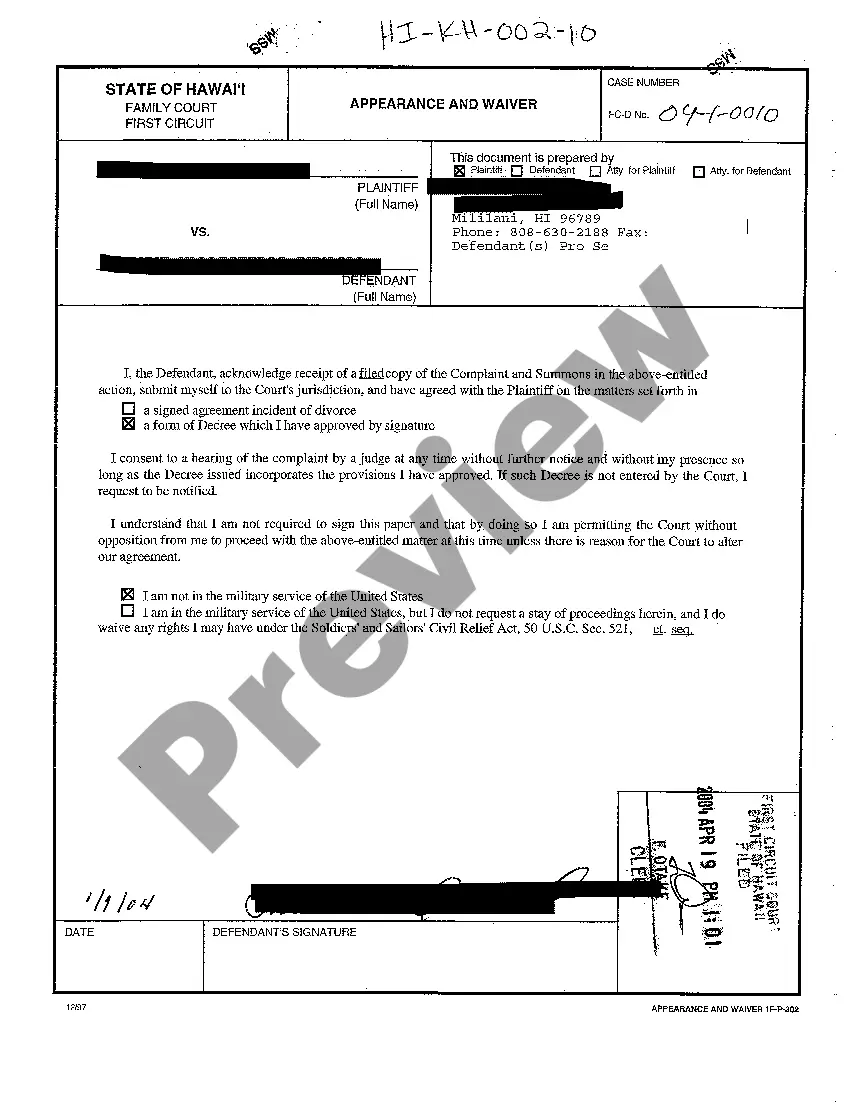
Oregon Certificate of Mailing
About this form
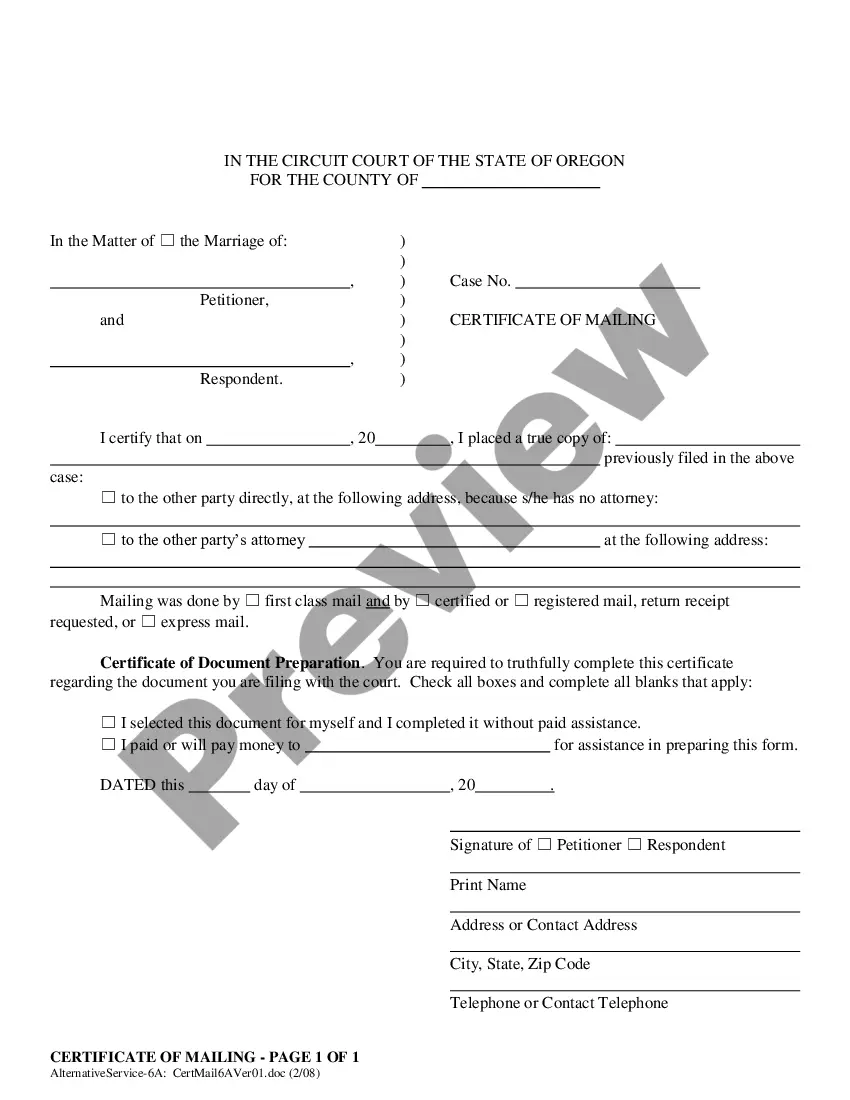
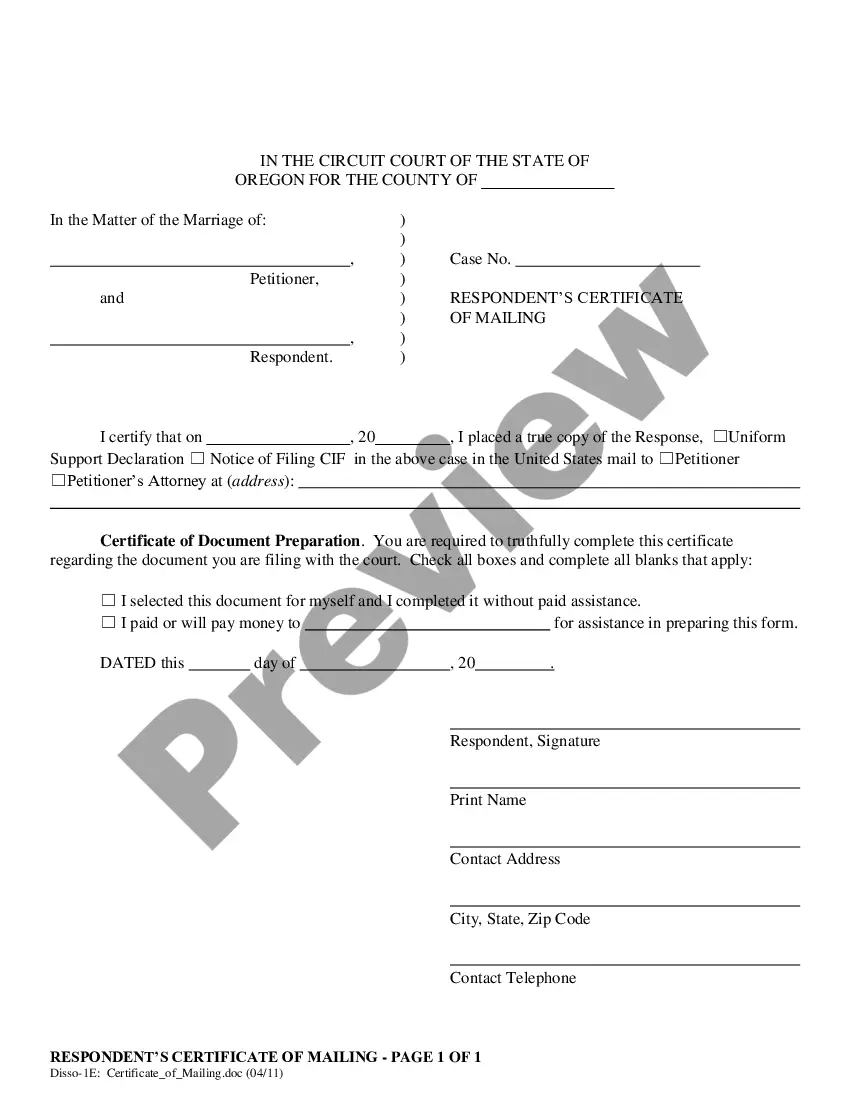
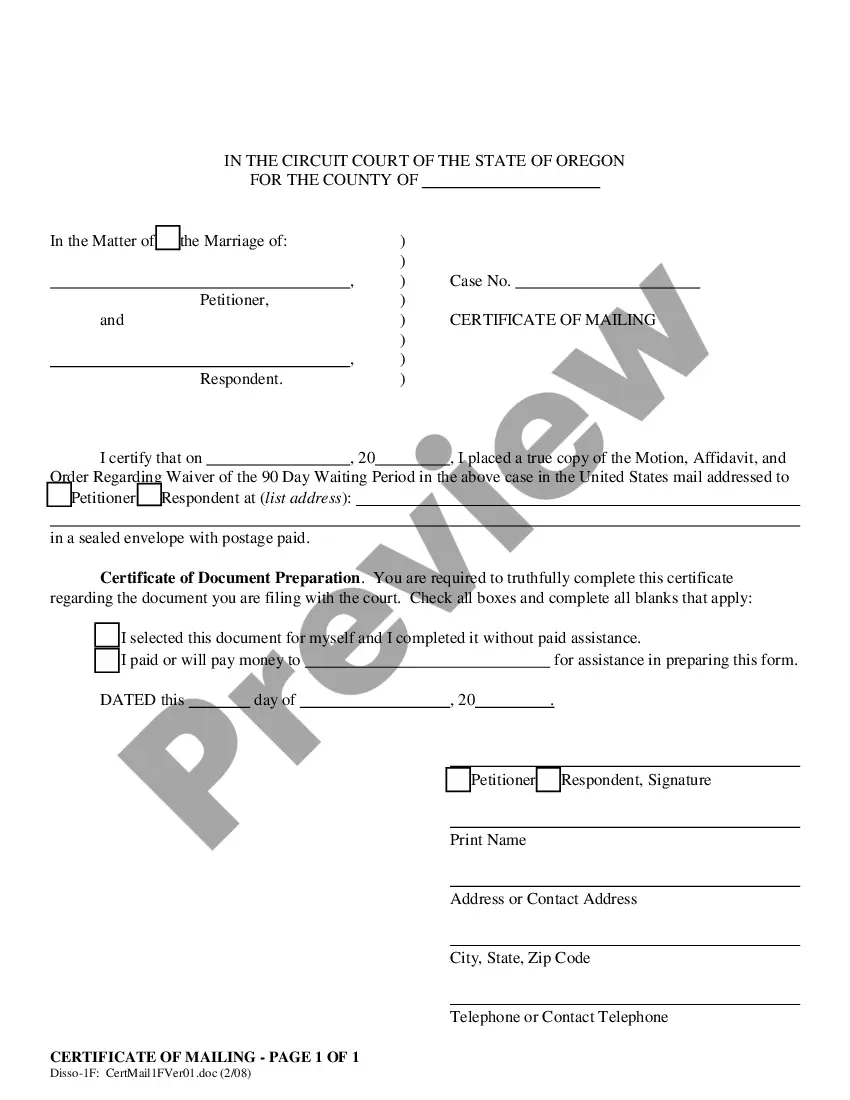
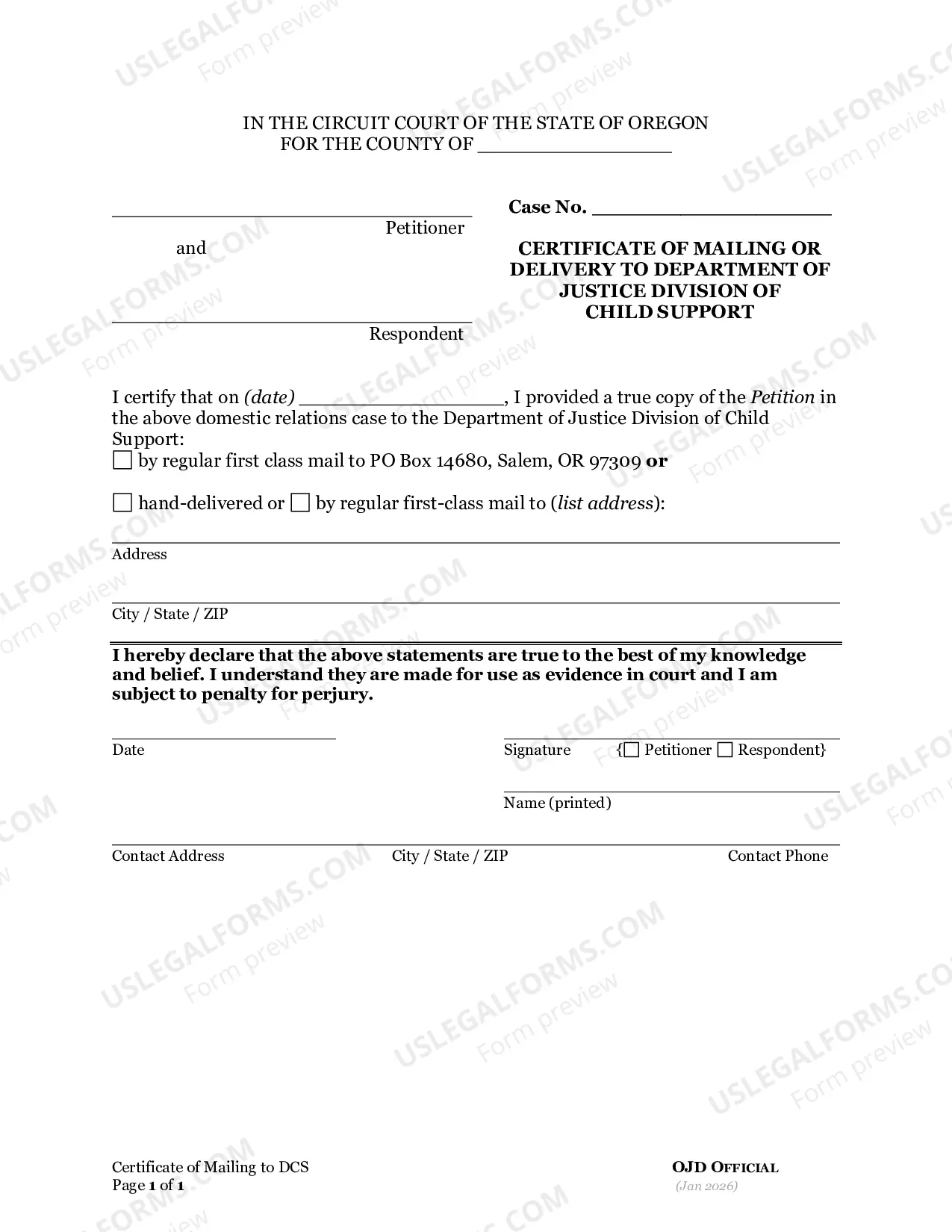
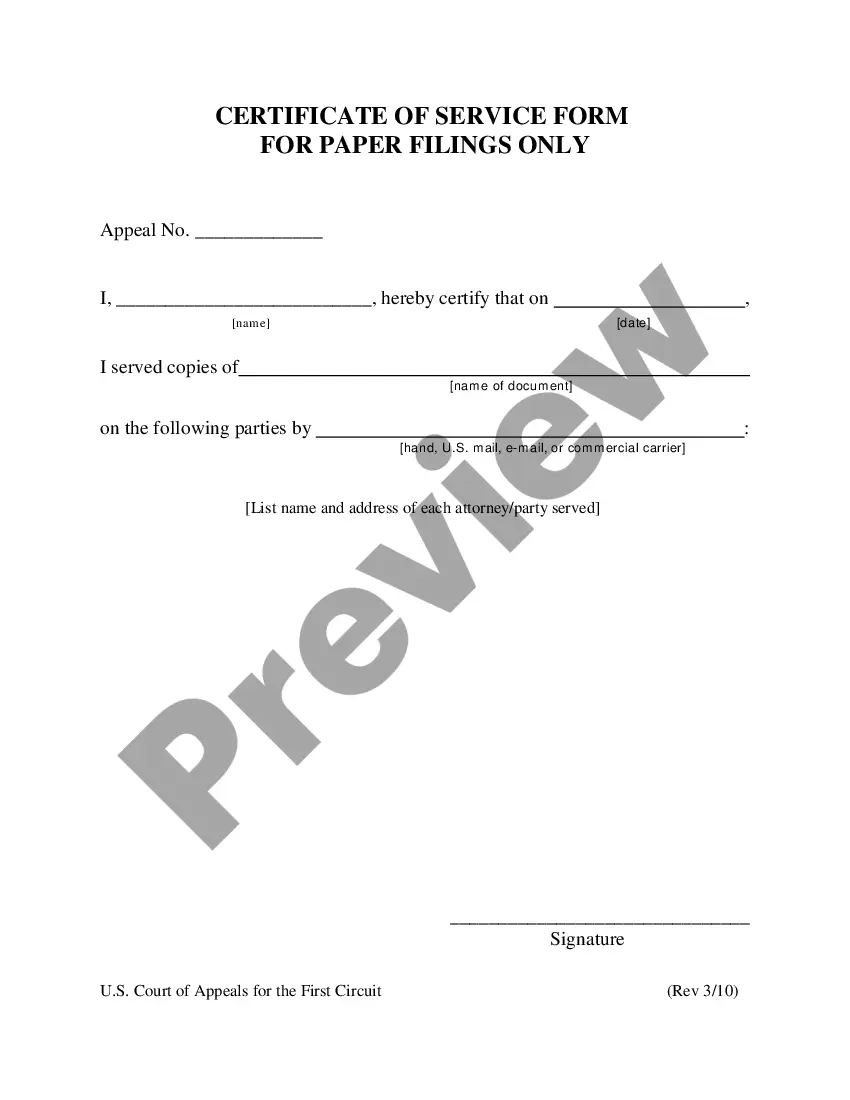
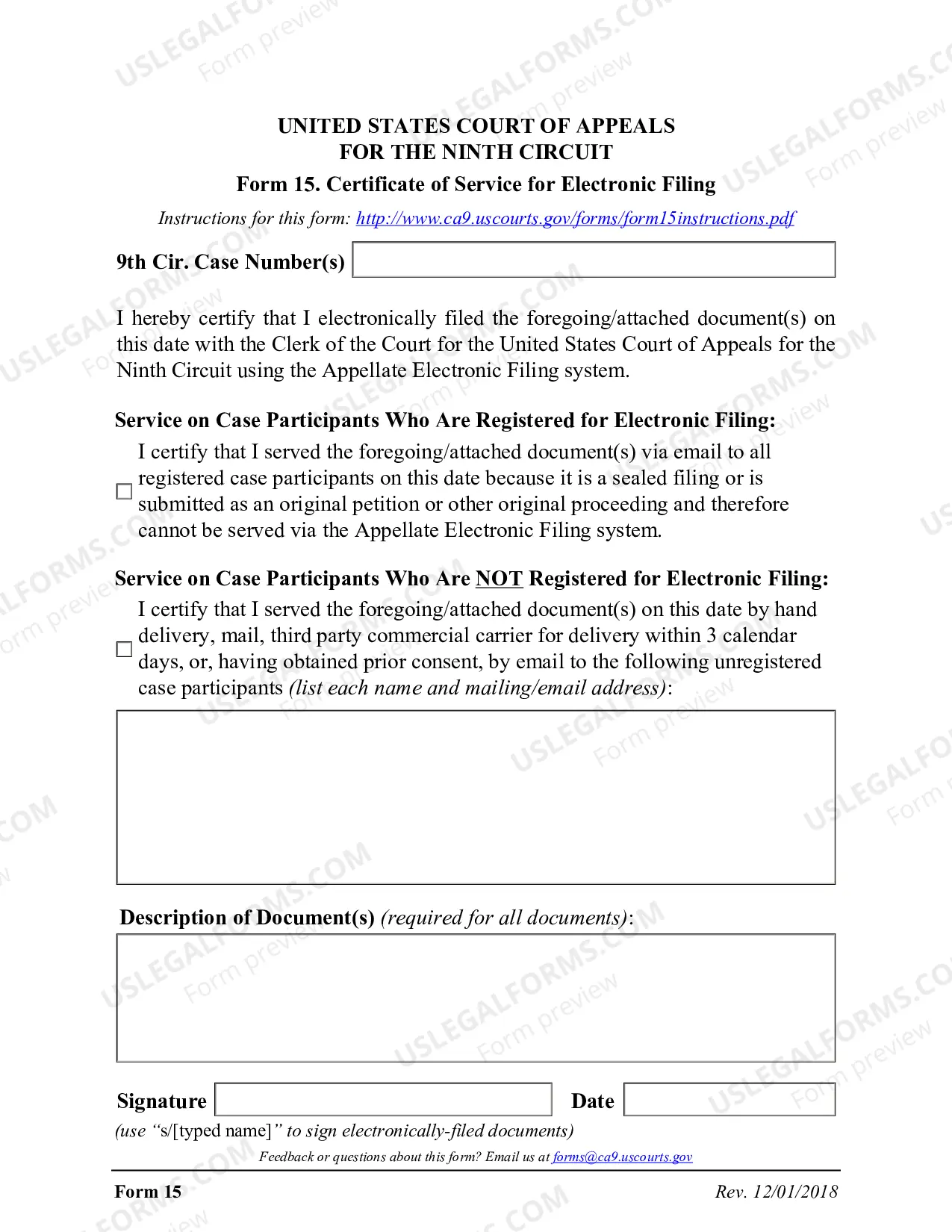
The Certificate of Mailing is a legal document used in Oregon to confirm that copies of court documents have been mailed to the relevant parties involved in domestic litigation. This form serves as proof of service, ensuring all parties are adequately informed. Unlike other notification forms, the Certificate of Mailing specifically focuses on verifying the method of delivery and the recipients, making it essential for compliance with court procedures.
Form components explained
- The header specifying it is a Certificate of Mailing.
- Details of the parties involved, including the petitioner and respondent.
- Spaces to document the date of mailing and the specific documents mailed.
- Options to indicate whether the mailing was done directly to a party or their attorney.
- Verification fields including a certificate of document preparation section for the filerâs statement.
- A signature section for the petitioner or respondent to affirm the contents are true.
When to use this document
This form should be used when you are required to notify the opposing party in a domestic court case that certain documents have been mailed to them. It is often necessary in situations involving divorce proceedings, custody battles, or related legal disputes where formal proof of document delivery is essential for court records.
Who needs this form
- Individuals engaged in domestic litigation in Oregon.
- Petitioners or respondents required to serve documents to the opposing party.
- Any party that is self-represented or those receiving legal assistance in filing court documents.
Instructions for completing this form
- Identify the parties involved by filling in the names of the petitioner and respondent.
- Enter the date on which the documents were mailed.
- Specify which documents were mailed by writing their titles or descriptions.
- Indicate whether the documents were sent directly to the party or their attorney.
- Choose the mailing method and check the appropriate boxes for first class, certified, registered, or express mail.
- Sign and print your name, along with providing your contact information at the end of the form.
Does this document require notarization?
This form does not typically require notarization unless specified by local law. However, ensure to verify any additional requirements that may be specific to your case or jurisdiction.
Get your form ready online
Our built-in tools help you complete, sign, share, and store your documents in one place.
Make edits, fill in missing information, and update formatting in US Legal Forms—just like you would in MS Word.
Download a copy, print it, send it by email, or mail it via USPS—whatever works best for your next step.
Sign and collect signatures with our SignNow integration. Send to multiple recipients, set reminders, and more. Go Premium to unlock E-Sign.
If this form requires notarization, complete it online through a secure video call—no need to meet a notary in person or wait for an appointment.
We protect your documents and personal data by following strict security and privacy standards.

Make edits, fill in missing information, and update formatting in US Legal Forms—just like you would in MS Word.

Download a copy, print it, send it by email, or mail it via USPS—whatever works best for your next step.

Sign and collect signatures with our SignNow integration. Send to multiple recipients, set reminders, and more. Go Premium to unlock E-Sign.

If this form requires notarization, complete it online through a secure video call—no need to meet a notary in person or wait for an appointment.

We protect your documents and personal data by following strict security and privacy standards.
Common mistakes
- Failing to enter the correct date of mailing.
- Not providing complete addresses for the petitioner and respondent.
- Omitting a signature from the person completing the form.
- Choosing the wrong method of mailing or not checking the required box.
Advantages of online completion
- Convenience of completing and downloading the form from home.
- Editable format to ensure all necessary information is filled out correctly.
- Access to expert-drafted templates, ensuring compliance with legal standards.
Looking for another form?
Form popularity
FAQ
Certified Mail. Certified mail is good for important legal documents. Choosing to send a document via certified mail doesn't interfere with the delivery time. The document should arrive on time as normal mail would.
USPS Certified Mail provides the sender proof of mailing and proof of delivery.This advanced tracking and reporting provides proof of mailing, acceptance and in-route delivery tracking through the final delivery scan. A copy of this information is stored inside your secure online account for 10 years.
Certified Mail. Certified mail is good for important legal documents. Choosing to send a document via certified mail doesn't interfere with the delivery time. The document should arrive on time as normal mail would.
A certificate of mailing is a receipt that documents the date a mail piece was received by the postal service for mailing. You can purchase a certificate of mailing at the post office when you send out a package.
Certificate Of Mailing To pay fee, affix stamps or meter postage here. This Certificate of Mailing provides evidence that mail has been presented to USPS® for mailing. This form may be used for domestic and international mail. From: To: PS Form 3817, April 2007 PSN 7530-02-000-9065 Postmark Here
The note is kept on file. This will not work with Certified Mail with Return Receiptyou can't leave a note in that case. Certified Mail costs more than Signature Confirmation.A signature request should be just that, no matter who the carrier is.
USPS will hold the letter at the local Post Office for 15 business days before they will mark the letter Unclaimed and return the letter to the sender.It is not uncommon for a piece of Certified Mail to go several weeks without a Delivery Scan.
It's not illegal to refuse certified mail.But if the sending party can prove that they made every attempt to send and deliver Certified Mail to you and you refused it, the court may pass judgment that's in favor of the sender.
In short, unless the statute or rule in question requires certified mail, do not use certified mail unless you are willing to accept the risk that its receipt will be delayed. If the statute or rule in question does require certified mail, then use it and service will be good when it is mailed.