North Dakota Last Will and Testament with All Property to Trust called a Pour Over Will
Overview of this form
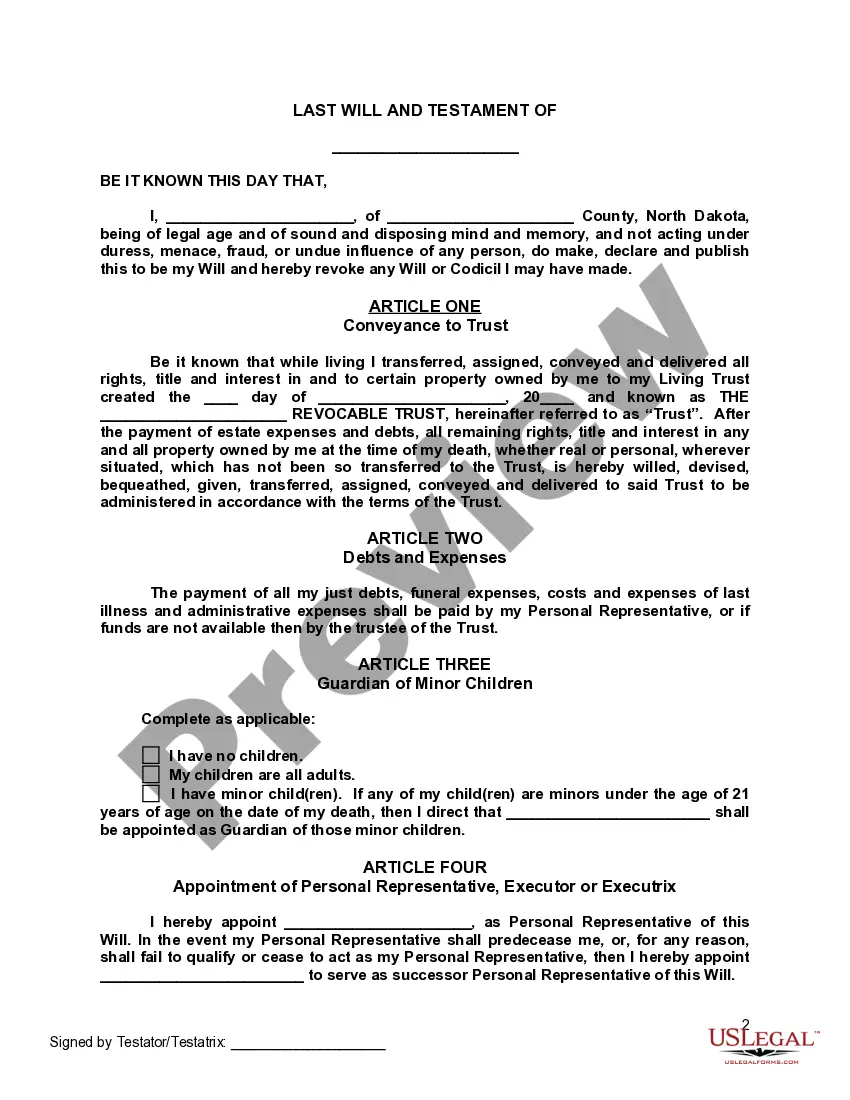
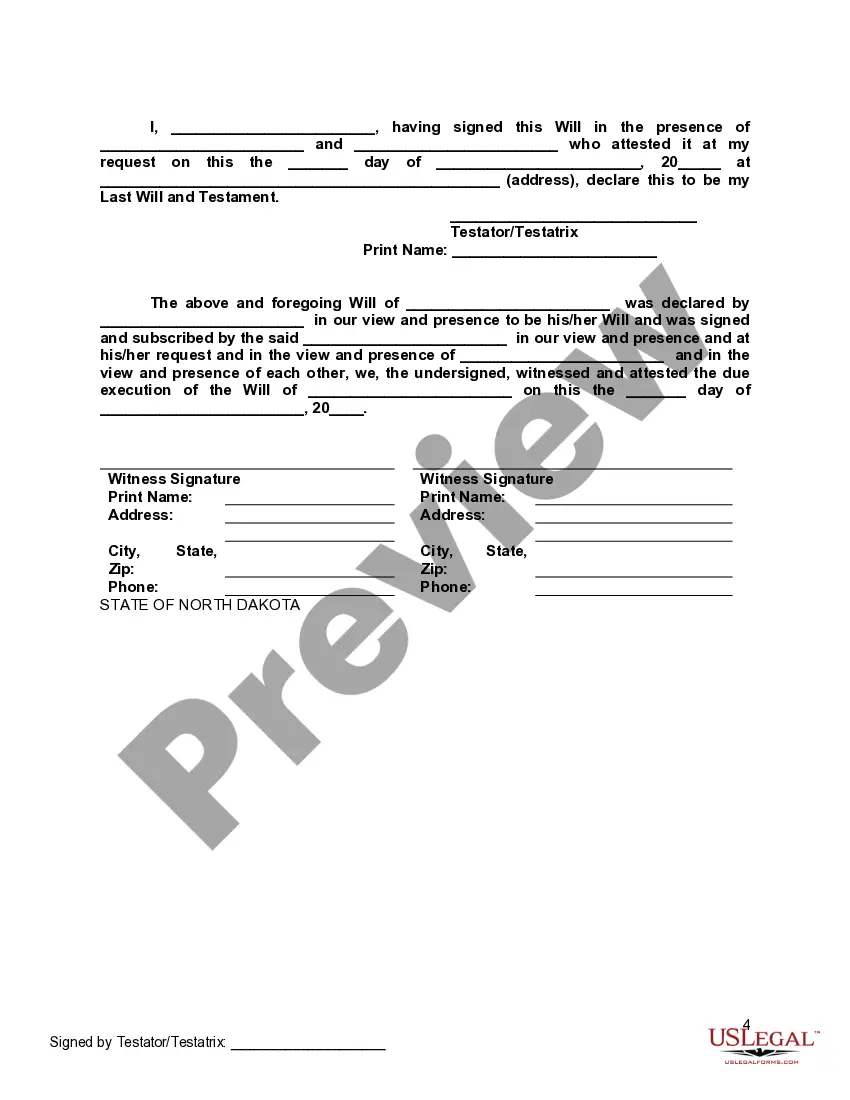
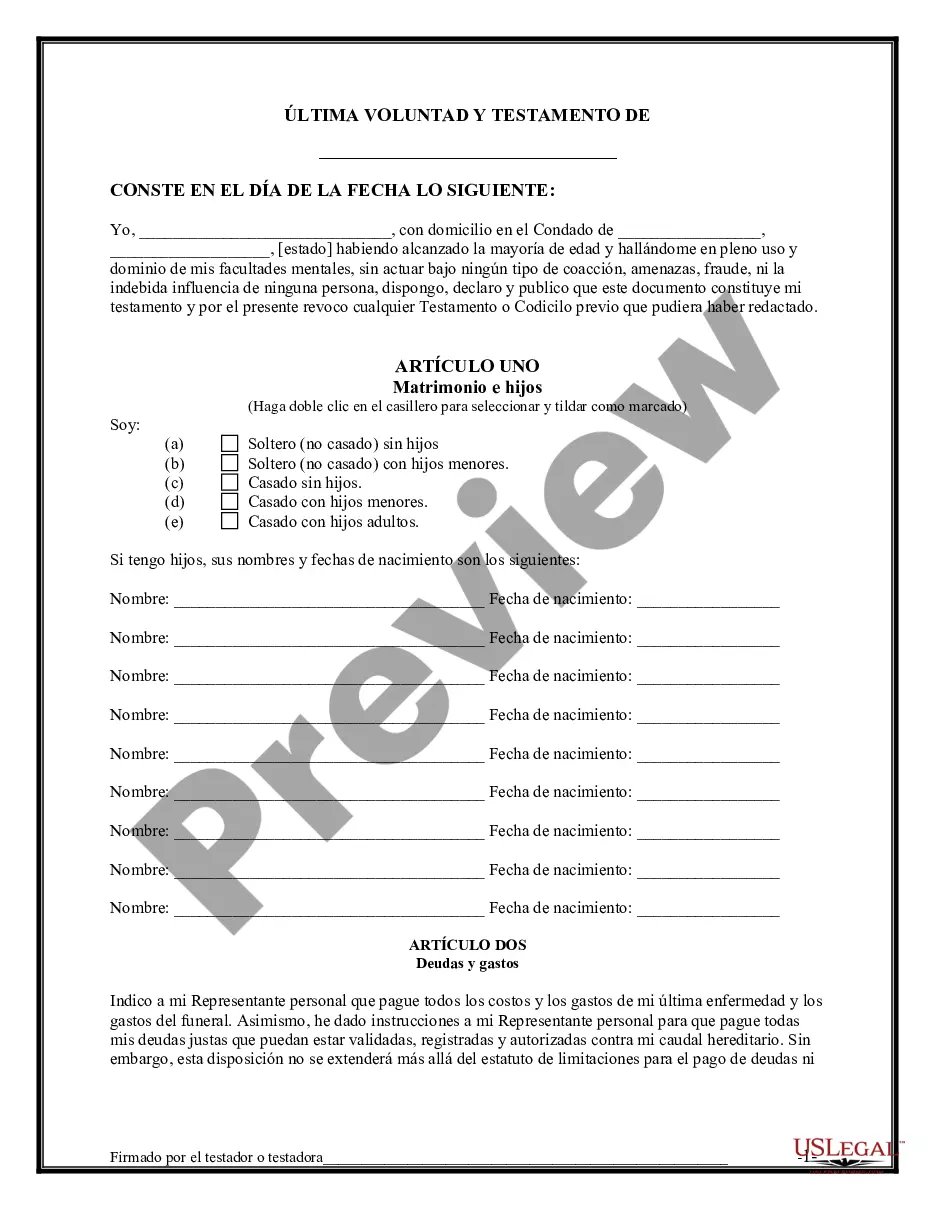
The Last Will and Testament known as a Pour Over Will is a legal document that allows individuals to direct that all their property not already transferred into a Living Trust will be transferred to that trust upon their death. This specific type of will ensures that any assets overlooked during the lifetime of the testator are still managed according to the terms of the trust, rather than being dispersed according to state laws. Unlike a standard will, a Pour Over Will serves in conjunction with a Living Trust, making it a vital tool for effective estate planning.
Key parts of this document
- Article One: Specifies the transfer of assets to the trust upon the testator's death.
- Article Two: Addresses the payment of debts and expenses from the estate before the distribution of assets.
- Article Three: Provides an option to appoint a guardian for minor children, if applicable.
- Article Four: Designates a Personal Representative to execute the will.
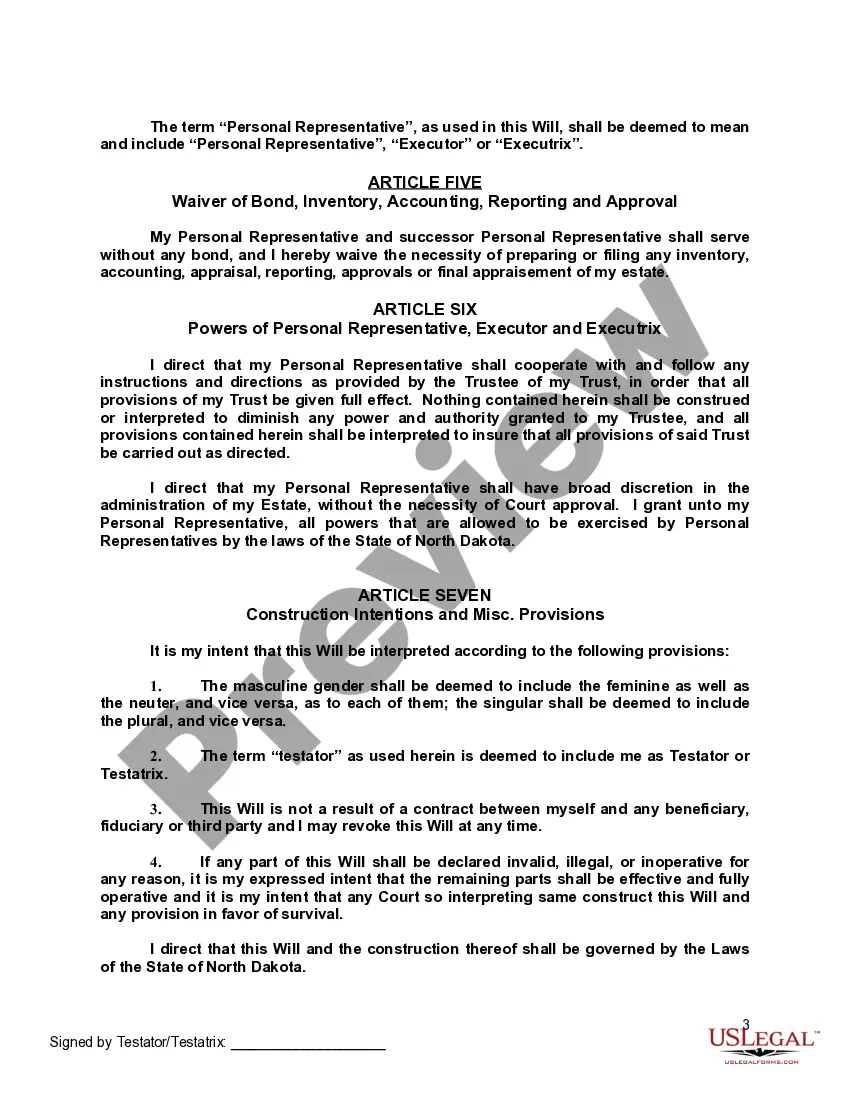
- Article Six: Outlines the powers granted to the Personal Representative for estate administration without court approval.
- Article Seven: Details the intentions of the testator and legal governing laws of the will.


When this form is needed
This form is ideal for individuals who have established a Living Trust but want to ensure that any remaining assets at the time of their death are still distributed according to their wishes. It is particularly useful for those who may have acquired new assets, or for those intending to avoid intestacy laws by directing their remaining properties to their trust.
Who should use this form
- Individuals who have established or are establishing a Living Trust.
- Testators looking to consolidate their estate planning documents for clear asset distribution.
- There are minor children or dependents for whom guardianship decisions are necessary.
- Those who wish to minimize the potential for probate disputes.
Completing this form step by step
- Identify yourself as the testator and provide your contact details.
- Specify the title and date of your Living Trust to connect the will with the trust.
- Name your Personal Representative, who will oversee the execution of your will.
- Fill in details such as the designation of guardians for minor children, if applicable.
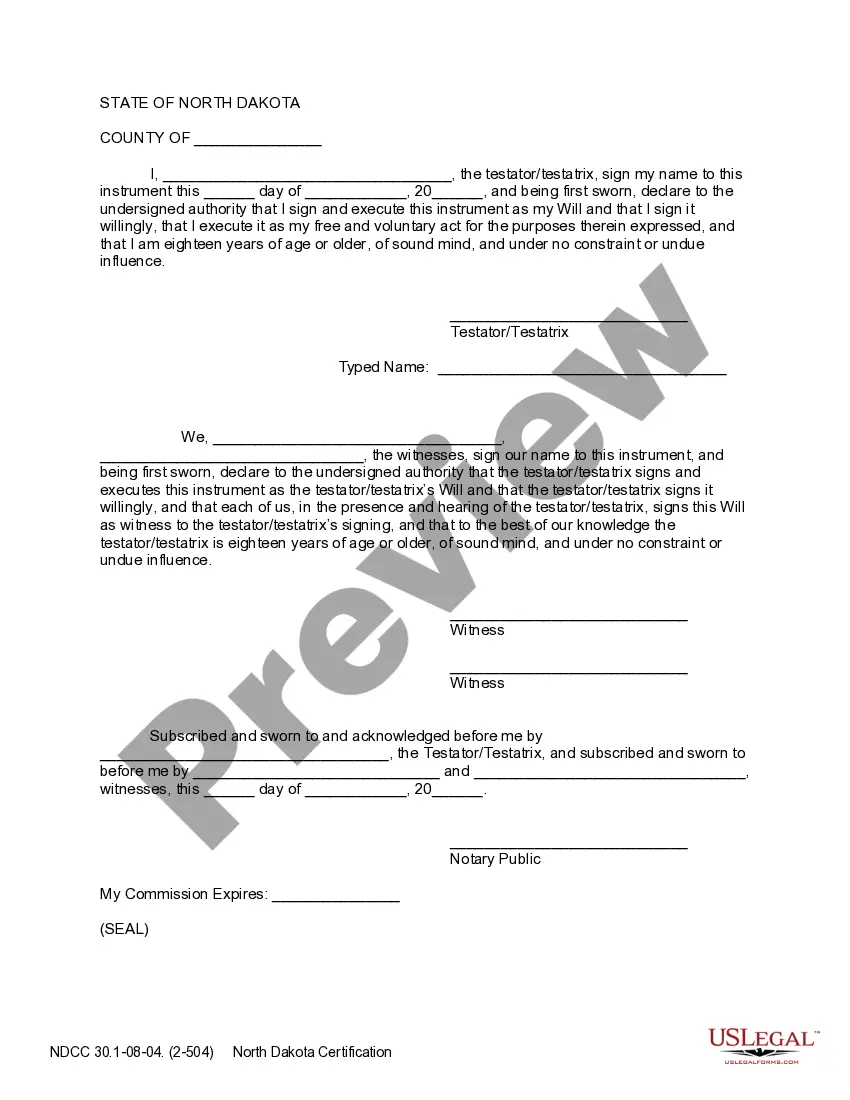
- Ensure all necessary signatures and witness notations are included for the document's validity.
Is notarization required?
This document requires notarization to meet legal standards. US Legal Forms provides secure online notarization powered by Notarize, allowing you to complete the process through a verified video call, available 24/7.
Get your form ready online
Our built-in tools help you complete, sign, share, and store your documents in one place.
Make edits, fill in missing information, and update formatting in US Legal Forms—just like you would in MS Word.
Download a copy, print it, send it by email, or mail it via USPS—whatever works best for your next step.
Sign and collect signatures with our SignNow integration. Send to multiple recipients, set reminders, and more. Go Premium to unlock E-Sign.
If this form requires notarization, complete it online through a secure video call—no need to meet a notary in person or wait for an appointment.
We protect your documents and personal data by following strict security and privacy standards.

Make edits, fill in missing information, and update formatting in US Legal Forms—just like you would in MS Word.

Download a copy, print it, send it by email, or mail it via USPS—whatever works best for your next step.

Sign and collect signatures with our SignNow integration. Send to multiple recipients, set reminders, and more. Go Premium to unlock E-Sign.

If this form requires notarization, complete it online through a secure video call—no need to meet a notary in person or wait for an appointment.

We protect your documents and personal data by following strict security and privacy standards.
Mistakes to watch out for
- Failing to update the will after significant life changes, such as marriage or the birth of children.
- Not naming an alternate Personal Representative in case the primary cannot fulfill their duties.
- Neglecting the requirement for witness signatures, which can invalidate the will.
- Forgetting to check the compatibility of the will with the existing Living Trust.
Advantages of online completion
- Convenient access to legal documents that can be completed at your own pace.
- Editable format allows customization to suit individual needs without needing to start from scratch.
- Reliability from a trusted source ensures the form meets legal standards.
Quick recap
- A Pour Over Will ensures all assets not placed in a Living Trust are directed to it upon death.
- This form is crucial for comprehensive estate planning, particularly for individuals with minor children.
- It's important to keep the will updated in conjunction with your Living Trust to ensure it reflects your current wishes.
Looking for another form?
Form popularity
FAQ
A Living Trust is a document that allows individual(s), or 'Grantor', to place their assets to the benefit of someone else at their death or incapacitation. Unlike a Will, a Trust does not go through the probate process with the court.
No, you don't need a lawyer to set up a trust, but it might be a good idea to seek legal advice to ensure the trust is set up correctly and that you have considered all long-term financial and estate planning aspects of the trust.Some living trusts are revocable, which means the trust can be changed at any time.
Deciding between a will or a trust is a personal choice, and some experts recommend having both. A will is typically less expensive and easier to set up than a trust, an expensive and often complex legal document.
Pick a type of living trust. If you're married, you'll first need to decide whether you want a single or joint trust. Take stock of your property. Choose a trustee. Draw up the trust document. Sign the trust. Transfer your property to the trust.
Find an online template or service. Make a list of your assets. Be specific about who gets what. If you have minor children, choose a guardian. Give instructions for your pet. Choose an executor. Name a 'residuary beneficiary' List your funeral preferences.
One main difference between a will and a trust is that a will goes into effect only after you die, while a trust takes effect as soon as you create it. A will is a document that directs who will receive your property at your death and it appoints a legal representative to carry out your wishes.
Bank accounts. Brokerage or investment accounts. Retirement accounts and pension plans. A life insurance policy.
Sure you can write your own revocable living trust. In fact, you can do it better than a lot of the attorneys. First you have to ascertain that you really want a trust.This is true whether you are preparing a revocable living trust, corporate bylaws, LLC documents, or any other legal documents.
This should include the titles and deeds to real property, bank account information, investment accounts, stock certificates, life insurance policies, and other assets you will be using to fund the trust. Having this information available will make it easier to prepare your trust distribution provisions.