Montana Quitclaim Deed from Individual to Two Individuals in Joint Tenancy
What is this form?
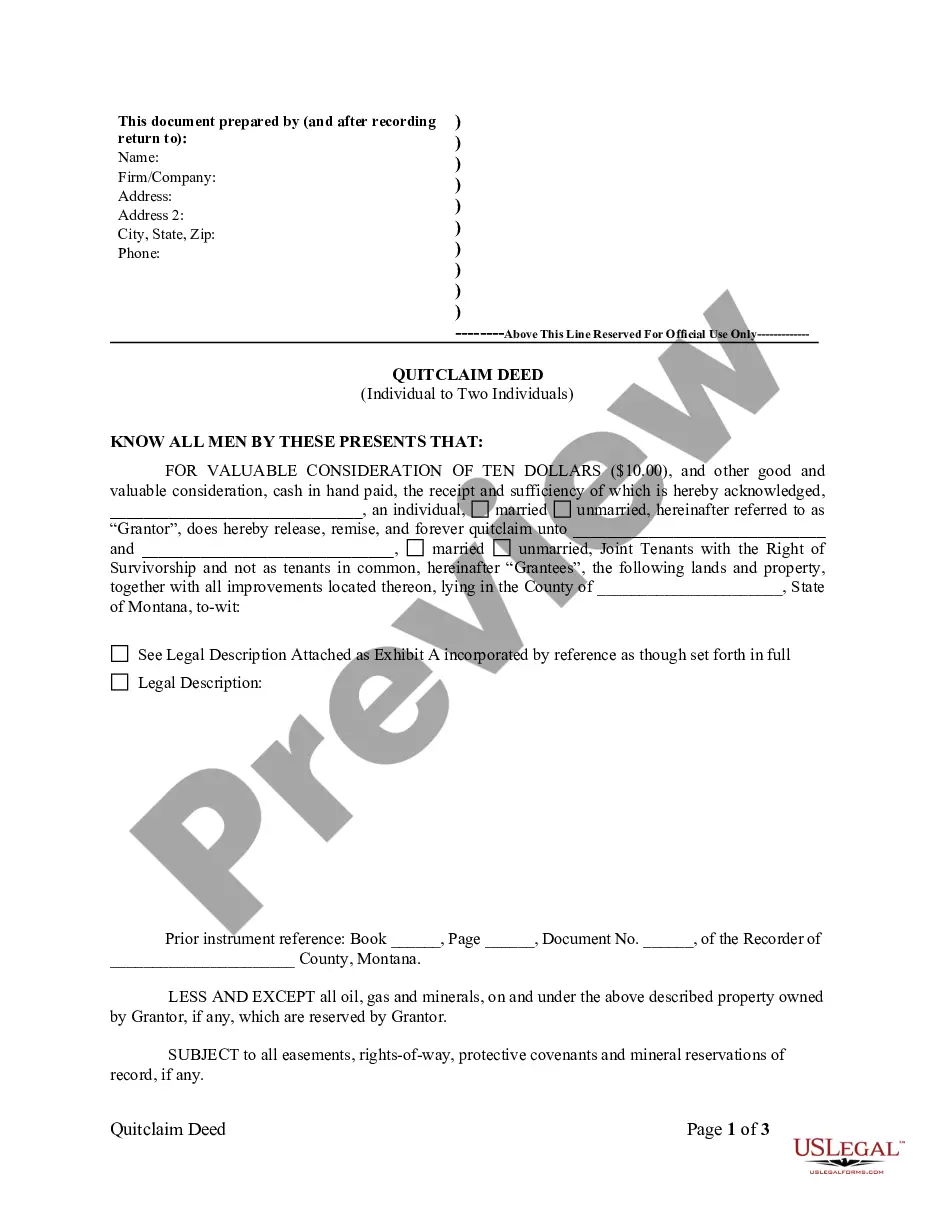
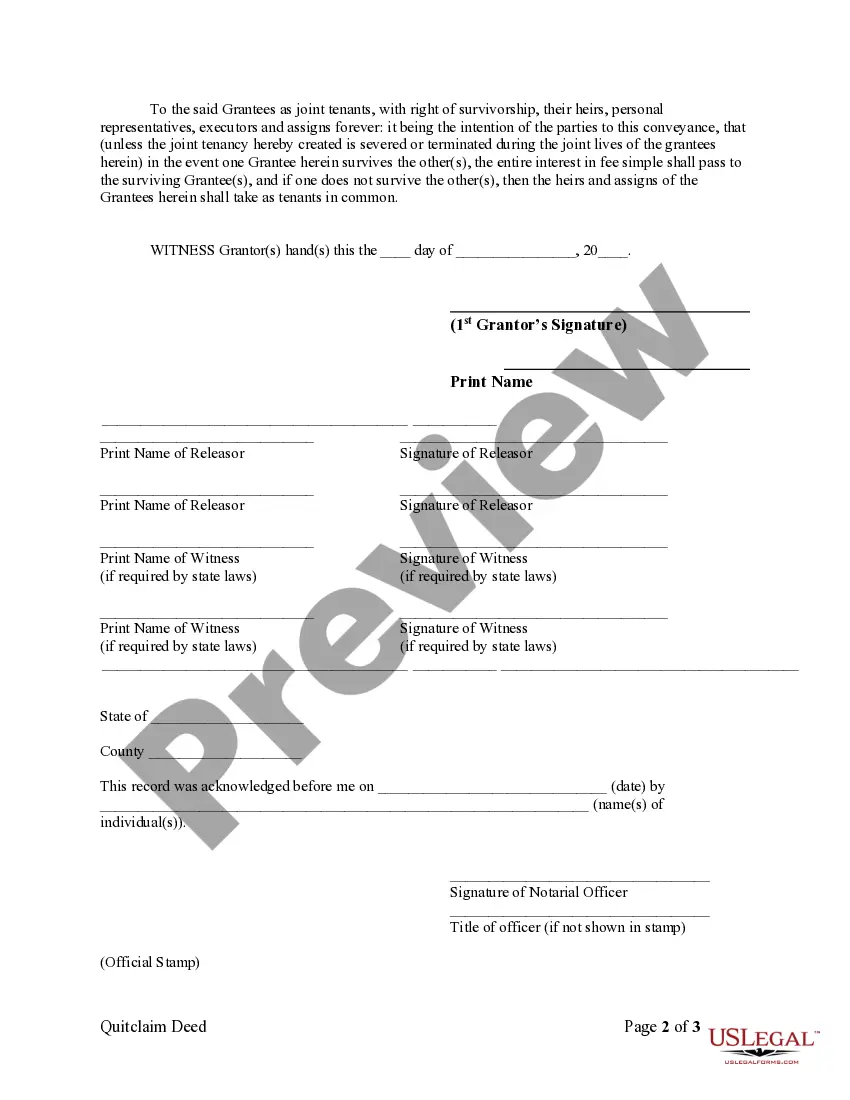
The Quitclaim Deed from Individual to Two Individuals in Joint Tenancy is a legal document that allows an individual (the Grantor) to transfer ownership of real property to two individuals (the Grantees) who will hold the property as joint tenants. This type of deed differs from warranty deeds since it does not guarantee that the Grantor holds clear title to the property. The key feature of this form is establishing joint tenancy with the right of survivorship, meaning that if one Grantee passes away, their share of the property automatically transfers to the surviving Grantee(s).
Key parts of this document
- Identification of the Grantor and Grantees
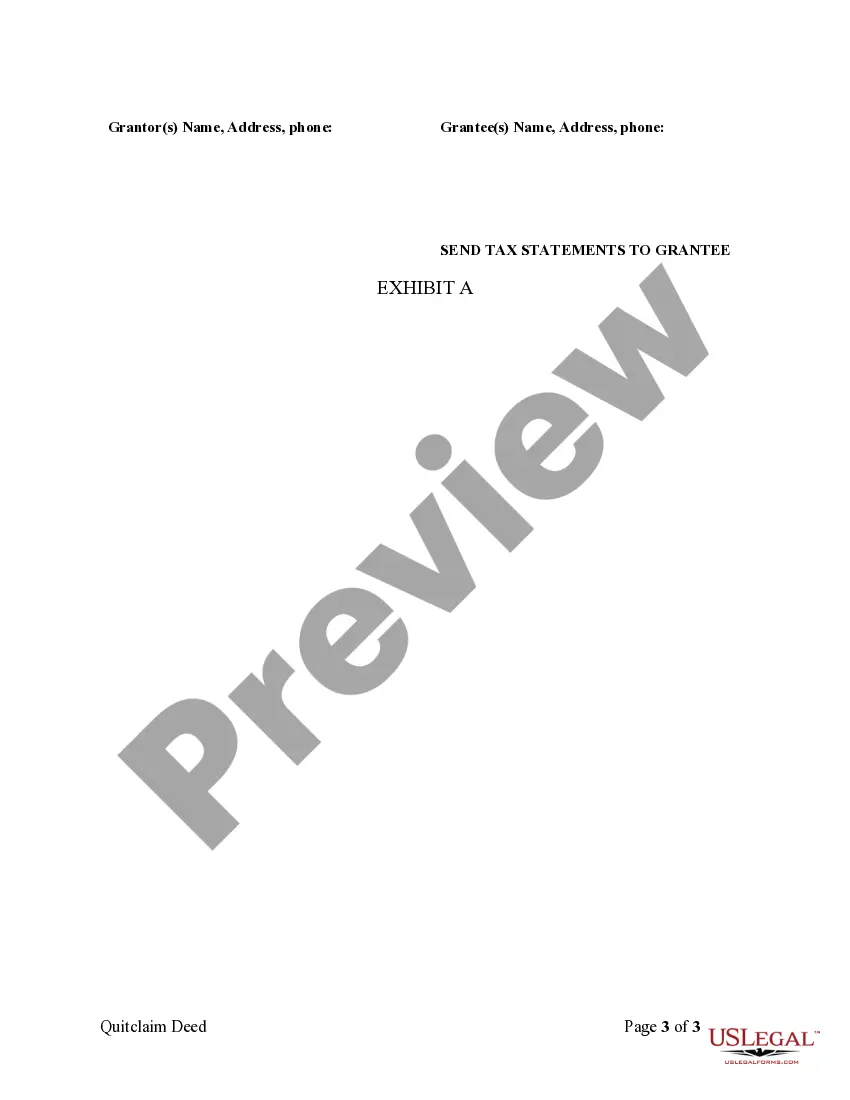
- A clear description of the property being transferred
- Provisions regarding the joint tenancy and right of survivorship
- Reservation of certain rights by the Grantor, such as mineral rights
- Signatures of the Grantor, witnesses, and notarization details





Common use cases
This form should be used when an individual wishes to transfer real estate ownership to two parties who will share the property as joint tenants. This may arise in situations such as transferring property between family members, partners, or friends. It is relevant in cases where the parties want to ensure that ownership passes directly to the surviving joint tenant(s) upon the death of one owner.
Who this form is for
This form is appropriate for:
- Property owners looking to transfer their interest to two individuals
- Couples or partners wanting to hold property together with survivorship rights
- Individuals transferring property to family members as part of an estate plan
Instructions for completing this form
- Identify the parties: Clearly name the Grantor and the two Grantees.
- Specify the property: Provide a detailed legal description of the property being transferred.
- Include the reservation: Indicate if any rights are being reserved by the Grantor, such as mineral rights.
- Sign the document: The Grantor must sign, and if required, have witnesses sign the document.
- Notarize the deed: Ensure the form is notarized if required by state law.
Does this form need to be notarized?
This document requires notarization to meet legal standards. US Legal Forms provides secure online notarization powered by Notarize, allowing you to complete the process through a verified video call, available 24/7.
Get your form ready online
Our built-in tools help you complete, sign, share, and store your documents in one place.
Make edits, fill in missing information, and update formatting in US Legal Forms—just like you would in MS Word.
Download a copy, print it, send it by email, or mail it via USPS—whatever works best for your next step.
Sign and collect signatures with our SignNow integration. Send to multiple recipients, set reminders, and more. Go Premium to unlock E-Sign.
If this form requires notarization, complete it online through a secure video call—no need to meet a notary in person or wait for an appointment.
We protect your documents and personal data by following strict security and privacy standards.

Make edits, fill in missing information, and update formatting in US Legal Forms—just like you would in MS Word.

Download a copy, print it, send it by email, or mail it via USPS—whatever works best for your next step.

Sign and collect signatures with our SignNow integration. Send to multiple recipients, set reminders, and more. Go Premium to unlock E-Sign.

If this form requires notarization, complete it online through a secure video call—no need to meet a notary in person or wait for an appointment.

We protect your documents and personal data by following strict security and privacy standards.
Avoid these common issues
- Failing to include a complete legal description of the property.
- Not having the required number of witnesses or notarization.
- Omitting the reservation of rights if applicable.
- Incorrectly identifying the parties involved.
Why complete this form online
- Convenient access to professionally drafted legal forms.
- Immediate download and printing capabilities.
- Editable templates allow users to customize their information easily.
- Compliance with state laws ensures the form's validity.
Looking for another form?








Form popularity
FAQ
Recording This form must be filed with the County Clerk and Recorder's Office in the jurisdiction where the land is located (See County Website List). Signing (§ 70-21-203) A quit claim deed that is filed in Montana must be witnessed by a Notary Public upon the signature(s) of the Grantor(s).
Discuss property ownership interests. Access a copy of your title deed. Complete, review and sign the quitclaim or warranty form. Submit the quitclaim or warranty form. Request a certified copy of your quitclaim or warranty deed.
A Quitclaim Deed must be notarized by a notary public or attorney in order to be valid.Consideration in a Quitclaim Deed is what the Grantee will pay to the Grantor for the interest in the property.
They are commonly used to add/remove someone to/from real estate title or deed (divorce, name changes, family and trust transfers). The quitclaim deed is a legal document (deed) used to transfer interest in real estate from one person or entity (grantor) to another (grantee).
Fill out the quit claim deed form, which can be obtained online, or write your own using the form as a guide. The person giving up the interest in the property is the grantor, and the person receiving the interest is the grantee.
But you might be wondering if an owner can transfer a deed to another person without a real estate lawyer. The answer is yes. Parties to a transaction are always free to prepare their own deeds.A quitclaim deed, for example, is far simpler than a warranty deed.
When done properly, a deed is recorded anywhere from two weeks to three months after closing. However, there are many instances where deeds are not properly recorded. Title agents commit errors, lose deeds, and even go out of business. Even county offices sometimes fail to record deeds that were properly submitted.
Filing a quitclaim deed is a right of any property owner. You can file a quitclaim deed without refinancing your mortgage, but you are still responsible for the payments. Transferring the mortgage without refinancing is possible through an assumption of the loan, which requires lender approval.