Mississippi Warranty Deed to Separate Property of One Spouse to Both Spouses as Joint Tenants
About this form
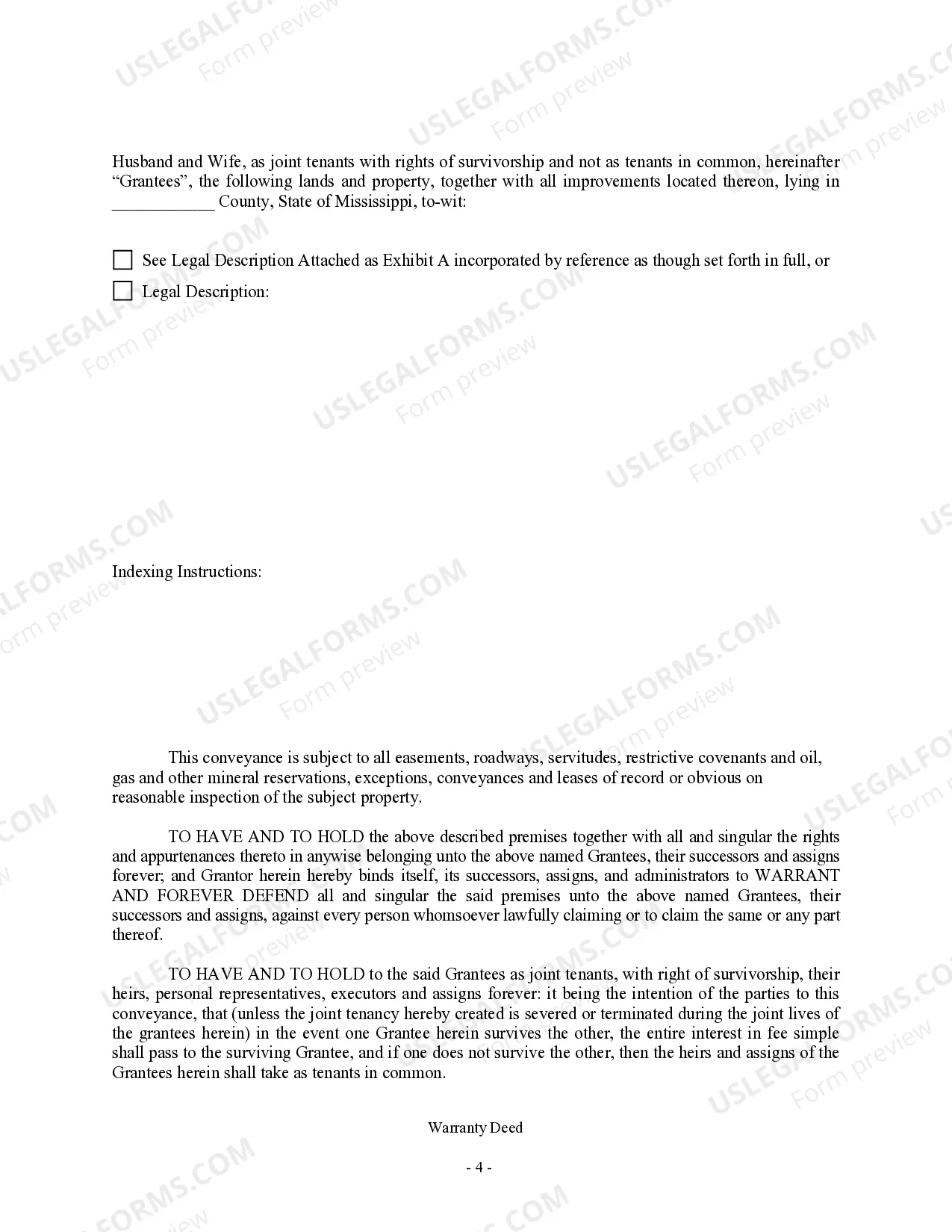
The Warranty Deed to Separate Property of One Spouse to Both Spouses as Joint Tenants is a legal document that allows one spouse to transfer property they solely own to both spouses as joint tenants. Unlike other types of deeds, this form specifically addresses the transfer of separate property into joint ownership, ensuring that both spouses have equal rights to the property now and in the event of one spouse's death, at which point the other spouse automatically inherits the property.
Key components of this form
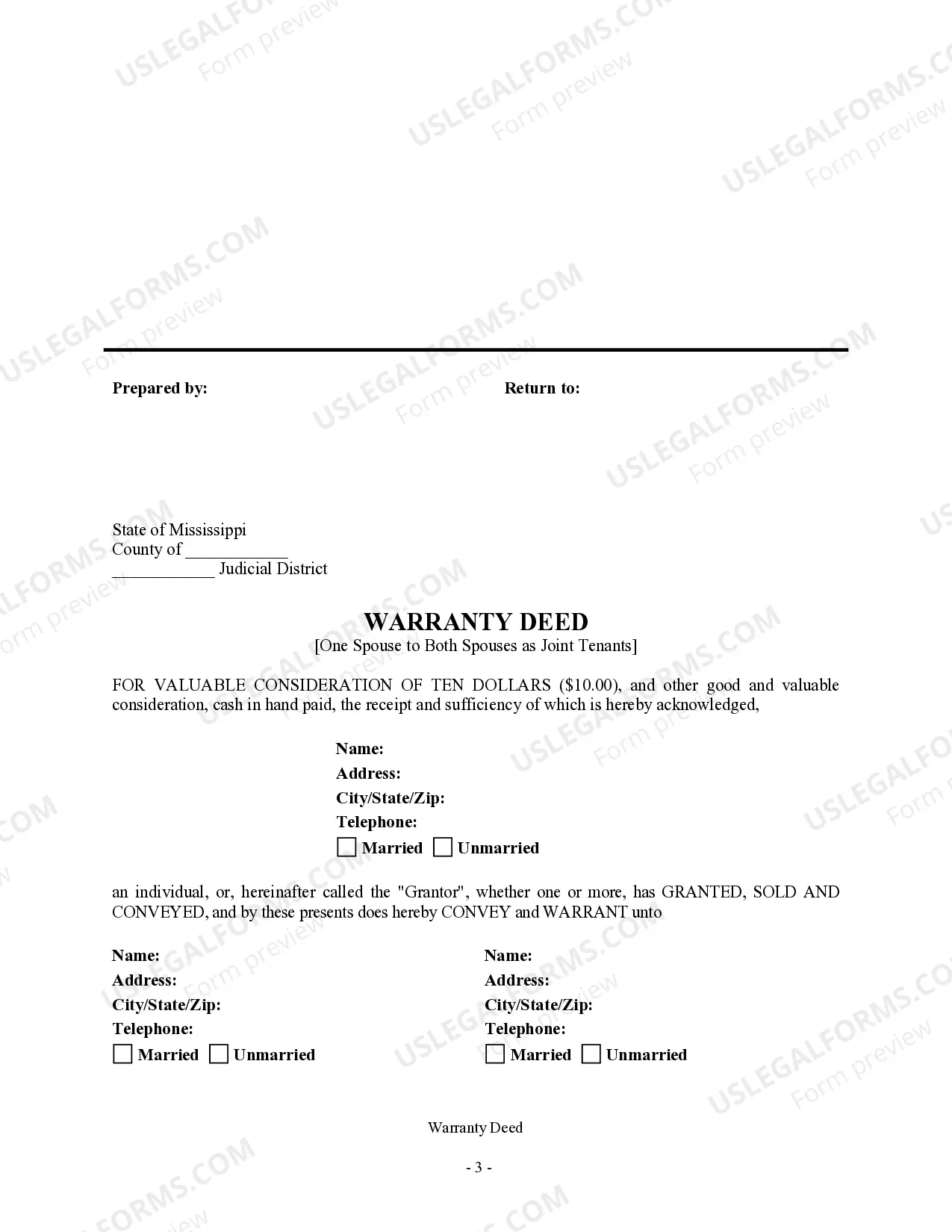
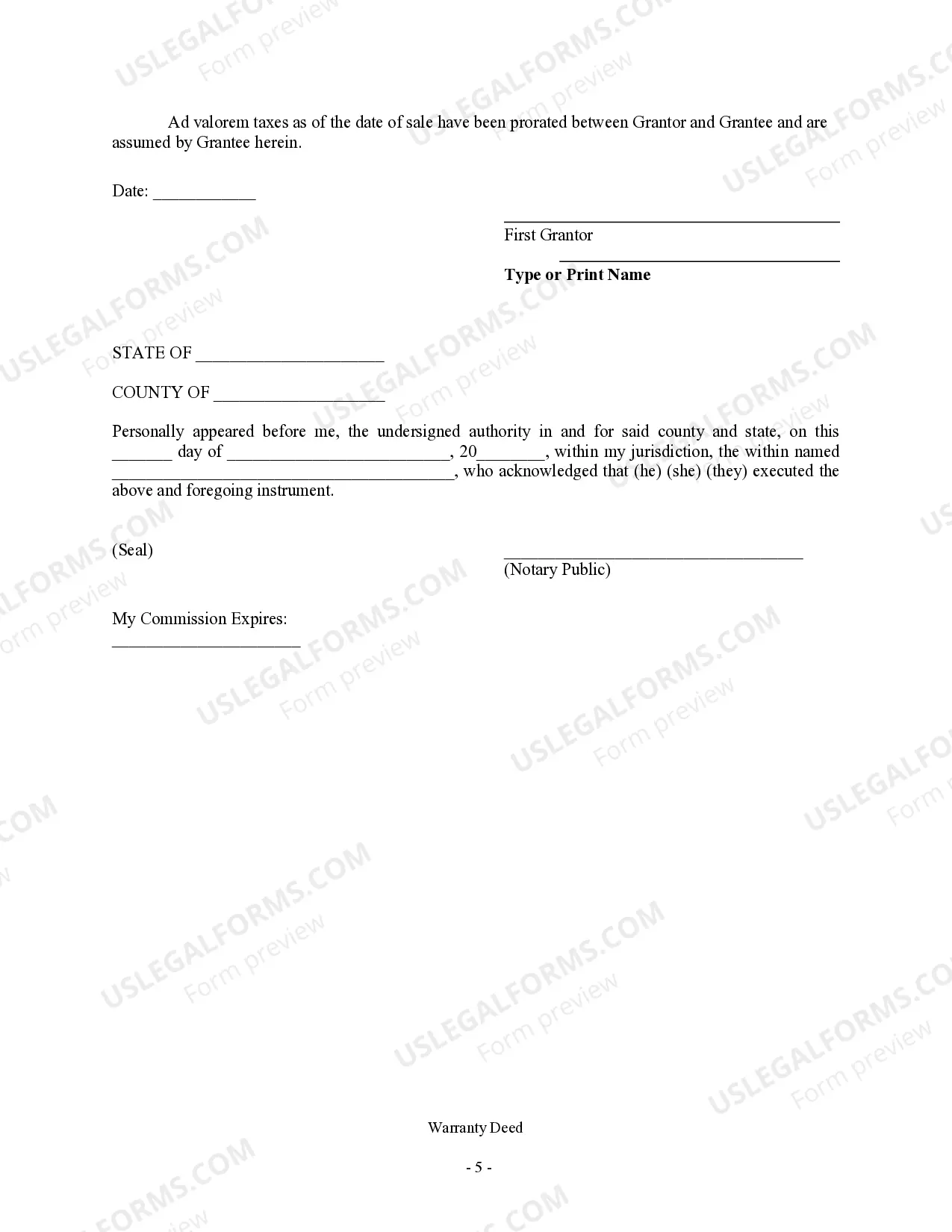
- Grantor and Grantee Information: Details identifying the transferring spouse (grantor) and the receiving spouses (grantees).
- Property Description: A section to clearly define the property being conveyed, typically referenced as an attachment.
- Consideration Clause: A statement acknowledging the valuable consideration involved in the transfer.
- Joint Tenancy Clause: Legal language that outlines the rights of survivorship between the spouses.
- Signatures and Notarization: Spaces for the grantor's signature and notary acknowledgment.




When to use this document
This form should be used when one spouse wishes to transfer ownership of their separate property to both spouses as joint tenants. Common scenarios include marriage where one spouse previously owned property, or when one spouse wants to ensure that upon their death, the property automatically passes to the surviving spouse without the need for probate proceedings.
Who should use this form
This form is intended for:
- Married couples looking to establish joint ownership of property.
- Individuals who own property solely in their name and want to include their spouse in ownership.
- Spouses seeking to ensure that their property transfers smoothly to the surviving partner in the event of death.
Instructions for completing this form
- Identify the parties involved by filling in the names of the grantor and the grantees.
- Specify the property being transferred by accurately describing its location and legal boundaries.
- Enter the date of transfer and any consideration amount, typically signified as ten dollars for legal purposes.
- Ensure that both spouses sign the document to validate the transfer.
- Have the document notarized to meet legal requirements.
Does this document require notarization?
Yes, this form must be notarized to be legally valid. Notarization adds an additional layer of security and helps prevent fraud. US Legal Forms offers integrated online notarization, available 24/7 through secure video calls, ensuring easy access without the need for travel.
Get your form ready online
Our built-in tools help you complete, sign, share, and store your documents in one place.
Make edits, fill in missing information, and update formatting in US Legal Forms—just like you would in MS Word.
Download a copy, print it, send it by email, or mail it via USPS—whatever works best for your next step.
Sign and collect signatures with our SignNow integration. Send to multiple recipients, set reminders, and more. Go Premium to unlock E-Sign.
If this form requires notarization, complete it online through a secure video call—no need to meet a notary in person or wait for an appointment.
We protect your documents and personal data by following strict security and privacy standards.

Make edits, fill in missing information, and update formatting in US Legal Forms—just like you would in MS Word.

Download a copy, print it, send it by email, or mail it via USPS—whatever works best for your next step.

Sign and collect signatures with our SignNow integration. Send to multiple recipients, set reminders, and more. Go Premium to unlock E-Sign.

If this form requires notarization, complete it online through a secure video call—no need to meet a notary in person or wait for an appointment.

We protect your documents and personal data by following strict security and privacy standards.
Common mistakes to avoid
- Failing to provide a complete and accurate property description.
- Not securing notarization, which may lead to invalidation of the deed.
- Neglecting to ensure both spouses sign the document.
Why complete this form online
- Convenient access to legally drafted templates tailored for various states.
- Editable fields allow for easy completion on your computer.
- Immediate availability without the need to visit an attorney in person.
Looking for another form?


Form popularity
FAQ
What Is the Difference Between a Warranty Deed & a Survivorship Deed?A warranty deed is the most comprehensive and provides the most guarantees. Survivorship isn't so much a deed as a title. It's a way to co-own property where, upon the death of one owner, ownership automatically passes to the survivor.
In California, most married couples hold real property (such as land and buildings) as joint tenants with right of survivorship.For instance, many married couples share real property as joint tenants. This way, upon the death of a spouse, the surviving spouse will own 100% share of the property.
In estate law, joint tenancy is a special form of ownership by two or more persons of the same property. The individuals, who are called joint tenants, share equal ownership of the property and have the equal, undivided right to keep or dispose of the property. Joint tenancy creates a Right of Survivorship.
The term joint tenancy refers to a legal arrangement in which two or more people own a property together, each with equal rights and obligations. Joint tenancies can be created by married and non-married couples, friends, relatives, and business associates.
Each party has a full ownership interest in the property. The property will pass instantly to the survivor upon the death of the other without probate. Conveyance by one party without the other breaks the joint tenancy. Seller warrants that he/she has good title and will warrant and defend title.
If you look at the registered title to your own jointly owned property and the text isn't shown on it, you own it as joint tenants. If it is there, you own it as tenants-in-common.
What is Community Property? Community property is also a form of co-ownership, but is applicable only between husband and wife. Like joint tenancy property, each spouse's interest in community property is equal during their marriage.
The dangers of joint tenancy include the following: Danger #1: Only delays probate. When either joint tenant dies, the survivor usually a spouse or child immediately becomes the owner of the entire property. But when the survivor dies, the property still must go through probate.
For example, joint tenants must all take title simultaneously from the same deed while tenants in common can come into ownership at different times. Another difference is that joint tenants all own equal shares of the property, proportionate to the number of joint tenants involved.