Minnesota Letter from Tenant to Landlord about Fair Housing Reduction or Denial of services to Family with Children
Overview of this form
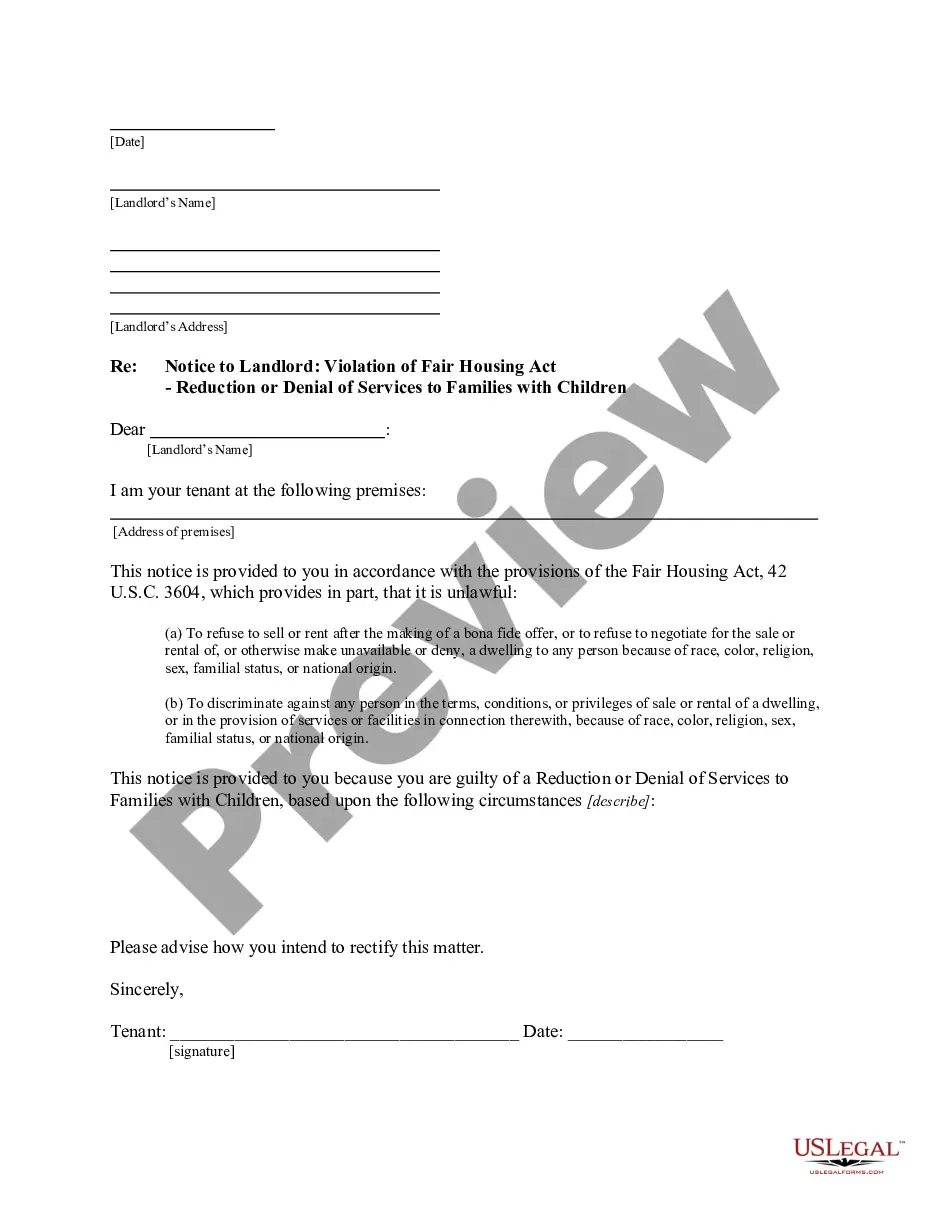
This form is a letter from a tenant to their landlord addressing violations of the Fair Housing Act. It specifically pertains to instances where the landlord reduces or denies services to families with children. This form is crucial for tenants who believe they are facing discrimination, as it formally notifies the landlord of their actions and seeks remedy. Unlike more general housing complaint forms, this letter directly addresses familial status discrimination.
Main sections of this form
- Identification of the tenant and landlord involved.
- A statement of the specific Fair Housing Act violations.
- Description of the reduction or denial of services experienced.
- Reference to the legal provisions against discrimination.
- A request for corrective action by the landlord.

When to use this form
This form should be used in situations where a tenant feels that their landlord has unlawfully discriminated against their family due to having children. Common scenarios include instances where facilities or services that are typically available to all tenants are denied to a family with children. It may also be necessary when a landlord refuses to negotiate rental terms targeted at families, thereby violating fair housing laws.
Who should use this form
- Tenants with children who believe they are facing discrimination from their landlord.
- Parents or guardians who have encountered reduced or denied services related to their housing situation.
- Anyone seeking to formally notify their landlord of suspected violations of the Fair Housing Act.
Instructions for completing this form
- Identify and fill in your name and address as the tenant.
- Include the name and address of your landlord.
- Detail the discriminatory actions or denial of services experienced.
- Reference relevant provisions of the Fair Housing Act.
- Clearly state your request for corrective action.
Notarization requirements for this form
This form does not typically require notarization unless specified by local law. It is advisable to check state-specific regulations to ensure compliance.
Get your form ready online
Our built-in tools help you complete, sign, share, and store your documents in one place.
Make edits, fill in missing information, and update formatting in US Legal Forms—just like you would in MS Word.
Download a copy, print it, send it by email, or mail it via USPS—whatever works best for your next step.
Sign and collect signatures with our SignNow integration. Send to multiple recipients, set reminders, and more. Go Premium to unlock E-Sign.
If this form requires notarization, complete it online through a secure video call—no need to meet a notary in person or wait for an appointment.
We protect your documents and personal data by following strict security and privacy standards.

Make edits, fill in missing information, and update formatting in US Legal Forms—just like you would in MS Word.

Download a copy, print it, send it by email, or mail it via USPS—whatever works best for your next step.

Sign and collect signatures with our SignNow integration. Send to multiple recipients, set reminders, and more. Go Premium to unlock E-Sign.

If this form requires notarization, complete it online through a secure video call—no need to meet a notary in person or wait for an appointment.

We protect your documents and personal data by following strict security and privacy standards.
Typical mistakes to avoid
- Failing to provide specific details about the violation.
- Not clearly identifying the landlord or tenant information.
- Using ambiguous language that may dilute the complaint.
- Neglecting to reference relevant legal provisions, which strengthens the claim.
Benefits of using this form online
- Convenient access to a tailored legal document at any time.
- Editable format allows for personal customization to fit individual situations.
- Guaranteed reliability as legal forms are drafted by licensed attorneys.
Legal use & context
- This letter serves as an official notice to the landlord and may be used as evidence in potential legal disputes.
- Filing this form preserves your rights under the Fair Housing Act while informing the landlord of the violation.
What to keep in mind
- This form addresses violations of the Fair Housing Act related to families with children.
- It serves as a formal notice to landlords, informing them of discriminatory practices.
- Completion of this form can help safeguard tenants' rights and initiate corrective actions.
Looking for another form?


Form popularity
FAQ
In Minnesota, fair housing laws prohibit discrimination in housing based on several protected classes, including family status. This means landlords cannot deny housing or services to families with children, making a Minnesota Letter from Tenant to Landlord about Fair Housing Reduction or Denial of services to Family with Children a crucial tool for tenants. It is essential to familiarize yourself with these laws to protect your rights effectively. Utilize resources from USLegalForms to better understand your options and ensure compliance with state regulations.
Yes, landlords often verify Emotional Support Animal (ESA) letters as part of their screening process. When you provide a Minnesota Letter from Tenant to Landlord about Fair Housing Reduction or Denial of services to Family with Children, landlords may contact the issuing professional to confirm its validity. Understanding this can help you prepare your documentation correctly and ensure it meets the necessary criteria. By using platforms like USLegalForms, you can create a compliant ESA letter that landlords will recognize.
In a fair housing complaint, you must prove that discrimination occurred based on protected classes, such as family status. Specifically, if you are filing a complaint related to a Minnesota Letter from Tenant to Landlord about Fair Housing Reduction or Denial of services to Family with Children, you need to demonstrate how the landlord's actions adversely affected your family. Gather evidence such as emails, text messages, or witness statements to support your claim. This documentation will strengthen your case and help you seek a resolution.
In a fair housing complaint, you must prove that discrimination occurred based on protected characteristics, such as familial status. This involves showing that a landlord denied housing or services specifically because you have children. A Minnesota Letter from Tenant to Landlord about Fair Housing Reduction or Denial of services to Family with Children can help clarify your position. Understanding these requirements will equip you to present your case effectively.
To support a fair housing complaint, gather evidence that demonstrates discrimination. This may include emails, text messages, or documented conversations with your landlord. A Minnesota Letter from Tenant to Landlord about Fair Housing Reduction or Denial of services to Family with Children can also serve as important documentation of your attempts to address the issue. Having a clear record will strengthen your case.
The most common basis for fair housing complaints often relates to discrimination against families with children. Landlords may refuse services or housing options due to the presence of minors. This is where a Minnesota Letter from Tenant to Landlord about Fair Housing Reduction or Denial of services to Family with Children can be pivotal. It's essential to understand your rights and advocate for fair treatment.
Children are generally considered occupants in a rental situation, not tenants. They do not sign the lease or have legal responsibilities under the rental agreement. However, families have rights that protect them under fair housing laws, ensuring that children are not discriminated against in housing situations. A Minnesota Letter from Tenant to Landlord about Fair Housing Reduction or Denial of services to Family with Children can help assert these rights.
The primary difference between an occupant and a tenant lies in the legal rights. A tenant has a lease agreement that grants them specific rights, while an occupant does not have a formal rental agreement. For families with children, understanding these distinctions can be crucial when discussing housing rights and fair practices. A Minnesota Letter from Tenant to Landlord about Fair Housing Reduction or Denial of services to Family with Children can clarify these concepts in your communication.
To write a reasonable accommodation letter, begin by stating your request clearly and concisely. Include relevant details about your situation, such as the need for adjustments due to family needs or fair housing rights. Utilize a Minnesota Letter from Tenant to Landlord about Fair Housing Reduction or Denial of services to Family with Children format to ensure you cover all essential points. This structured approach will help your landlord understand your needs effectively.
When communicating with your landlord, avoid making demands or using aggressive language. Instead, express your concerns respectfully and clearly. A Minnesota Letter from Tenant to Landlord about Fair Housing Reduction or Denial of services to Family with Children should focus on facts and your rights, rather than accusations. Keeping the tone professional can foster a more constructive dialogue.