Michigan Last Will and Testament for Single Person with No Children

Understanding this form
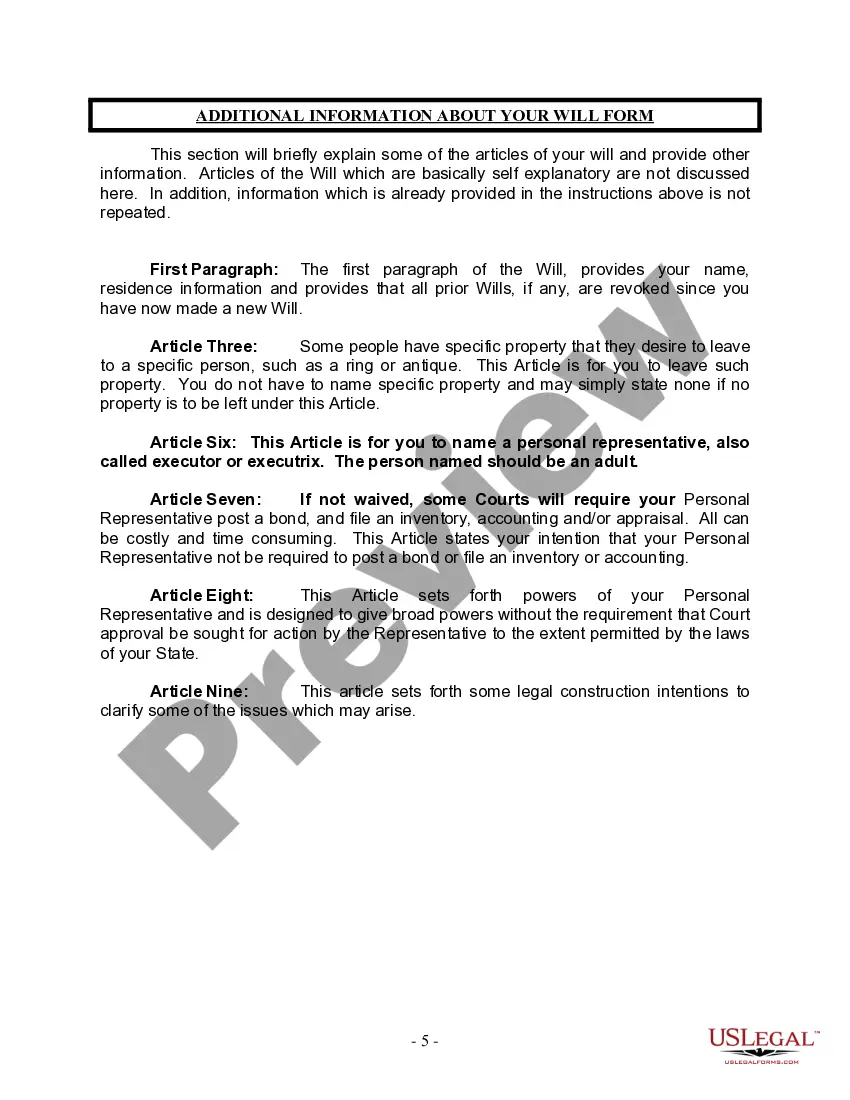
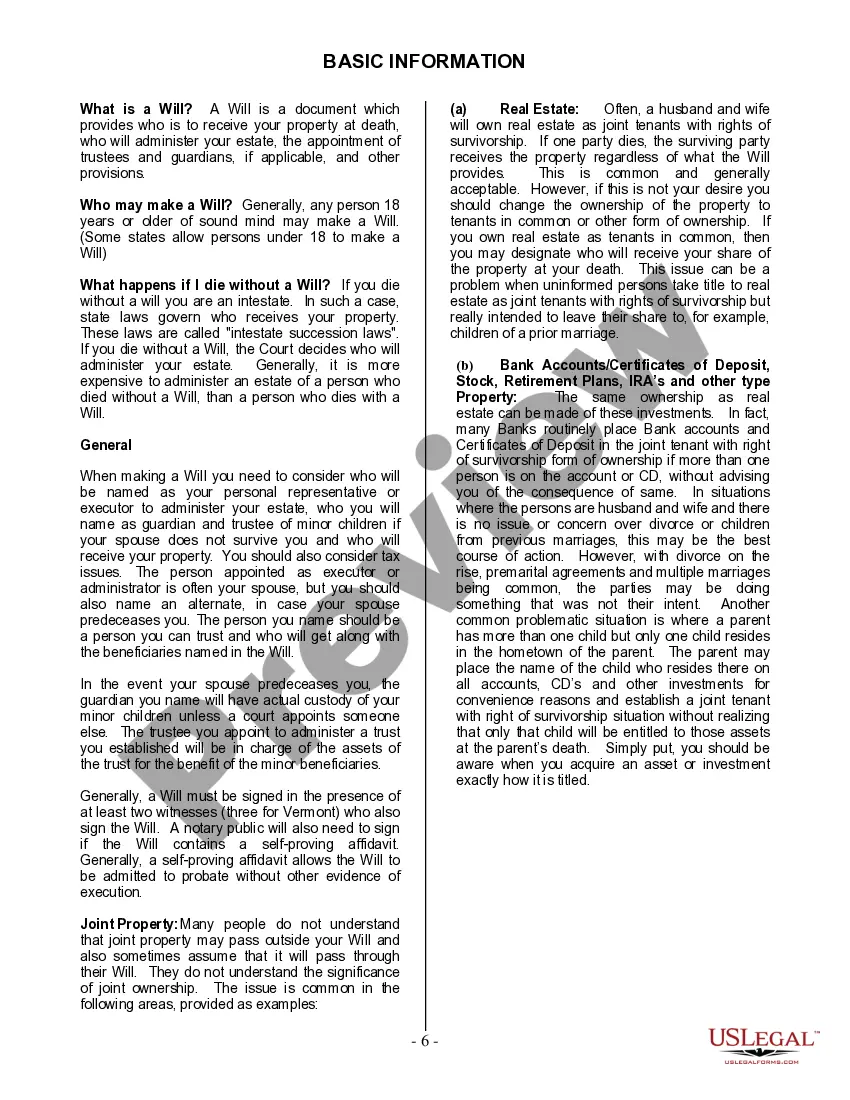
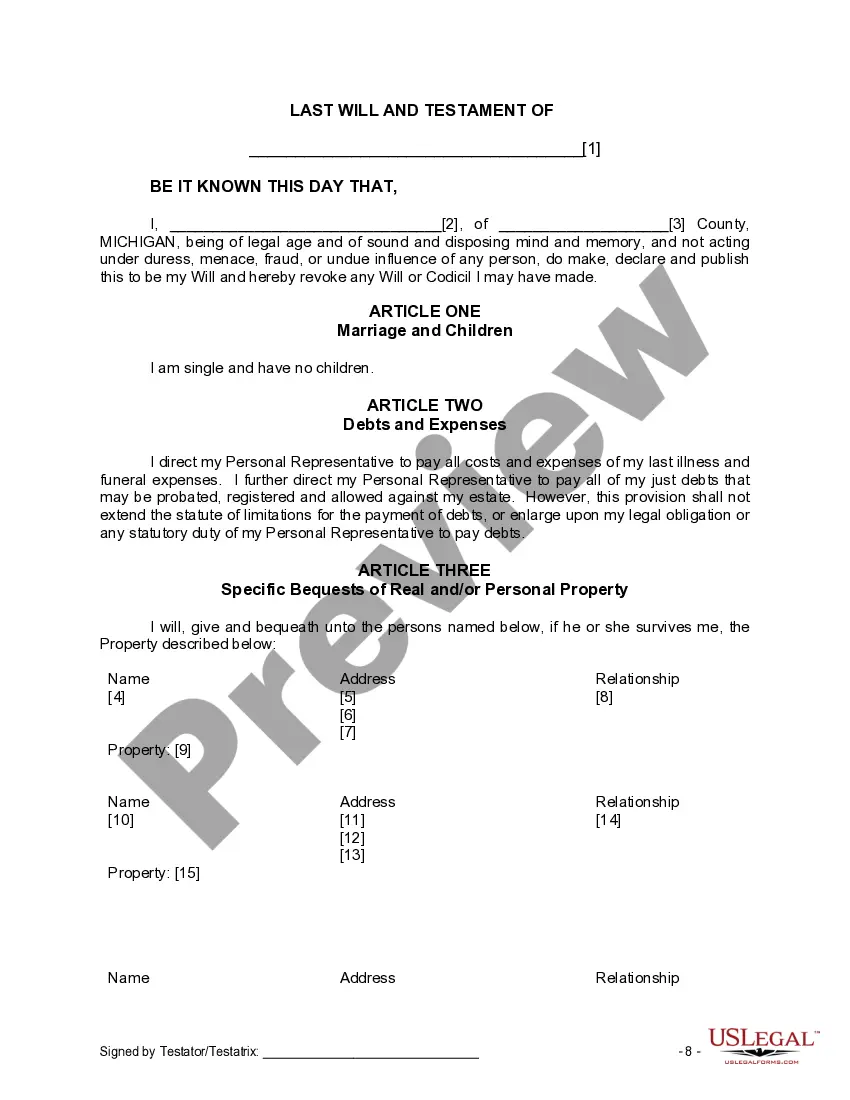
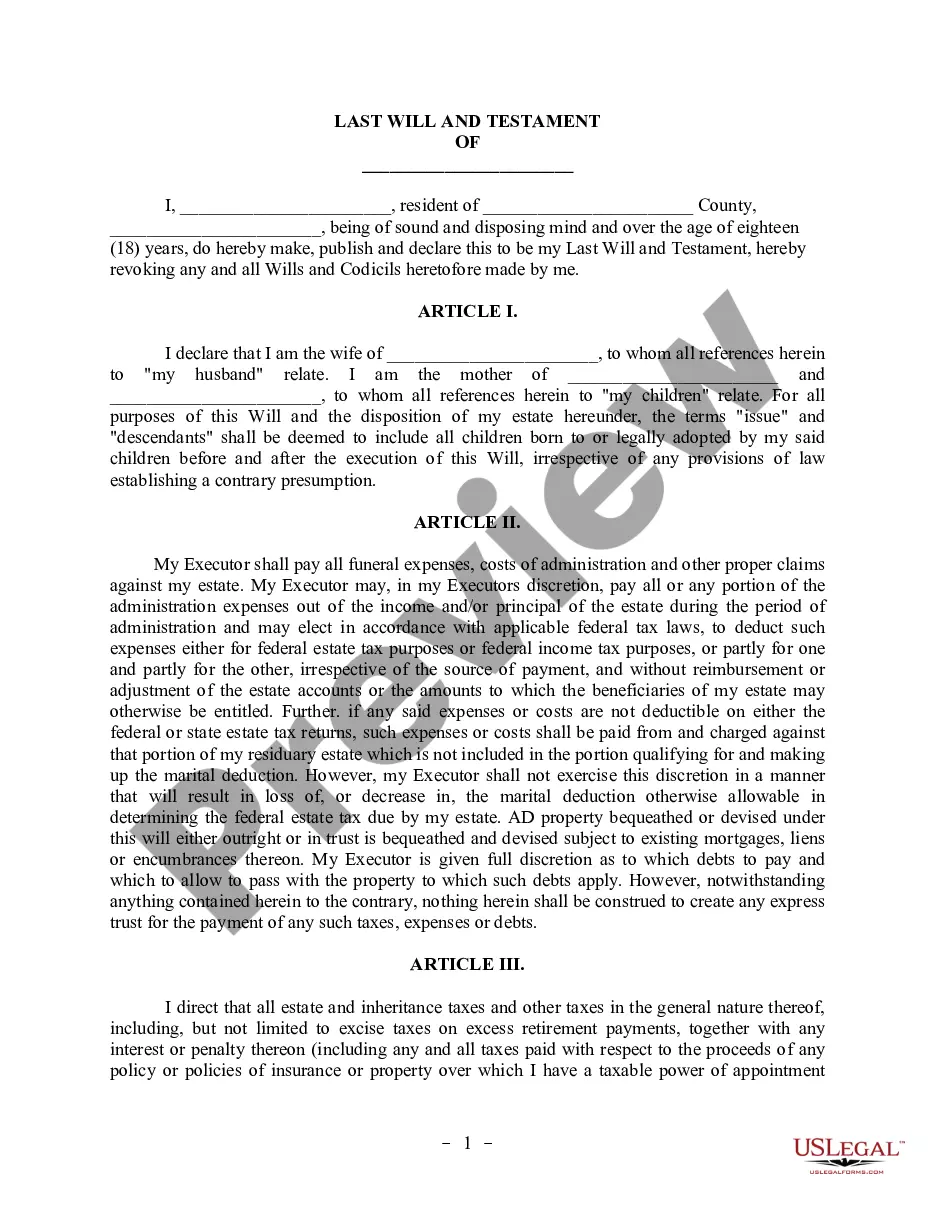
This Last Will and Testament is a legal document specifically designed for a single individual without children. It outlines how your assets and property will be distributed upon your death, names a personal representative or executor to manage your estate, and includes provisions for specific bequests. Unlike other wills, this form is tailored for those who do not have dependents, making it simpler and more focused on personal asset distribution.
Form components explained
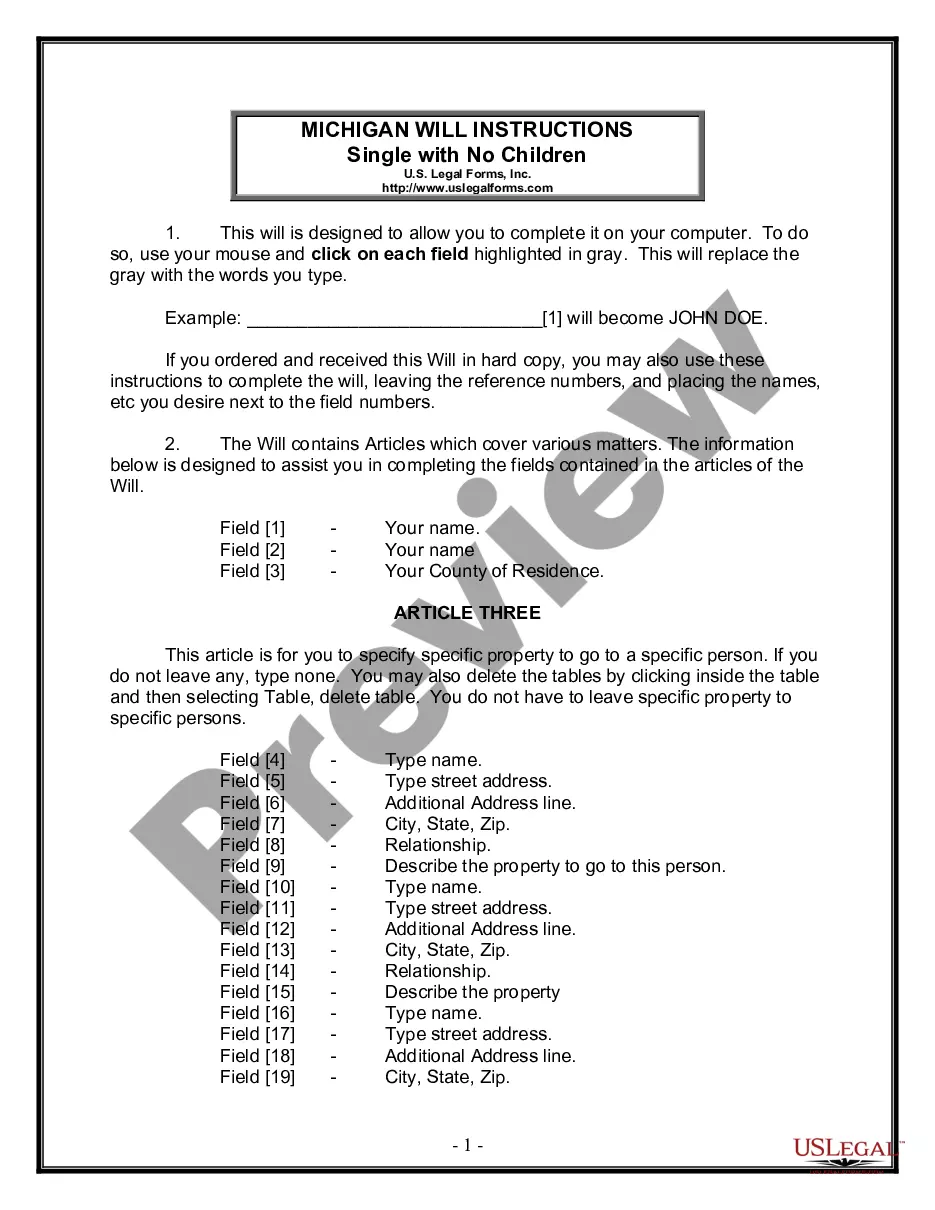
- Personal Information: Fields to enter your name and county of residence.
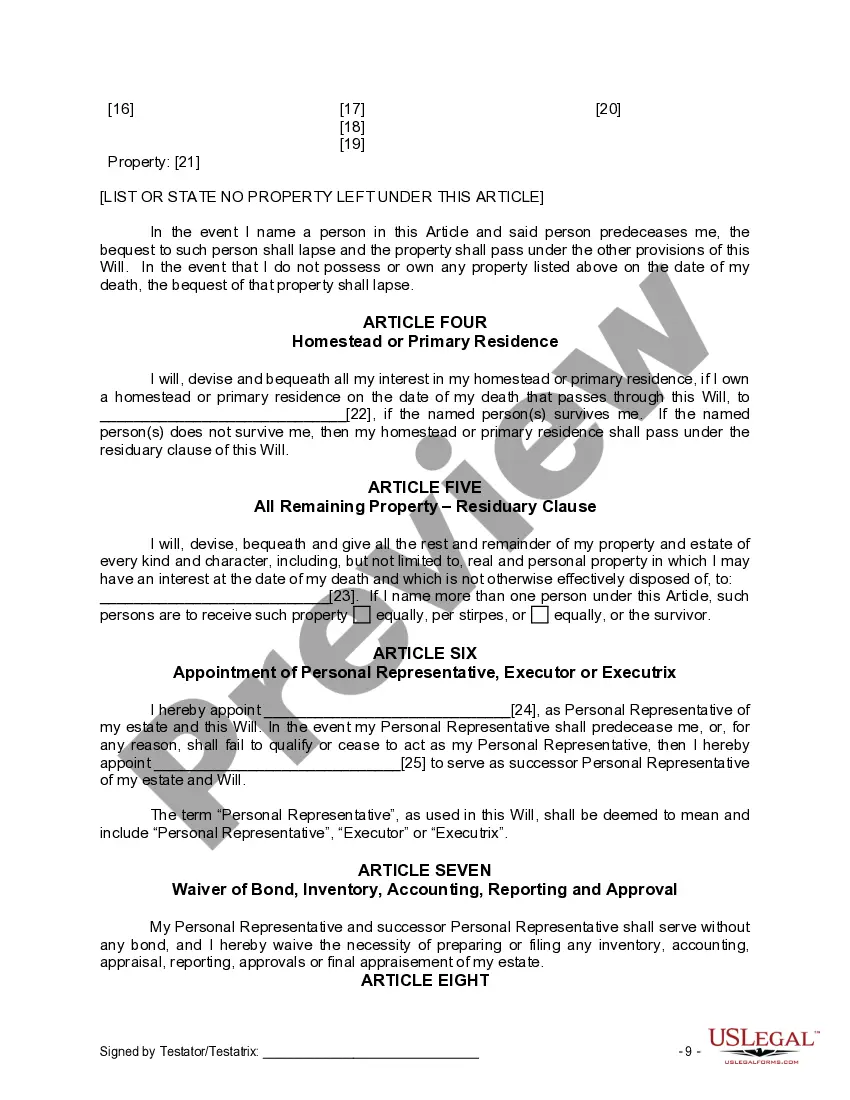
- Specific Bequests: Sections to designate individuals who will receive specific property or assets.
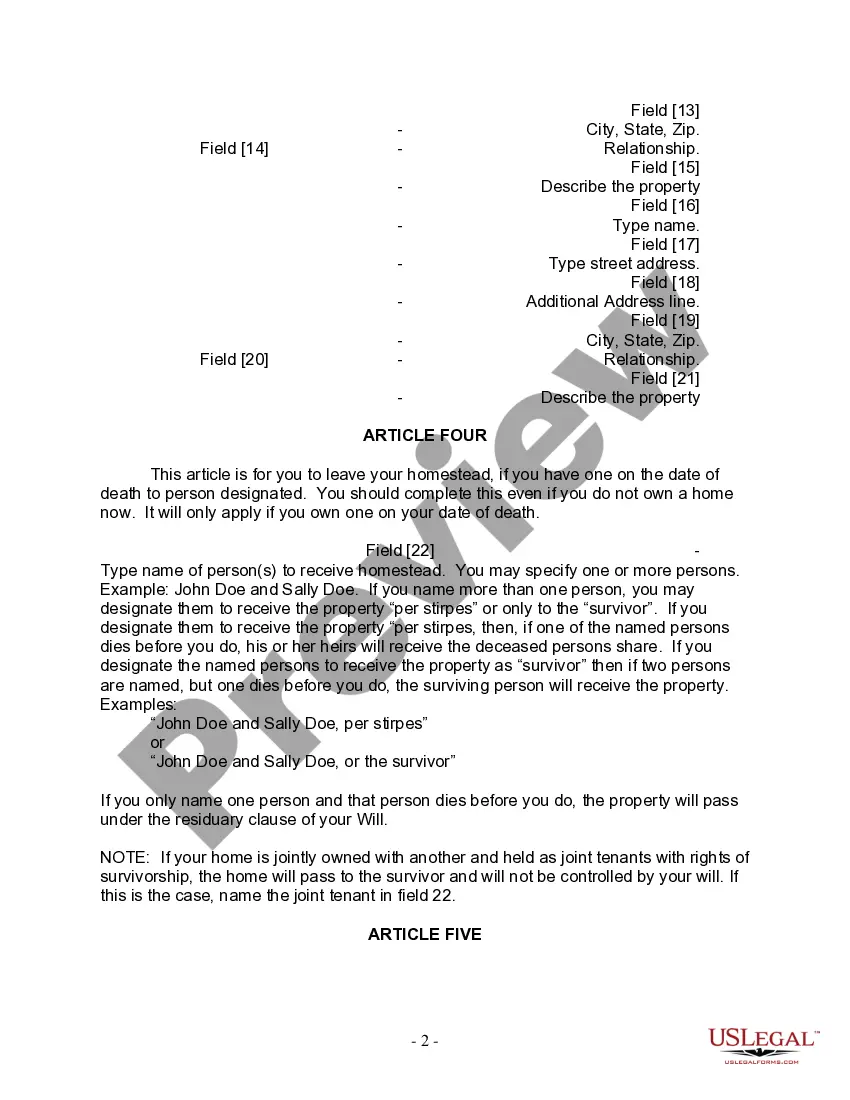
- Homestead Designation: An article allowing you to bequeath your primary residence.
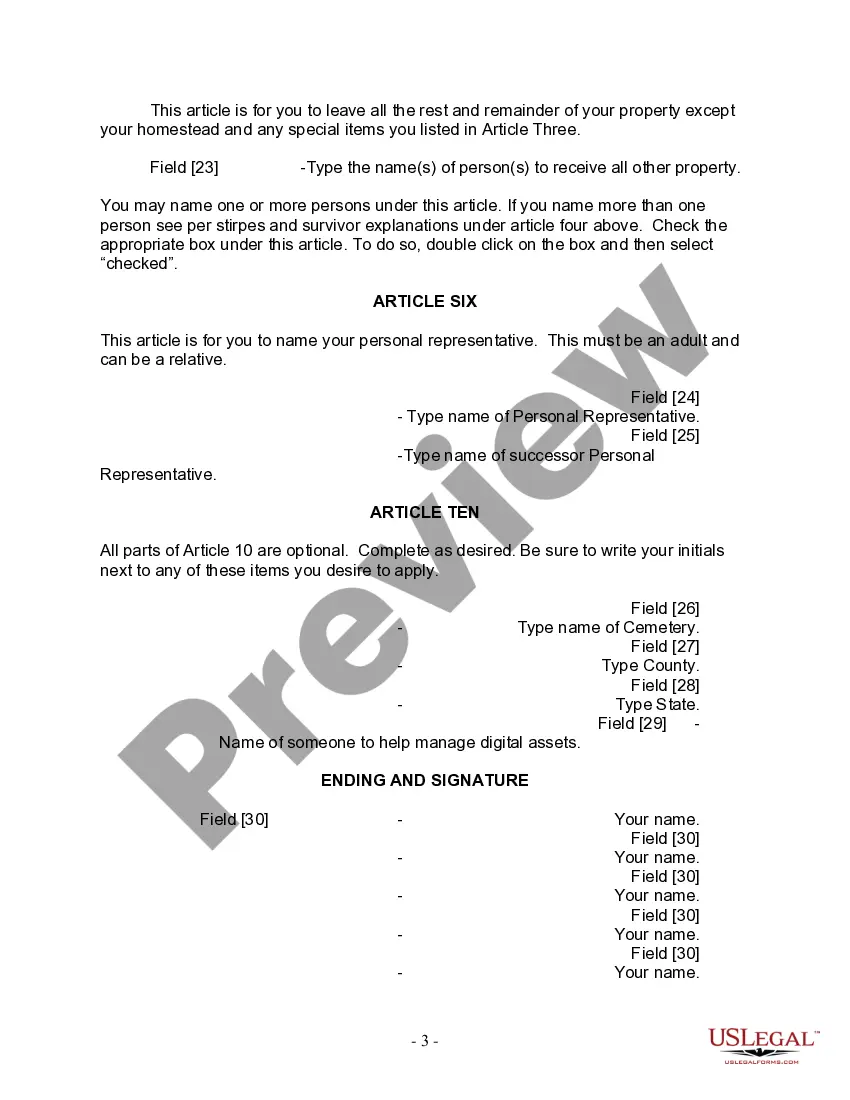
- Residuary Clause: Instructions for the distribution of any remaining assets not specifically mentioned.
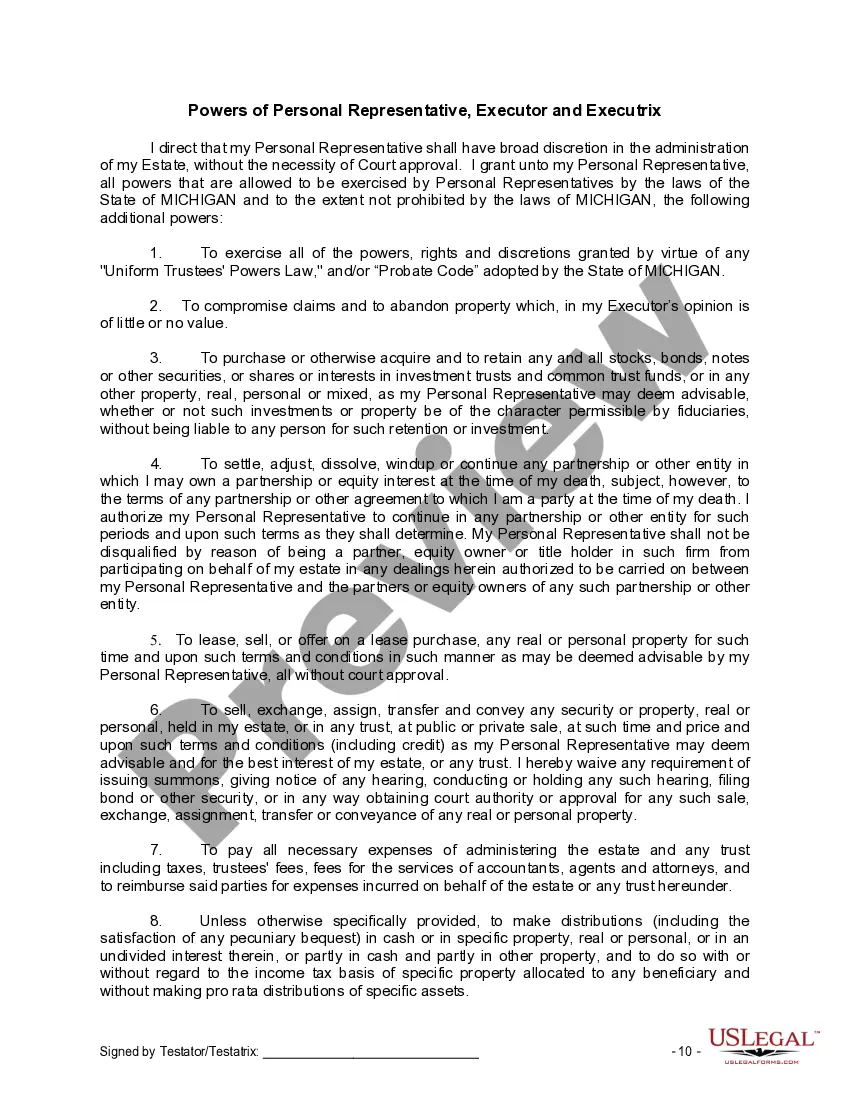
- Appointment of Executor: Provisions for naming a personal representative to handle your estate.
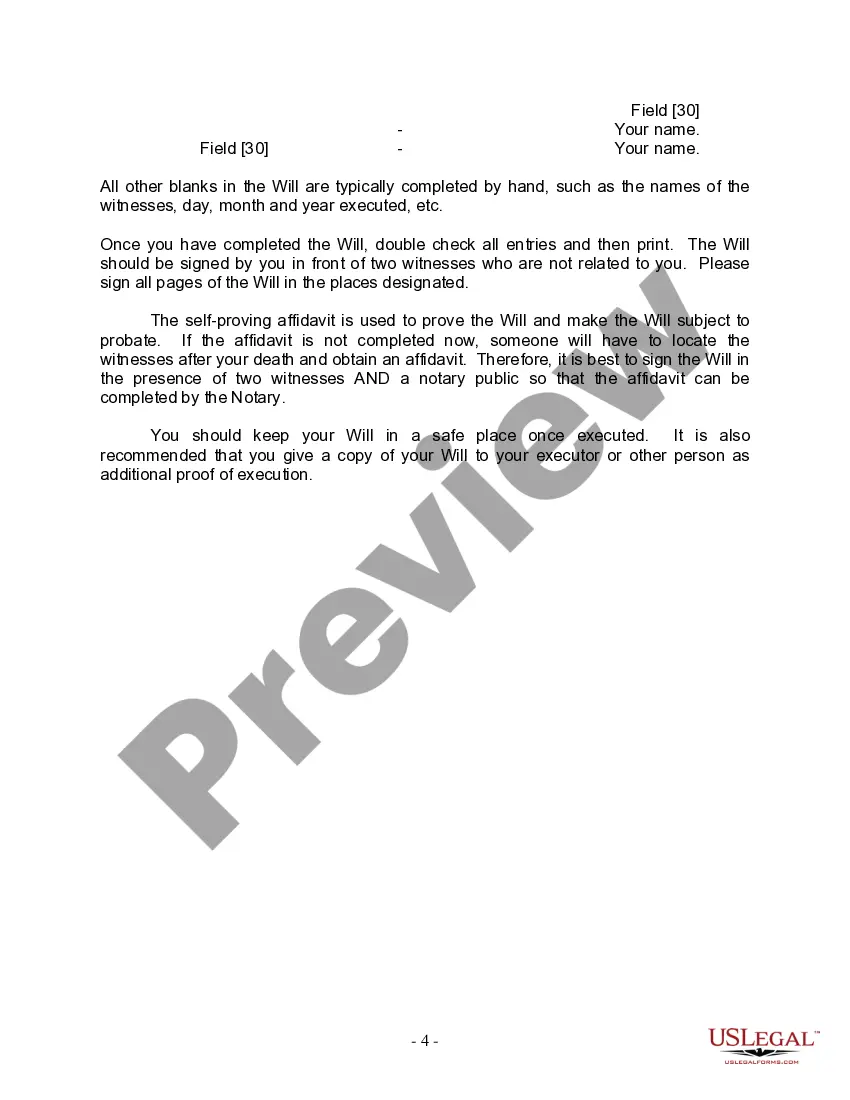
- Signed Witnesses: Required signatures from two witnesses who are not beneficiaries.



Common use cases
This form is necessary when you want to clearly define how your assets will be distributed after your passing and ensure that your final wishes are documented legally. It is especially useful for single individuals who do not have children and wish to avoid the complications of intestate succession laws that apply if no will is created.
Who needs this form
- Single individuals without children.
- Adults seeking to specify the distribution of their assets upon death.
- Those who want to appoint a personal representative for their estate.
- Anyone wishing to simplify estate planning without complex familial considerations.
Instructions for completing this form
- Enter your full name and county of residence at the top of the document.
- Specify any property or assets you wish to bequeath to individuals in the designated sections.
- Assign your homestead to a specific person if applicable.
- Identify a personal representative to manage your estate and a successor if needed.
- Sign the will in front of two unrelated witnesses who will also sign the document.
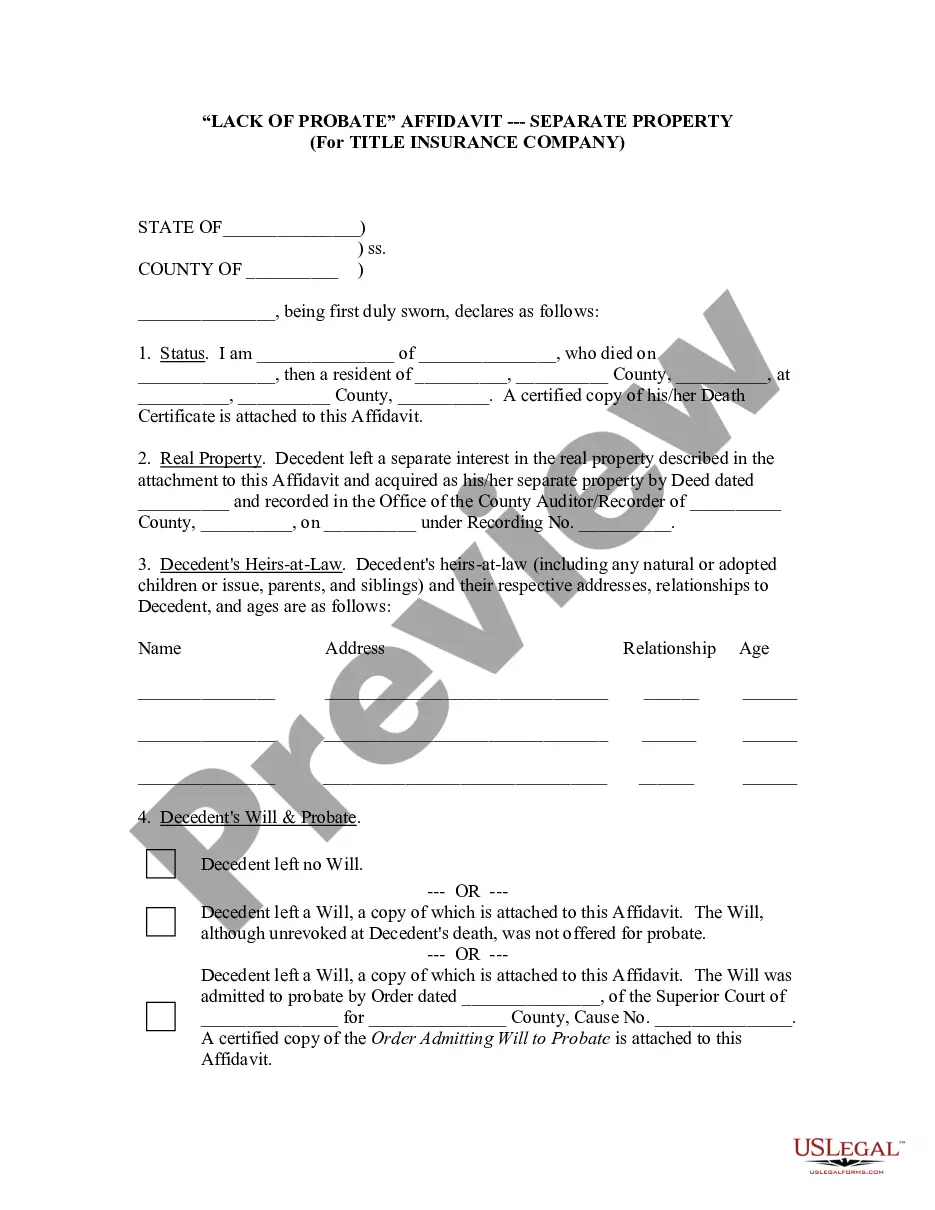
- If applicable, complete the self-proving affidavit with a notary public to simplify the probate process.
Is notarization required?
Notarization is required for this form to take effect. Our online notarization service, powered by Notarize, lets you verify and sign documents remotely through an encrypted video session, available 24/7.
Get your form ready online
Our built-in tools help you complete, sign, share, and store your documents in one place.
Make edits, fill in missing information, and update formatting in US Legal Forms—just like you would in MS Word.
Download a copy, print it, send it by email, or mail it via USPS—whatever works best for your next step.
Sign and collect signatures with our SignNow integration. Send to multiple recipients, set reminders, and more. Go Premium to unlock E-Sign.
If this form requires notarization, complete it online through a secure video call—no need to meet a notary in person or wait for an appointment.
We protect your documents and personal data by following strict security and privacy standards.

Make edits, fill in missing information, and update formatting in US Legal Forms—just like you would in MS Word.

Download a copy, print it, send it by email, or mail it via USPS—whatever works best for your next step.

Sign and collect signatures with our SignNow integration. Send to multiple recipients, set reminders, and more. Go Premium to unlock E-Sign.

If this form requires notarization, complete it online through a secure video call—no need to meet a notary in person or wait for an appointment.

We protect your documents and personal data by following strict security and privacy standards.
Avoid these common issues
- Not having the will signed by the required number of witnesses.
- Failing to specify beneficiaries for all assets.
- Not including a self-proving affidavit if required in your jurisdiction.
- Not storing the will in a safe but accessible location.
Advantages of online completion
- Convenience of filling out the form at your own pace from your home.
- Editability allows you to revise your choices easily as your circumstances change.
- Access to templates drafted by licensed attorneys ensures compliance with legal standards.
Key takeaways
- This will is specifically for single individuals without children, allowing for clear distribution of assets.
- Ensure it is signed in the presence of witnesses and notarized to be enforceable.
- Consider specifying your homestead and other property to prevent probate issues.
Looking for another form?


Form popularity
FAQ
Yes, having a will is important for anyone, including single individuals. A Michigan Last Will and Testament for Single Person with No Children helps ensure that your personal belongings are handled according to your wishes. Without a will, the state may decide how your assets are distributed, which may not align with your intentions. Creating a will can give you control over your legacy and protect your interests.
Even as a single person with no children, a Michigan Last Will and Testament for Single Person with No Children is beneficial. It allows you to specify how your assets should be divided among friends or relatives. Additionally, it can prevent any conflicts or confusion among your loved ones after you are gone. Establishing a will can provide peace of mind, knowing that your wishes will be followed.
Yes, you can write your own will in Michigan, and having it notarized can add an extra layer of validity. However, it is essential to ensure that your Michigan Last Will and Testament for Single Person with No Children meets all legal requirements. Uslegalforms offers templates that can guide you in drafting your will accurately. This way, you can avoid common pitfalls and ensure your wishes are clearly expressed.
Yes, creating a Michigan Last Will and Testament for Single Person with No Children is still a wise decision. A will allows you to designate how your assets will be distributed after your passing. It also lets you name an executor to manage your affairs, ensuring your wishes are honored. Even without dependents, a will can simplify the process for your loved ones.
In Michigan, a valid will must meet certain criteria to ensure it is legally recognized. First, the will must be in writing, and it must be signed by the person creating the will, known as the testator. Additionally, the will requires the signatures of at least two witnesses who are present at the same time. For a Michigan Last Will and Testament for Single Person with No Children, these requirements are crucial for ensuring that your wishes are honored after your passing.
Yes, having a will is beneficial even if you do not have children. A Michigan Last Will and Testament for Single Person with No Children allows you to dictate how your assets should be managed and distributed after your passing. It also helps to streamline the estate settlement process and minimizes the risk of conflicts among your heirs. Utilize US Legal Forms to create a will that meets your unique circumstances and desires.
For a will to be valid in Michigan, it must be in writing, signed by the testator, and witnessed by at least two individuals who are not beneficiaries. Additionally, the testator must be of sound mind and at least 18 years old when signing the document. Ensuring these requirements are met is crucial for the enforceability of your Michigan Last Will and Testament for Single Person with No Children. US Legal Forms provides resources to help you understand and meet these legal requirements.
Yes, you still need a will even if there are no children. A Michigan Last Will and Testament for Single Person with No Children ensures that your belongings and assets are allocated according to your desires. It provides clarity and reduces potential disputes among family members or friends. US Legal Forms can assist you in drafting a will that addresses your specific situation and needs.
Even if you are single with no children, having a will is still important. A Michigan Last Will and Testament for Single Person with No Children allows you to specify how you want your assets distributed after your death. Without a will, Michigan's intestacy laws will dictate the distribution of your estate, which may not align with your wishes. Consider using platforms like US Legal Forms to easily create a will that reflects your preferences.
To avoid probate in Michigan without a will, you can utilize certain methods such as creating a living trust or designating beneficiaries on assets like bank accounts and retirement plans. These options allow your assets to transfer directly to your heirs without going through probate. Additionally, consider joint ownership of property, which can enable a smooth transfer upon death. For a tailored approach, explore resources like US Legal Forms that offer guidance for creating a Michigan Last Will and Testament for Single Person with No Children.