Michigan Do Not Resuscitate Order - DNR - Statutory Form
Overview of this form
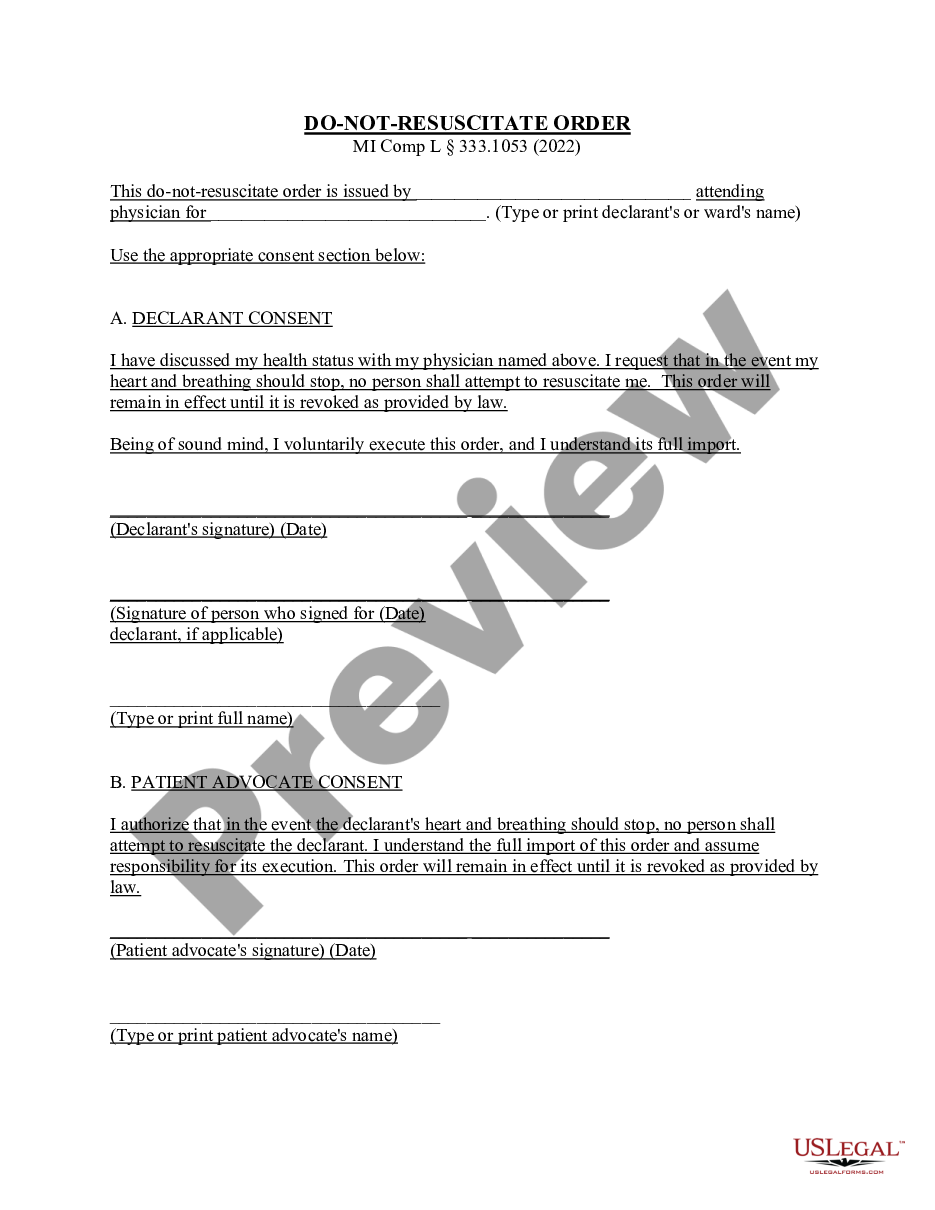
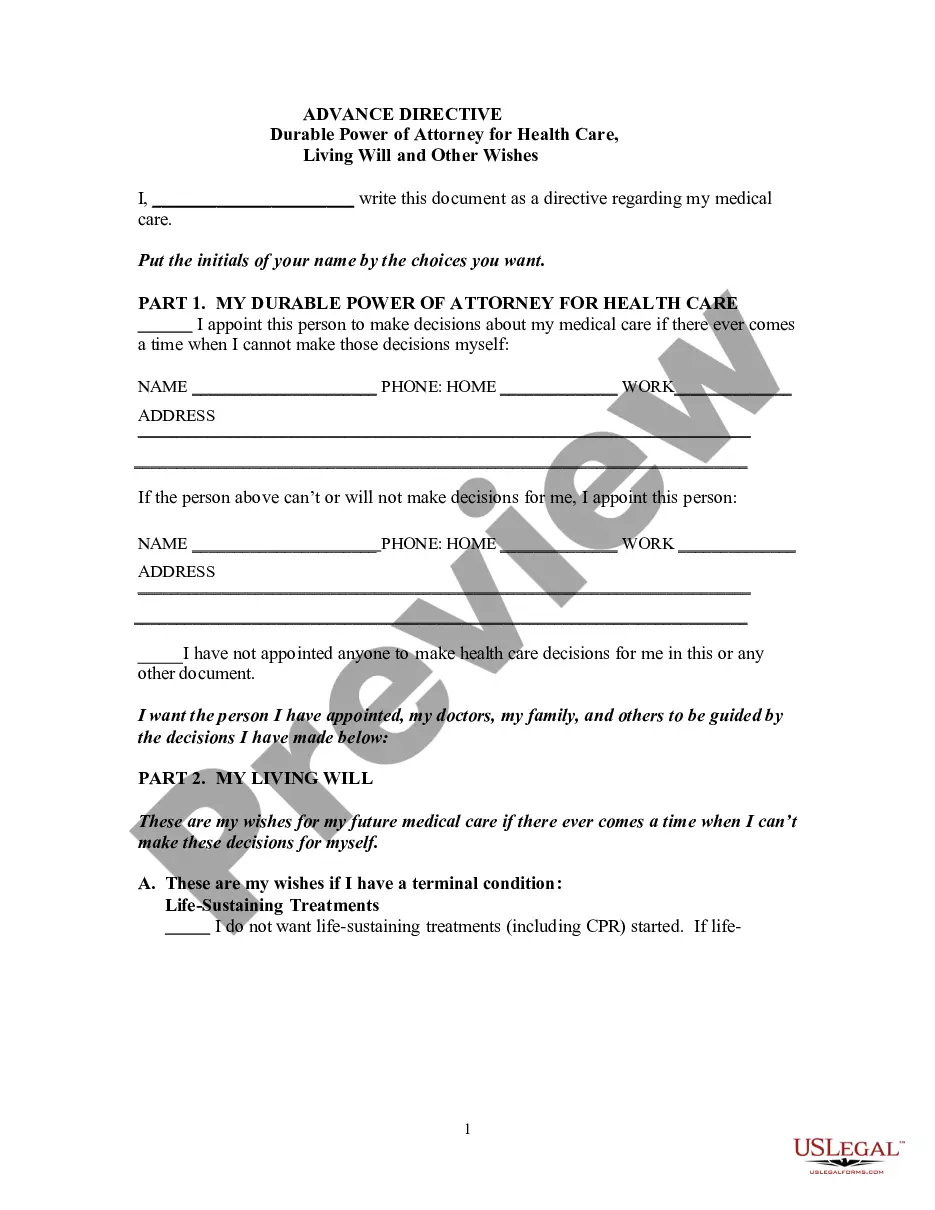
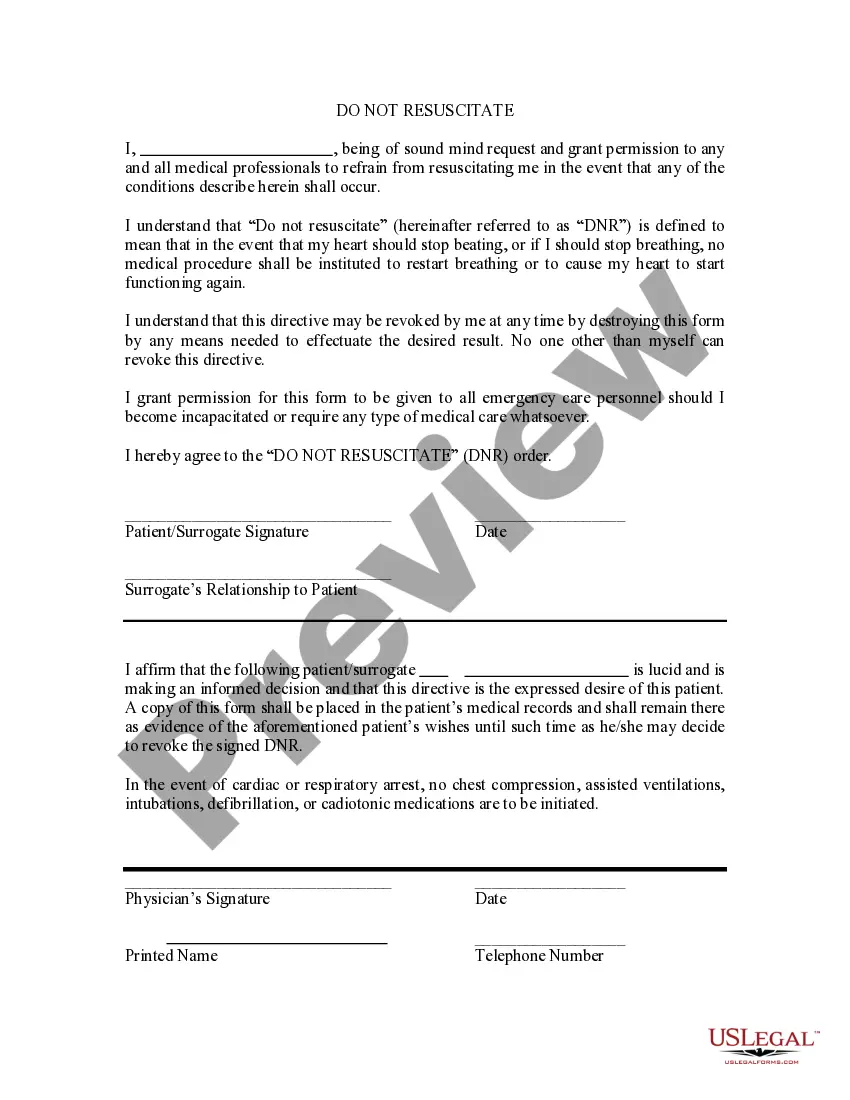
The Do Not Resuscitate (DNR) Order - Statutory Form is a legally recognized document in Michigan that allows individuals to specify their wishes regarding resuscitation in the event of cardiac arrest or respiratory failure. This form clearly states that no efforts should be made to revive the individual if their heart and breathing stop. It is crucial for ensuring that a person's end-of-life preferences are honored in a medical emergency, distinguishing it from other advance directives like living wills or healthcare proxies.
Main sections of this form
- Identifying information for the attending physician and the declarant or ward.
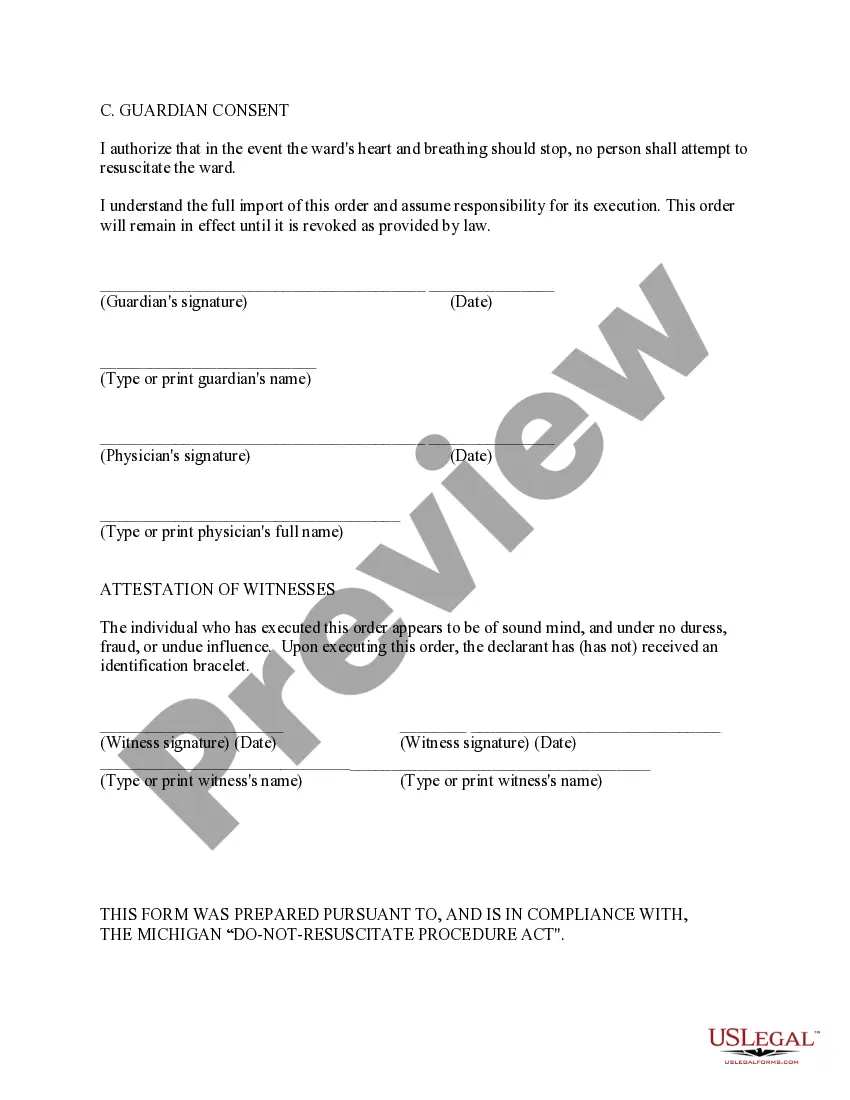
- Consent sections for the declarant, patient advocate, or guardian.
- Signatures of the declarant, patient advocate, guardian, and attending physician.
- Attestation by witnesses confirming sound mind and absence of duress.
When this form is needed
This form should be used when an individual wishes to communicate their preferences regarding resuscitation in a medical setting. It is typically utilized by those with serious health conditions, advanced age, or a desire to avoid prolonging life through artificial means. The DNR Order is essential for patients who want to ensure their end-of-life wishes are respected by healthcare providers and family members during medical emergencies.
Who can use this document
- Individuals with serious or terminal health conditions.
- Patients who wish to avoid resuscitation efforts in case of cardiac or respiratory failure.
- Guardians or patient advocates making decisions on behalf of those unable to express their wishes.
How to prepare this document
- Identify and print the names of the attending physician and the declarant or ward at the top of the form.
- Choose the appropriate consent section (Declarant Consent, Patient Advocate Consent, or Guardian Consent) based on who is executing the order.
- Have the relevant party complete their signature and date the form.
- Ensure witnesses sign and date the form, confirming the declarant's mental capacity and voluntariness.
- Provide a copy of the completed DNR order to the attending physician and retain a copy for personal records.
Does this form need to be notarized?
This form usually doesn’t need to be notarized. However, local laws or specific transactions may require it. Our online notarization service, powered by Notarize, lets you complete it remotely through a secure video session, available 24/7.
Get your form ready online
Our built-in tools help you complete, sign, share, and store your documents in one place.
Make edits, fill in missing information, and update formatting in US Legal Forms—just like you would in MS Word.
Download a copy, print it, send it by email, or mail it via USPS—whatever works best for your next step.
Sign and collect signatures with our SignNow integration. Send to multiple recipients, set reminders, and more. Go Premium to unlock E-Sign.
If this form requires notarization, complete it online through a secure video call—no need to meet a notary in person or wait for an appointment.
We protect your documents and personal data by following strict security and privacy standards.

Make edits, fill in missing information, and update formatting in US Legal Forms—just like you would in MS Word.

Download a copy, print it, send it by email, or mail it via USPS—whatever works best for your next step.

Sign and collect signatures with our SignNow integration. Send to multiple recipients, set reminders, and more. Go Premium to unlock E-Sign.

If this form requires notarization, complete it online through a secure video call—no need to meet a notary in person or wait for an appointment.

We protect your documents and personal data by following strict security and privacy standards.
Common mistakes to avoid
- Failing to include all required signatures can render the form invalid.
- Not having the form witnessed properly, which is necessary for enforceability.
- Overlooking the need to communicate the DNR order to healthcare providers and family members.
Why complete this form online
- Convenient access to legally compliant DNR forms available for instant download.
- Editability allows users to customize the form to meet their specific needs.
- Reliability, as forms are drafted by licensed attorneys ensuring compliance with Michigan laws.
Legal use & context
- The DNR Order is legally enforceable in Michigan when completed and signed according to state law.
- It provides clear instructions to healthcare providers regarding the individual's wishes at the end of life.
- This order remains effective until revoked in accordance with legal procedures.
Main things to remember
- The Do Not Resuscitate Order expresses an individual's wish not to undergo resuscitation.
- It is critical for individuals with serious health concerns to clearly communicate their preferences in advance.
- Obtaining the necessary signatures and witnesses is essential for legality.
- Utilizing this form ensures compliance with Michigan law regarding do-not-resuscitate orders.
Looking for another form?

Form popularity
FAQ
Creating a Michigan Do Not Resuscitate Order - DNR - Statutory Form involves obtaining the official form and filling it out in accordance with state guidelines. You will need to provide personal information, sign the form, and have it witnessed by the required parties. Ensure that you discuss your decision with medical professionals to fully understand the implications. For a streamlined process, consider using uslegalforms to access personalized assistance and templates that simplify completing your DNR form.
To submit a Michigan Do Not Resuscitate Order - DNR - Statutory Form, you must first fill out the form accurately. Once completed, distribute copies to your healthcare provider and caregivers to ensure they are aware of your wishes. It is essential to keep a copy in a easily accessible location. Additionally, you can utilize the uslegalforms platform to find and submit the necessary documents securely.
You can obtain a Michigan Do Not Resuscitate Order - DNR - Statutory Form from your healthcare provider or through official state health websites. Additionally, USLegalForms offers easy access to downloadable DNR forms. It’s essential to consult your physician when filling out the form to ensure that your wishes are accurately represented. Make sure to keep the finalized form easily accessible as part of your medical records.
Yes, you can print a Michigan Do Not Resuscitate Order - DNR - Statutory Form from various reputable online resources. Ensure that you use an official template that complies with state requirements. Once printed, you should fill it out and have it signed by your physician. This allows you to have easy access to your DNR documentation at all times.
To obtain a Michigan Do Not Resuscitate Order - DNR - Statutory Form, you need to discuss your wishes with your healthcare provider. They will help you complete the form according to Michigan law. It is a crucial step that ensures your healthcare preferences are respected. Utilizing platforms like USLegalForms can streamline this process for you.
No, a Michigan Do Not Resuscitate Order - DNR - Statutory Form does not require notarization. You simply need to ensure that the form is signed by you and the physician. This keeps the process straightforward and accessible for everyone involved. Always make sure to keep copies of your signed DNR document for your personal records.
To obtain a Michigan Do Not Resuscitate Order - DNR - Statutory Form, you can visit the official state website or contact your healthcare provider for a copy. UsLegalForms platform also provides easy access to this essential document, ensuring you have the correct and legally recognized form. Once you have the form, you can fill it out with guidance from your physician to ensure it meets all legal requirements.
A Michigan Do Not Resuscitate Order - DNR - Statutory Form is valid if it is properly completed and signed by a patient or their legal representative. It must also contain the signature of a licensed physician. Additionally, the form needs to indicate that the patient understands the consequences of their decision, and must be in the correct statutory format approved by Michigan law.
Completing a Michigan Do Not Resuscitate Order - DNR - Statutory Form is an important step in expressing your medical wishes. First, you should obtain the official form, which is available online or through healthcare providers. Fill in the necessary details, including your name, date of birth, and the declaration indicating your wishes. Once completed, ensure you sign the document and have it witnessed, as this will make it a valid legal directive.