Maine Last Will and Testament for Married Person with Adult and Minor Children from Prior Marriage
Overview of this form
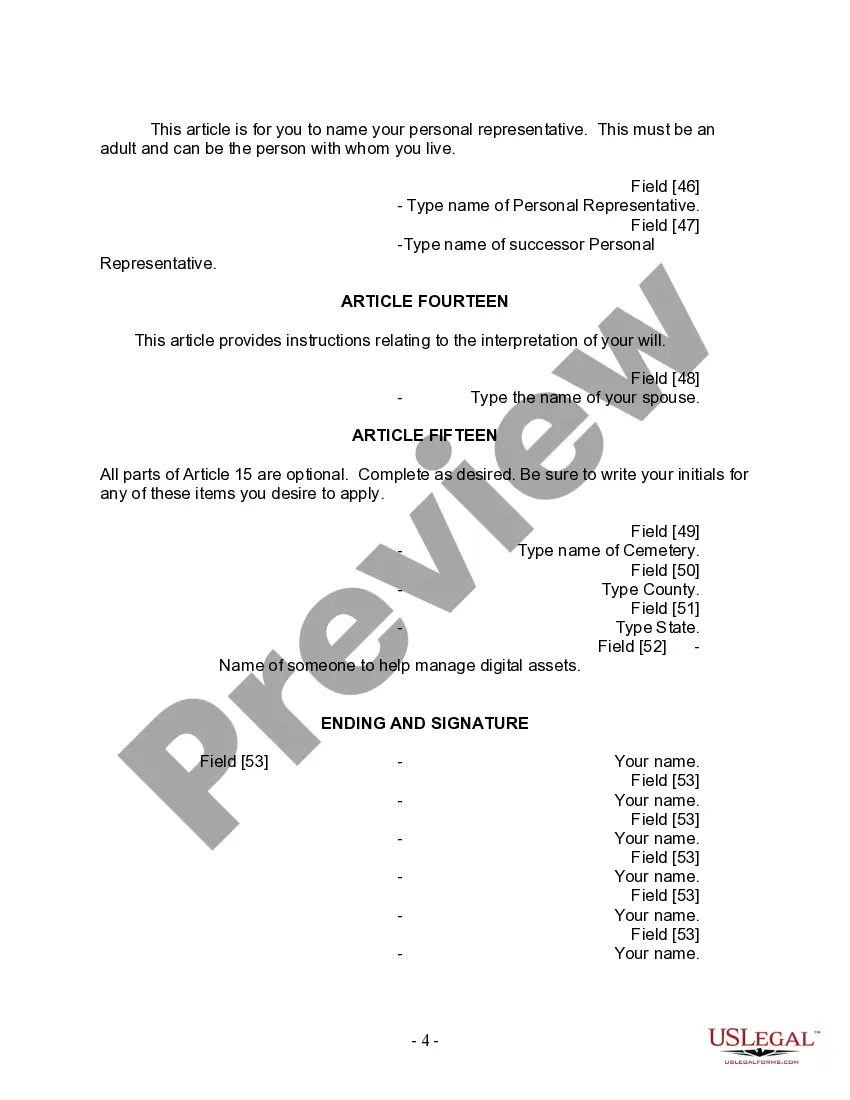
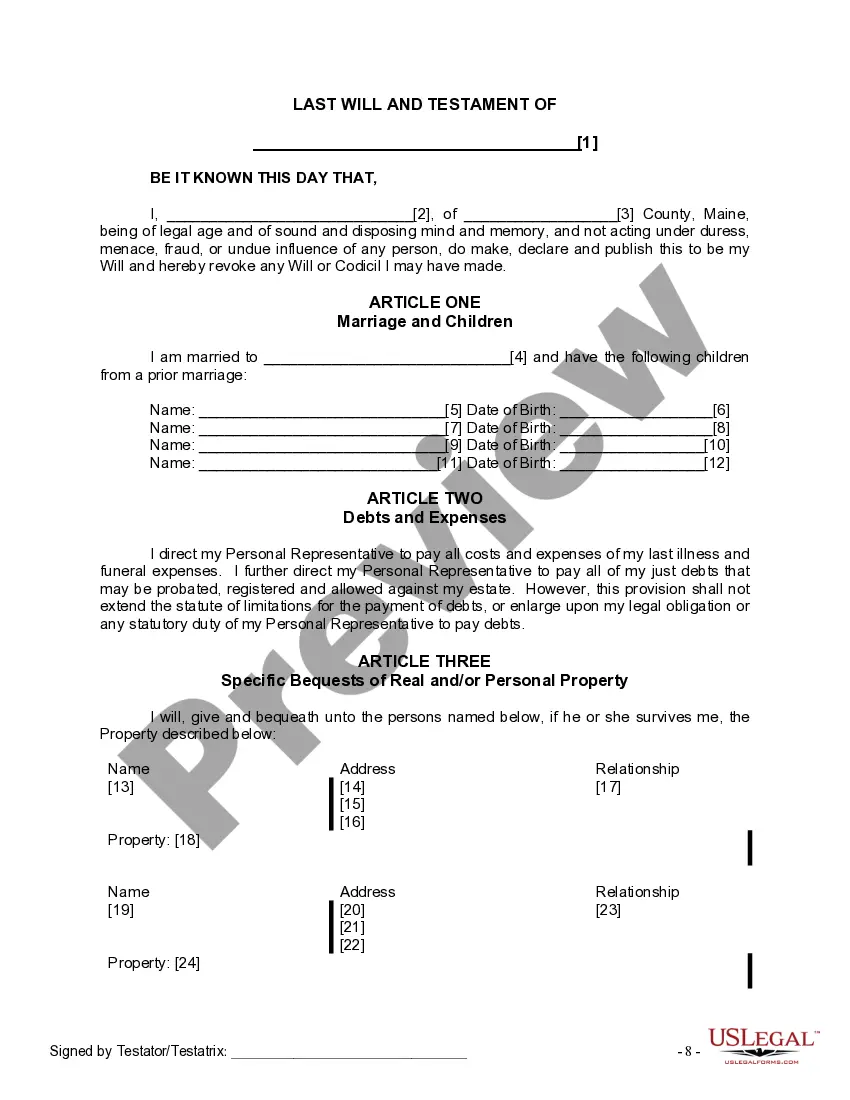
The Last Will and Testament for Married Person with Adult and Minor Children from Prior Marriage is a legal document that outlines how your assets will be distributed upon your death, specifically tailored for individuals who are married and have children from a previous relationship. This form specifically allows for the appointment of a personal representative, the designation of beneficiaries, and provisions for minor children, ensuring that all aspects of your estate are addressed according to your wishes.
Main sections of this form
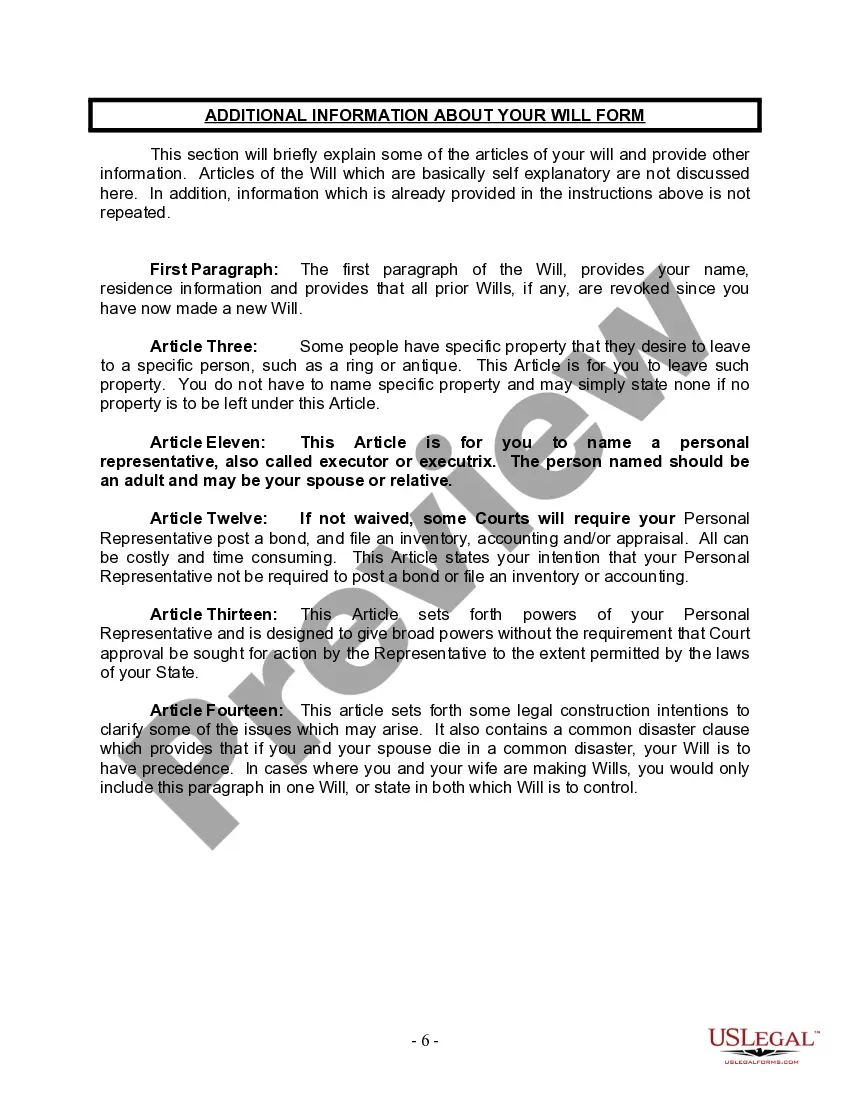
- Appointment of a personal representative or executor to manage your estate
- Designations for adult and minor children, including specific bequests
- Provisions for a trustee to manage assets left to minor beneficiaries
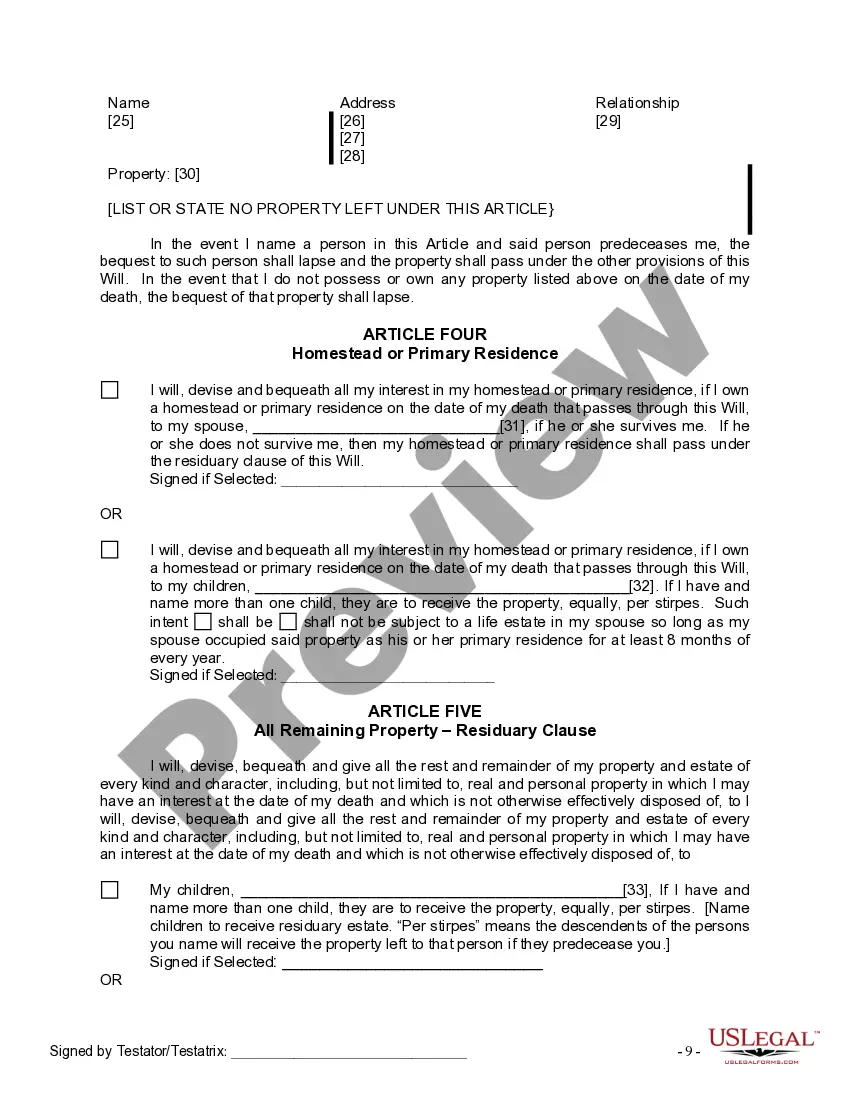
- Instructions for paying debts and funeral expenses from your estate
- Clauses for property distribution, including homestead or primary residence
- Provisions for guardianship of minor children




When to use this document
This form should be used when a married individual has children from a previous marriage and wishes to ensure that their estate is divided according to their specific wishes. It is especially relevant when considering the care and financial security of minor children and the potential complexities that arise from blended families. Using this form can help prevent disputes among heirs and clarify your wishes regarding property distribution.
Who needs this form
- Married individuals with children from prior marriages
- Parents wanting to secure their children's inheritances
- Individuals seeking to establish clear directives for their estate
- Anyone looking to minimize potential conflicts among heirs after their death
Completing this form step by step
- Enter your full name and county of residence at the top of the document.
- List your spouse's name and your children's names along with their birthdates.
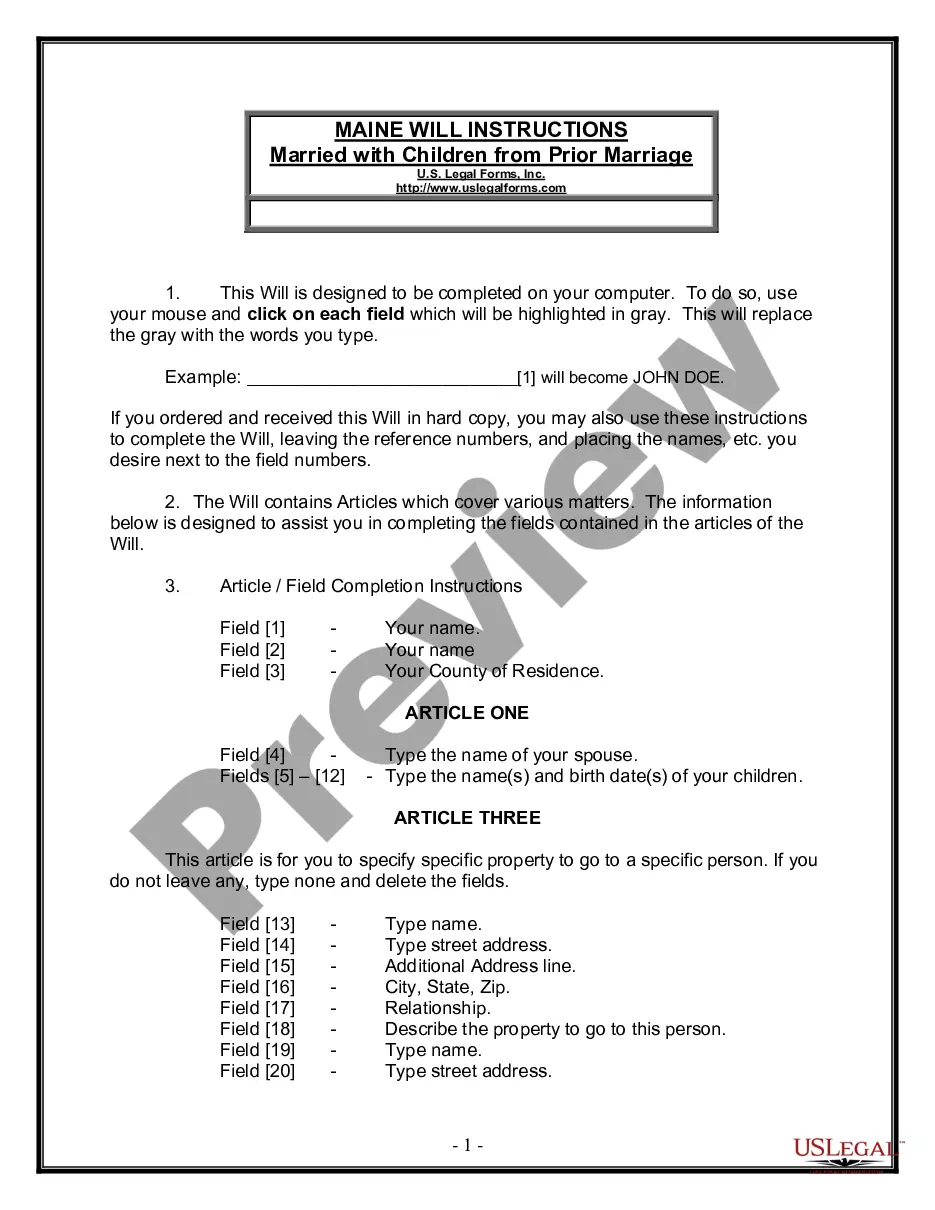
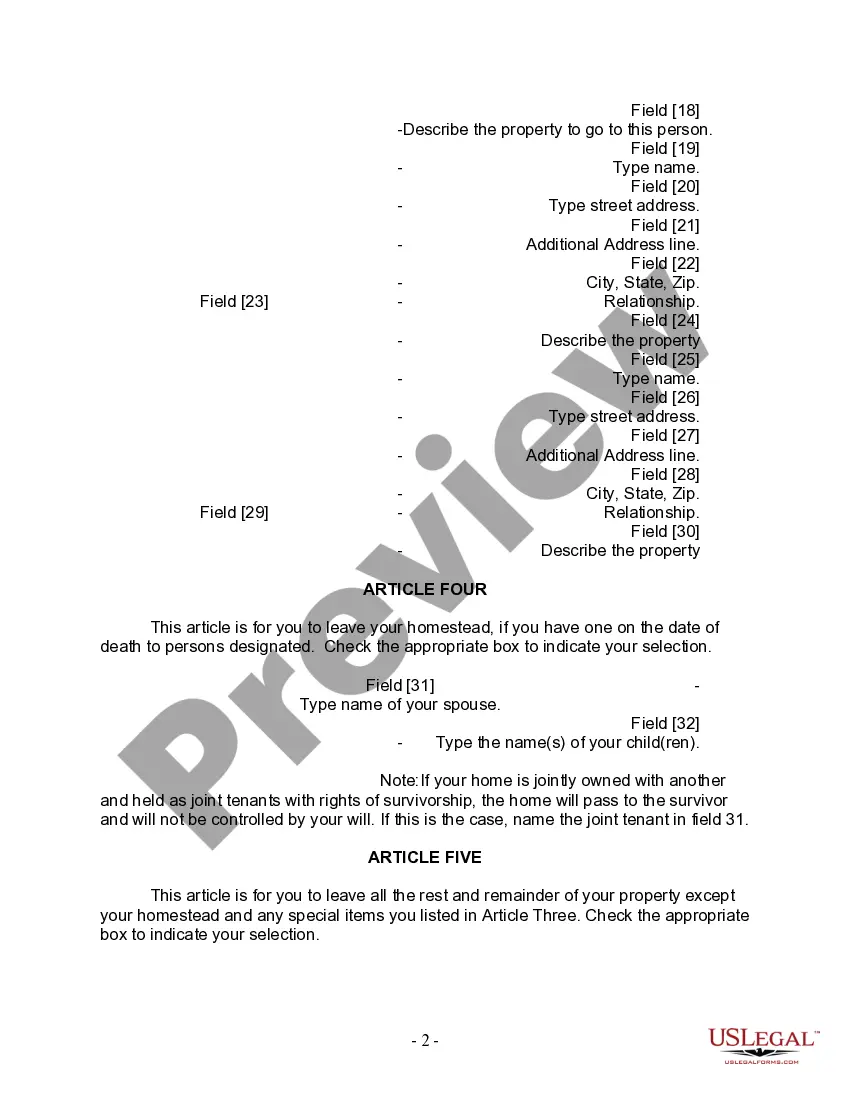
- Specify any specific bequests or property that you wish to leave to designated individuals.
- Indicate your wishes regarding your primary residence and any other real estate.
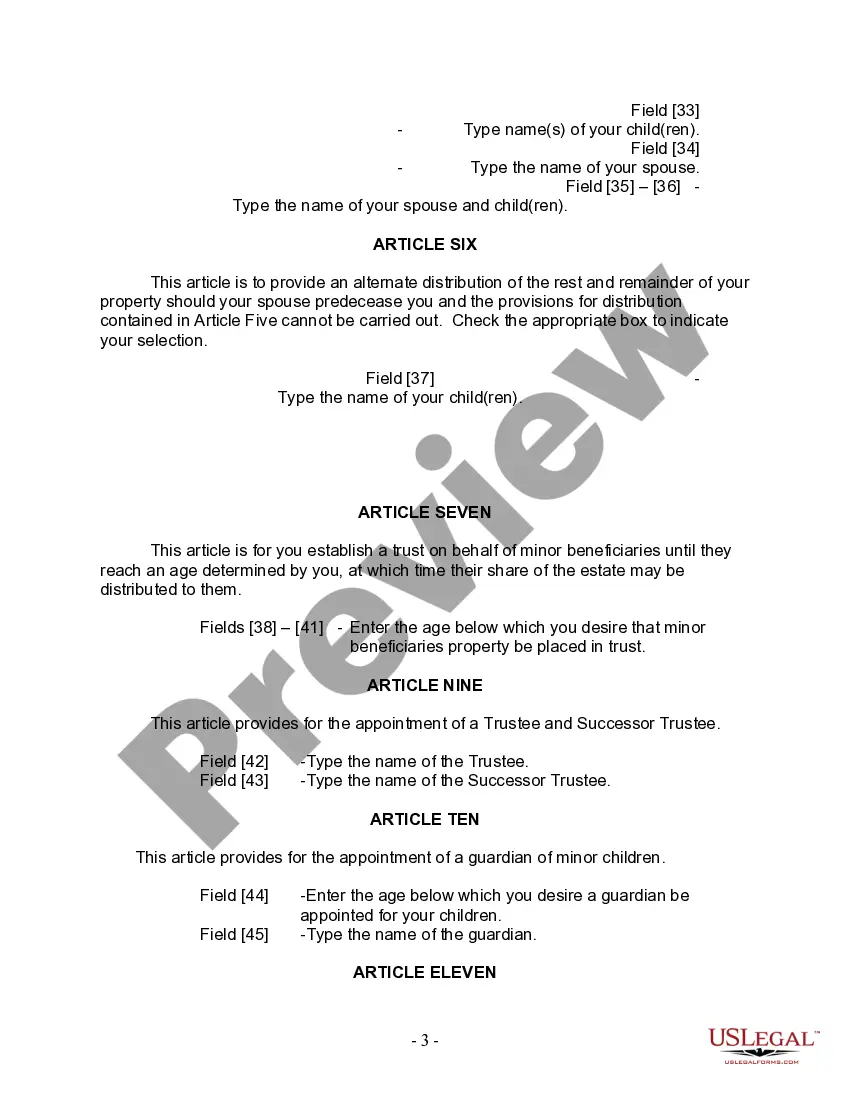
- Designate a trustee for your minor children's inheritances and a guardian if necessary.
- Have the will signed in the presence of two witnesses, who are not beneficiaries.
Notarization requirements for this form
Notarization is required for this form to take effect. Our online notarization service, powered by Notarize, lets you verify and sign documents remotely through an encrypted video session, available 24/7.
Get your form ready online
Our built-in tools help you complete, sign, share, and store your documents in one place.
Make edits, fill in missing information, and update formatting in US Legal Forms—just like you would in MS Word.
Download a copy, print it, send it by email, or mail it via USPS—whatever works best for your next step.
Sign and collect signatures with our SignNow integration. Send to multiple recipients, set reminders, and more. Go Premium to unlock E-Sign.
If this form requires notarization, complete it online through a secure video call—no need to meet a notary in person or wait for an appointment.
We protect your documents and personal data by following strict security and privacy standards.

Make edits, fill in missing information, and update formatting in US Legal Forms—just like you would in MS Word.

Download a copy, print it, send it by email, or mail it via USPS—whatever works best for your next step.

Sign and collect signatures with our SignNow integration. Send to multiple recipients, set reminders, and more. Go Premium to unlock E-Sign.

If this form requires notarization, complete it online through a secure video call—no need to meet a notary in person or wait for an appointment.

We protect your documents and personal data by following strict security and privacy standards.
Avoid these common issues
- Not having the form signed in front of the required number of witnesses.
- Failing to include details for minor children's guardianship.
- Omitting specific bequests which can lead to ambiguity in property distribution.
- Not updating the will to reflect changes in family circumstances.
Benefits of completing this form online
- Convenience of filling out the form from home at your own pace.
- Editability allows you to update your information easily.
- Access to professionally drafted templates ensures legal compliance.
- Downloadable format allows for easy printing and signing.
Looking for another form?








Form popularity
FAQ
Choosing the oldest adult child as the executor is common, but it is not mandatory. The role of executor requires responsibility and impartiality in managing the estate, which includes executing a Maine Last Will and Testament for Married Person with Adult and Minor Children from Prior Marriage. Consider the individual qualities of each child to select someone who can handle these duties effectively.
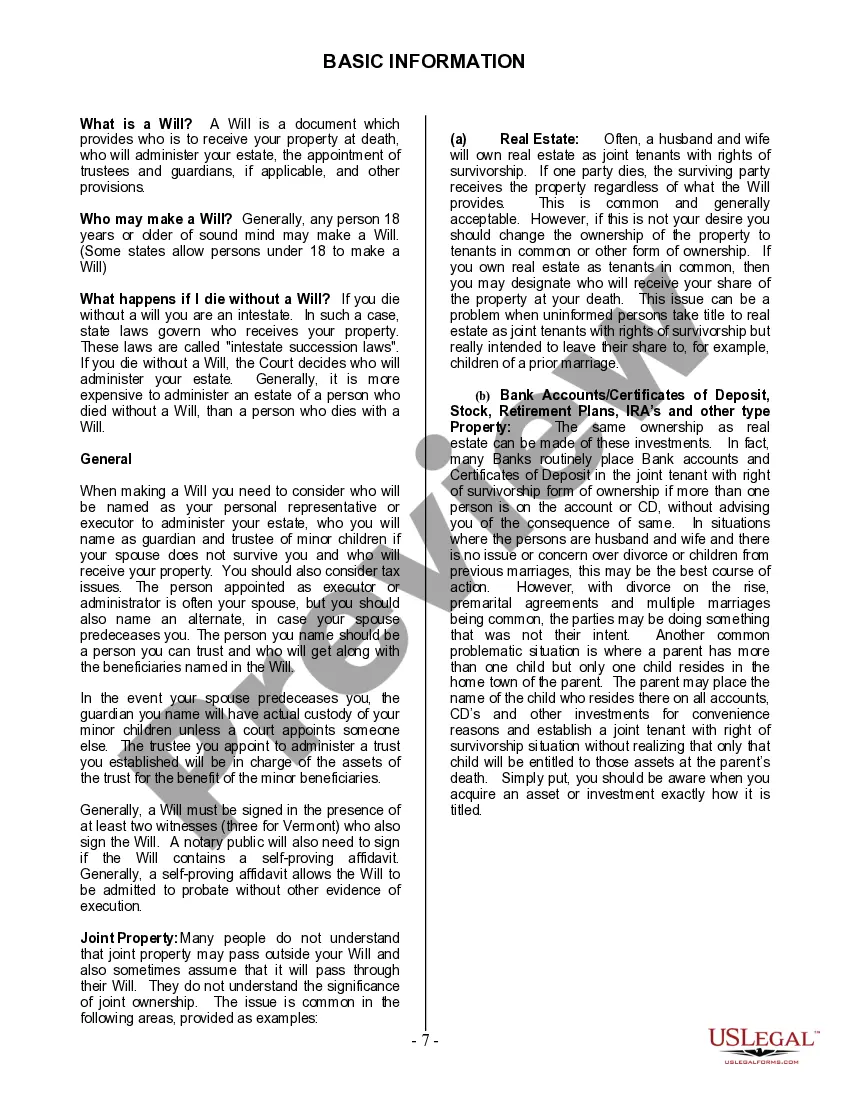
In Maine, anyone aged 18 or older who is of sound mind can make a Will. When you write your Will, you list all your property and who you want to give it to after you die (these people are called your beneficiaries).
No, in Maine, you do not need to notarize your will to make it legal. However, Maine allows you to make your will "self-proving" and you'll need to go to a notary if you want to do that. A self-proving will speeds up probate because the court can accept the will without contacting the witnesses who signed it.
In most situations, a will template is an easy and inexpensive way to make sure your wishes are known and carried out. Most people can get everything they need by using a will template, with little cost or hassle.
In addition, Maine allows a will to be made without witnesses if it is written by hand by the testator and signed at the end. 18-A M.R.S.A. § 2-503. This is called a holographic will.
It must be in writing. Generally, of course, wills are composed on a computer and printed out. The person who made it must have signed and dated it. A will must be signed and dated by the person who made it. Two adult witnesses must have signed it. Witnesses are crucial.
A notarized will does not need to be probated.When a person dies leaving behind a will that is not notarized, the law requires that its validity be ascertained by a notary or by a court. Similarly, any non-notarized modification made to a will must be probated, whether the will is notarized or not.
To start the probate process, you need to file an Application for Probate in the probate court in the county where the decedent lived. In Maine, each county has its own probate court. If there is a Will, it needs to be submitted to the probate court. The probate judge will decide whether or not the Will is valid.
Notarizing a will is not necessary as long as your will has been properly constructed and witnessed; the court will view it as a legally binding document. However, you may still want to include a self-proving affidavit and get your will notarized, since it can help the probate process move faster.
The Free Last Will and Testament Template for Word is compatible with Word 2003 or later versions.