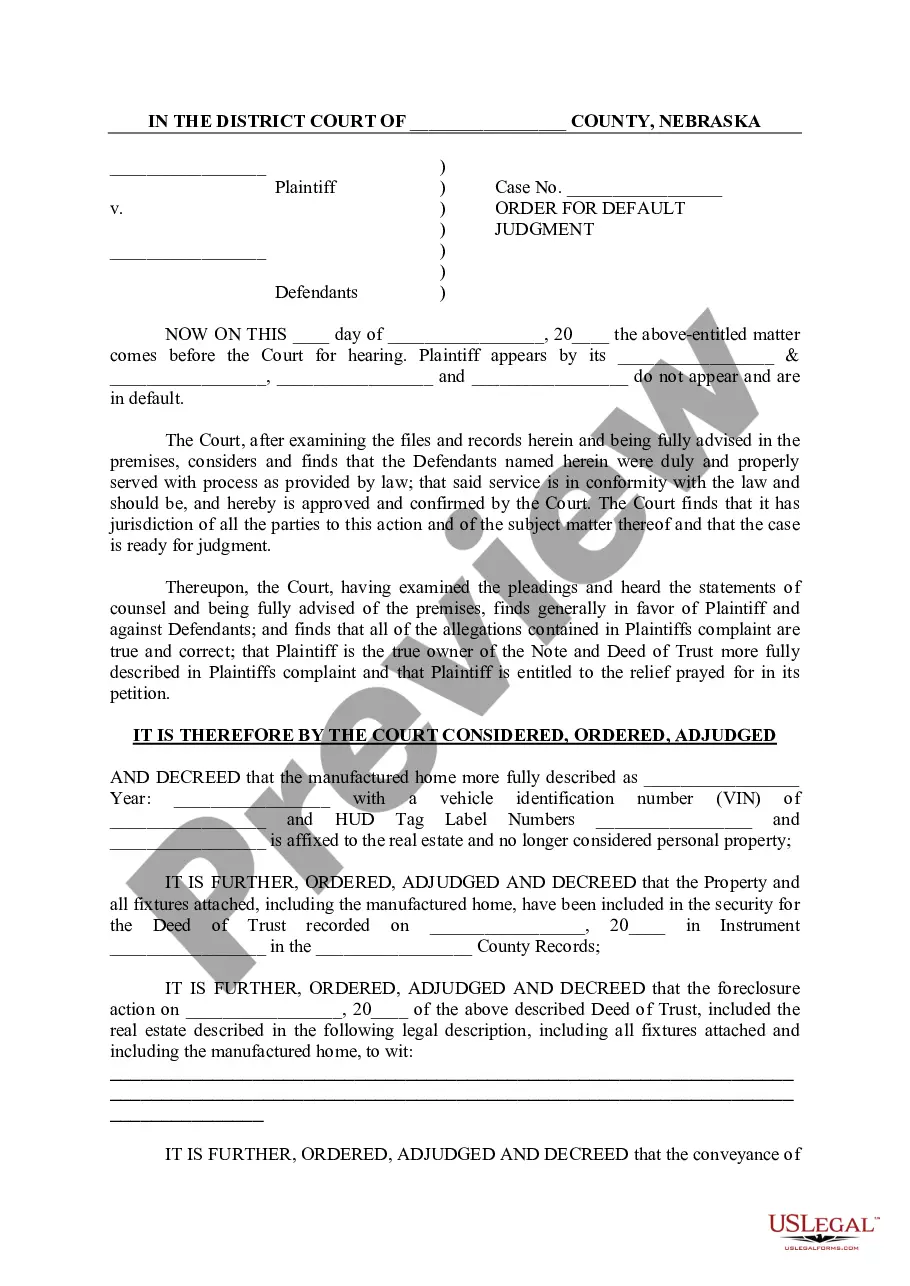
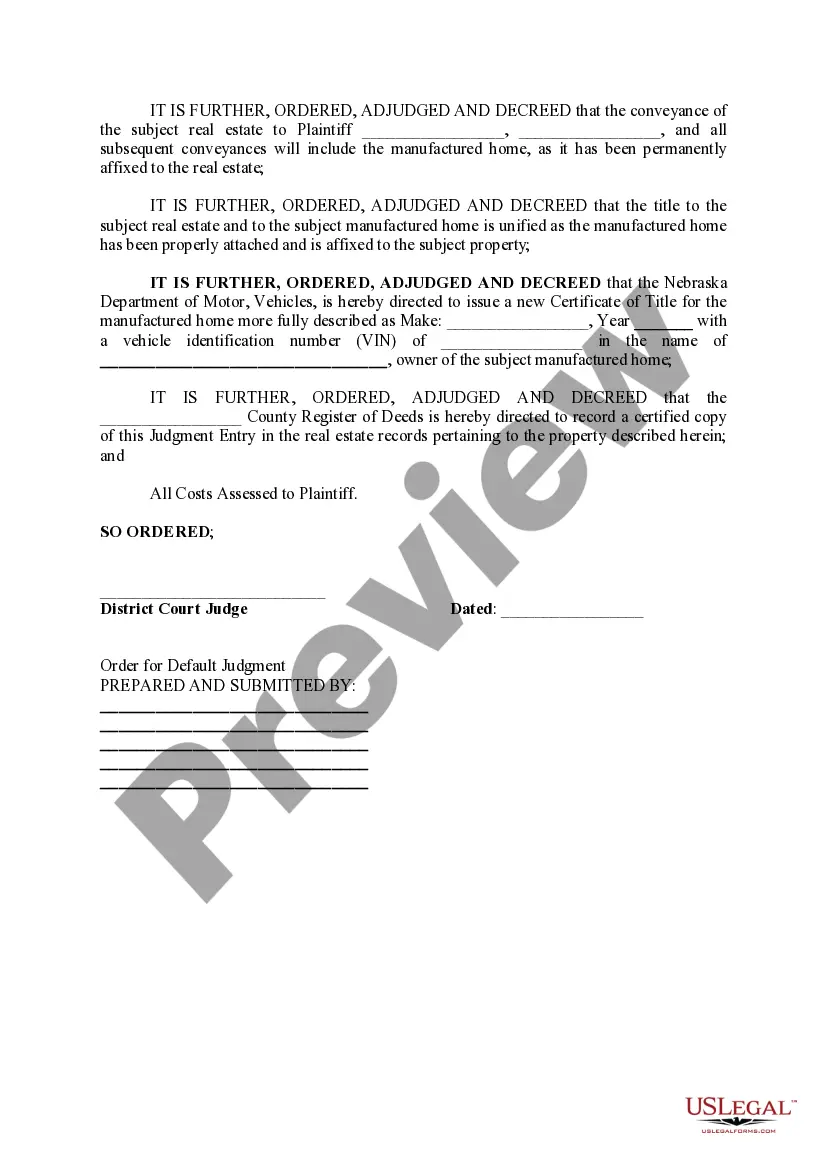
Omaha Nebraska Order for Default Judgment
Description
Get your form ready online
Our built-in tools help you complete, sign, share, and store your documents in one place.
Make edits, fill in missing information, and update formatting in US Legal Forms—just like you would in MS Word.
Download a copy, print it, send it by email, or mail it via USPS—whatever works best for your next step.
Sign and collect signatures with our SignNow integration. Send to multiple recipients, set reminders, and more. Go Premium to unlock E-Sign.
If this form requires notarization, complete it online through a secure video call—no need to meet a notary in person or wait for an appointment.
We protect your documents and personal data by following strict security and privacy standards.

Make edits, fill in missing information, and update formatting in US Legal Forms—just like you would in MS Word.

Download a copy, print it, send it by email, or mail it via USPS—whatever works best for your next step.

Sign and collect signatures with our SignNow integration. Send to multiple recipients, set reminders, and more. Go Premium to unlock E-Sign.

If this form requires notarization, complete it online through a secure video call—no need to meet a notary in person or wait for an appointment.

We protect your documents and personal data by following strict security and privacy standards.
Looking for another form?
How to fill out Nebraska Order For Default Judgment?
We consistently endeavor to reduce or avert legal harm when handling intricate law-related or financial matters.
To achieve this, we enroll in attorney services that, as a standard, are quite expensive.
However, not all legal issues are of the same level of complexity.
The majority of them can be managed independently.
Utilize US Legal Forms whenever you need to retrieve and download the Omaha Nebraska Order for Default Judgment or any other document swiftly and securely.
- US Legal Forms is a digital repository of current DIY legal documents covering anything from wills and powers of attorney to articles of incorporation and petitions for dissolution.
- Our platform aids you in taking control of your matters without needing to rely on an attorney.
- We provide access to legal document templates that aren’t always readily available.
- Our templates are specific to states and regions, which considerably simplifies the search process.
Form popularity
FAQ
In the US, a default judgment is entered against the defaulting party without consideration of the merits of the case. A default judgment is binding and may be entered against a party who fails to: Respond to a complaint. Appear at a scheduled hearing or trial.
How is a Judgment in Default of Appearance entered? A legal action in the civil courts are initiated via a Writ of Summons or an Originating Summons. Upon the issuance of the sealed Writ by the Court, the Plaintiff is to serve the sealed Writ to the Defendant within 6 months after the writ is issued by the Court.
Once the court has entered a judgment, your creditor can collect the judgment by garnishing you. This lets the creditor take the money directly from your bank account or paycheck. Your creditor might also legally seize your property.
A default judgment (also known as judgment by default) is a ruling granted by a judge or court in favor of a plaintiff in the event that the defendant in a legal case fails to respond to a court summons or does not appear in court.
Default judgment is a binding judgment in favor of either party based on some failure to take action by the other party. Most often, it is a judgment in favor of a plaintiff when the defendant has not responded to a summons or has failed to appear before a court of law.
A default judgment (or a judgment in default) is a judgment made by the court against a party because they failed to do something. For example, failing to file a document required by the court within a given period of time. Depending on the nature of your claim, a default judgment can be: A final judgment.