Louisiana Relative Caretaker Legal Documents Package
What is this form package?
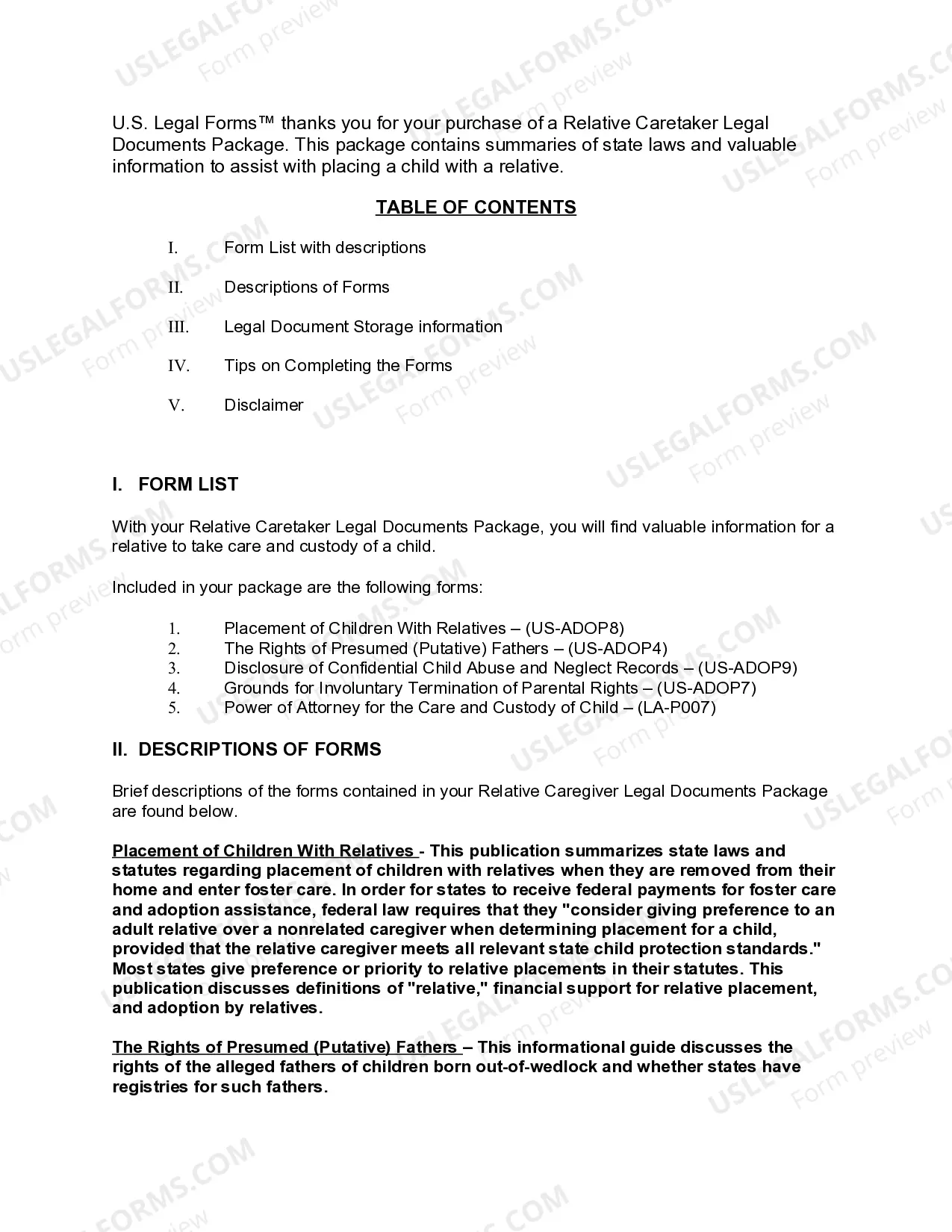
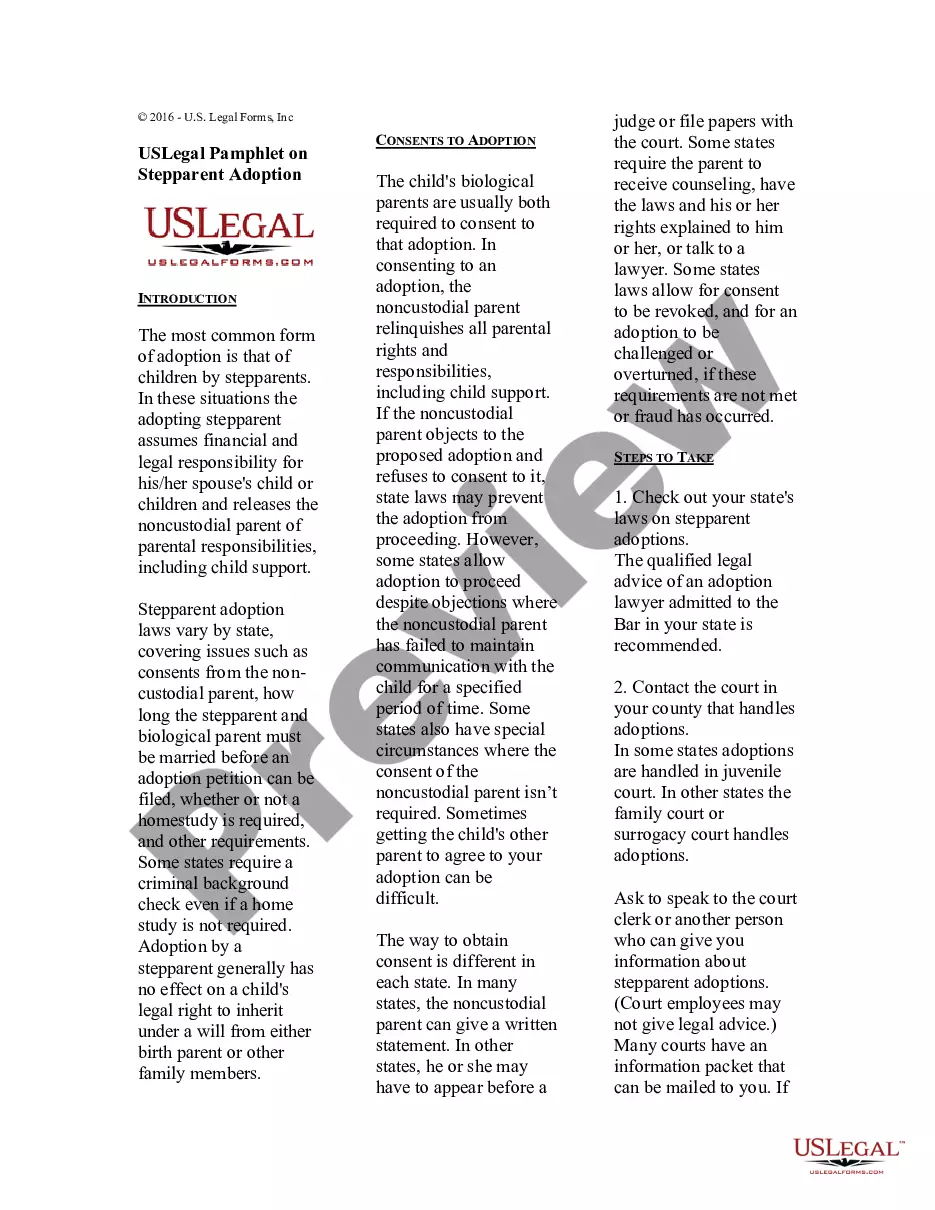
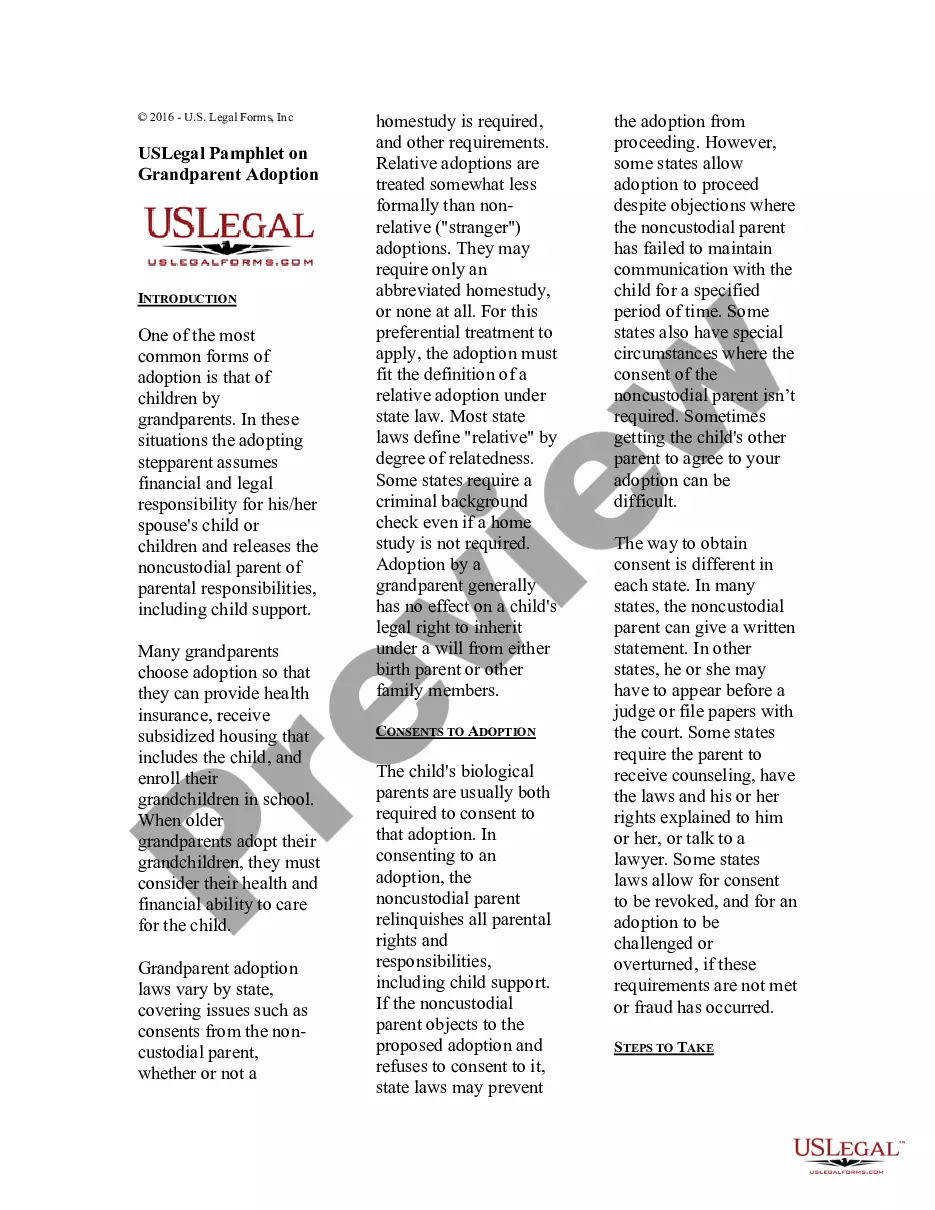
The Louisiana Relative Caretaker Legal Documents Package provides essential legal forms and summaries of state laws designed to assist relatives in gaining custody and care of a child. This package stands out by offering a comprehensive set of resources that save you over 50 percent compared to purchasing each document separately. It includes valuable insights into relative placements, parental rights, and more, making it an essential tool for navigating child custody situations in Louisiana.
Forms provided in this package
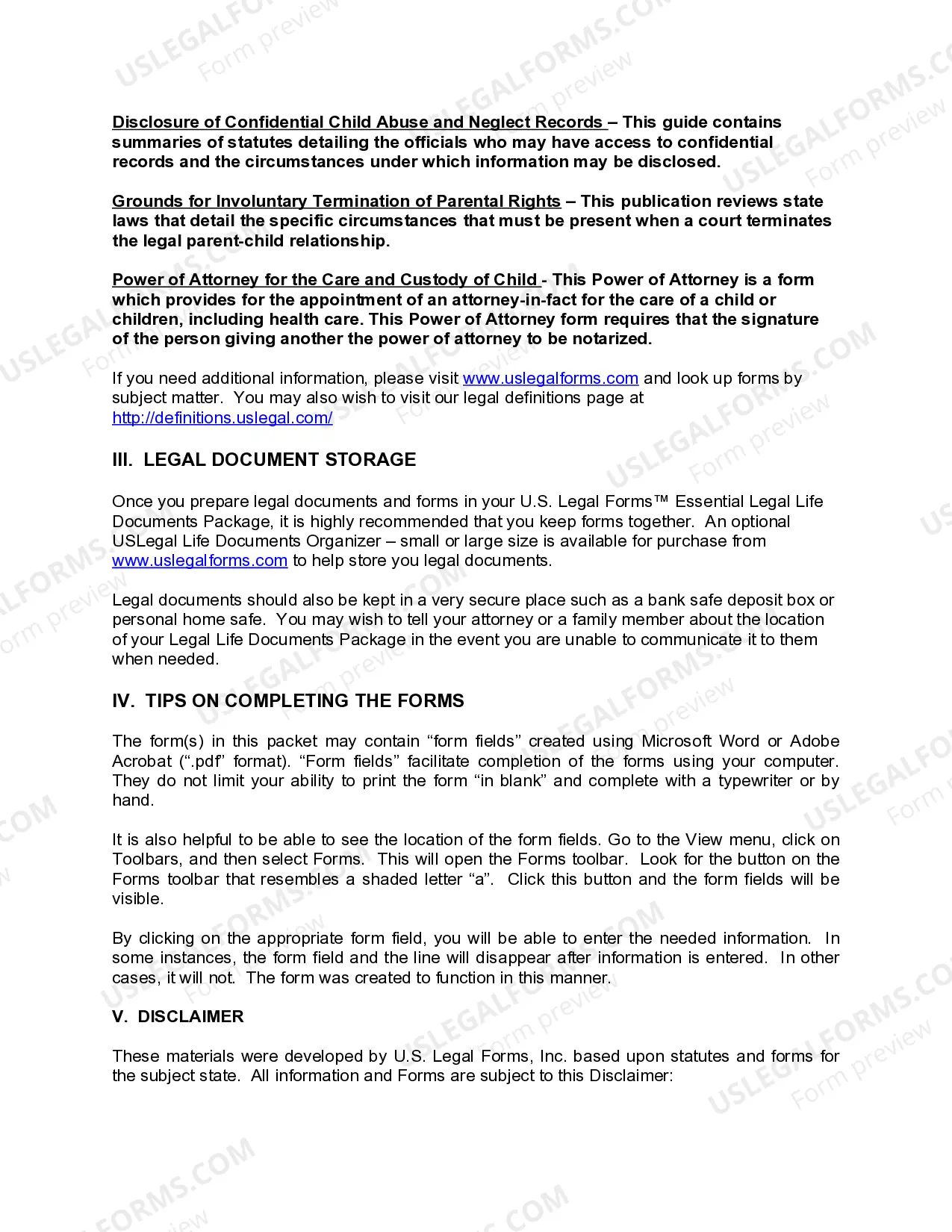
- Statutory General Power of Attorney for Care and Custody of Child or Children - Provisional Custody by Mandate
- The Rights of Presumed (Putative) Fathers
- Grounds for Involuntary Termination of Parental Rights
- Placement of Children With Relatives
- Disclosure of Confidential Child Abuse and Neglect Records


Common use cases
This form package is useful in various situations, including:
- When a child needs to be placed with a relative after being removed from their home.
- If you are a presumed father attempting to establish your rights concerning a child born out-of-wedlock.
- When you need to understand the conditions under which parental rights can be involuntarily terminated.
- If you require a Power of Attorney for the care of a child in order to make decisions regarding their health and well-being.
Intended users of this form package
- Relatives seeking custody of a child currently in foster care.
- Presumed fathers of children born out-of-wedlock looking to assert their rights.
- Anyone involved in a child custody case that includes navigational complexities related to child protection laws.
- Individuals needing legal authority to make decisions for a child's care and custody, such as healthcare decisions.
Instructions for completing these forms
- Review the included guides to understand your rights and the legal process for relative placements.
- Identify all parties involved, including the child, the relative caregiver, and any legal representatives.
- Complete the required forms with accurate information, being careful to follow the instructions provided.
- Ensure all necessary signatures are obtained and that any required notarizations are completed.
- Store your completed legal documents securely, and inform a trusted individual of their location.
Notarization details for included forms
Some forms in this package need notarization to be legally binding. Our online notarization service, powered by Notarize, lets you verify and sign documents remotely through an encrypted video session, available 24/7.
Get your form ready online
Our built-in tools help you complete, sign, share, and store your documents in one place.
Make edits, fill in missing information, and update formatting in US Legal Forms—just like you would in MS Word.
Download a copy, print it, send it by email, or mail it via USPS—whatever works best for your next step.
Sign and collect signatures with our SignNow integration. Send to multiple recipients, set reminders, and more. Go Premium to unlock E-Sign.
If this form requires notarization, complete it online through a secure video call—no need to meet a notary in person or wait for an appointment.
We protect your documents and personal data by following strict security and privacy standards.

Make edits, fill in missing information, and update formatting in US Legal Forms—just like you would in MS Word.

Download a copy, print it, send it by email, or mail it via USPS—whatever works best for your next step.

Sign and collect signatures with our SignNow integration. Send to multiple recipients, set reminders, and more. Go Premium to unlock E-Sign.

If this form requires notarization, complete it online through a secure video call—no need to meet a notary in person or wait for an appointment.

We protect your documents and personal data by following strict security and privacy standards.
Typical mistakes to avoid
- Not fully understanding the definitions of "relative" as outlined in the guides.
- Failing to obtain notarization on necessary forms.
- Omitting critical information or signatures from the forms.
- Not reviewing state-specific legal requirements adequately before completion.
Why use this package online
- Easy access to all necessary documents and legal information in one package.
- Convenient download options allow for immediate use without waiting for physical delivery.
- Editable forms are designed to simplify data entry and enhance accuracy.
- Cost-effective compared to purchasing individual forms.
Looking for another form?
Form popularity
FAQ
The process of adoption begins with an initial conversation with a Kinship Center adoption professional. Prospective adoptive parents may call (831) 455-4740. Someone will speak to you then or return your call promptly. Or you may complete and submit the Adoption Interest Form and someone will call you.
A relative or NREFM who is caring for a dependent child is eligible to receive a monthly foster care maintenance payment whether the child is federally eligible or ineligible. This payment is currently about $688 to $859 per month, depending on the age of the child.
The process to become an approved foster carer usually takes around 3 to 6 months. This varies depending on your individual circumstances and the type of care you want to provide.
If you're a foster/kinship foster carer, you can get help, training and financial support. This includes an allowance to cover costs, tax relief and help getting a State Pension. Social workers also visit to support you and the foster child.
Guide covers how to use the information your team has collected. By this point, your KPM team will have created detailed documentation of your current kinship care practices, which will position you to proceed with improvements to your child welfare system. All three phases of KPM take approximately eight weeks.
Prospective Adoptive Parents in Louisiana are required to complete a home study before beginning the adoption process and a postplacement assessment after the adoption takes place. Both will assess your ability to provide a safe and stable environment for the child you wish to adopt.
Unlike fostering, kinship is a type of out-of-home care where the child or young person is with a caregiver with whom they have had a previous relationship.informal, when the caregiver is providing home care as a private arrangement with the family, unrecognised by both the court and jurisdiction.
Foster/Adopt Parent Concurrent caregivers can be relatives or non-relative foster parents who provide foster care for children while reunification services are provided to the child and his or her birth parents.
This type of agreement allows birth parents to still make decisions concerning their child. In other arrangements, kinship parents receive both legal and physical custody of the child.Often, it starts out as a temporary arrangement and becomes permanent if the relative chooses to adopt the child.