Kentucky Warranty Deed to Separate Property of One Spouse to Both Spouses as Joint Tenants
Overview of this form
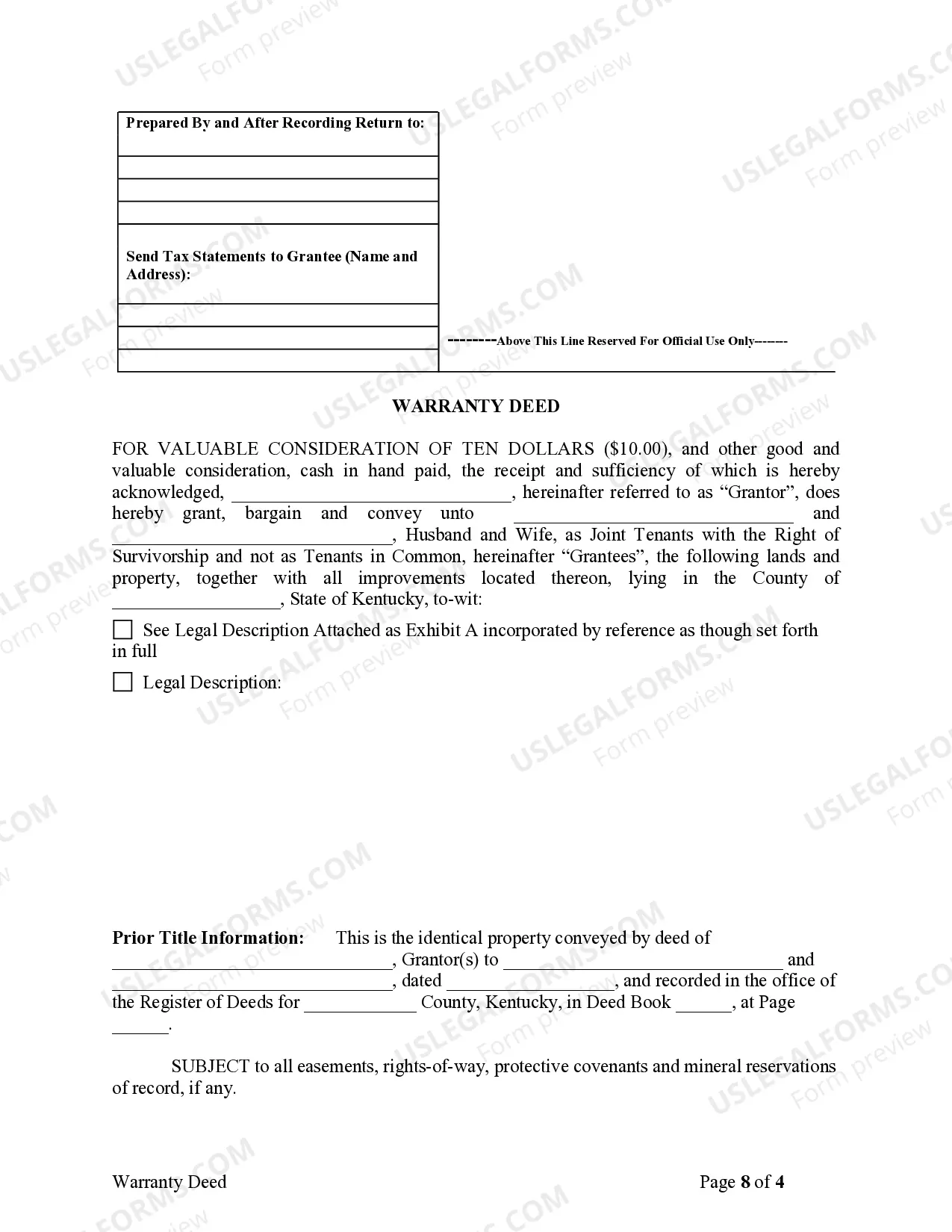
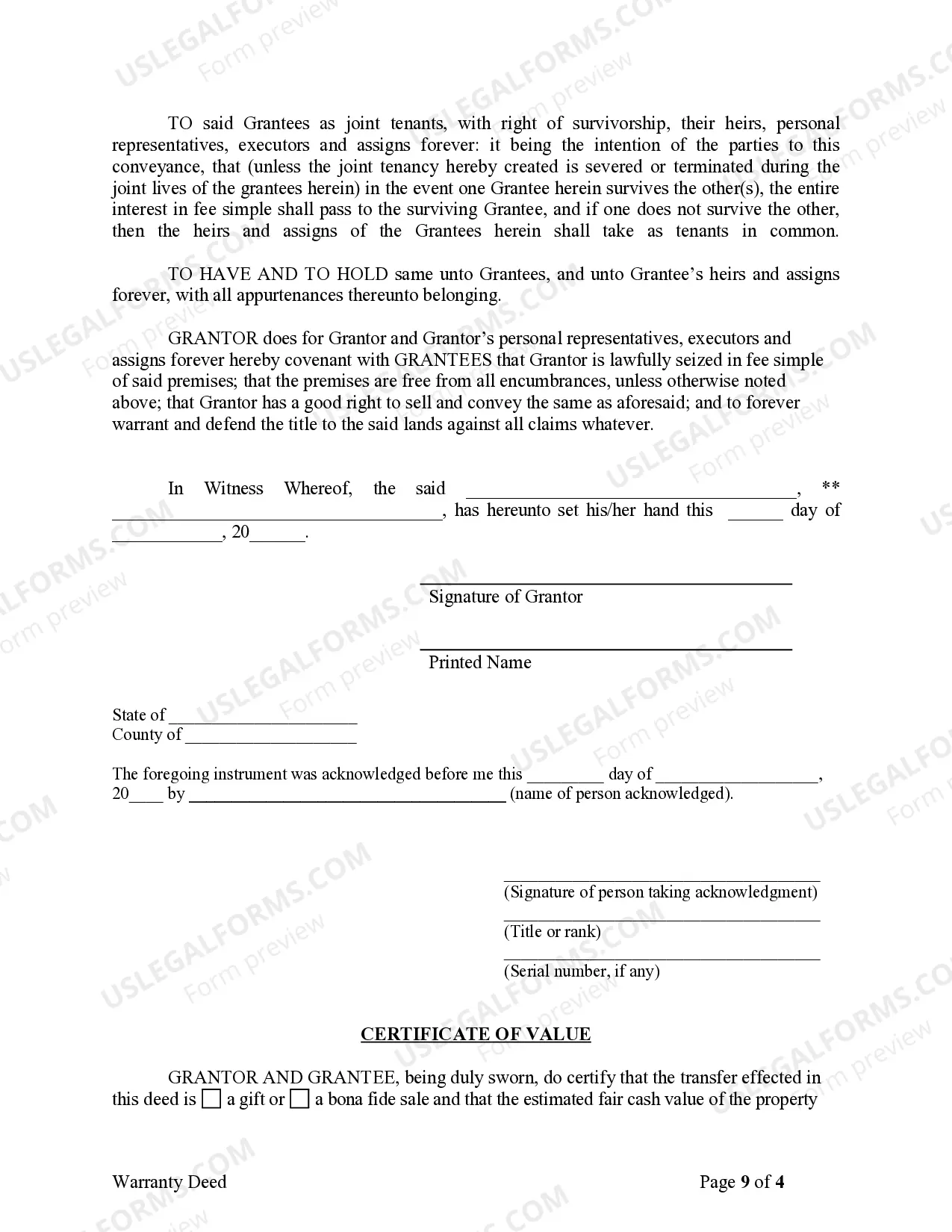
This Warranty Deed allows one spouse to transfer their separate property to both spouses as joint tenants with the right of survivorship. This means that if one spouse passes away, the surviving spouse automatically inherits the entire property without going through probate. This form differs from other deeds, such as general or special warranty deeds, as it specifically addresses the transfer of property between spouses with right of survivorship, ensuring protection for the surviving spouse's ownership rights.
Main sections of this form
- Identification of the grantor (the spouse transferring the property).
- Identification of the grantees (both spouses receiving the property).
- Description of the property being transferred, including legal description.
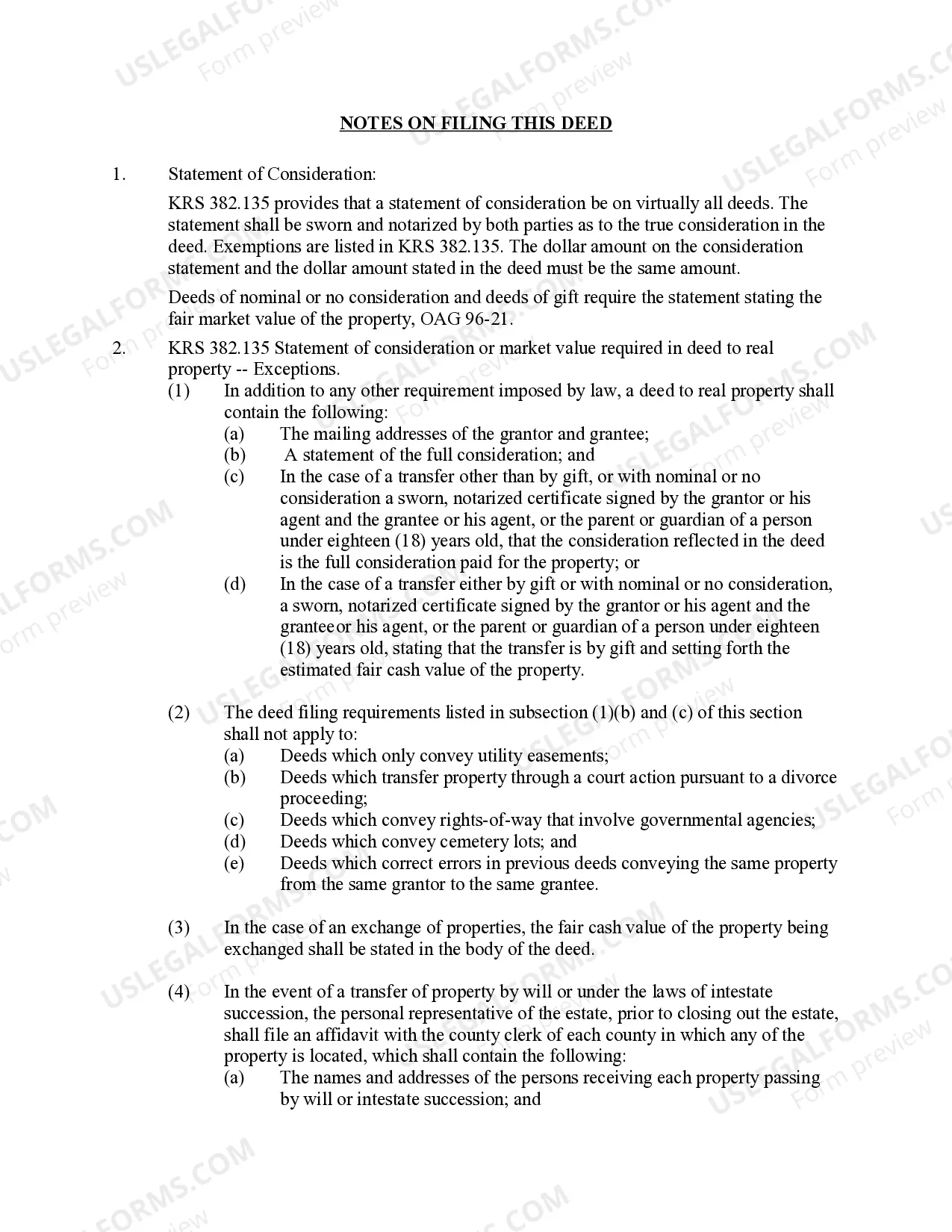
- Statement of consideration reflecting the value exchanged.
- Covenants by the grantor regarding their ownership of the property.
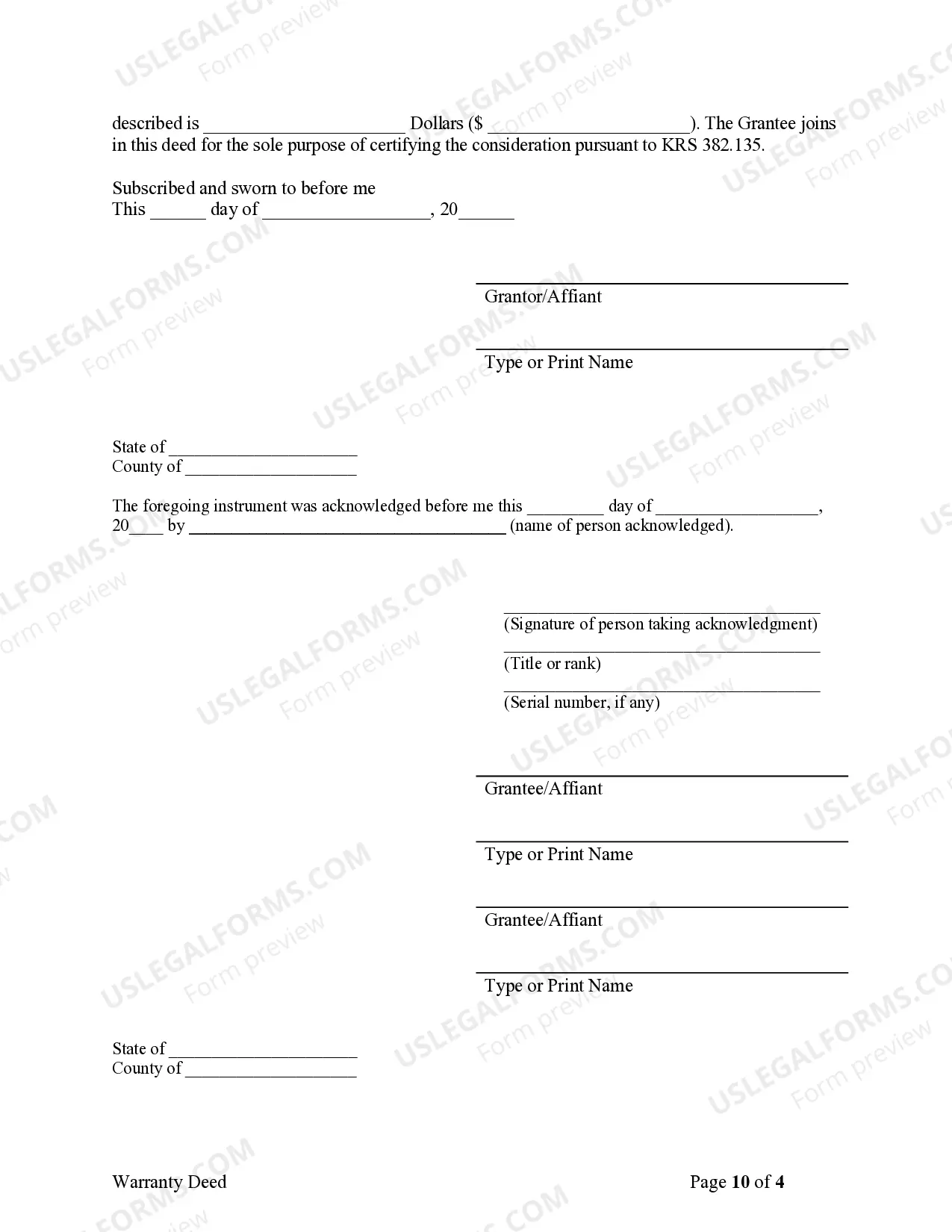
- Notarization and certification of value requirements.


Common use cases
This form is useful when a spouse wishes to formally transfer ownership of their separate property into joint ownership with their spouse. It is particularly relevant when couples are looking to secure their property rights together or plan for future scenarios concerning inheritance and property ownership. Utilizing this Warranty Deed can provide peace of mind that both spouses will have equal rights to the property and ensure a smooth transition of ownership in case of one spouse's passing.
Who this form is for
This form is intended for:
- Married couples wanting to consolidate ownership of separate properties.
- Spouses interested in protecting each other's rights to property ownership.
- Individuals looking to establish joint tenancy with right of survivorship for estate planning purposes.
Instructions for completing this form
- Identify the parties involved: the spouse transferring the property (grantor) and both spouses (grantees).
- Provide a complete legal description of the property being transferred.
- Fill in the statement of consideration reflecting the property's value.
- Sign the deed in the presence of a notary public.
- Complete any required certificates of value and have them notarized.
Notarization guidance
Yes, this form must be notarized to be legally valid. It is essential for both parties' signatures to be witnessed and notarized, confirming the legitimacy of the transfer. U.S. Legal Forms offers integrated online notarization services available 24/7 via secure video calls, making the process easy and accessible without the need to travel.
Get your form ready online
Our built-in tools help you complete, sign, share, and store your documents in one place.
Make edits, fill in missing information, and update formatting in US Legal Forms—just like you would in MS Word.
Download a copy, print it, send it by email, or mail it via USPS—whatever works best for your next step.
Sign and collect signatures with our SignNow integration. Send to multiple recipients, set reminders, and more. Go Premium to unlock E-Sign.
If this form requires notarization, complete it online through a secure video call—no need to meet a notary in person or wait for an appointment.
We protect your documents and personal data by following strict security and privacy standards.

Make edits, fill in missing information, and update formatting in US Legal Forms—just like you would in MS Word.

Download a copy, print it, send it by email, or mail it via USPS—whatever works best for your next step.

Sign and collect signatures with our SignNow integration. Send to multiple recipients, set reminders, and more. Go Premium to unlock E-Sign.

If this form requires notarization, complete it online through a secure video call—no need to meet a notary in person or wait for an appointment.

We protect your documents and personal data by following strict security and privacy standards.
Avoid these common issues
- Failing to include the legal description of the property adequately.
- Not having both parties sign the deed in front of a notary.
- Neglecting to ensure the consideration amount is consistent throughout the document.
- Forgetting to file the deed with the appropriate county office after completion.
Advantages of online completion
- Convenience of filling out and saving the document at your own pace.
- Access to pre-drafted legal language vetted by licensed attorneys.
- Ability to easily edit and print the form whenever necessary.
- Secure digital storage options for your completed legal documents.
Looking for another form?
Form popularity
FAQ
The deed specifies that the joint tenants own an equal amount of interest in the purchased property and are thus equally liable for it financially. Since the joint tenants have equal interest, the property cannot be sold without all parties' consent.
If you look at the registered title to your own jointly owned property and the text isn't shown on it, you own it as joint tenants. If it is there, you own it as tenants-in-common.
In estate law, joint tenancy is a special form of ownership by two or more persons of the same property. The individuals, who are called joint tenants, share equal ownership of the property and have the equal, undivided right to keep or dispose of the property. Joint tenancy creates a Right of Survivorship.
A partition deed is executed by co-owners In case a partition is by mutual consent, a partition deed is executed by the co-owners. The partition deed is required to be registered at the office of the sub-registrar of the place where the property is situated as in case of any other registration.
If you're joint tenants and you both want to leave, either you or your ex-partner can end the tenancy by giving notice. You'll both need to move out.You can apply to court to change your ex-partner's tenancy to your name, or remove their name from a joint tenancy.
In California, most married couples hold real property (such as land and buildings) as joint tenants with right of survivorship.For instance, many married couples share real property as joint tenants. This way, upon the death of a spouse, the surviving spouse will own 100% share of the property.
Tenants in common and joint tenants can petition a court to partition the property. This means that the court is being asked to divide the property into different lots or sections. There are two general types of partitions.
Yes, it is legal in California for a joint tenant to encumber the property to obtain a loan without the knowledge or consent of the other.
This is known as 'Severing the Joint Tenancy'. It requires service of a written notice of change the 'severance'. It can be done without the other owner's cooperation or agreement. It is recorded at the Land Registry, and the other owner will know it has been done but only 'after the event' so to speak.