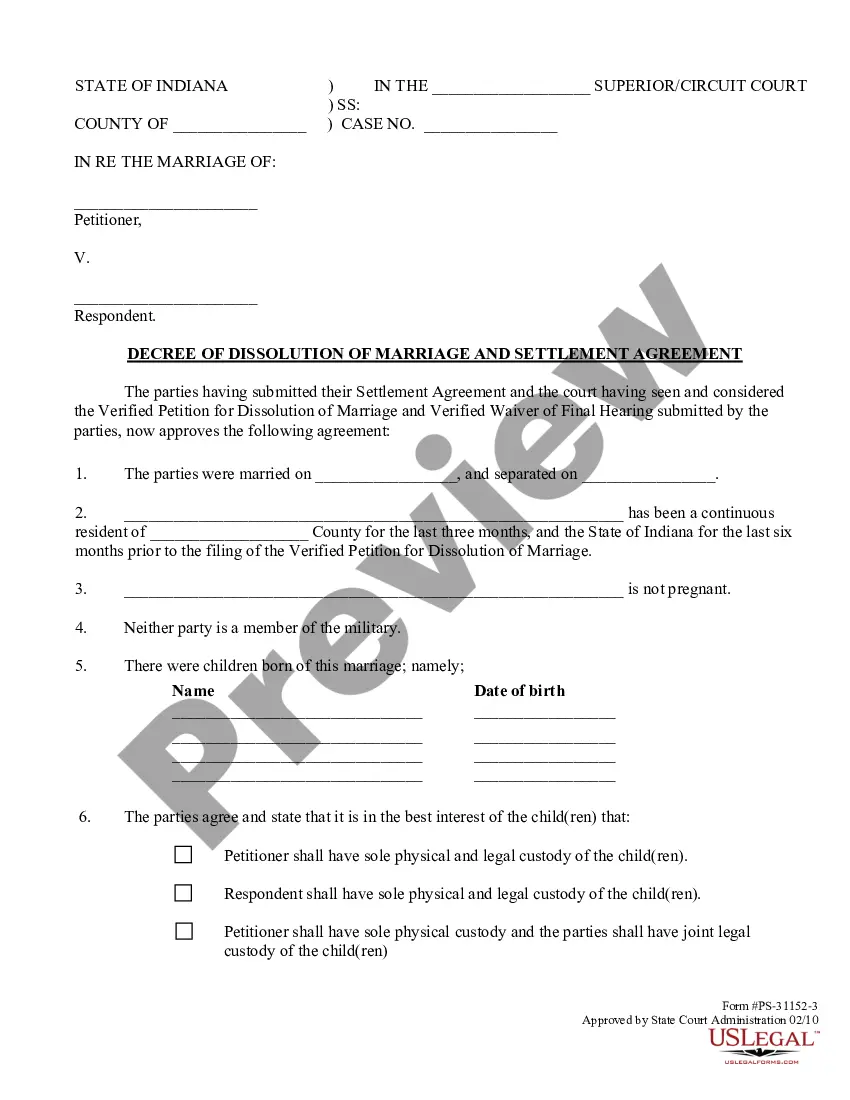
Indiana Transfer on Death Deed - TOD from Two Individuals / Husband and Wife, to an Individual
What this document covers
The Transfer on Death Deed (TOD) allows two individuals, typically a husband and wife, to transfer property titles to a designated individual upon their death. This form simplifies the process of transferring real estate without going through probate, allowing the designated beneficiary to take immediate ownership after the grantors pass away. It can also include provisions for a contingent beneficiary in case the primary beneficiary dies first, making it a versatile tool for estate planning.
Key components of this form
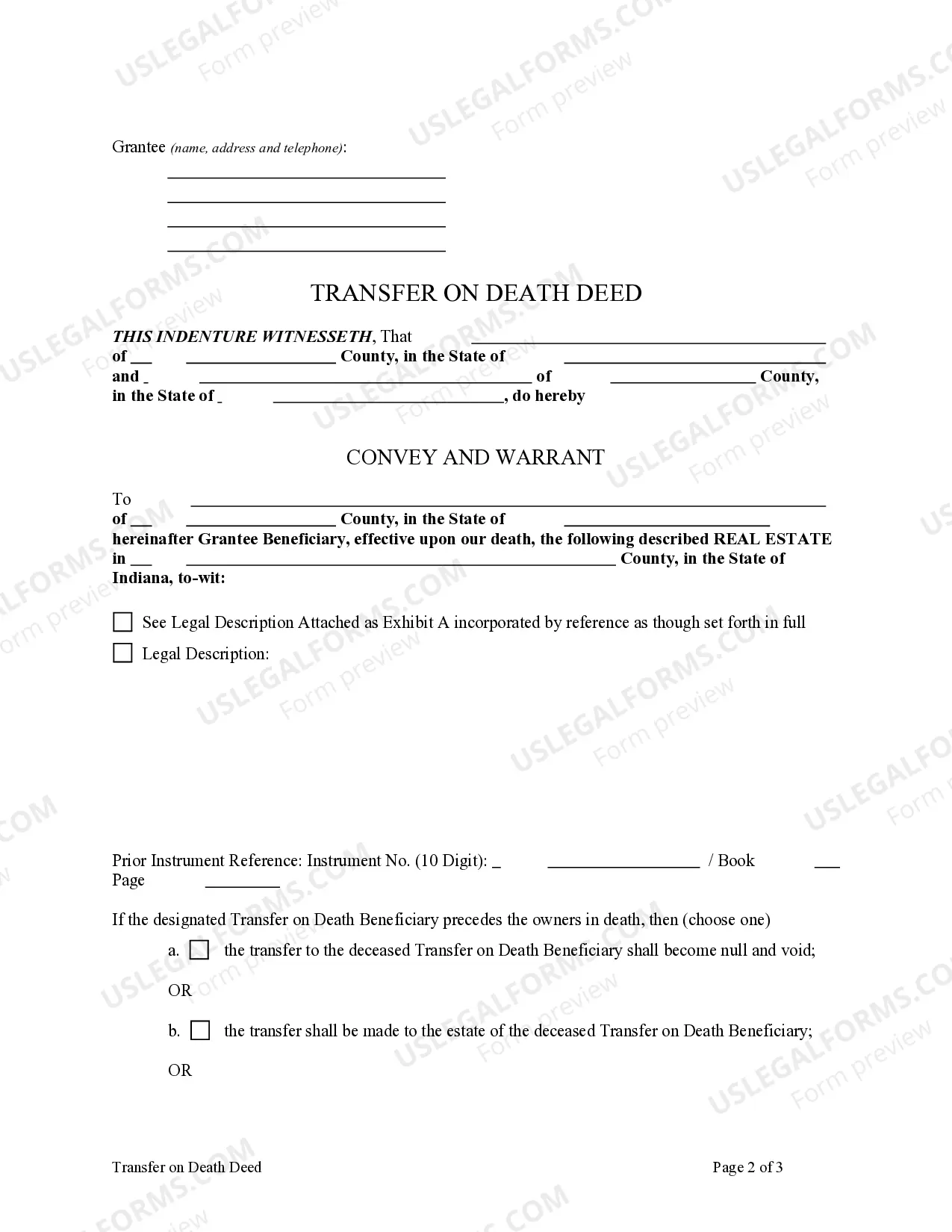
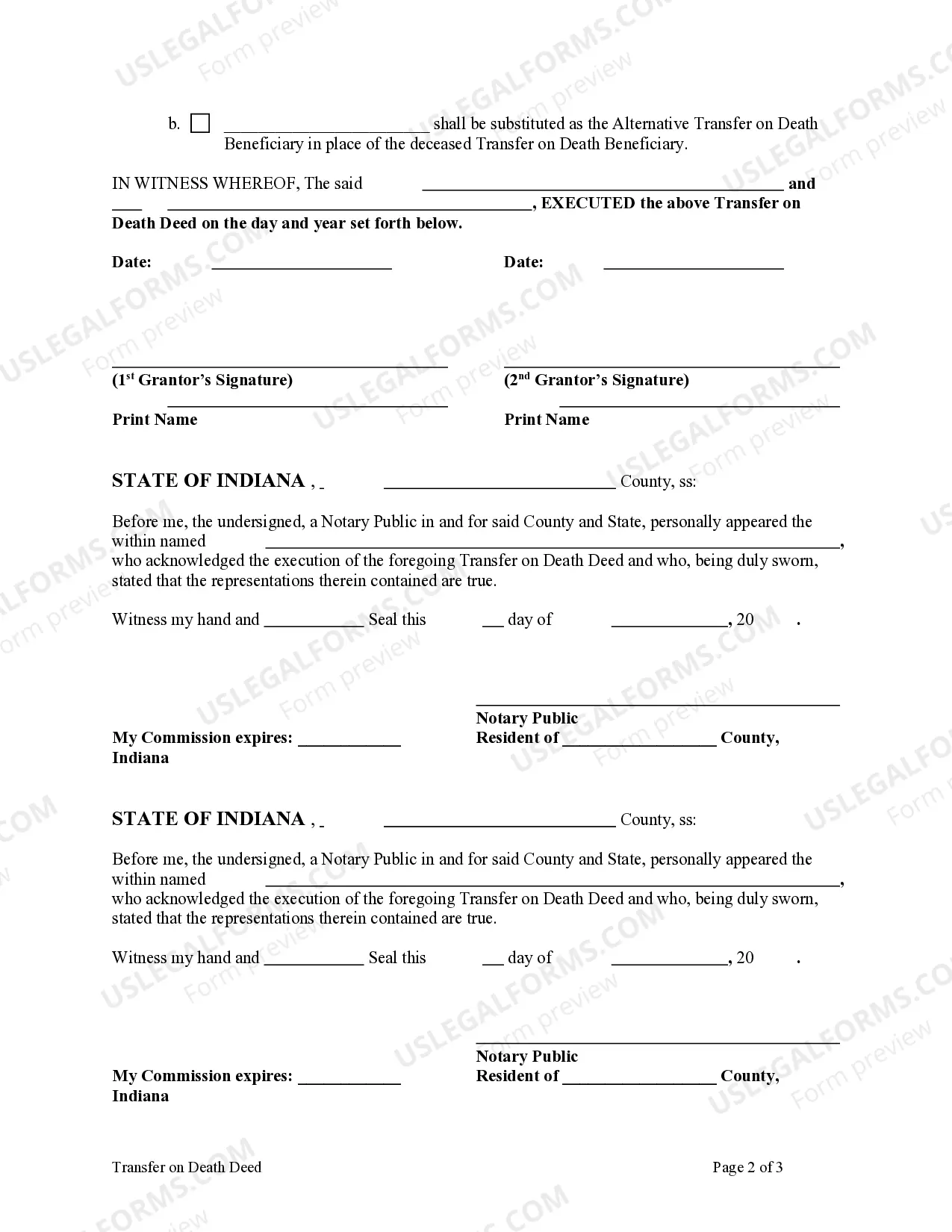
- Grantors' names and addresses: Identifies the current owners of the property.
- Grantee's name: Specifies who will receive the property upon the grantors' death.
- Real estate description: Details the specific property being transferred.
- Contingent beneficiary options: Provides choices for what happens if the primary beneficiary predeceases the grantors.
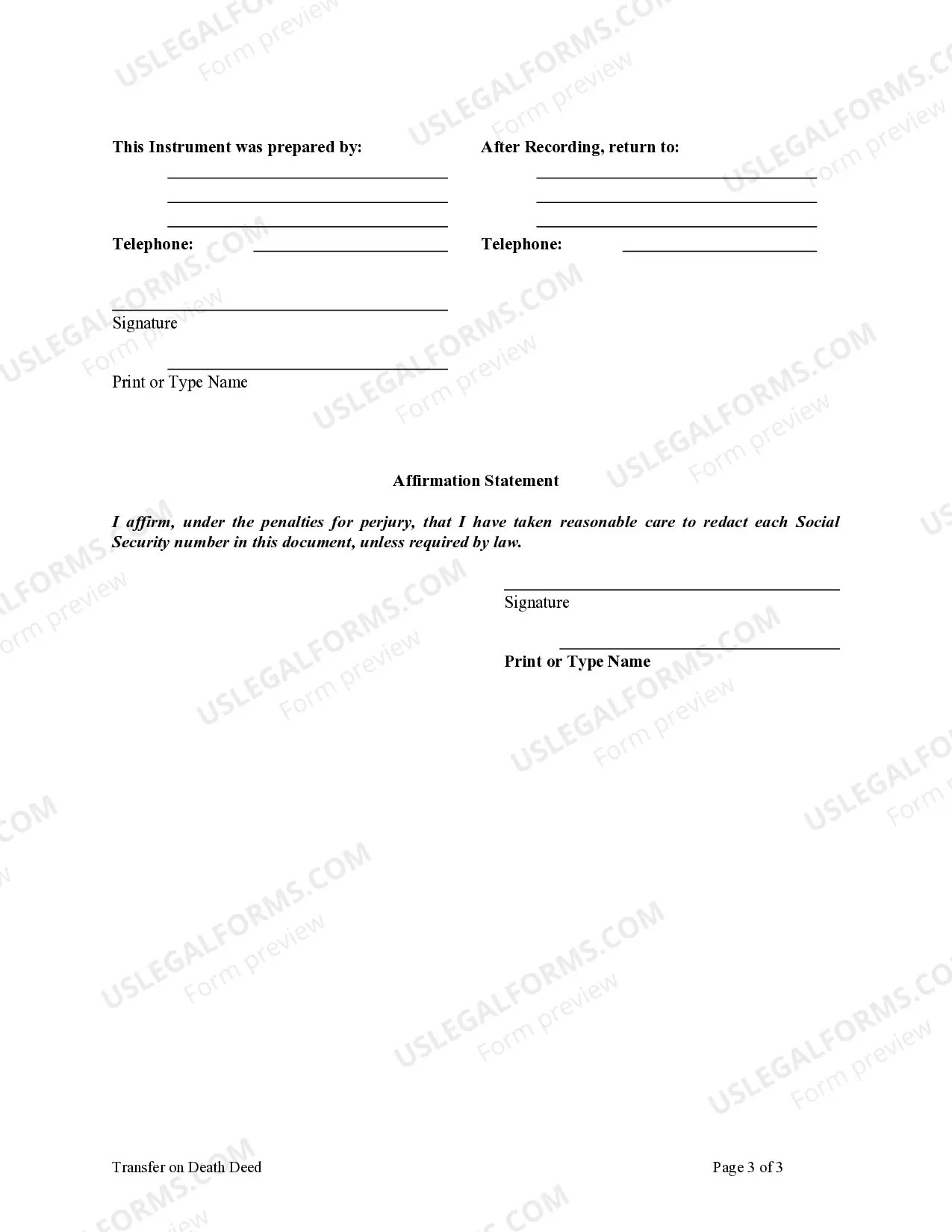
- Signature lines: Requires signatures from both grantors to validate the deed.
- Notary acknowledgment area: Confirms the identity of the signing grantors and the validity of their signatures.




When to use this document
This form is particularly useful when two individuals want to ensure their property is transferred directly to a chosen beneficiary without the need for lengthy probate proceedings. It's ideal for estate planning where the grantors want to maintain control over their assets during their lifetime while providing for automatic transfer upon their death.
Who should use this form
- Married couples who own property together and wish to designate a single beneficiary.
- Individuals looking to simplify the transfer of real estate after their death.
- Those who want to specify an alternative beneficiary in case the primary beneficiary cannot inherit the property.
- Homeowners in Indiana seeking a legally recognized method to transfer their property upon death.
Completing this form step by step
- Identify the grantors: Enter the full names and addresses of the individuals transferring the property.
- Name the grantee: Specify the individual who will inherit the property upon the grantors' death.
- Complete the property description: Provide a legal description of the real estate being transferred.
- Select contingent beneficiary options: Decide what happens if the primary beneficiary dies before the grantors.
- Sign and date the document: Both grantors must sign the deed, acknowledging the transfer.
- Get notarized: Have the document notarized to ensure its legality and validity.
Is notarization required?
This document requires notarization to meet legal standards. US Legal Forms provides secure online notarization powered by Notarize, allowing you to complete the process through a verified video call, available 24/7.
Get your form ready online
Our built-in tools help you complete, sign, share, and store your documents in one place.
Make edits, fill in missing information, and update formatting in US Legal Forms—just like you would in MS Word.
Download a copy, print it, send it by email, or mail it via USPS—whatever works best for your next step.
Sign and collect signatures with our SignNow integration. Send to multiple recipients, set reminders, and more. Go Premium to unlock E-Sign.
If this form requires notarization, complete it online through a secure video call—no need to meet a notary in person or wait for an appointment.
We protect your documents and personal data by following strict security and privacy standards.

Make edits, fill in missing information, and update formatting in US Legal Forms—just like you would in MS Word.

Download a copy, print it, send it by email, or mail it via USPS—whatever works best for your next step.

Sign and collect signatures with our SignNow integration. Send to multiple recipients, set reminders, and more. Go Premium to unlock E-Sign.

If this form requires notarization, complete it online through a secure video call—no need to meet a notary in person or wait for an appointment.

We protect your documents and personal data by following strict security and privacy standards.
Common mistakes
- Not providing a complete legal description of the property.
- Failing to select a contingent beneficiary.
- Omitting notarization, which can invalidate the deed.
- Not ensuring both grantors sign the document.
Advantages of online completion
- Convenient access from anywhere, allowing for easy completion at your own pace.
- Editable format for easy customization to fit your specific needs.
- Reliable, attorney-drafted templates ensure legal validity and compliance.
Summary of main points
- The Transfer on Death Deed allows for property title transfer upon the owners' death.
- It provides flexibility with beneficiary designations, including options for contingent beneficiaries.
- Proper execution, including notarization and recording, is essential for legality.
Looking for another form?





Form popularity
FAQ
A TOD Beneficiary may be added to an Indiana Certificate of Title at the time of purchase (title transfer), or, if you already have title to the vehicle, you may apply for new title containing the TOD designation.
What Is the Difference Between TOD and Beneficiary? A transfer on death is an instrument that transfers ownership of specific accounts and assets to someone. A beneficiary is someone that is named to receive something of value.
TOD/POD disadvantages: these accounts pass directly to the beneficiary and do not go through probate, if the executor does not have enough probate assets to pay the debts of the estate, creditors are entitled to claim some non- probate assets, including TOD accounts.
An Indiana transfer on death deed is an estate planning tool that allows a property owner to designate who will receive their property in the event of their death. If properly executed, the deed will allow the beneficiary of the property to avoid a potentially long and arduous probate process.
In Indiana, you can make a living trust to avoid probate for virtually any asset you own?real estate, bank accounts, vehicles, and so on. You need to create a trust document (it's similar to a will), naming someone to take over as trustee after your death (called a successor trustee).
You must sign the deed and get your signature notarized, and then record (file) the deed with the county recorder's office before your death. Otherwise, it won't be valid. You can make an Indiana transfer on death deed with WillMaker.
Signing (IC § 32-21-2-3) ? All deed must be executed by one of the following: judge, clerk of a court of record, county auditor, county recorder, notary public, mayor of a city in Indiana or any other state, commissioner appointed in a state other than Indiana by the governor of Indiana, clerk of the city county
Probate Avoidance ? A TOD deed allows the property to pass to the beneficiaries named in the deed without going through Indiana probate. Indiana law has a $50,000 limit on nonprobate transfers using the small estate procedure. The TOD deed can be used even if the value exceeds $50,000.