Indiana Final Notice of Default for Past Due Payments in connection with Contract for Deed
What this document covers
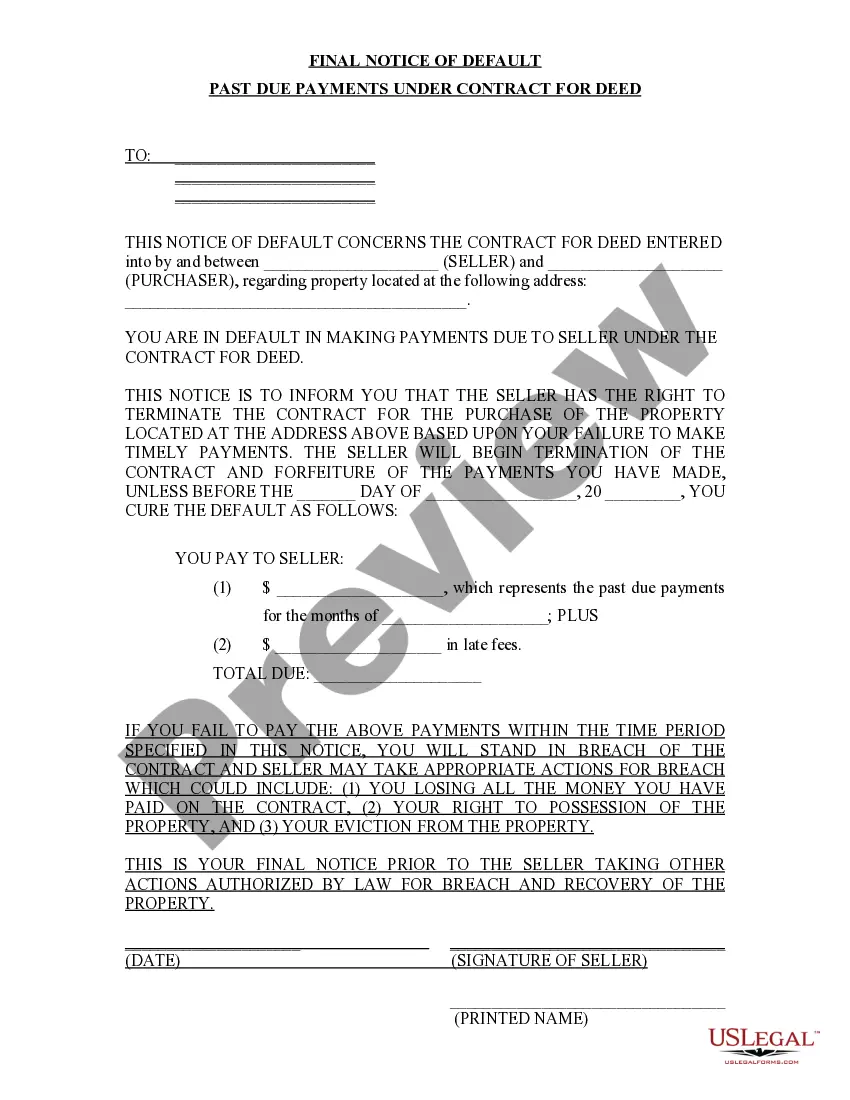
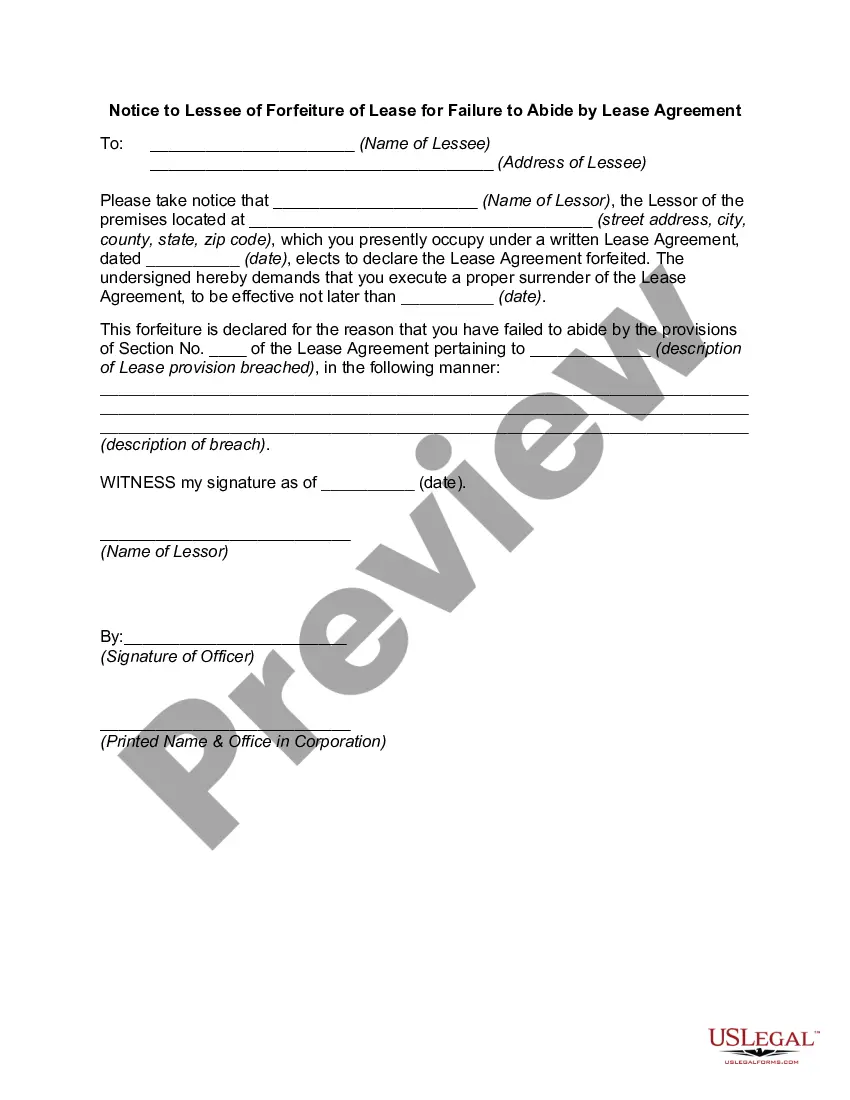
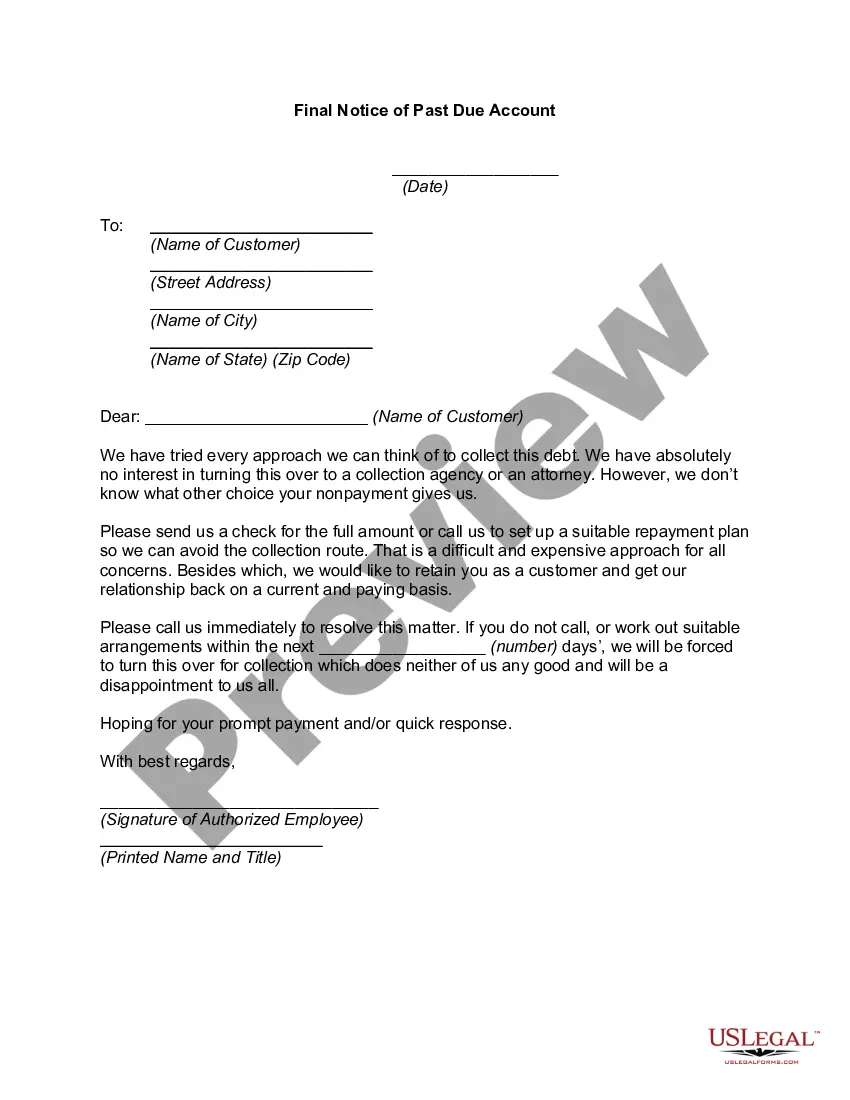
The Final Notice of Default for Past Due Payments in connection with Contract for Deed is a formal document that the seller uses to inform the purchaser of their failure to make required payments. This final notice serves as a crucial communication that indicates if payment is not made by the specified date, the contract will be in default. This form differs from a regular payment reminder by escalating the issue to a formal notice that may lead to contract termination and potential legal actions.
What’s included in this form
- Parties involved: Identification of the seller and purchaser.
- Property details: Specification of the property address under the contract for deed.
- Notification of default: Clear statement on the payment default.
- Payment details: Amount owed and breakdown of past due payments and any applicable late fees.
- Deadline for payment: Date by which the purchaser must cure the default.
- Consequences of non-payment: Description of potential legal actions by the seller.
When to use this form
This form should be used when a purchaser fails to make timely payments on a property purchased through a contract for deed. It is specifically necessary if the seller wants to formally communicate that the contract is in danger of default, and the purchaser has not responded to previous reminders or notices to fulfill their payment obligations.
Who should use this form
- Property sellers who have entered into a contract for deed and have not received timely payments from the purchaser.
- Purchasers who are behind on their payments and need to understand the consequences of default.
Instructions for completing this form
- Identify the parties: Fill in the names of the seller and purchaser as outlined in the contract.
- Specify the property: Write the complete address of the property regarding the contract for deed.
- Enter the payment details: List the amount due, including the past due payments and any late fees.
- Set the payment deadline: Clearly state the date by which the purchaser must make the payment to avoid contract termination.
- Sign and date the notice: The seller must provide their signature along with the date on which the notice is issued.
Notarization requirements for this form
To make this form legally binding, it must be notarized. Our online notarization service, powered by Notarize, lets you verify and sign documents remotely through an encrypted video session.
Get your form ready online
Our built-in tools help you complete, sign, share, and store your documents in one place.
Make edits, fill in missing information, and update formatting in US Legal Forms—just like you would in MS Word.
Download a copy, print it, send it by email, or mail it via USPS—whatever works best for your next step.
Sign and collect signatures with our SignNow integration. Send to multiple recipients, set reminders, and more. Go Premium to unlock E-Sign.
If this form requires notarization, complete it online through a secure video call—no need to meet a notary in person or wait for an appointment.
We protect your documents and personal data by following strict security and privacy standards.

Make edits, fill in missing information, and update formatting in US Legal Forms—just like you would in MS Word.

Download a copy, print it, send it by email, or mail it via USPS—whatever works best for your next step.

Sign and collect signatures with our SignNow integration. Send to multiple recipients, set reminders, and more. Go Premium to unlock E-Sign.

If this form requires notarization, complete it online through a secure video call—no need to meet a notary in person or wait for an appointment.

We protect your documents and personal data by following strict security and privacy standards.
Common mistakes
- Failing to properly identify the seller and purchaser, which can lead to legal disputes.
- Not specifying the correct property address, which may invalidate the notice.
- Omitting payment amounts or deadlines, which could lead to confusion for the purchaser.
- Not signing or dating the notice, which is crucial for the document's validity.
Advantages of online completion
- Convenient access: Download the form immediately and fill it out from home.
- Editability: Easy to modify fields specific to your situation.
- Reliability: Legal documents drafted by licensed attorneys, ensuring accuracy and compliance with the law.
Legal use & context
This notice acts as a formal warning to the purchaser, indicating the seller's intent to terminate the contract if payments are not made. It is an important step in maintaining legal rights concerning property transactions under a contract for deed.
Key takeaways
- This form serves as a final notice to a purchaser under a contract for deed for past due payments.
- It should be completed accurately and delivered promptly to ensure legal compliance.
- Understanding the implications of this notice can help prevent potential loss of property and payments.
Looking for another form?





Form popularity
FAQ
Do I get paid my annual leave when I resign? The employer has to compensate the employee for any unpaid yearly leave days that they are entitled to after the notice period expires. The employee should know their rights and the number of days they have to work.
You should get your full normal pay if you work during your notice period. This should include any work benefits you get, such as pension contributions or free meals.However, you're entitled to full pay for 1 week of your notice period, whether you give notice of only 1 week or more than 1 week.
If you're made redundant, your job won't end straight away - you'll get a paid notice period. You might get notice pay instead of your notice period - this is called 'pay in lieu of notice'. This is as well as any redundancy pay you're entitled to.
When an employee is paid money that he or she would have earned through working during the contracted period because he or she is being terminated without notice, it is called wages in lieu of notice. A contractual period for notice may be included as a term in an implied or express contract.
Notice pay when the employee is working Work out weekly pay by using the 12 weeks leading up to the first day of the notice period. Add up the total amount of pay during the 12 weeks and divide it by 12 to get their average weekly pay. This is the minimum amount they must receive during their notice period.
The amount to be paid will normally cover all salaries that would have been earned during the notice period. That will normally cover basic pay and may include other things like commission and compensation for the loss of benefits, like personal use of a company car, phone, or medical insurance.
A 30 to 90-day notice period applies in order to terminate 'workmen' (as defined in the Industrial Disputes Act, 1947) that is, employees whose role is not primarily supervisory, administrative or managerial) for convenience, with 15 days' pay due for every year worked.
It is mandatory to give notice before leaving the job. therefore notice of leaving a job by way of resgination is should be given to the employer then only the employee is entitiled for notice pay. The context 'Notice pay' included what you are gaining for last months will continue for further notice period.
If you're made redundant, your job won't end straight away - you'll get a paid notice period. You might get notice pay instead of your notice period - this is called 'pay in lieu of notice'. Your employer will tell you if they'll give you pay in lieu of notice.This is as well as any redundancy pay you're entitled to.