Illinois Last Will and Testament for Married person with Adult Children from Prior Marriage
Understanding this form
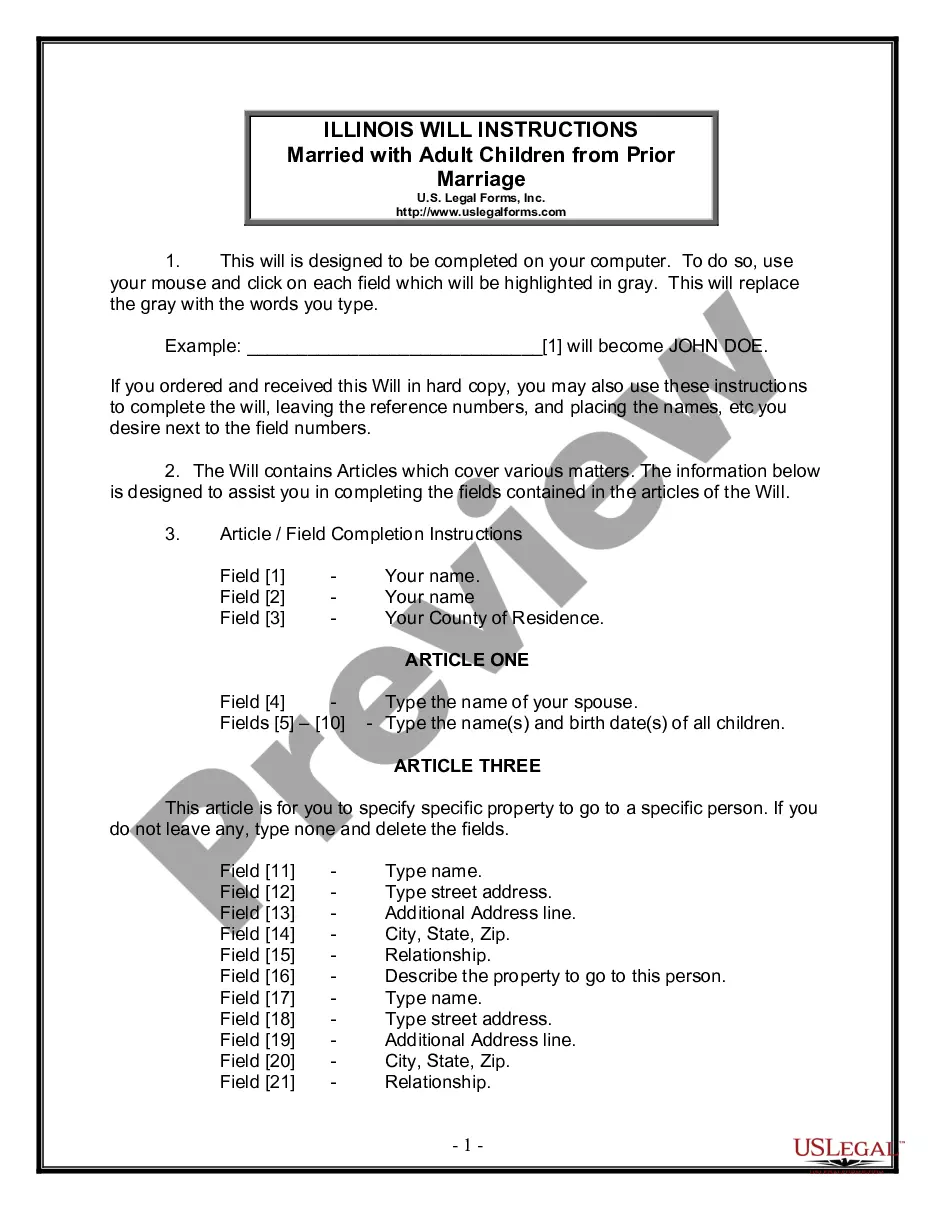
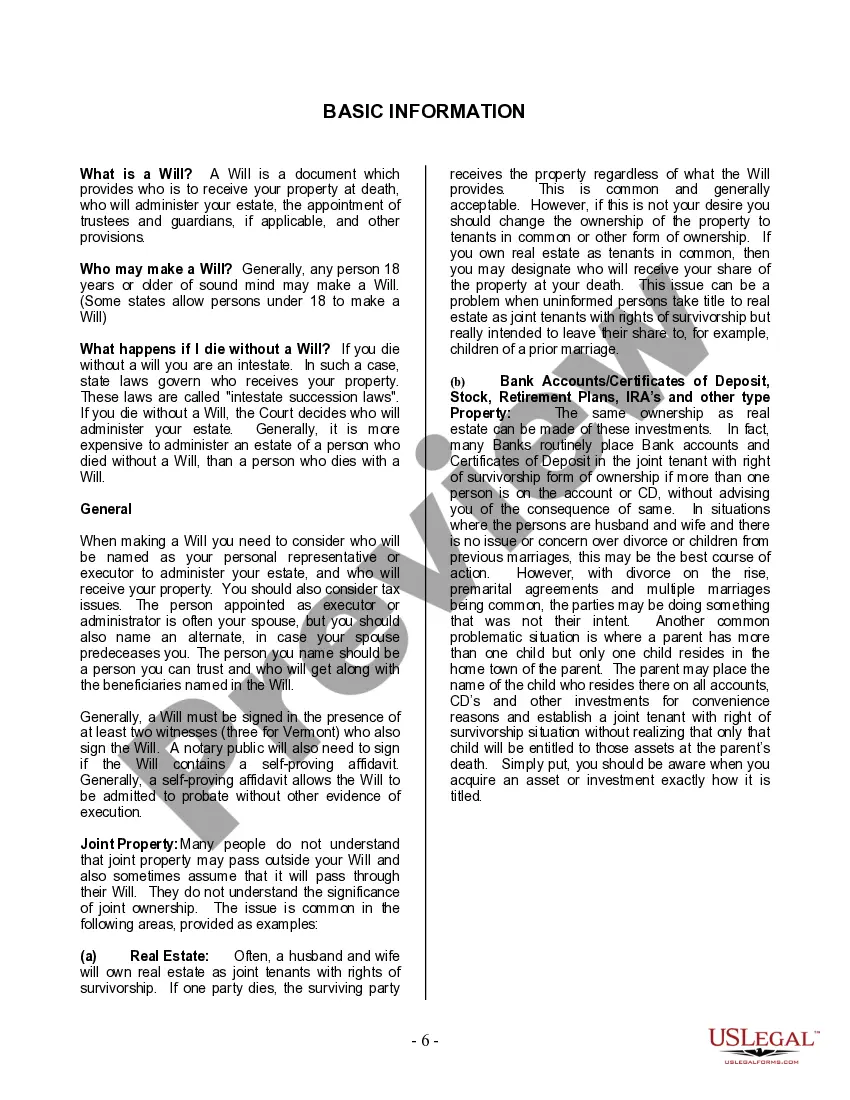
The Last Will and Testament for a married person with adult children from a prior marriage is a legal document that outlines how your assets will be distributed upon your death. It specifically addresses the needs of individuals who have children from a previous relationship while being married to someone else. This will enables you to designate beneficiaries, appoint an executor, and establish specific provisions for your children, ensuring your wishes are honored after your passing.
Main sections of this form
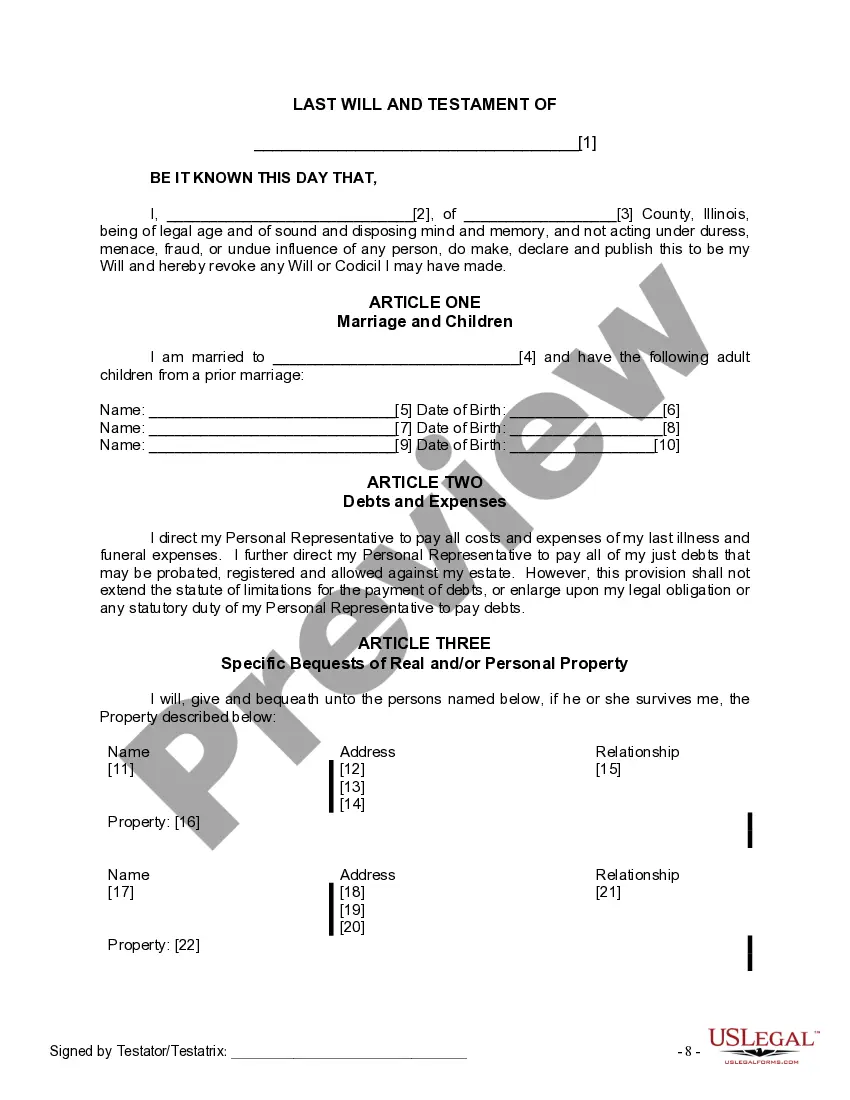
- Your personal information and family details, including spouse and children from a prior marriage.
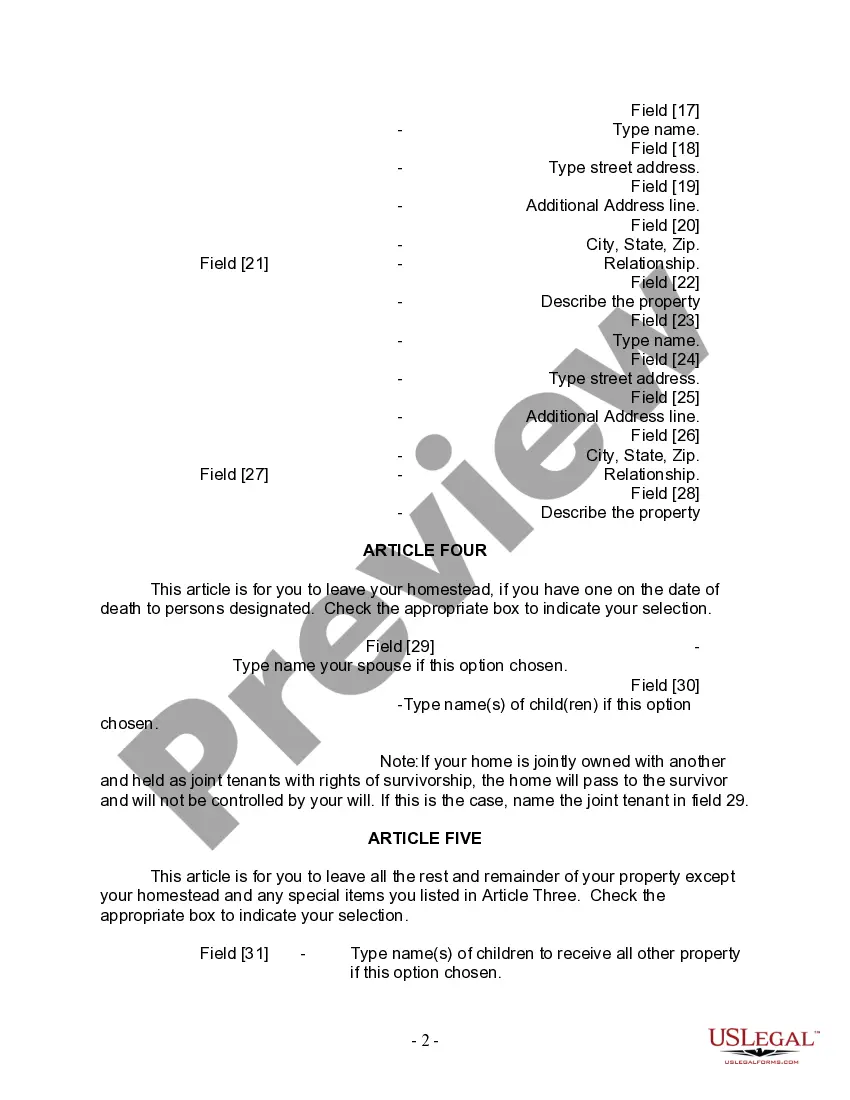
- Specific bequests for transferring particular property to designated individuals.
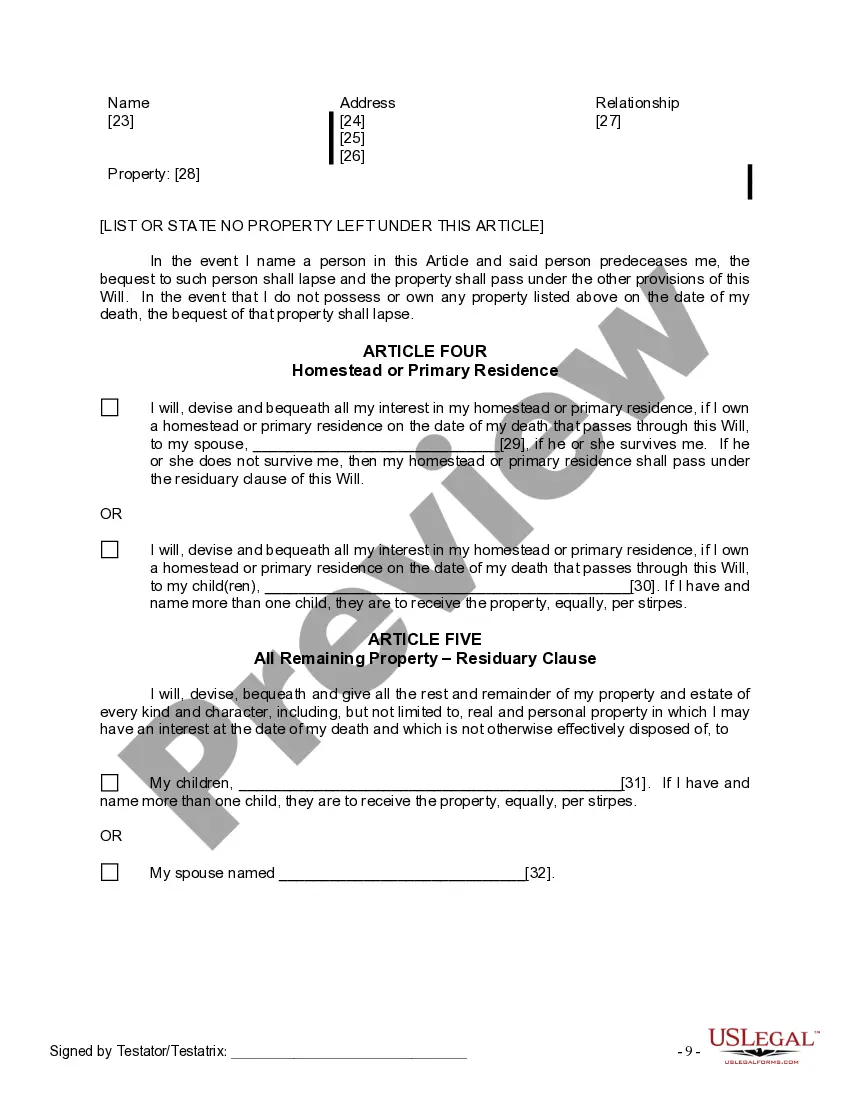
- Provisions for your homestead or primary residence and how it will be divided among beneficiaries.
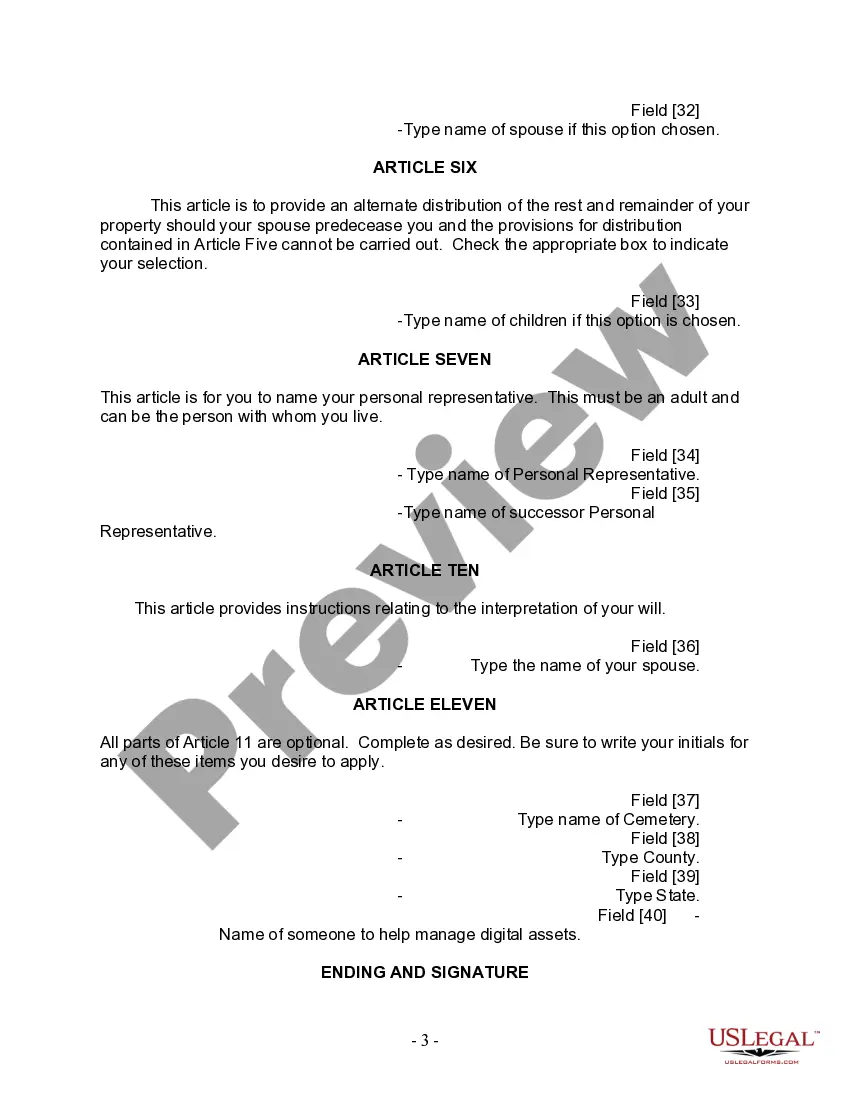
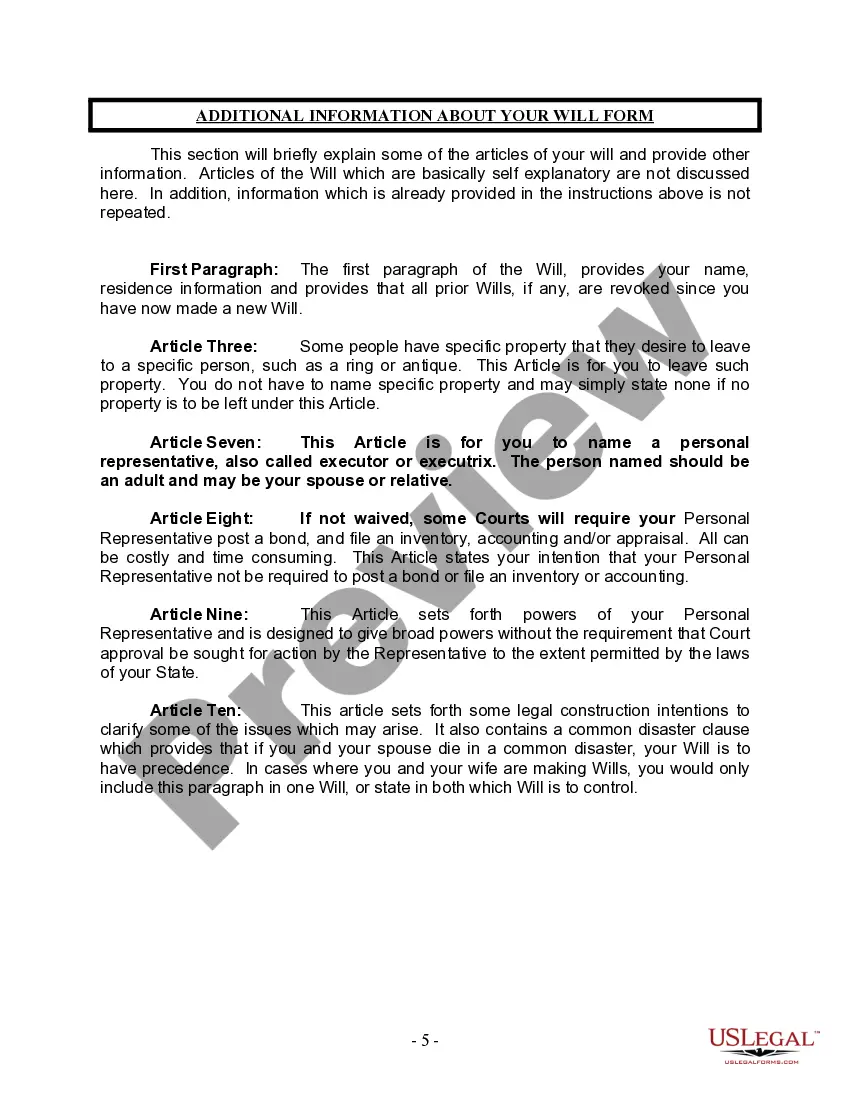
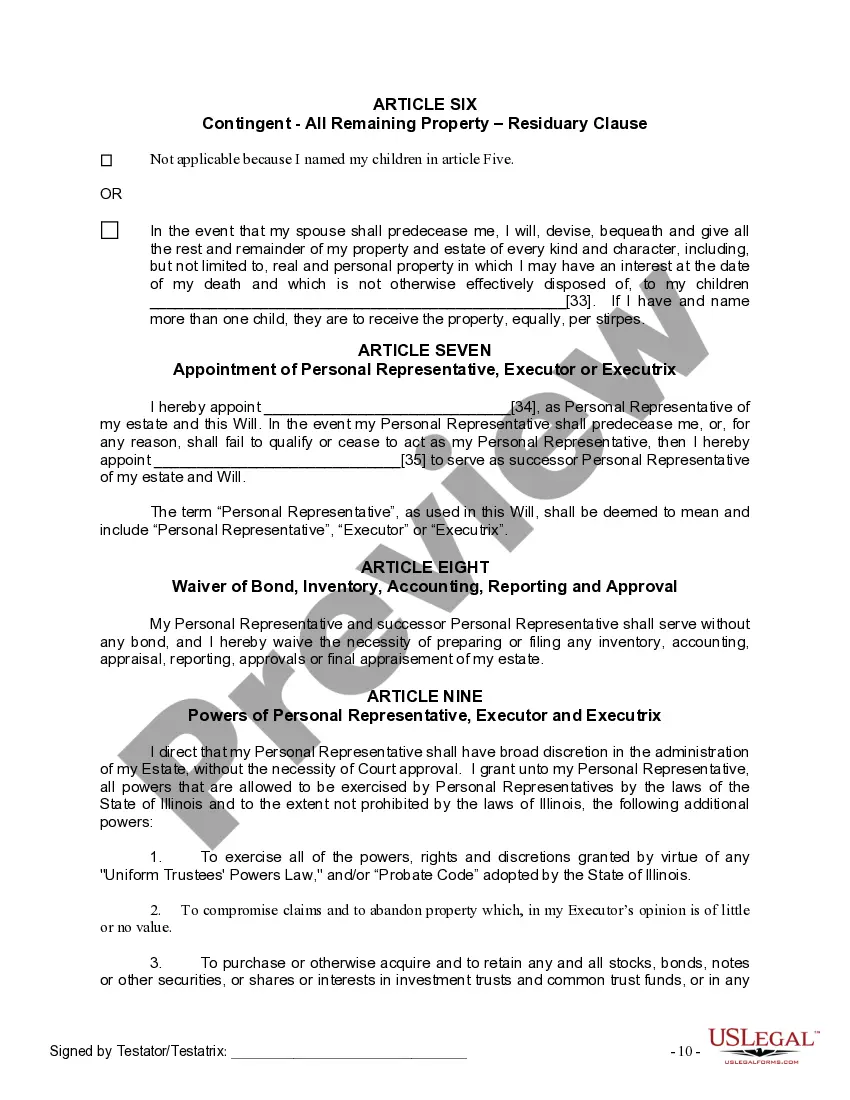
- Appointment of a personal representative (executor) to manage your estate.
- Optional clauses for funeral arrangements and other miscellaneous requests.





When this form is needed
This form is essential if you are a married individual with adult children from a previous marriage and wish to clearly define how your estate should be handled after your death. Use this will to convey your intentions regarding property distribution, appoint an executor, and set forth provisions to protect your children's interests.
Who can use this document
- Married individuals with adult children from a previous marriage.
- Individuals desiring to ensure equitable distribution of their assets.
- Anyone wanting to formalize their estate planning wishes legally.
- Those looking for guidance on appointing an executor for their estate management.
Completing this form step by step
- Identify and enter your personal information, including your name, address, and marital status.
- List all your children from a prior marriage, including their names and birthdates.
- Designate specific bequests for property you wish to leave to particular individuals.
- Choose how to distribute your homestead and other remaining property among your beneficiaries.
- Appoint a personal representative to manage your estate and provide any additional preferences as necessary.
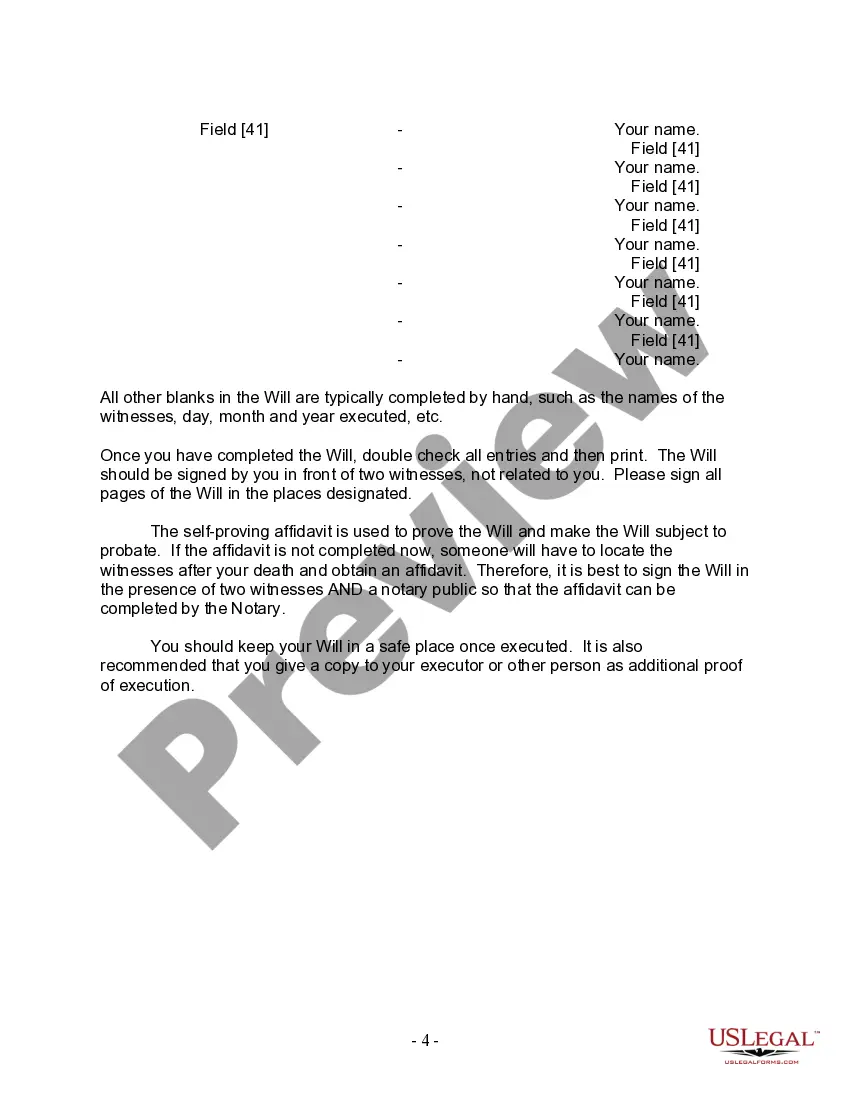
- Follow the signing requirements, ensuring you have two witnesses present when signing the document.
Notarization requirements for this form
Yes, this form must be notarized to be legally valid. It is advisable to sign the will in the presence of both witnesses and a notary public, which helps streamline the probate process and validate your intentions.
Get your form ready online
Our built-in tools help you complete, sign, share, and store your documents in one place.
Make edits, fill in missing information, and update formatting in US Legal Forms—just like you would in MS Word.
Download a copy, print it, send it by email, or mail it via USPS—whatever works best for your next step.
Sign and collect signatures with our SignNow integration. Send to multiple recipients, set reminders, and more. Go Premium to unlock E-Sign.
If this form requires notarization, complete it online through a secure video call—no need to meet a notary in person or wait for an appointment.
We protect your documents and personal data by following strict security and privacy standards.

Make edits, fill in missing information, and update formatting in US Legal Forms—just like you would in MS Word.

Download a copy, print it, send it by email, or mail it via USPS—whatever works best for your next step.

Sign and collect signatures with our SignNow integration. Send to multiple recipients, set reminders, and more. Go Premium to unlock E-Sign.

If this form requires notarization, complete it online through a secure video call—no need to meet a notary in person or wait for an appointment.

We protect your documents and personal data by following strict security and privacy standards.
Mistakes to watch out for
- Failing to sign in the presence of two unrelated witnesses.
- Not specifying how particular assets should be distributed.
- Forgetting to update the will after significant life changes.
- Neglecting to appoint a successor executor in case the primary cannot serve.
Why use this form online
- Convenient access to legal form templates anytime and anywhere.
- Edit your will easily to reflect changes in your personal situation.
- Reliable templates drafted by licensed attorneys to ensure legal compliance.
- Streamlined process to fill out and download, saving time and effort.
Summary of main points
- A Last Will and Testament ensures your assets are distributed according to your wishes.
- It is particularly suited for married individuals with children from prior marriages.
- Completing the will requires specific personal and beneficiary information.
- Notarization aids in the legal recognition of your will following your death.
Looking for another form?



Form popularity
FAQ
Handwritten Wills in Illinois In the state of Illinois, holographic wills are not considered to be valid. Illinois does recognize, however, handwritten wills that are signed by two witnesses and satisfy all other requirements for wills as stated in the law.
Under other state laws, the will is automatically revoked and you need to write a new will, or risk dying intestate.More importantly, your ex-spouse may decide to contest the will, delaying the probate process and costing your estate a lot of money to defend.
Illinois law states that the will must become public record upon the death of the person. As such, it must be filed with their local county clerk within 30 days of discovery.For instance, your will generally appoints a legal representative, called an executor, to carry out your wishes and oversee the probate process.
Many states allow you to make your will "self-proving," which allows the probate court to accept the will without contacting your witnesses. However, Illinois allows your will to be self-proved without a self-proving affidavit, as long as you sign and witness it correctly.
The will of a person, after divorce, remains valid as to any person named as a beneficiary, except the former divorced spouse, whose beneficiary status if any, has been rendered invalid or nonexistent by statute.
Anyone who is an immediate family member of the deceased, whether or not he or she is listed in the will, is legally entitled to view a copy.Those are the primary parties who may request access to a will, but there are other less groups of people that also have a legal right to view and receive copies of the document.
In Illinois, to have a valid will it is required that two or more credible witnesses validate or attest the will. This means each witness must watch the testator (person making his or her will) sign or acknowledge the will, determine the testator is of sound mind, and sign the will in front of the testator.
It's very common for a lawyer to charge a flat fee to write a will and other basic estate planning documents. The low end for a simple lawyer-drafted will is around $300. A price of closer to $1,000 is more common, and it's not unusual to find a $1,200 price tag. Lawyers like flat fees for several reasons.
Once filed, the will is a matter of public record. Anyone can see it. Interested parties can also usually learn the name of the executor by getting a copy of the death certificate from the county registrar.