Illinois Final Notice of Forfeiture and Request to Vacate Property under Contract for Deed
What this document covers
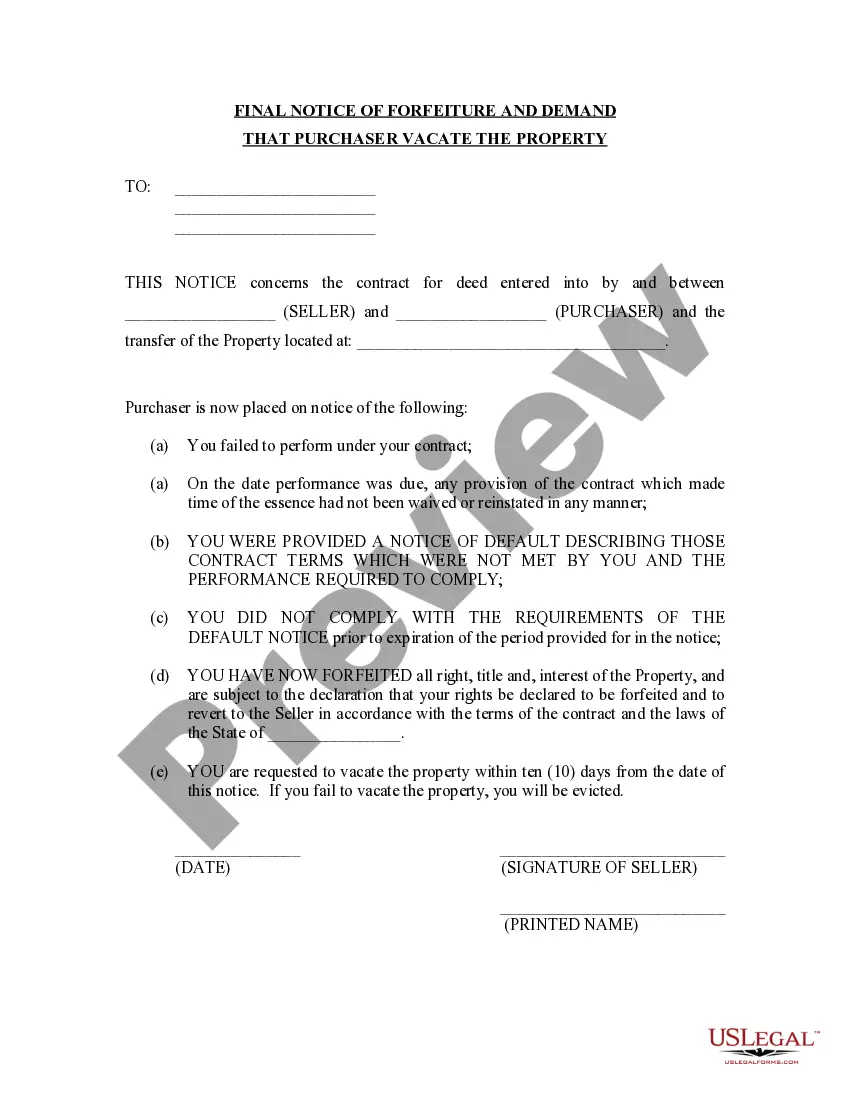
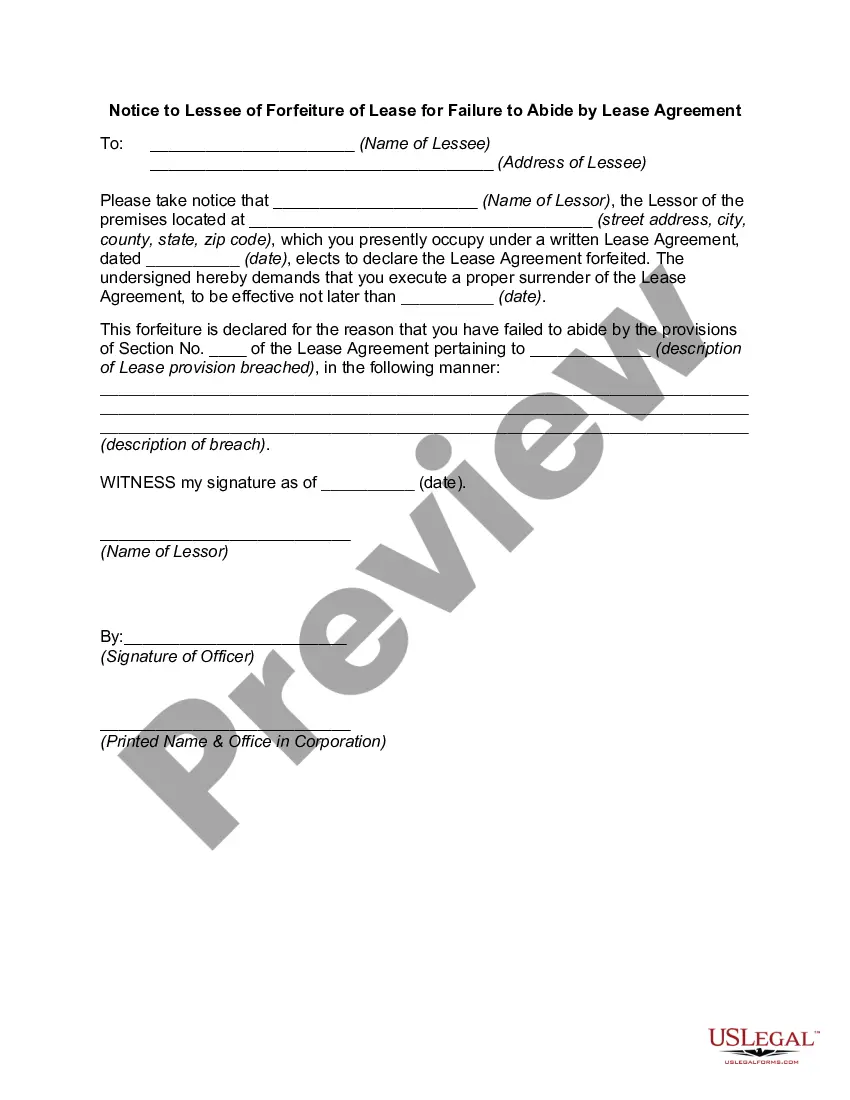
The Final Notice of Forfeiture and Request to Vacate Property under Contract for Deed is a legal document that formally notifies the buyer that the seller has decided to terminate the contract for deed. This notice is issued after previous notifications of breach have lapsed, and it indicates that all payments made by the buyer are forfeited. The form also warns that continued occupancy of the property without compliance could result in court action. Unlike other notices, this document consolidates the seller's final decision to cancel the agreement, ensuring clarity in the termination process.
Form components explained
- Identification of the seller and buyer involved in the contract.
- Details about the property subject to the contract for deed.
- Statement of the prior notice of default and breach of contract terms.
- Formal declaration of the seller's decision to forfeit and cancel the contract.
- Instructions for vacating the property, including legal implications of non-compliance.
Situations where this form applies
This form should be used primarily when a seller has provided a buyer with previous notices regarding their failure to meet the terms of the contract for deed, and the time period allowed for compliance has expired. It is essential in situations where the seller wishes to legally document the cancellation of the contract and to alert the buyer that they must vacate the property immediately. This form serves as a last resort to protect the seller's interests in the property after all other resolutions have failed.
Who can use this document
- Property sellers who have entered into a contract for deed with a buyer.
- Those who have previously notified a buyer of contract breaches.
- Individuals seeking to formally cancel a contract for deed after the expiration of compliance deadlines.
- Landlords or property owners needing to regain possession of their property due to contract violations.
Completing this form step by step
- Identify the parties involved in the contract (seller and buyer) and include their contact information.
- Specify the property address and any relevant details to clearly define the subject of the contract.
- Detail the previous notice of default and the specific terms that were not met by the buyer.
- Clearly state the seller's decision to cancel the contract for deed and forfeit any payments made.
- Include instructions for the buyer regarding vacating the property and possible consequences of non-compliance.
Notarization guidance
This form does not typically require notarization unless specified by local law. It is important to check your stateâs legal requirements to ensure compliance.
Get your form ready online
Our built-in tools help you complete, sign, share, and store your documents in one place.
Make edits, fill in missing information, and update formatting in US Legal Forms—just like you would in MS Word.
Download a copy, print it, send it by email, or mail it via USPS—whatever works best for your next step.
Sign and collect signatures with our SignNow integration. Send to multiple recipients, set reminders, and more. Go Premium to unlock E-Sign.
If this form requires notarization, complete it online through a secure video call—no need to meet a notary in person or wait for an appointment.
We protect your documents and personal data by following strict security and privacy standards.

Make edits, fill in missing information, and update formatting in US Legal Forms—just like you would in MS Word.

Download a copy, print it, send it by email, or mail it via USPS—whatever works best for your next step.

Sign and collect signatures with our SignNow integration. Send to multiple recipients, set reminders, and more. Go Premium to unlock E-Sign.

If this form requires notarization, complete it online through a secure video call—no need to meet a notary in person or wait for an appointment.

We protect your documents and personal data by following strict security and privacy standards.
Typical mistakes to avoid
- Failing to clearly identify the parties involved, leading to potential disputes.
- Not providing sufficient detail about the breach of contract, which could weaken the case.
- Neglecting to specify the timeframe in which the buyer must vacate the property.
- Using incorrect legal terminology that could cause confusion or mishandling of the notice.
Benefits of completing this form online
- Easy access to the form allows for quick downloads and completion.
- Templates are drafted by licensed attorneys, ensuring legal reliability.
- User-friendly guidance throughout the process simplifies completion.
- Ability to edit the form as needed before finalizing, allowing for personalization.
Legal use & context
- The form serves as a formal declaration of contract cancellation.
- It holds legal weight in court proceedings regarding property eviction.
- Proper completion and submission of this form help establish the seller's right to reclaim possession of the property.
Key takeaways
- This form marks the formal end of a contract for deed due to buyer non-compliance.
- It obligates the buyer to vacate the property after receiving notice.
- Ensuring all parties' information is accurate and complete is crucial.
Looking for another form?

Form popularity
FAQ
In a contract for deed arrangement, the responsibility for paying property taxes typically falls on the buyer. This means that even though the buyer doesn't hold the title, they still enjoy the obligation of maintaining the property, including taxes. Familiarizing yourself with the Illinois Final Notice of Forfeiture and Request to Vacate Property under Contract for Deed is essential, as it informs buyers about their responsibilities.
401(k) plan forfeitures occur when a participant terminates employment (voluntarily or involuntarily) prior to satisfying the required service years to become fully vested in his/her account.Participants are generally always 100% vested in the contributions made by the participant.
If the buyer defaults on the land contract, or fails to make the monthly payments to the seller as required, the seller can file a court action called land contract forfeiture.In other words, if the buyer fails to pay, the seller keeps all money received, plus the seller keeps the real estate.
Forfeiture, under an agreement, highlights a mandate by a defaulting party to relinquish an asset or monetary sum as compensation if that party breaches the contract.Example: In a contractual relationship, a party may have to relinquish a specified property if that party fails to fulfill an obligation.
Forfeiture is the loss of any property without compensation as a result of defaulting on contractual obligations, or as a penalty for illegal conduct.
The name of the notice that is given to property owners to appear in court to say why the property shouldn't be forfeited.
Forfeiture, under the terms of a contract, refers to the requirement by the defaulting party to give up ownership of an asset, or cash flows from an asset, as compensation for the resulting losses to the other party.The process of forfeiture often involves proceedings in a court of law.
Criminal forfeiture is an action brought as a part of the criminal prosecution of a defendant.Civil judicial forfeiture is an in rem (against the property) action brought in court against the property. The property is the defendant and no criminal charge against the owner is necessary.
Forfeiture refers to a loss of any property, money, or assets without consideration or compensation in return. A forfeiture generally occurs due to default in complying with repayment obligations under a contract. It can also be used as a penalty for an illegal way of conducting business.
Forfeiture refers to a loss of any property, money, or assets without consideration or compensation in return. A forfeiture generally occurs due to default in complying with repayment obligations under a contract. It can also be used as a penalty for an illegal way of conducting business.