Hawaii Final Notice of Default for Past Due Payments in connection with Contract for Deed
About this form
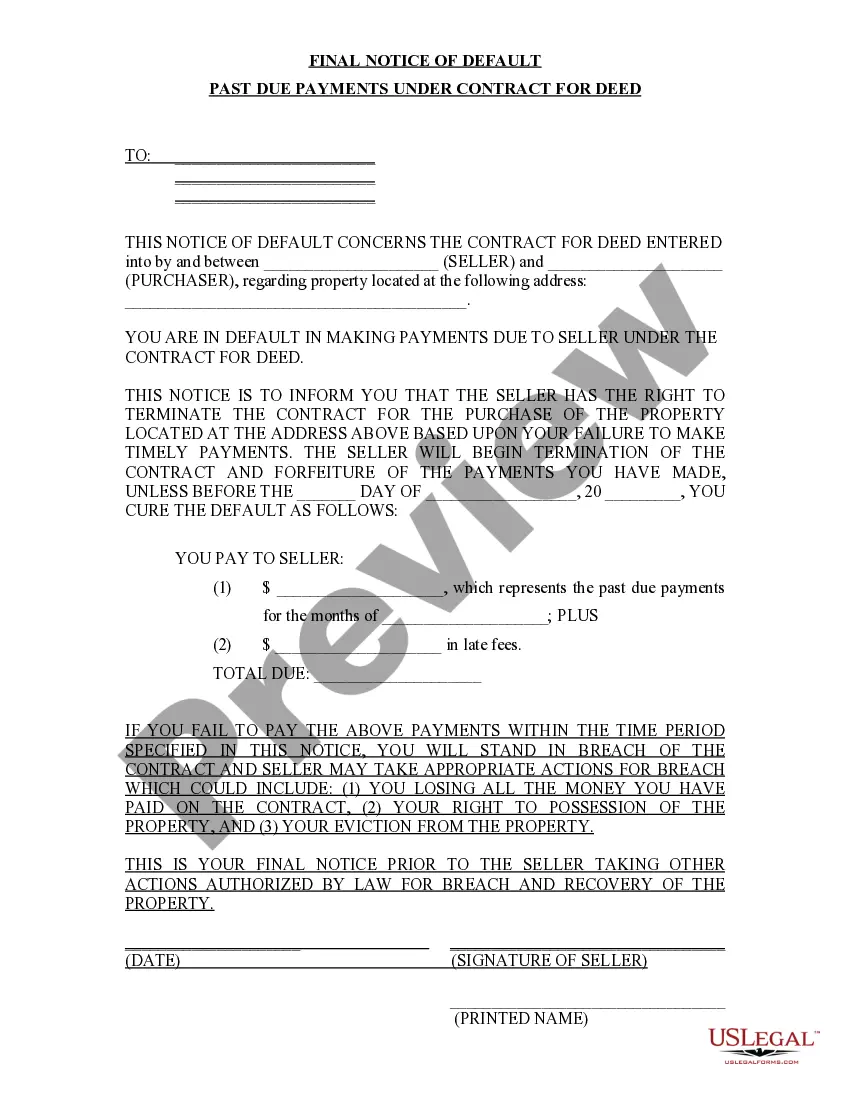
The Final Notice of Default for Past Due Payments in connection with Contract for Deed is a legal document used by sellers to formally notify purchasers of their failure to make payments under a contract for deed agreement. This notice serves as an official warning that failure to cure the default by a specified deadline may lead to the termination of the contract and loss of rights to the property. It is distinct from other notices in that it serves as the final opportunity for the purchaser to rectify their payment issues before further legal actions are taken.
Main sections of this form
- Identification of the seller and purchaser involved in the contract for deed.
- Details regarding the property in question, including the address.
- Declaration of default due to missed payments.
- Notice of seller's right to terminate the contract if payments are not made by a specified date.
- Instructions on how the purchaser can remedy the default by specifying overdue amounts and late fees.
- Signature fields for the seller to validate the notice and dates for formal record-keeping.

When to use this form
This form should be used when a purchaser under a contract for deed has failed to make one or more payments as agreed. It is necessary when the seller wishes to officially inform the purchaser that they are in default and to provide them with a final opportunity to resolve the situation. Using this notice correctly helps protect the sellerâs rights while offering the purchaser a chance to avoid further legal consequences.
Who needs this form
- Sellers in a contract for deed transaction who need to notify the purchaser of default.
- Purchasers who are late on their payments and need to understand the consequences of continued default.
- Real estate professionals and attorneys representing either party in a contract for deed scenario.
How to prepare this document
- Identify and enter the names of the seller and purchaser at the top of the form.
- Specify the property address for which the contract for deed is held.
- Clearly state the overdue payment amounts and any late fees in the designated fields.
- Set the final payment deadline by entering the date by which the default must be cured.
- Include the seller's signature and printed name along with the date to formalize the notice.
Notarization requirements for this form
This form does not typically require notarization unless specified by local law. However, having the form notarized can provide an additional level of validation and may be recommended for maintaining a clear legal record.
Get your form ready online
Our built-in tools help you complete, sign, share, and store your documents in one place.
Make edits, fill in missing information, and update formatting in US Legal Forms—just like you would in MS Word.
Download a copy, print it, send it by email, or mail it via USPS—whatever works best for your next step.
Sign and collect signatures with our SignNow integration. Send to multiple recipients, set reminders, and more. Go Premium to unlock E-Sign.
If this form requires notarization, complete it online through a secure video call—no need to meet a notary in person or wait for an appointment.
We protect your documents and personal data by following strict security and privacy standards.

Make edits, fill in missing information, and update formatting in US Legal Forms—just like you would in MS Word.

Download a copy, print it, send it by email, or mail it via USPS—whatever works best for your next step.

Sign and collect signatures with our SignNow integration. Send to multiple recipients, set reminders, and more. Go Premium to unlock E-Sign.

If this form requires notarization, complete it online through a secure video call—no need to meet a notary in person or wait for an appointment.

We protect your documents and personal data by following strict security and privacy standards.
Avoid these common issues
- Failing to provide adequate details about the property, which may lead to confusion.
- Omitting the final payment deadline, which is crucial for the purchaser to understand their timeline.
- Not signing the form, rendering it invalid as a legal notice.
- Incorrectly calculating the total amount due, leading to disputes with the purchaser.
Why complete this form online
- Convenience of filling out and downloading the form from anywhere at any time.
- Editability to tailor the form to specific situations and jurisdictions as needed.
- Access to forms drafted by licensed attorneys, ensuring compliance with current legal standards.
- Quick access to a record of the notice for both parties involved in the contract.
Legal use & context
This form stands as a formal legal document that highlights the consequences of failing to meet payment obligations under a contract for deed. The notice provides evidence that the seller has made a good faith effort to resolve the default before taking further legal actions.
Main things to remember
- The form serves as a final warning to the purchaser regarding missed payments.
- Timely completion and delivery of the notice are essential to protect the sellerâs rights.
- Understand the potential legal repercussions of defaulting under a contract for deed.
Looking for another form?
Form popularity
FAQ
Backing out of a land contract is possible, but it can lead to significant consequences, including losing any investment made. Buyers may be forced to adhere to the contract, or they could face a Hawaii Final Notice of Default for Past Due Payments in connection with Contract for Deed. It is important to consult with a legal expert to understand the implications of withdrawing from such an agreement.
When a buyer defaults on a land contract, the seller can legally pursue action to enforce the terms of the contract. This often involves issuing a Hawaii Final Notice of Default for Past Due Payments in connection with Contract for Deed, which alerts the buyer to their missed payments. Ultimately, if the issue is not resolved, the seller may take steps to terminate the contract and reclaim the property.
If someone defaults on a land contract, the seller may initiate a legal process to reclaim the property. This typically involves sending a Hawaii Final Notice of Default for Past Due Payments in connection with Contract for Deed, informing the buyer of their default status and the potential consequences. The buyer may lose their investment and could face eviction from the property.
A land contract can be voided if either party fails to adhere to the contractual terms, such as failing to make timely payments. Additionally, if the seller misrepresents the property or its condition, this can also provide grounds for voiding the agreement. Understanding these conditions is crucial when considering a Hawaii Final Notice of Default for Past Due Payments in connection with Contract for Deed.
Risks of a land contract include the potential loss of your investment if you default on payments, as the seller retains legal title during the payment term. Buyers may also face restrictions on the property, such as lack of access to traditional financing options until the contract is fulfilled. Additionally, in the event of a Hawaii Final Notice of Default for Past Due Payments in connection with Contract for Deed, buyers could lose their rights to the property.
A request for notice of default is a formal request for notification when a borrower is late on payments, which could lead to default. This notice serves as a warning and provides the borrower a chance to address any missed payments before potential foreclosure actions. It plays a critical role in managing a Hawaii Final Notice of Default for Past Due Payments in connection with Contract for Deed.
A notice of default is a formal declaration that a borrower has fallen behind on mortgage payments or other obligations related to a property, like those specified in a Hawaii Final Notice of Default for Past Due Payments in connection with Contract for Deed. This notice typically serves as the first step before potentially initiating foreclosure proceedings. It is a critical communication that requires immediate attention.
Default refers to the failure to meet the legal obligations of a Contract for Deed, such as missed payments outlined in a Hawaii Final Notice of Default for Past Due Payments. Foreclosure, on the other hand, is a legal procedure that lenders use to reclaim property when the borrower has defaulted. Understanding these terms is crucial for anyone involved in real estate transactions or home ownership.
A Hawaii Final Notice of Default for Past Due Payments in connection with Contract for Deed signals a significant issue for the buyer. This notice indicates that the buyer has not made the required payments per the agreement. Consequently, this can lead to further legal actions, including foreclosure, if not addressed. It is essential to take this notice seriously and seek advice on the next steps.
Responding to a notice of default requires immediate attention. Start by reviewing your financial situation and contacting your lender to discuss available options. You can also consider seeking professional help from platforms like UsLegalForms, which provide resources and templates to help you formulate a response effectively and assertively.