Fuel Delivery And Storage Services - Self-Employed
What this document covers
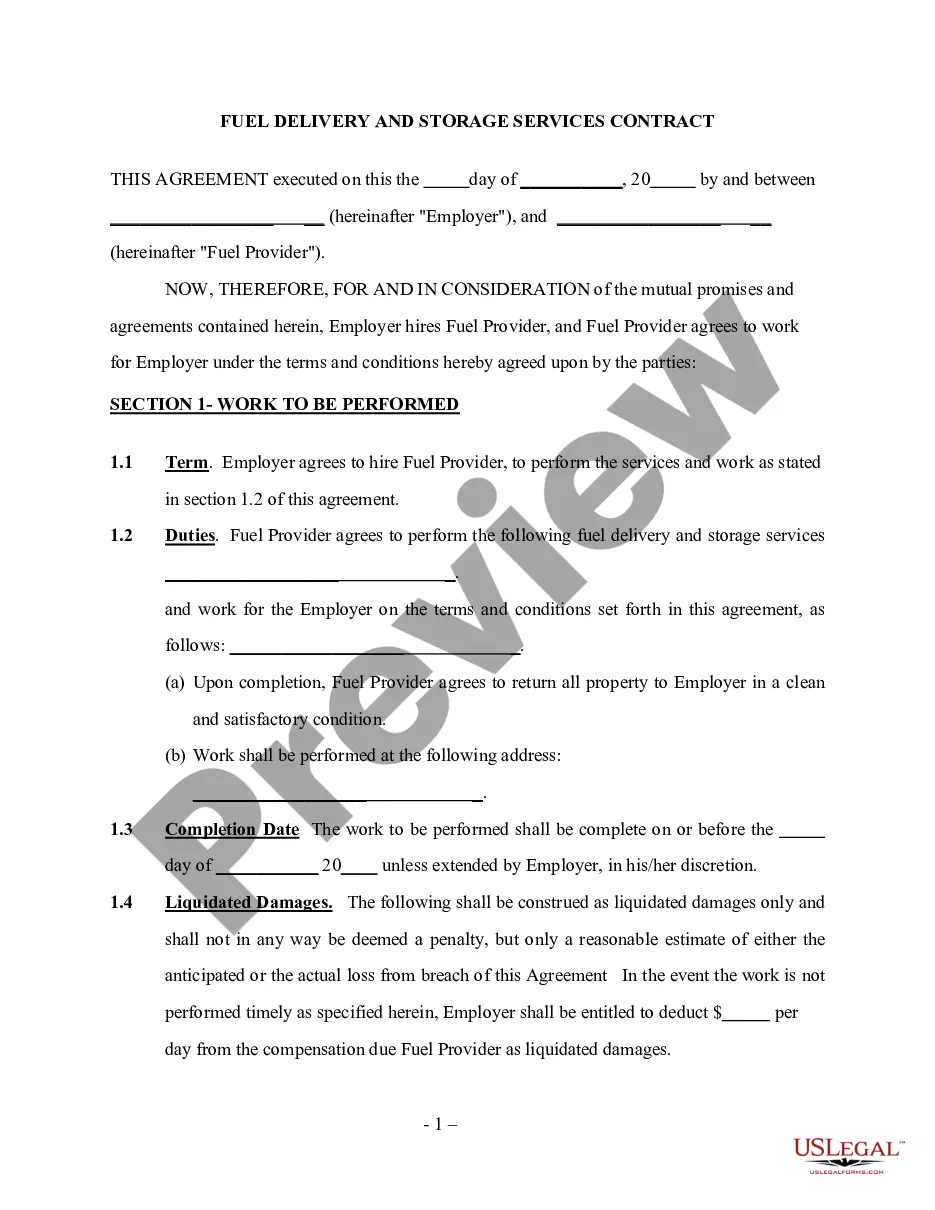
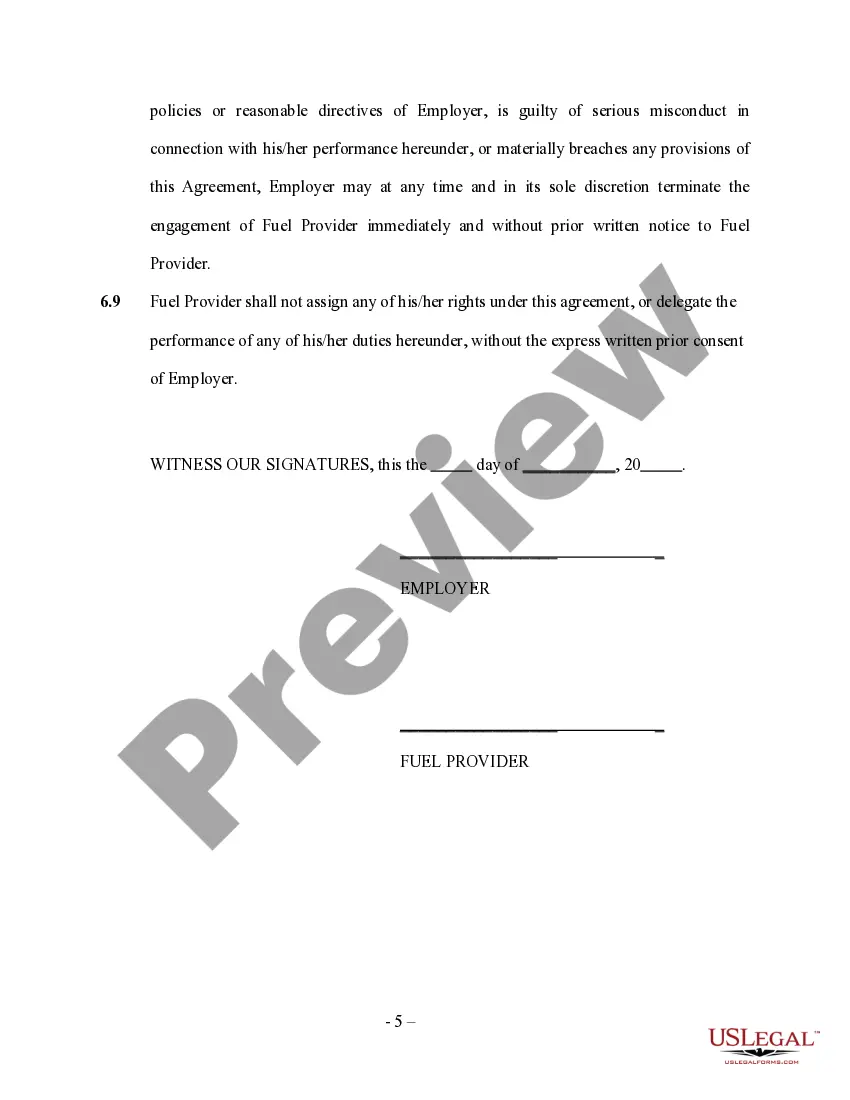
This Fuel Delivery and Storage Services Agreement is a legal document that outlines the terms under which an employer hires an independent contractor, referred to as the Fuel Provider, to perform fuel delivery and storage services. This form is essential for establishing the responsibilities and compensation for the Fuel Provider while clarifying their independent contractor status, which distinguishes it from employment agreements and ensures both parties understand their liabilities and obligations.
Form components explained
- Identification of the parties involved: Employer and Fuel Provider.
- Work to be performed: Detailed description of the fuel delivery and storage services.
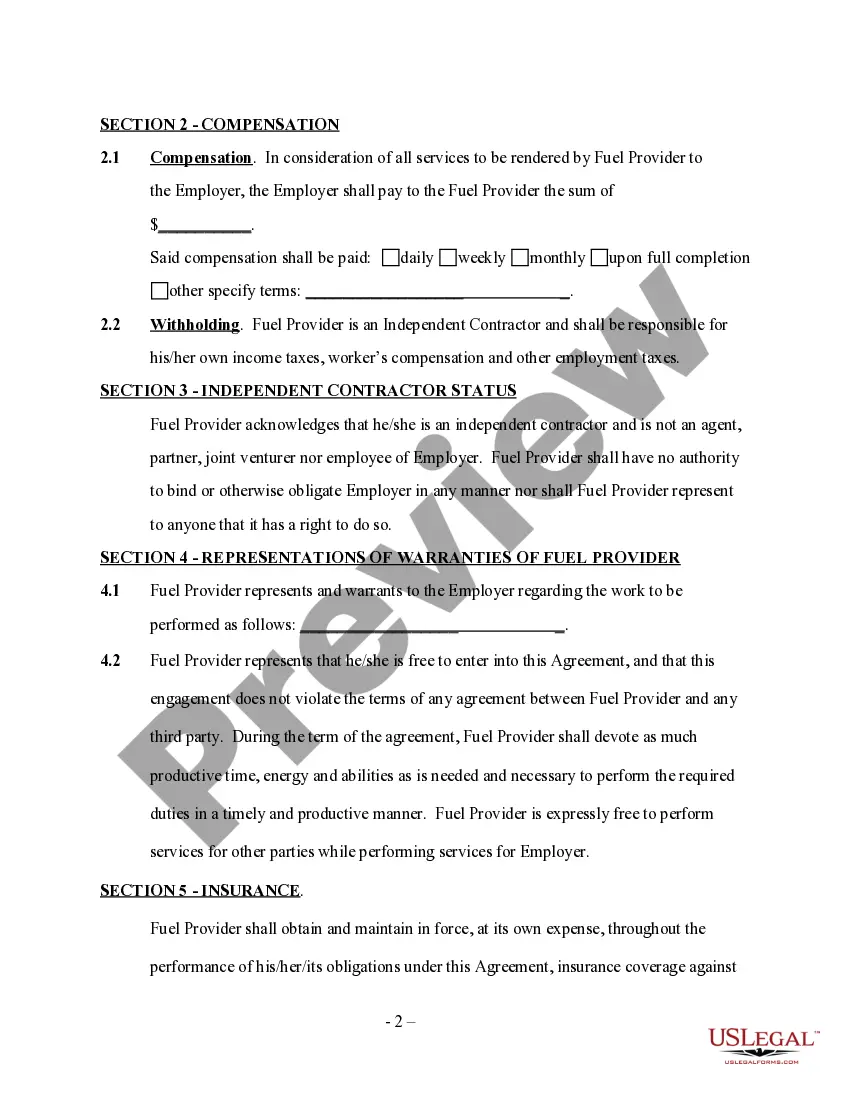
- Compensation terms: Clear stipulations on payment frequencies and amounts.
- Independent contractor status: Affirmation of the Fuel Provider's independent contractor role.
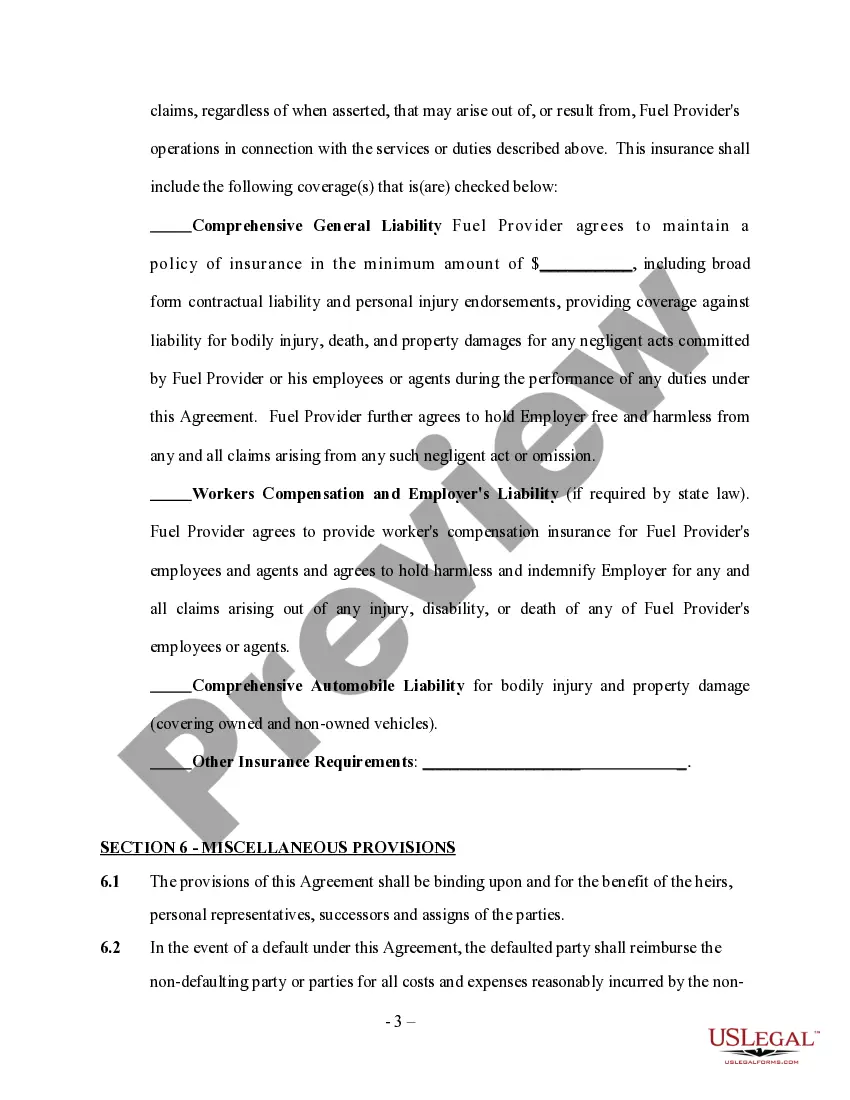
- Insurance requirements: Obligations for the Fuel Provider to maintain appropriate insurance.
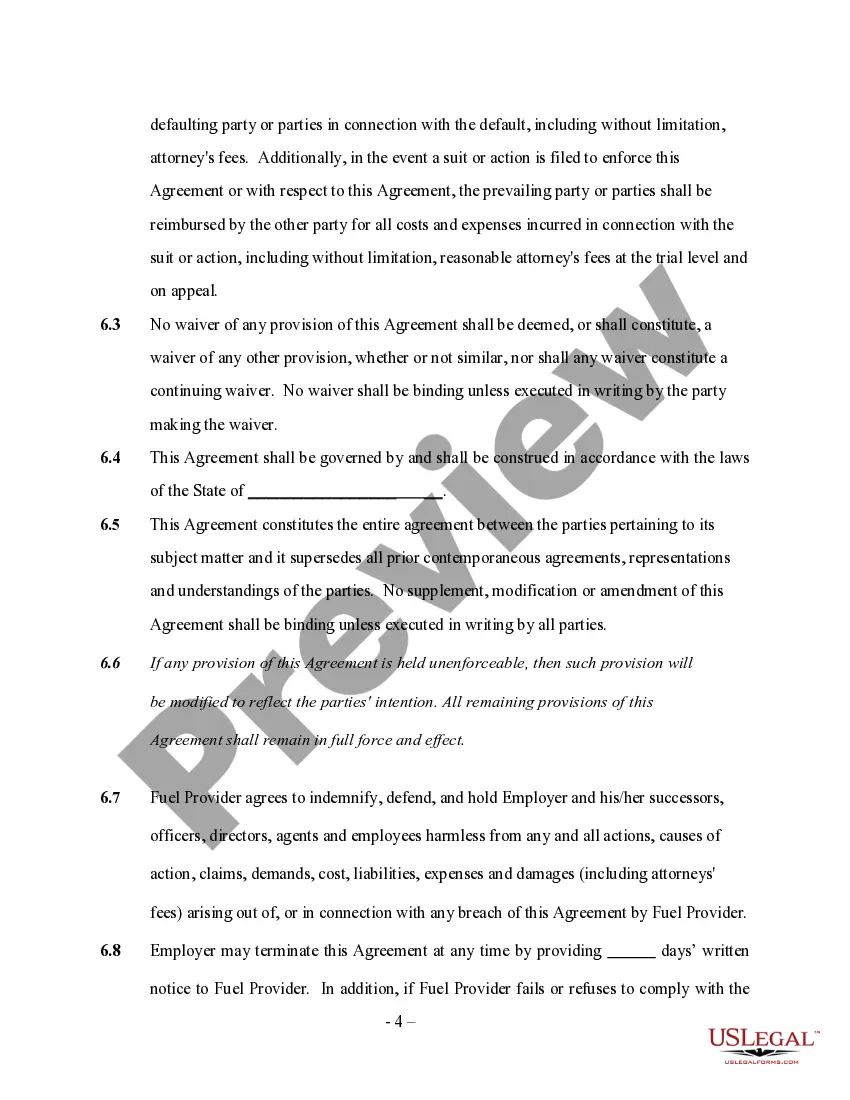
- Miscellaneous provisions: Guidelines for default, waiver, and modifications to the agreement.
When this form is needed
This form should be used when an employer wishes to hire an independent contractor specifically for fuel delivery and storage services. It is applicable in various situations such as establishing a new service contract with a fuel provider, renewing existing agreements, or clarifying the terms of an ongoing contractor relationship when fuel transportation and storage responsibilities are involved.
Who needs this form
- Employers looking to engage independent contractors for fuel delivery and storage services.
- Independent contractors providing fuel delivery and storage solutions seeking formal agreements.
- Firms and businesses in the fuel industry looking to clarify contractual relationships and service expectations.
How to prepare this document
- Identify the parties by providing the names and addresses of both the Employer and the Fuel Provider.
- Specify the services to be performed in detail, including any locations and conditions required for delivery and storage.
- Enter the agreed compensation structure, indicating how frequently the Fuel Provider will be paid.
- Verify and fill in the independent contractor acknowledgment section to confirm the Fuel Provider's status.
- Sign and date the agreement to make it legally binding, ensuring both parties retain copies.
Notarization requirements for this form
This form usually doesn’t need to be notarized. However, local laws or specific transactions may require it. Our online notarization service, powered by Notarize, lets you complete it remotely through a secure video session, available 24/7.
Get your form ready online
Our built-in tools help you complete, sign, share, and store your documents in one place.
Make edits, fill in missing information, and update formatting in US Legal Forms—just like you would in MS Word.
Download a copy, print it, send it by email, or mail it via USPS—whatever works best for your next step.
Sign and collect signatures with our SignNow integration. Send to multiple recipients, set reminders, and more. Go Premium to unlock E-Sign.
If this form requires notarization, complete it online through a secure video call—no need to meet a notary in person or wait for an appointment.
We protect your documents and personal data by following strict security and privacy standards.

Make edits, fill in missing information, and update formatting in US Legal Forms—just like you would in MS Word.

Download a copy, print it, send it by email, or mail it via USPS—whatever works best for your next step.

Sign and collect signatures with our SignNow integration. Send to multiple recipients, set reminders, and more. Go Premium to unlock E-Sign.

If this form requires notarization, complete it online through a secure video call—no need to meet a notary in person or wait for an appointment.

We protect your documents and personal data by following strict security and privacy standards.
Typical mistakes to avoid
- Failing to clearly define the scope of work, leading to misunderstandings.
- Not specifying payment terms, which can cause disputes later.
- Omitting the independent contractor acknowledgment, risking employee misclassification.
- Leaving out insurance requirements, which may expose the contractor and employer to liability.
Why use this form online
- Convenience of immediate access to a legally vetted contract template.
- Editability to customize terms according to specific situations and needs.
- Reliability from using forms created by licensed attorneys, ensuring legal compliance.
Legal use & context
- Defines the legal relationship between the Employer and the Fuel Provider.
- Outlines the responsibilities for taxes and insurance, ensuring compliance.
- Establishes enforceability of the agreement due to clear terms and conditions.
Summary of main points
- The form clearly delineates the roles and responsibilities of the parties involved.
- Understanding independent contractor status is essential for compliance.
- All payment and service details must be well-defined to avoid disputes.
Looking for another form?
Form popularity
FAQ
The $550 fee covers trucks weighing more than 55,000 pounds and is due by Aug. 1 for the July 1-June 30 period. You also face fuel and mileage taxes under the International Fuel Tax Agreement (IFTA).Everything they do on the road is deductible.
Yes, you can deduct the mileage. As an independent contractor (received a 1099-MISC) you are considered self employed by the IRS. Because you received a 1099-MISC, you are considered a "business" owner.You can deduct the miles driven for business.
Yes, you can deduct the cost of gasoline on your taxes. Use the actual expense method to claim the cost of gasoline, taxes, oil and other car-related expenses on your taxes.
You report the self-employed mileage deduction in the Expenses section of Schedule C.
The answer is yes. It is treated as earned compensation and then the expense of fuel is the total amount. That's how I handle it. The surcharge is income and then the fuel is deducted as an expense.
If you're claiming actual expenses, things like gas, oil, repairs, insurance, registration fees, lease payments, depreciation, bridge and tunnel tolls, and parking can all be written off." Just make sure to keep a detailed log and all receipts, he advises, or keep track of your yearly mileage and then deduct the
Mileage for self-employed workers isn't subject to any threshold requirements either. In other words, all miles are deductible regardless of how much a person drives for work.Self-employed workers can claim their mileage deduction on their Schedule C tax form, rather than a Schedule A form for itemized deductions.
As a self-employed taxpayer, you can deduct expenses for mileage accrued while doing business. If you use a car solely for business, you can deduct all the expenses related to operating the car. However, if you use the car for both personal and business travel, you can only deduct the cost of the business use.
You can deduct more in 2019, the IRS says. The Internal Revenue Service is giving some taxpayers who use their cars for business a much-appreciated bonus: a boost of three-and-a-half cents per mile, bringing the mileage deduction to 58 cents per mile in 2019.The typical driver logs about 14,000 miles per year.