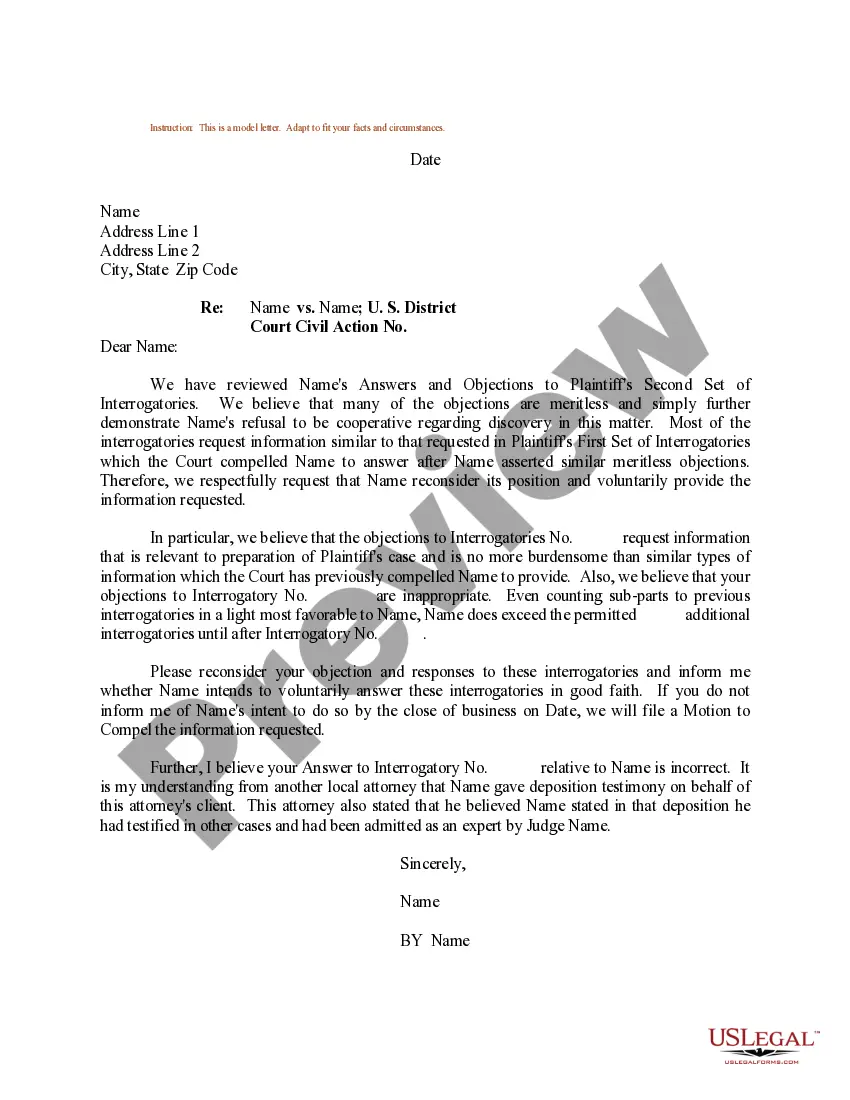
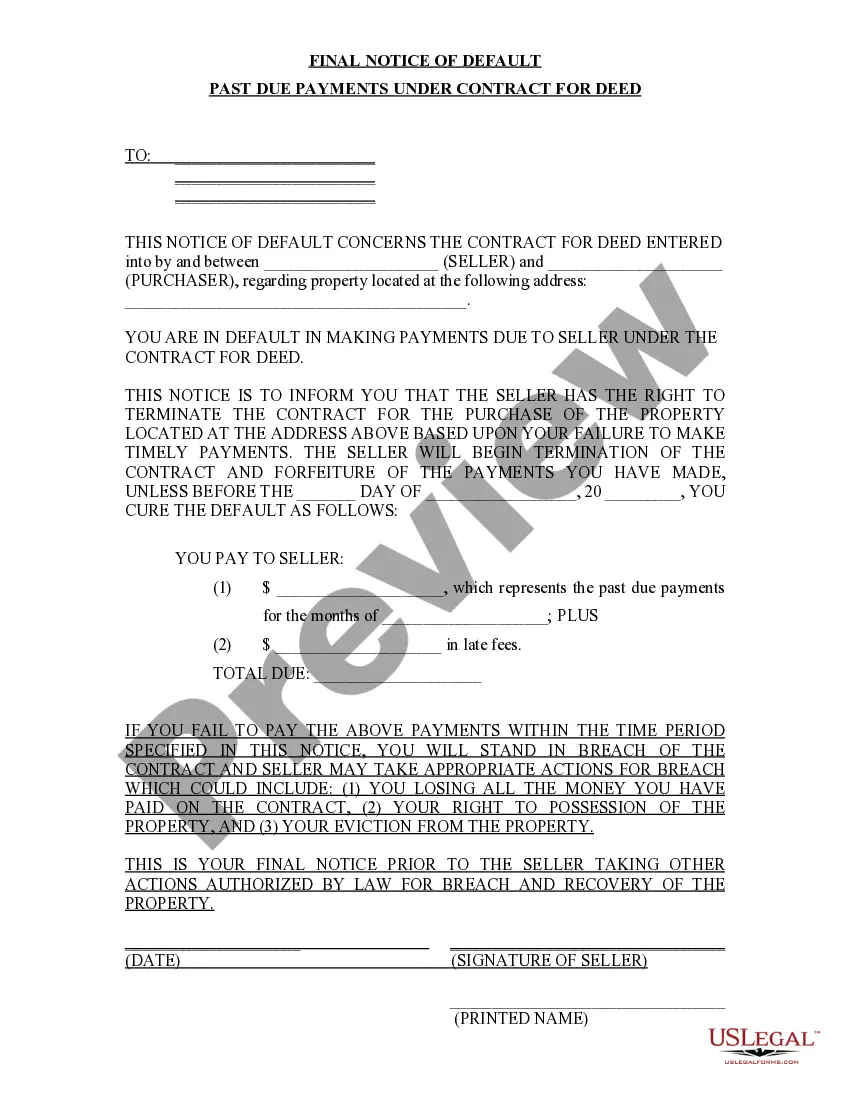
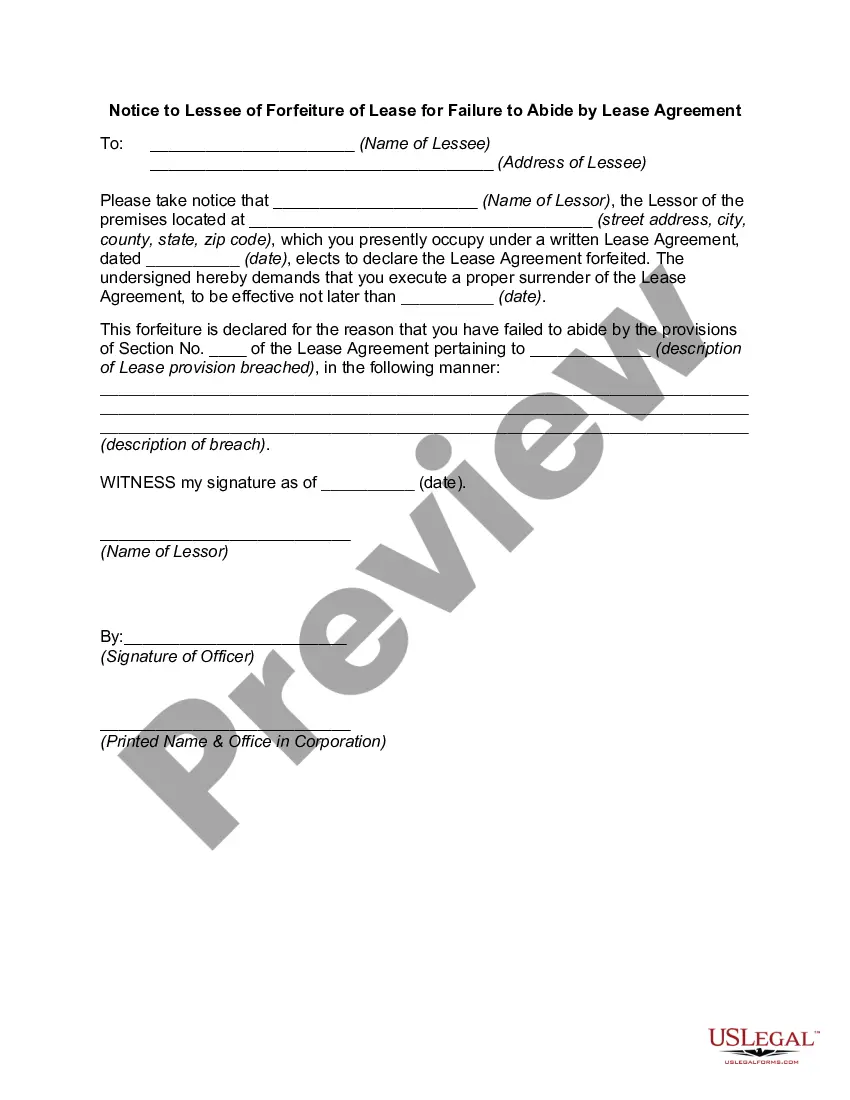
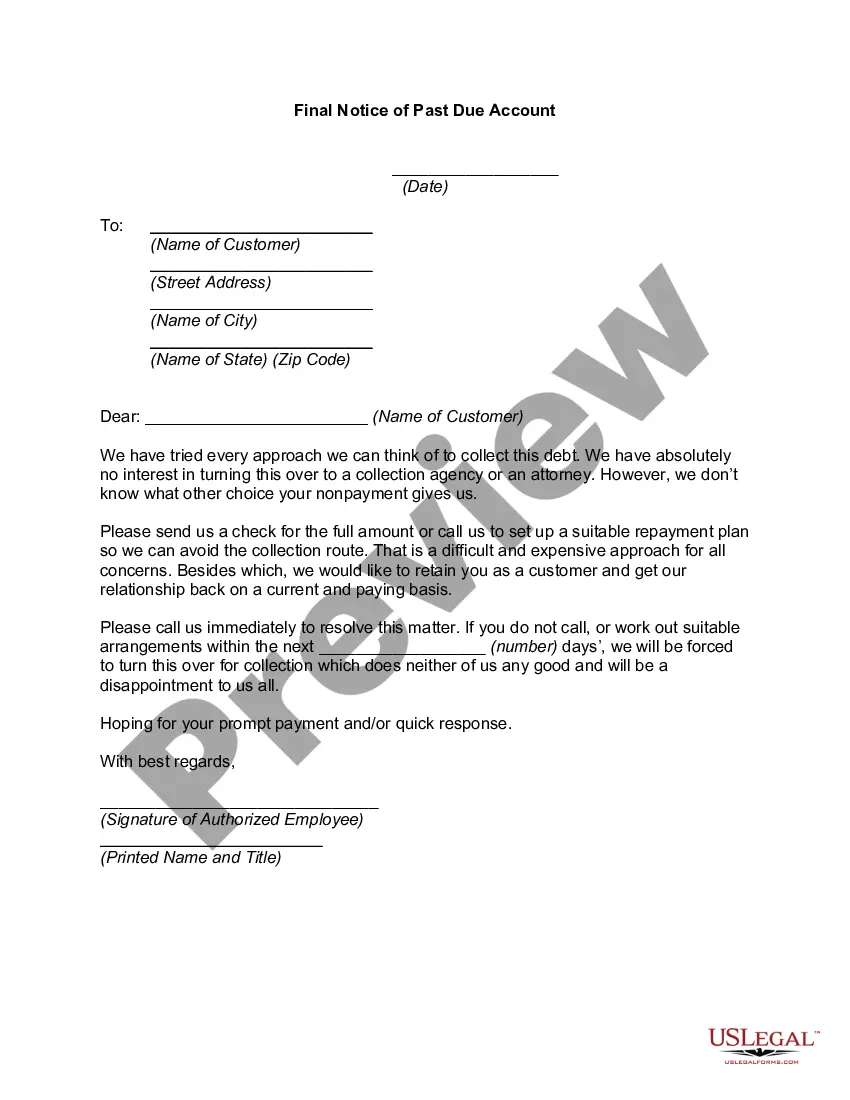
Georgia Final Notice of Default for Past Due Payments in connection with Contract for Deed
Overview of this form
The Final Notice of Default for Past Due Payments in connection with Contract for Deed is a legal document that informs a purchaser of their failure to make timely payments under a contract for deed. This form serves as the seller's last warning before taking potential legal action for breach of contract, allowing the purchaser a final opportunity to remedy the default before facing eviction or loss of paid amounts. Unlike other notices, this final notice emphasizes urgency and the consequences of continued non-payment.
Key components of this form
- Identification of the seller and purchaser
- Property address associated with the contract
- Details of the missed payments including amounts due
- Deadline for payment to cure the default
- Consequences of failing to address the default
- Signature and date by the seller
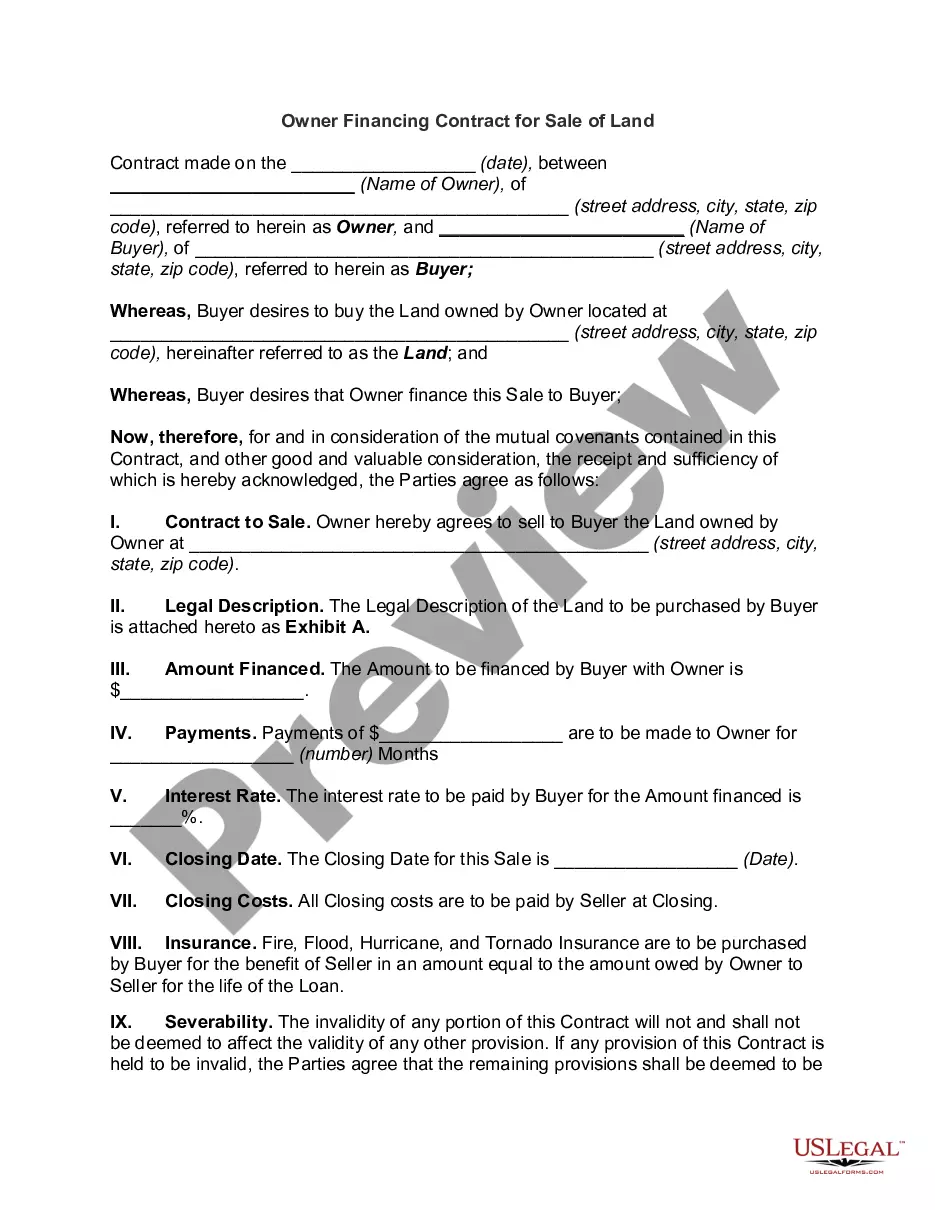
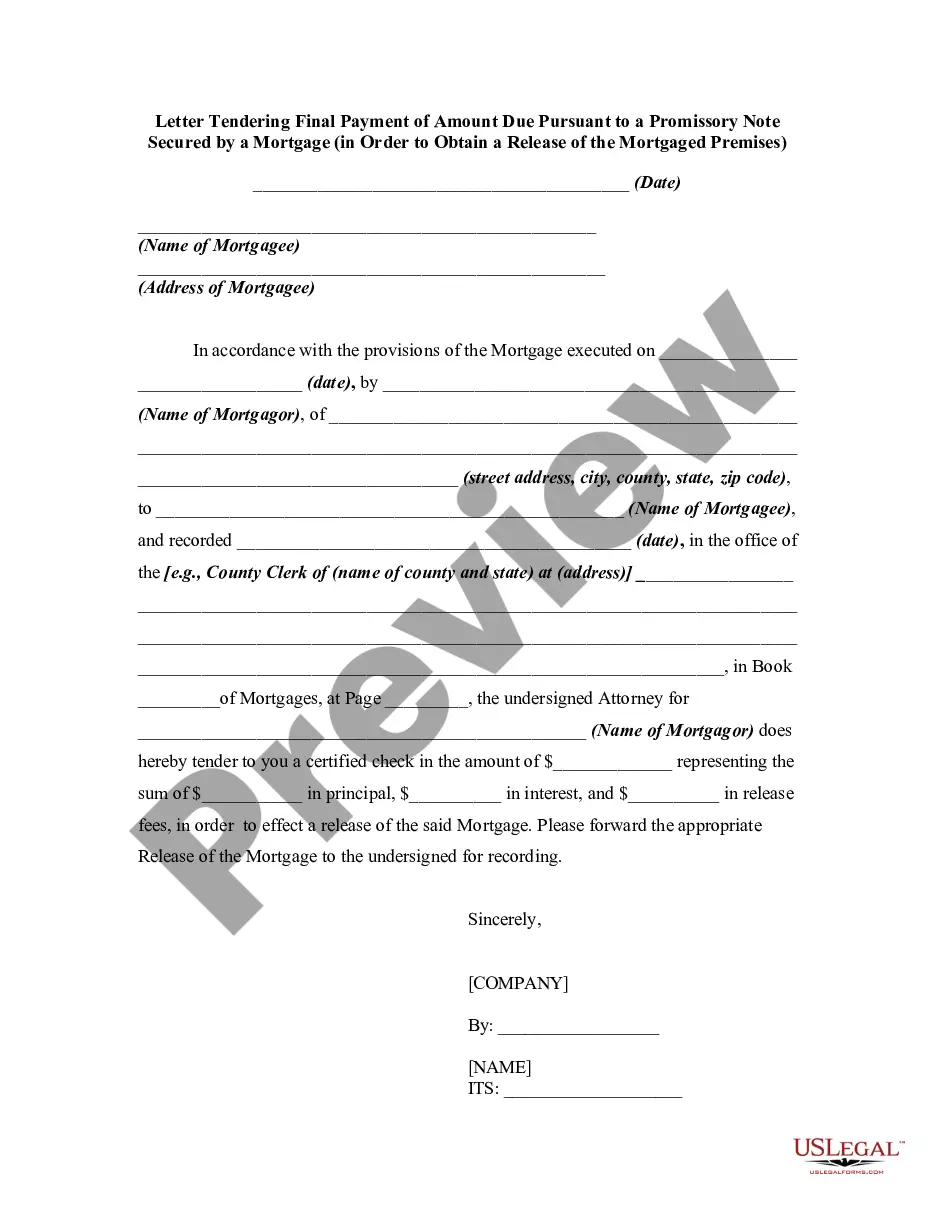
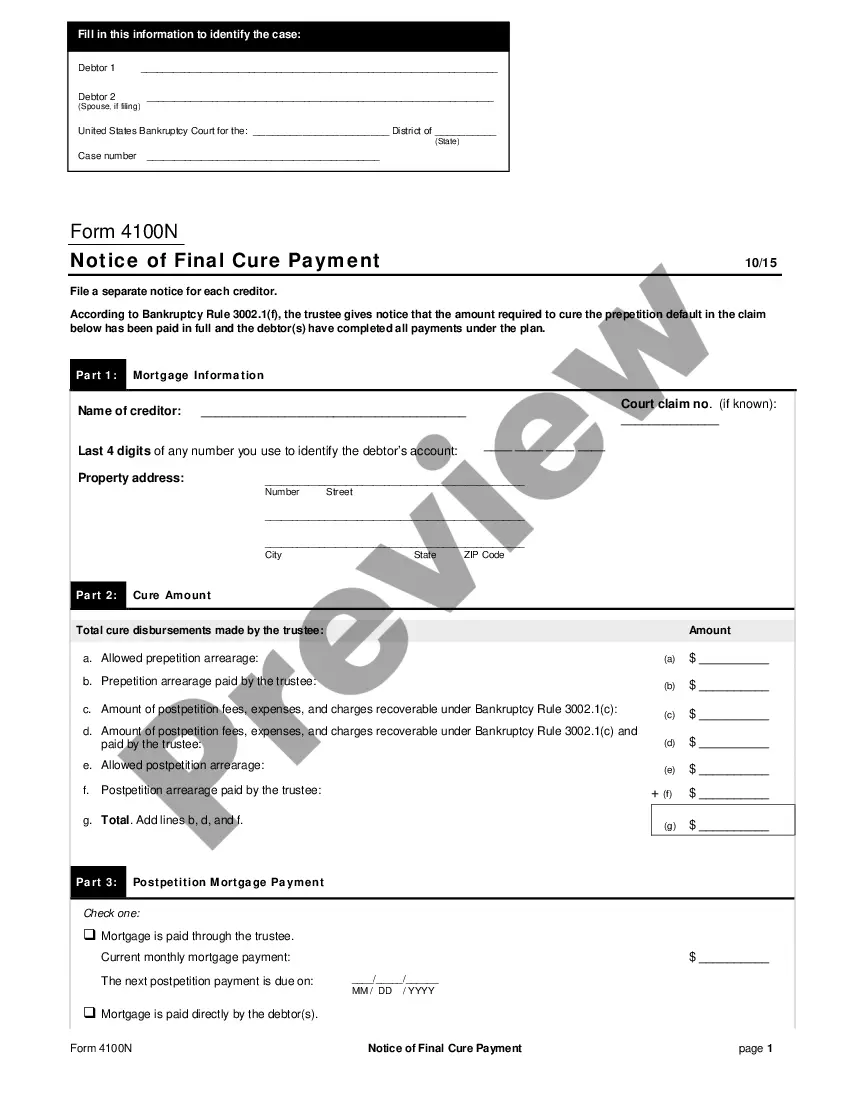
When to use this document
This form should be used when a purchaser under a contract for deed has missed one or more payments. It is essential to send this final notice before taking legal action, such as terminating the contract or initiating eviction procedures. If the seller has already communicated payment issues but payment has not been made, this document reaffirms the seriousness of the situation.
Who this form is for
This form is intended for:
- Property sellers who have entered into a contract for deed
- Property purchasers who have fallen behind on their payments
- Legal professionals assisting clients in real estate transactions
Steps to complete this form
- Identify and enter the names of the seller and purchaser.
- Specify the property address being purchased.
- Fill in the amount of missed payments and any applicable late fees.
- State the deadline for curing the default.
- Provide the date and sign the document as the seller.
Is notarization required?
To make this form legally binding, it must be notarized. Our online notarization service, powered by Notarize, lets you verify and sign documents remotely through an encrypted video session.
Get your form ready online
Our built-in tools help you complete, sign, share, and store your documents in one place.
Make edits, fill in missing information, and update formatting in US Legal Forms—just like you would in MS Word.
Download a copy, print it, send it by email, or mail it via USPS—whatever works best for your next step.
Sign and collect signatures with our SignNow integration. Send to multiple recipients, set reminders, and more. Go Premium to unlock E-Sign.
If this form requires notarization, complete it online through a secure video call—no need to meet a notary in person or wait for an appointment.
We protect your documents and personal data by following strict security and privacy standards.

Make edits, fill in missing information, and update formatting in US Legal Forms—just like you would in MS Word.

Download a copy, print it, send it by email, or mail it via USPS—whatever works best for your next step.

Sign and collect signatures with our SignNow integration. Send to multiple recipients, set reminders, and more. Go Premium to unlock E-Sign.

If this form requires notarization, complete it online through a secure video call—no need to meet a notary in person or wait for an appointment.

We protect your documents and personal data by following strict security and privacy standards.
Common mistakes to avoid
- Failing to include all relevant payment details.
- Not providing a specific deadline for payment to cure the default.
- Omitting signatures or dates which can invalidate the notice.
- Not verifying the property address is accurate.
- Using vague language instead of clear statements about payment issues.
Benefits of completing this form online
- Convenience of downloading and printing immediately.
- Ability to customize the document to fit specific needs.
- Access to templates that are drafted by licensed attorneys.
- Time savings by avoiding lengthy legal procedures for creating documents from scratch.
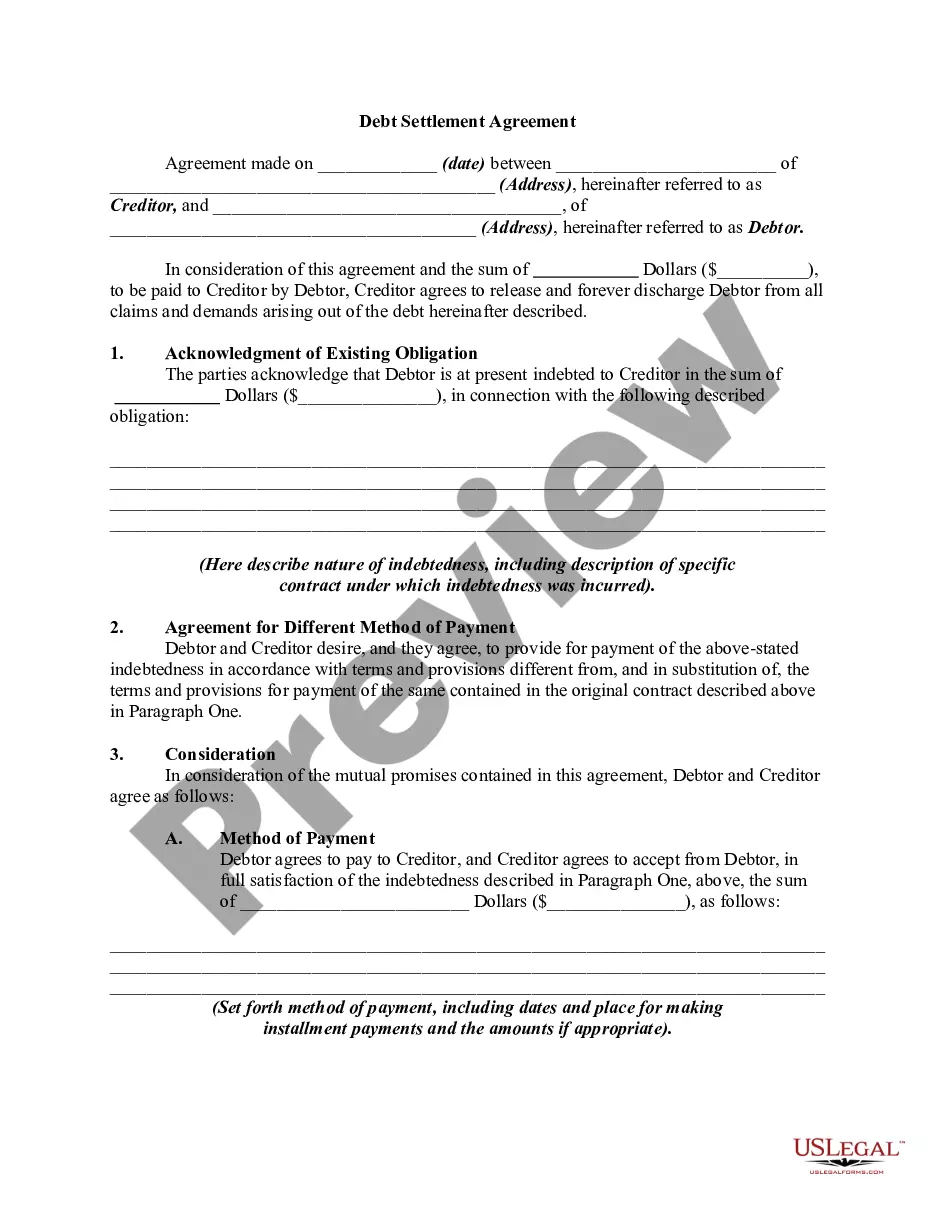
Looking for another form?







Form popularity
FAQ
People often choose contracts for deed because they offer a simpler pathway to homeownership. This arrangement allows buyers to make monthly payments directly to the seller, rather than going through a traditional mortgage lender. Additionally, contracts for deed can be appealing to those with less-than-ideal credit, as they may face fewer barriers compared to conventional financing. However, be aware that a Georgia Final Notice of Default for Past Due Payments in connection with Contract for Deed can lead to serious repercussions if payments are missed.
To set aside a default judgment in Georgia, you need to file a motion in the same court that issued the judgment. You must demonstrate a valid reason for missing the original court date, such as lack of notice or an error in your information. If you can prove your case, the court may grant you relief, allowing you to contest the judgment. Understanding how a Georgia Final Notice of Default for Past Due Payments in connection with Contract for Deed influences these proceedings can help you navigate the process.
Con: Buyer Depends On Seller Unless the seller owns the property outright, he is still making payments to a lending institution. If, for any reason, the seller does not make regular payments, the property can be foreclosed upon, leaving the buyer with a worthless contract and no home.
A land contract is a form of seller financing. It is similar to a mortgage, but rather than borrowing money from a lender or bank to buy real estate, the buyer makes payments to the real estate owner, or seller, until the purchase price is paid in full.
No statute prevents selling your mortgaged home using a contract for deed.A mortgage lender, though, can immediately foreclose its loan if it discovers a contract for deed sale took place. Other than mortgage lender permission to sell your home via contract for deed, you have no easy way around the due-on-sale clause.
A closing IS performed, and real estate professionals are paid, if any are involved. They are NOT paid at the expiration/maturity of the land contract, that is, when the buyers payoff the land contract. 3. The land contract IS then recorded at the county clerk's office to make it official record.
Failure to record a deed effectively makes it impossible for the public to know about the transfer of a property. That means the legal owner of the property appears to be someone other than the buyer, a situation that can generate serious ramifications.
In a self-financed real estate transaction where no new bank loan is involved, the Seller can still enter into a purchase agreement with the Buyer even if the property being sold is encumbered by an existing mortgage held by Seller's lender.
As the property is mortgaged, you can not sell part of the land without first getting your lender's consent.You may find that the lender wants to have a professional valuation carried out, for which you will have to pay and if there is still sufficient equity to support your mortgage you should get consent.
In the first instance, if your deed is not recorded, there is nothing in the public record to stop the seller from conveying the property to another person.The second situation could happen if your seller fails to pay his or her debts and the seller's creditors file liens or judgments against your property.