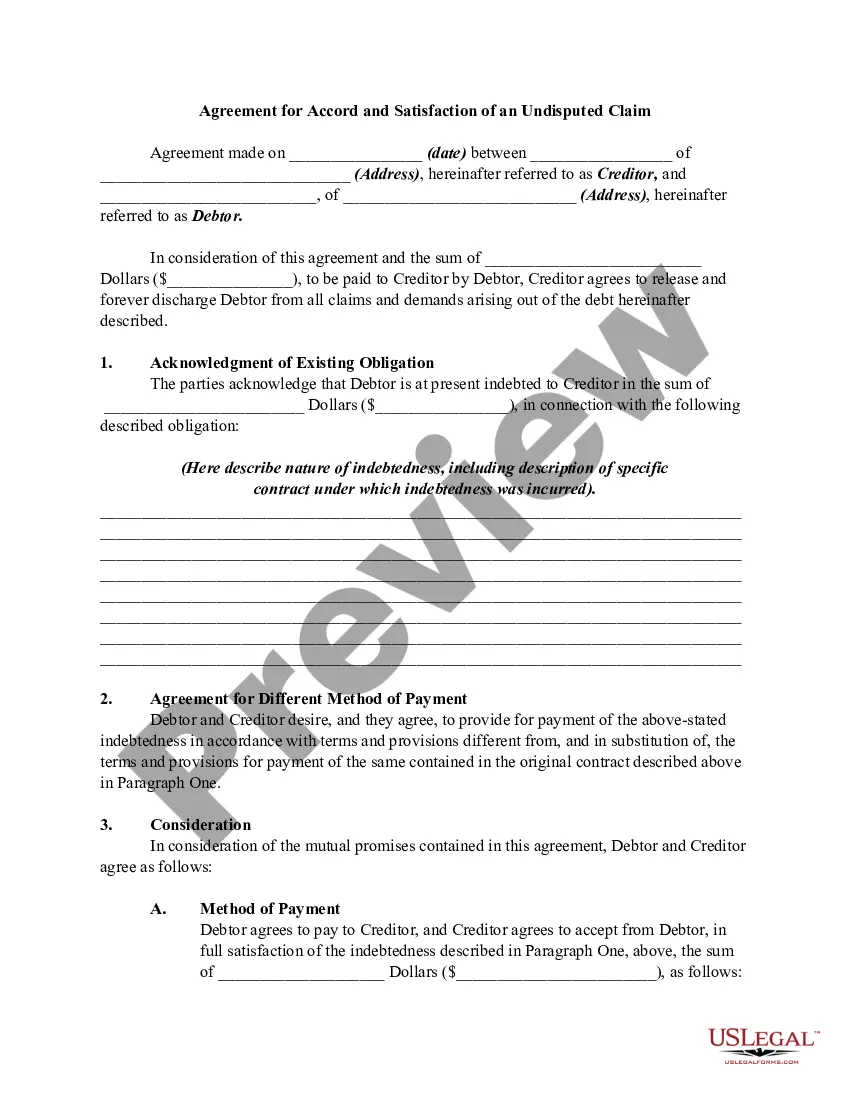
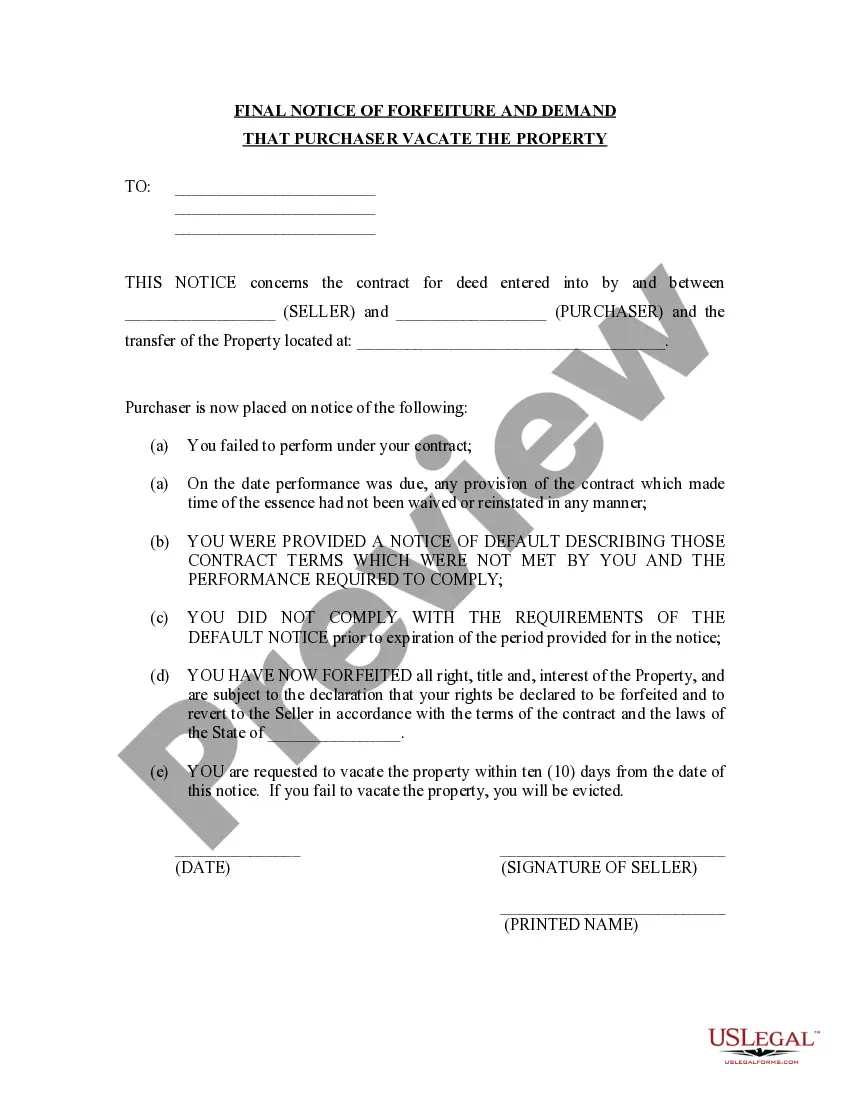
Georgia Final Notice of Forfeiture and Request to Vacate Property under Contract for Deed
What this document covers
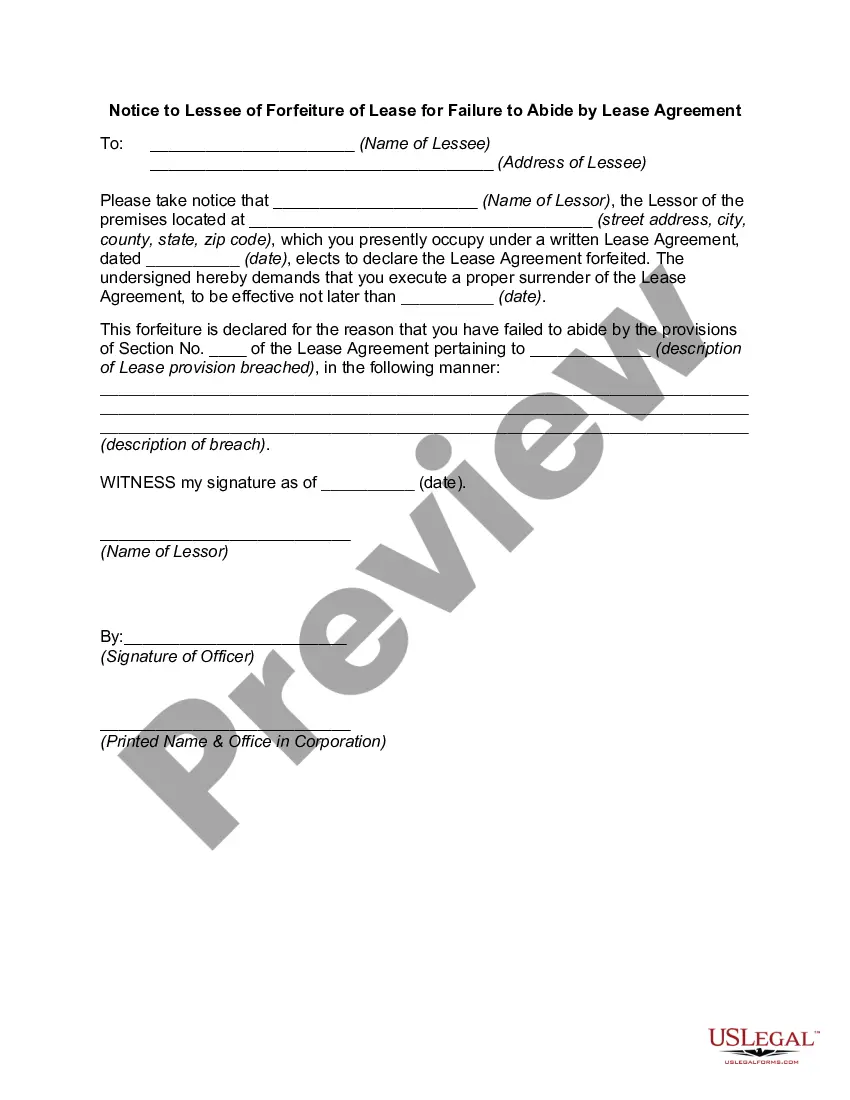
The Final Notice of Forfeiture and Request to Vacate Property under Contract for Deed is a legal document used by a seller to formally notify a buyer that their contract for deed has been canceled. This notice is issued after previous breach notices have expired. The form indicates that any payments made by the buyer are forfeited, and if the buyer remains on the property, further legal action may be pursued. This form is specifically tailored for situations involving property sales under contract for deed, distinguishing it from other eviction or lease termination notices.
What’s included in this form
- Identification of the seller and purchaser involved in the contract.
- Description of the property in question.
- Details on prior notices of breach and default.
- Declaration of the cancellation of contract for deed.
- Statement outlining the forfeiture of any payments made by the purchaser.
- Instructions regarding the demand for the buyer to vacate the premises.
When this form is needed
This form should be used when a seller has previously notified the buyer of a breach of contract and the buyer has failed to remedy the default. It is appropriate to issue this final notice when the seller wishes to officially cancel the contract for deed and reclaim the property, particularly following multiple attempts to resolve the breach.
Who should use this form
- Sellers engaged in a contract for deed with a buyer who has defaulted on their obligations.
- Real estate professionals handling transactions involving contracts for deed.
- Property owners seeking to enforce their rights against a buyer who has not complied with the contract terms.
How to prepare this document
- Identify and enter the full names of the seller and the purchaser.
- Describe the property being affected by the contract for deed.
- Reference any prior notices of breach issued to the buyer.
- Clearly state the cancellation of the contract for deed and the effect on any payments made.
- Include a demand for the buyer to vacate the property, along with any relevant dates.
Does this form need to be notarized?
This form does not typically require notarization unless specified by local law. It is recommended to check local regulations to ensure compliance.
Get your form ready online
Our built-in tools help you complete, sign, share, and store your documents in one place.
Make edits, fill in missing information, and update formatting in US Legal Forms—just like you would in MS Word.
Download a copy, print it, send it by email, or mail it via USPS—whatever works best for your next step.
Sign and collect signatures with our SignNow integration. Send to multiple recipients, set reminders, and more. Go Premium to unlock E-Sign.
If this form requires notarization, complete it online through a secure video call—no need to meet a notary in person or wait for an appointment.
We protect your documents and personal data by following strict security and privacy standards.

Make edits, fill in missing information, and update formatting in US Legal Forms—just like you would in MS Word.

Download a copy, print it, send it by email, or mail it via USPS—whatever works best for your next step.

Sign and collect signatures with our SignNow integration. Send to multiple recipients, set reminders, and more. Go Premium to unlock E-Sign.

If this form requires notarization, complete it online through a secure video call—no need to meet a notary in person or wait for an appointment.

We protect your documents and personal data by following strict security and privacy standards.
Typical mistakes to avoid
- Failing to properly identify all parties involved in the contract.
- Not including specific details about prior breach notices.
- Omitting essential information about the property in question.
- Failure to ensure the form is signed by the seller.
Advantages of online completion
- Convenient access to legal forms without the need for in-person consultations.
- Quick download and easy editing to meet specific needs.
- Reliability of professionally drafted forms by licensed attorneys.
Legal use & context
- This form serves as a official record of a seller's decision to cancel a contract for deed.
- Ensures that the seller takes necessary legal steps to reclaim the property.
- Failure to complete this process properly may result in challenges in court if eviction is pursued.
Quick recap
- The Final Notice of Forfeiture is essential for sellers who wish to cancel a contract for deed.
- Proper completion and delivery of this form are crucial for legal enforceability.
- Staying informed of state-specific rules can prevent complications during the eviction process.
Looking for another form?
Form popularity
FAQ
Claiming Unclaimed Property in Georgia In Georgia, property is generally presumed abandoned if it has remained unclaimed by the owner for more than five years after it became payable or distributable. However, this time limit varies depending on the type of property involved.
After one year or more, those assets are unclaimed and go to the state. That money is lawfully protected and kept by the state to be returned to the owner rather than reverting back to the party who initially distributed the money. In most states, the money is generally held until the owner is found.
For questions about unclaimed property, call Monday through Friday between 8 a.m. and p.m. (excluding state holidays), at (855) 329-9863, or you can send an email to ucpmail@dor.ga.gov. To search for unclaimed money that may be lying in a different state's treasury, click here.
For most states, the dormancy period is five years. When property is officially designated by the state as abandoned or unclaimed, it undergoes a process known as escheatment, where the state assumes ownership of that property until the rightful owner files a claim.
The National Association of Unclaimed Property Administrators' website www.unclaimed.org is an excellent resource. This association consists of state officials charged with the responsibility of reuniting lost owners with their unclaimed property.
Search multiple states at once with MissingMoney.com Most states participate in MissingMoney.coma free website, sponsored by NAUPA, from which you can search participating state's databases for unclaimed property.
Checking or savings accounts. Stocks. Uncashed dividends or payroll checks. Refunds. Traveler's checks. Trust distributions. Unredeemed money orders or gift certificates (in some states) Certificates of deposit.
Unclaimed property refers to accounts held by financial institutions and other businesses who have lost contact with their owner of record.