West Virginia Lease Subordination Agreement
Overview of this form
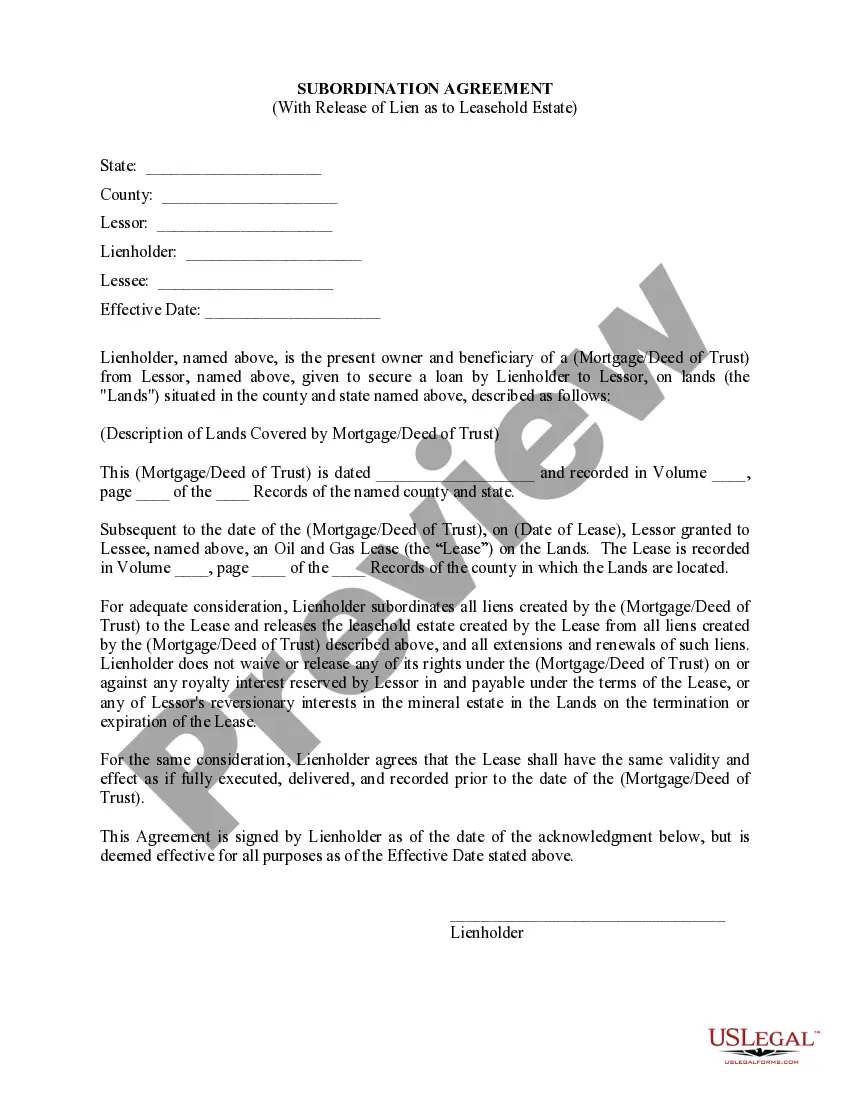
A Lease Subordination Agreement is a legal document that specifies how various liens on a property are prioritized. It allows a lienholder, typically a mortgage lender, to subordinate its interest in the property to a lease, often related to mineral, oil, or gas rights. This form is essential in ensuring that a new lease can take precedence over existing mortgages, which is crucial in real estate and resource extraction transactions.
Main sections of this form
- Identification of the parties involved: Lessor, Lienholder, and Lessee
- Description of the property and the mortgage or deed of trust
- Details about the lease, including its recorded information
- Statement of subordination, releasing the leasehold estate from existing liens
- Retention of rights by the lienholder under the original mortgage or deed of trust
- Signatures and effective date of the agreement
Common use cases
This form is necessary when a property owner intends to grant an oil or gas lease on a property already encumbered by a mortgage. By using the Lease Subordination Agreement, the lienholder can agree to lower its priority, allowing the new lease to be valid and enforceable without conflicts regarding outstanding debts.
Who this form is for
This form is suitable for:
- Property owners wishing to lease mineral, oil, or gas rights while having an existing mortgage
- Mortgage lenders who need to subordinate their interest to allow leases to be executed
- Lessees acquiring rights to the property for resource extraction
How to prepare this document
- Identify the parties: Enter the names and addresses of the Lessor, Lienholder, and Lessee.
- Specify the property: Describe the land involved, including its location and any relevant legal identifiers.
- Enter the mortgage details: Fill out the date of the mortgage, volume, and page numbers where it is recorded.
- Detail the lease: Insert the date of the lease and its recorded information.
- Obtain signatures: Ensure all parties sign and date the agreement to make it legally binding.
- Review for completeness: Verify that all fields are accurately filled to prevent future disputes.
Notarization guidance
This form does not typically require notarization unless specified by local law, but it is always prudent to check local requirements to ensure compliance.
Get your form ready online
Our built-in tools help you complete, sign, share, and store your documents in one place.
Make edits, fill in missing information, and update formatting in US Legal Forms—just like you would in MS Word.
Download a copy, print it, send it by email, or mail it via USPS—whatever works best for your next step.
Sign and collect signatures with our SignNow integration. Send to multiple recipients, set reminders, and more. Go Premium to unlock E-Sign.
If this form requires notarization, complete it online through a secure video call—no need to meet a notary in person or wait for an appointment.
We protect your documents and personal data by following strict security and privacy standards.

Make edits, fill in missing information, and update formatting in US Legal Forms—just like you would in MS Word.

Download a copy, print it, send it by email, or mail it via USPS—whatever works best for your next step.

Sign and collect signatures with our SignNow integration. Send to multiple recipients, set reminders, and more. Go Premium to unlock E-Sign.

If this form requires notarization, complete it online through a secure video call—no need to meet a notary in person or wait for an appointment.

We protect your documents and personal data by following strict security and privacy standards.
Avoid these common issues
- Omitting important details about the property or the mortgage.
- Not obtaining signatures from all necessary parties.
- Failing to properly reference recorded documents related to the mortgage and lease.
- Not reviewing local laws and regulations which may affect the form's enforceability.
Advantages of online completion
- Quick access to a legally drafted document tailored to meet your needs.
- Editable templates that allow you to personalize the form for your specific situation.
- Secure online platform ensures your data is protected throughout the process.
- No need for physical trips to legal offices; everything can be done online.
Legal use & context
- This agreement helps protect the rights of both the lienholder and the lessee in the event of financial disputes.
- Subordination ensures that leases can be executed without conflicting interests from existing mortgages.
- Proper use of this form can prevent future legal challenges regarding property rights and obligations.
Summary of main points
- A Lease Subordination Agreement prioritizes a lease over existing mortgages on a property.
- It is essential for facilitating new leases in properties that already have liens.
- Careful completion and accuracy are critical to avoid errors and enforceability issues.
Looking for another form?


Form popularity
FAQ
Subordination is the tenant's agreement that its interest under the lease will be subordinate to that of the lender.Attornment is the tenant's agreement to become the tenant of someone other than the original landlord and who has now taken title to the property.
A subordination agreement acknowledges that one party's claim or interest is superior to that of another party in the event that the borrower's assets must be liquidated to repay the debts.
A subordination fee is a fee directly related to the credit transaction. There is no comparable cash transaction to compare it to and a subordination is not a required document to perfect your lien. It's only required to perfect your lien in the position that you required as a condition of making the loan.
But as property values are going up and the demand for refinance isn't as much, it seems that the subordination process has gotten a little easier. Typically, it takes two to three weeks to get the resubordination paperwork through, and it is likely to set you back $200 to $300.
Subordination agreements are prepared by your lender. The process occurs internally if you only have one lender. When your mortgage and home equity line or loan have different lenders, both financial institutions work together to draft the necessary paperwork.
In the case of commercial property changing hands, an attornment clause in a subordination, non-disturbance, and attornment (SNDA) agreement requires the tenant to acknowledge a new owner as their landlord and to continue paying rent regardless of whether the property changes hands through a normal sale or a
SNDA stands for Subordination, Non-disturbance and Attornment Agreement. You need an SNDA if you are a commercial tenant, a commercial landlord, or a lender taking a mortgage against commercial property. If you're a tenant, the SNDA protects you from being evicted if your landlord stops paying its mortgage loan.
Unless there is a subordination agreement, it is virtually impossible to refinance your first mortgage. The document agreeing to the subordination must be signed by the lender and the borrower and requires notarization.
A nondisturbance clause is a provision in a mortgage contract that ensures that a rental agreement between the tenant and the landlord will continue under any circumstances.A nondisturbance clause ensures that a tenant will not be evicted in the event that the landlord goes bankrupt.