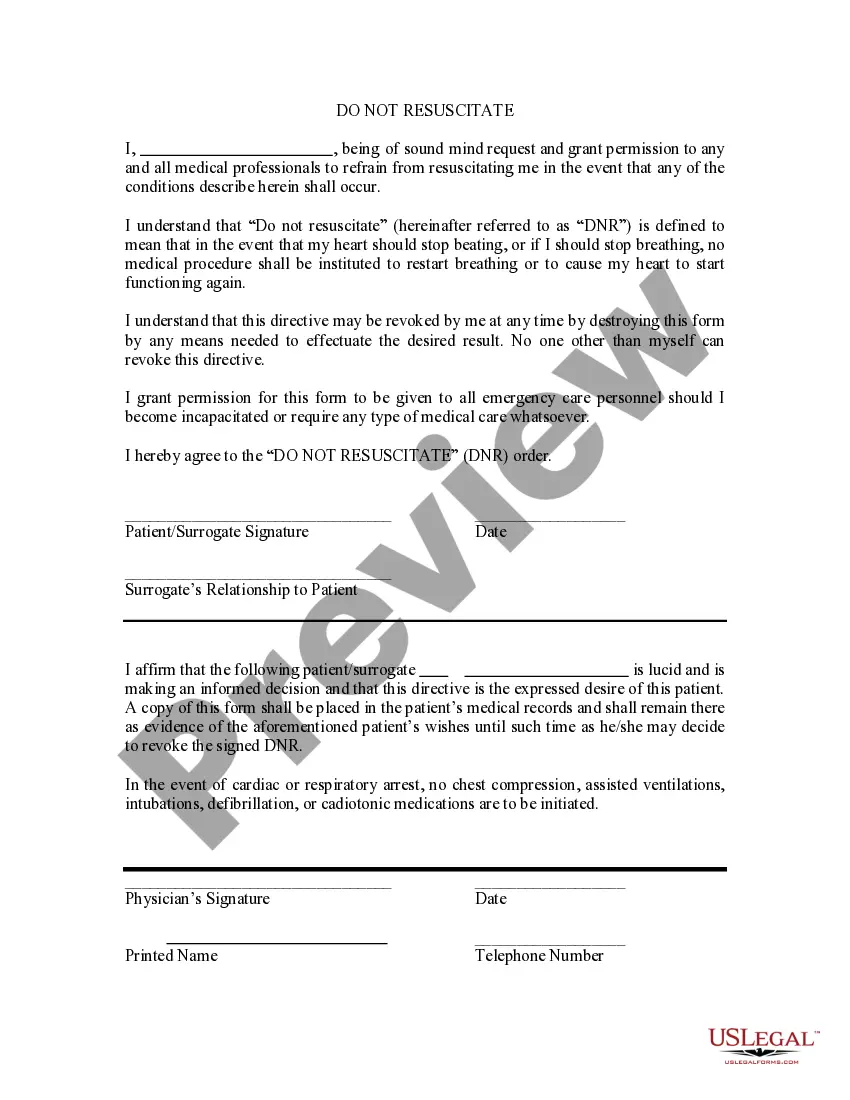
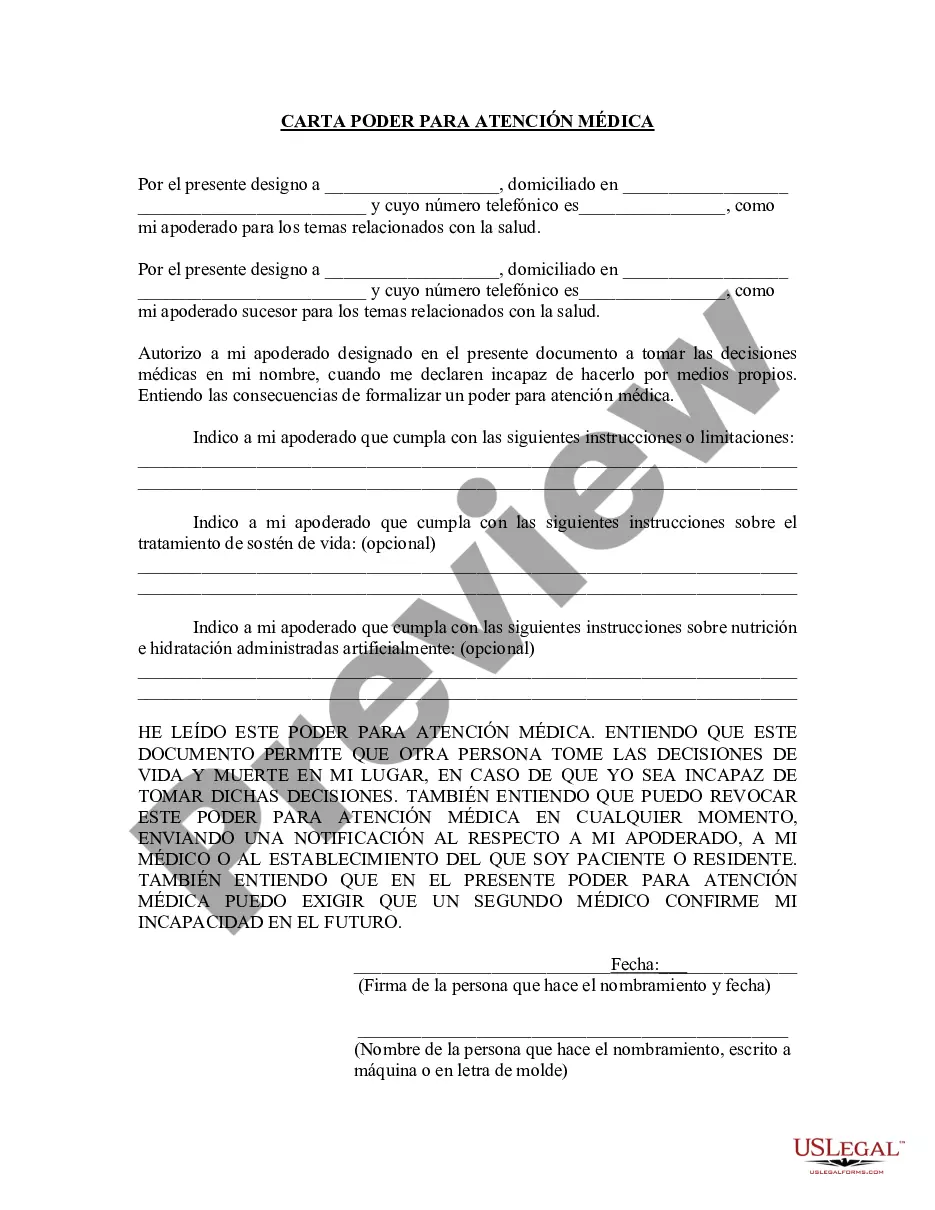
This is a form initiated by a patient requesting that he/she not be resuscitated should he/she stop breathing or should his/her heart stop beating. This form is also to be signed by a physician attesting to patient's wishes and to be placed in the patient's file.
Wisconsin Do Not Resuscitate Request - DNR
State:
Multi-State
Control #:
US-PRM-12
Format:
Word;
Rich Text
Instant download
Description
Free preview

Get your form ready online
Our built-in tools help you complete, sign, share, and store your documents in one place.
Built-in online Word editor
Make edits, fill in missing information, and update formatting in US Legal Forms—just like you would in MS Word.
Export easily
Download a copy, print it, send it by email, or mail it via USPS—whatever works best for your next step.
E-sign your document
Sign and collect signatures with our SignNow integration. Send to multiple recipients, set reminders, and more. Go Premium to unlock E-Sign.
Notarize online 24/7
If this form requires notarization, complete it online through a secure video call—no need to meet a notary in person or wait for an appointment.
Store your document securely
We protect your documents and personal data by following strict security and privacy standards.

Make edits, fill in missing information, and update formatting in US Legal Forms—just like you would in MS Word.

Download a copy, print it, send it by email, or mail it via USPS—whatever works best for your next step.

Sign and collect signatures with our SignNow integration. Send to multiple recipients, set reminders, and more. Go Premium to unlock E-Sign.

If this form requires notarization, complete it online through a secure video call—no need to meet a notary in person or wait for an appointment.

We protect your documents and personal data by following strict security and privacy standards.
Looking for another form?





How to fill out Do Not Resuscitate Request - DNR?
US Legal Forms - one of the largest collections of legal documents in the United States - provides a broad assortment of legal form templates that you can download or print. By utilizing the site, you can discover numerous forms for business and personal purposes, categorized by types, states, or keywords.
You can obtain the latest versions of forms such as the Wisconsin Do Not Resuscitate Request - DNR within moments. If you already have a monthly membership, Log In and download the Wisconsin Do Not Resuscitate Request - DNR from your US Legal Forms library. The Acquire button will appear on every form you view. You have access to all previously downloaded forms in the My documents section of your account.
If you want to use US Legal Forms for the first time, here are simple steps to get started: Ensure you have selected the correct form for your region/area. Click the Review button to evaluate the form's content. Read the form summary to confirm you have chosen the right form. If the form doesn’t meet your needs, use the Search field at the top of the screen to find one that does. If you are satisfied with the form, confirm your choice by clicking the Buy now button. Then, choose the payment plan you wish and provide your details to register for an account.
Access the Wisconsin Do Not Resuscitate Request - DNR with US Legal Forms, one of the most extensive collections of legal document templates. Utilize thousands of professional and state-specific templates that cater to your business or personal needs and requirements.
- Process the purchase. Use your credit card or PayPal account to complete the transaction.
- Select the format and download the form to your device.
- Make modifications. Fill out, edit, and print and sign the downloaded Wisconsin Do Not Resuscitate Request - DNR.
- Each template you added to your account has no expiration date and is yours permanently.
- So, if you wish to download or print another copy, simply go to the My documents section and click on the form you need.
Form popularity
FAQ
A decision not to attempt resuscitation may be appropriate when: - The patient's condition indicates that effective CPR is unlikely to be successful; - CPR is not in accord with the recorded wishes of a mentally competent patient; - CPR is not in accord with an applicable advance directive (living will).
Summary. The main point is this: as a bystander, i.e. a non-medical professional, you cannot get into any legal trouble for giving CPR to a person with a DNR, and should always give CPR as soon as possible to all victims of sudden cardiac arrest.
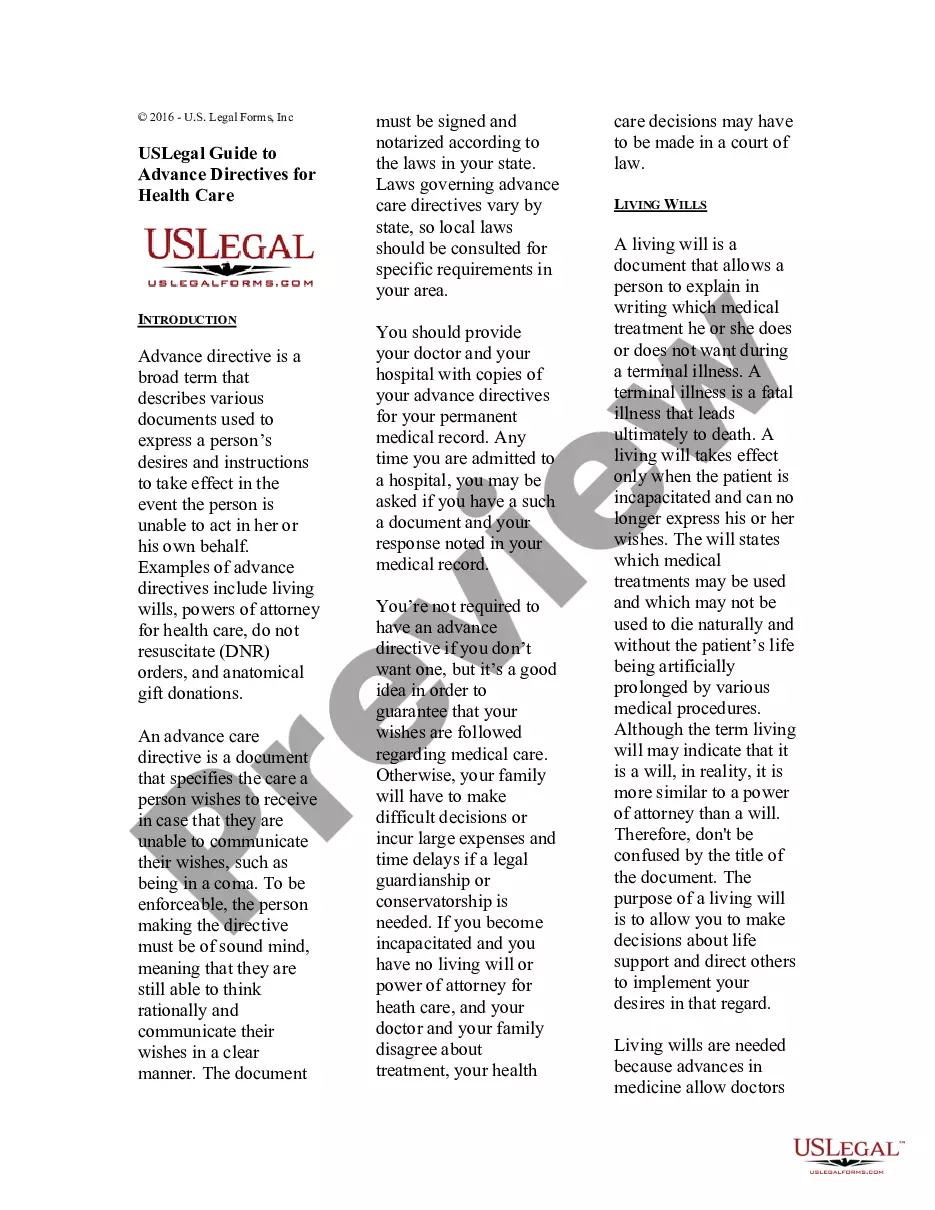
It is an emergency rescue technique that was developed to save the life of people who are generally in good health. NOTE: If you do not have a DNR orders, health care providers will begin CPR in an emergency.
What is a 'do not resuscitate order'? A DNR order is a medical order to withhold cardiopulmonary resuscitation (CPR). Such an order lets the healthcare team know that, in the event of a cardiac arrest, CPR must not be conducted. Instead, healthcare staff should promote comfort and prepare for end-of-life care.
Those who are resuscitated may also suffer brain damage. As such, it can lead to broken ribs, punctured lungs, and possibly a damaged heart. These actions may be too much for someone in frail health. If you wish to explore a DNR order, it's important to know that the orders vary from state to state.
A doctor decides in advance DNACPR is a medical treatment decision that can be made by your doctor even if you do not agree. You must be told that a DNACPR form will be/has been completed for you, but a doctor does not need your consent.
The DNR order must be signed by the healthcare provider. In those cases where orders were taken by a nurse over the phone, states usually set a deadline for the practitioner to physically verify and sign the orderin California, for example, a medical professional must sign the DNR within 24 hours.
At many hospitals, the policy is to write a DNR order only with patient/family agreement. If there is disagreement, every reasonable effort should be made to communicate with the patient or family. In many cases, this will lead to resolution of the conflict. In difficult cases, an ethics consultation can prove helpful.
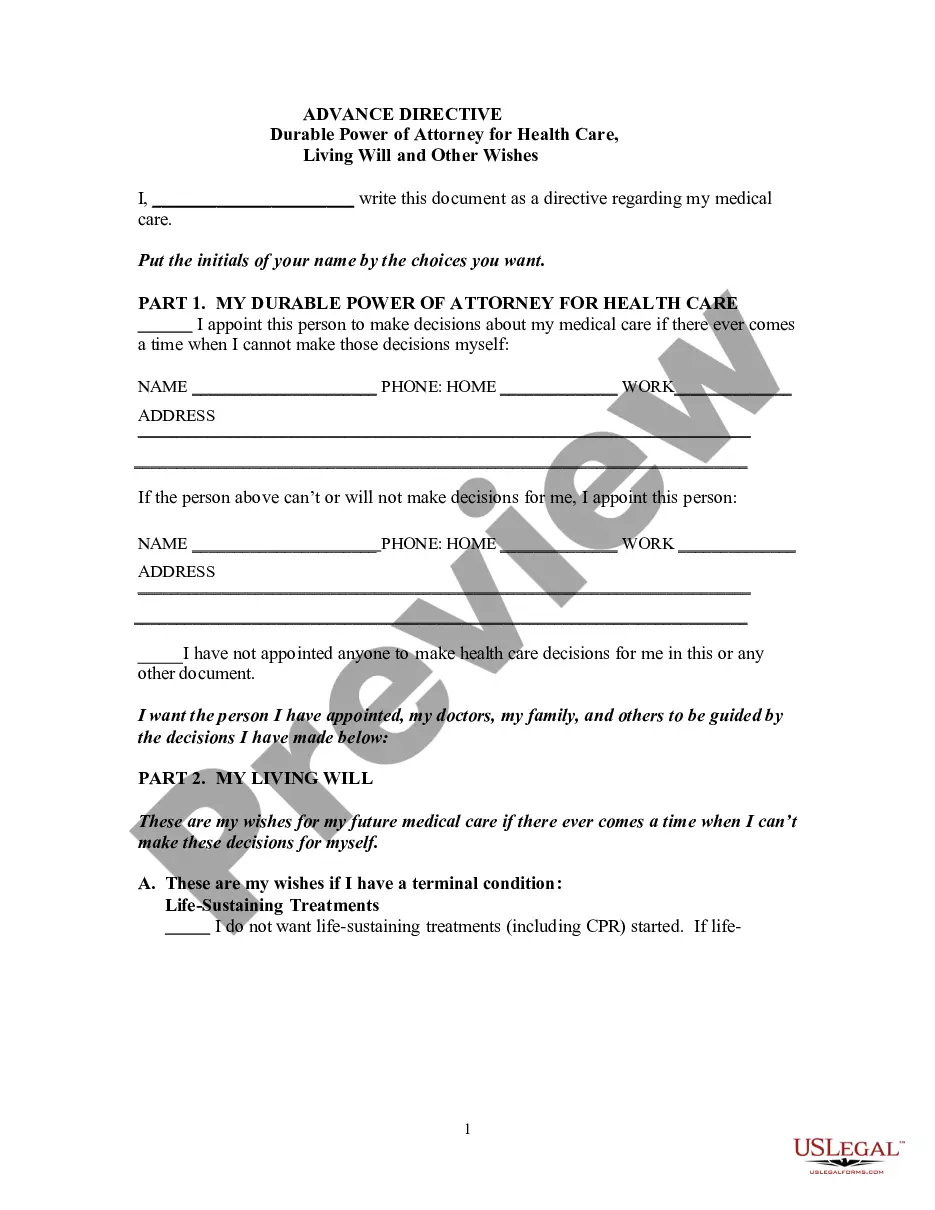
You can use an advance directive form or tell your doctor that you don't want to be resuscitated. Your doctor will put the DNR order in your medical chart. Doctors and hospitals in all states accept DNR orders. They do not have to be part of a living will or other advance directive.
notresuscitate order, or DNR order, is a medical order written by a doctor. It instructs health care providers not to do cardiopulmonary resuscitation (CPR) if a patient's breathing stops or if the patient's heart stops beating.