Wisconsin Quitclaim Deed - Three Individuals to Three Individuals

Understanding this form
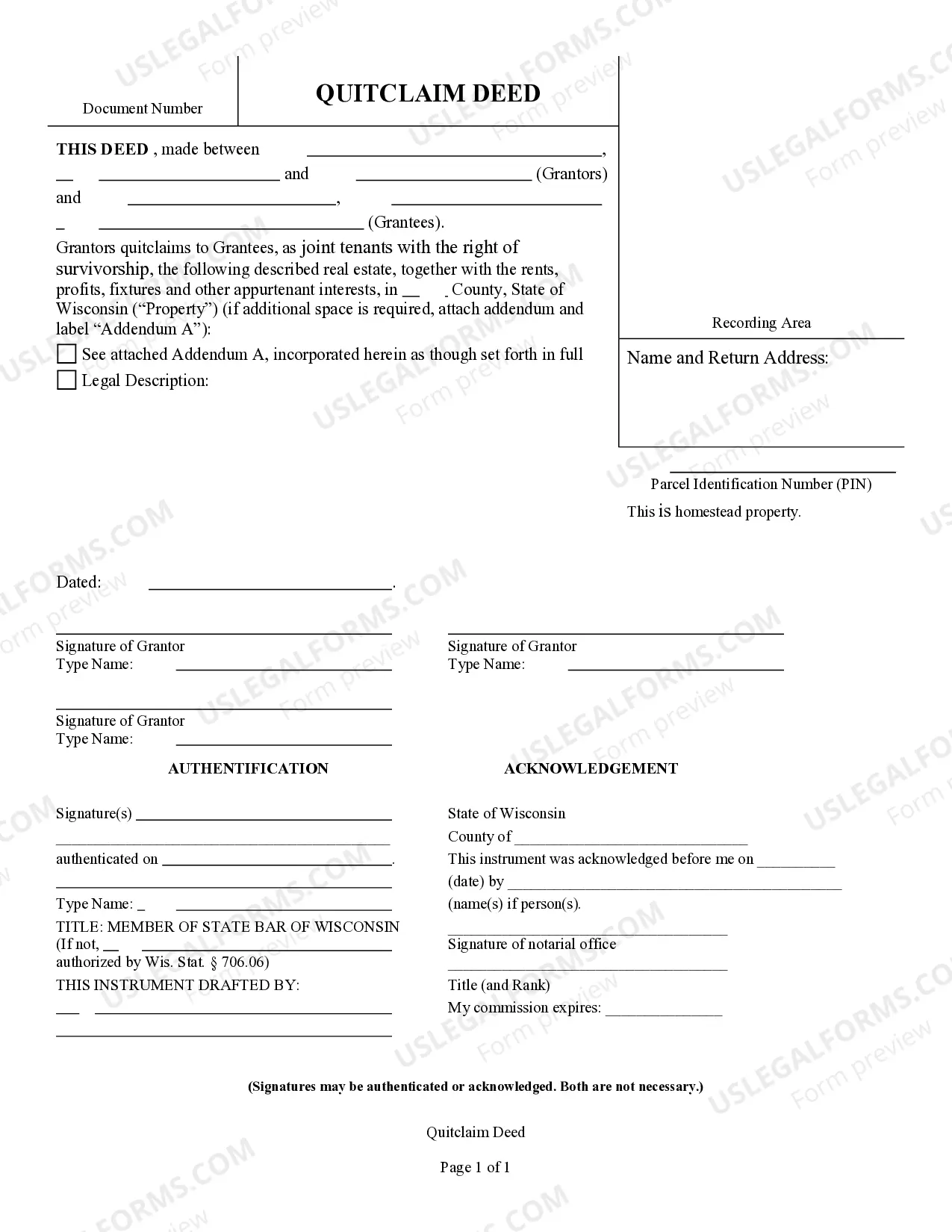
A Quitclaim Deed is a legal document used to transfer ownership of property from one party to another without any warranties. In this specific form, the grantors and grantees are both groups of three individuals. This type of deed allows the grantees to take property either as joint tenants with the right of survivorship or as tenants in common, providing flexibility in how the property is managed and inherited. This quitclaim deed is distinct from other deeds, such as warranty deeds, which provide guarantees regarding the title of the property.
Form components explained
- Grantors: Names of the three individuals transferring the property.
- Grantees: Names of the three individuals receiving the property.
- Property Description: A detailed description of the property being transferred.
- Transfer Type: Indicates whether the ownership is shared as joint tenants or tenants in common.
- Date: The date when the deed is executed.
- Signatures: Signatures of all parties involved in the transaction.





When to use this form
This form is typically used when the owners of a property wish to transfer their interests to other individual co-owners. Common scenarios include family members dividing assets, friends wanting to co-own property, or when individuals decide to simplify property ownership. It is also useful in estate planning situations where property is passed on to beneficiaries without formal disputes.
Who should use this form
- Individuals looking to transfer property ownership to others.
- Family members dividing inherited property.
- Friends or partners co-owning real estate.
- Individuals involved in estate planning or asset management.
Steps to complete this form
- Identify the parties involved: the three grantors and three grantees.
- Provide a thorough description of the property being transferred.
- Select the type of ownership: joint tenants with right of survivorship or tenants in common.
- Enter the date of execution of the deed.
- Ensure all parties sign the deed in the designated areas.
Notarization requirements for this form
This form must be notarized to be legally valid. US Legal Forms provides secure online notarization powered by Notarize, allowing you to complete the process through a verified video call.
Get your form ready online
Our built-in tools help you complete, sign, share, and store your documents in one place.
Make edits, fill in missing information, and update formatting in US Legal Forms—just like you would in MS Word.
Download a copy, print it, send it by email, or mail it via USPS—whatever works best for your next step.
Sign and collect signatures with our SignNow integration. Send to multiple recipients, set reminders, and more. Go Premium to unlock E-Sign.
If this form requires notarization, complete it online through a secure video call—no need to meet a notary in person or wait for an appointment.
We protect your documents and personal data by following strict security and privacy standards.

Make edits, fill in missing information, and update formatting in US Legal Forms—just like you would in MS Word.

Download a copy, print it, send it by email, or mail it via USPS—whatever works best for your next step.

Sign and collect signatures with our SignNow integration. Send to multiple recipients, set reminders, and more. Go Premium to unlock E-Sign.

If this form requires notarization, complete it online through a secure video call—no need to meet a notary in person or wait for an appointment.

We protect your documents and personal data by following strict security and privacy standards.
Avoid these common issues
- Failing to include a complete property description.
- Not having all parties sign the deed.
- Leaving out the transfer type selected by the grantees.
- Not dating the document properly.
Advantages of online completion
- Convenient access to legal forms from anywhere.
- Editable form fields allow for straightforward completion.
- Ensures that the form adheres to current legal standards.
- Secure storage options to keep sensitive information safe.
Looking for another form?
Form popularity
FAQ
In most cases, the surviving owner or heir obtains the title to the home, the former owner's death certificate, a notarized affidavit of death, and a preliminary change of ownership report form. When all these are gathered, the transfer gets recorded, the fees are paid, and the county issues a new title deed.
Step 1: Download the WI quitclaim deed form. Step 2: Fill in the appropriate information. Step 3: Add the name and return address of the person and place where you wish to have the deed sent when the Register of Deeds is done recording the information.
Six people can be on title. It can cause a lot of problems when it comes time to sell though. If even one of the six won't sign, you have a problem. They can sign at different times and from different locations depending on the closing attorney or escrow company.
Discuss property ownership interests. Access a copy of your title deed. Complete, review and sign the quitclaim or warranty form. Submit the quitclaim or warranty form. Request a certified copy of your quitclaim or warranty deed.
But you might be wondering if an owner can transfer a deed to another person without a real estate lawyer. The answer is yes. Parties to a transaction are always free to prepare their own deeds.A quitclaim deed, for example, is far simpler than a warranty deed.
It is possible to be named on the title deed of a home without being on the mortgage. However, doing so assumes risks of ownership because the title is not free and clear of liens and possible other encumbrances.If a mortgage exists, it's best to work with the lender to make sure everyone on the title is protected.
Adding someone to your house deed requires the filing of a legal form known as a quitclaim deed. When executed and notarized, the quitclaim deed legally overrides the current deed to your home. By filing the quitclaim deed, you can add someone to the title of your home, in effect transferring a share of ownership.
The law doesn't forbid adding people to a deed on a home with an outstanding mortgage. Mortgage lenders are familiar and frequently work with deed changes and transfers.When you "deed" your home to someone, you've effectively transferred part ownership, which could activate the "due-on-sale" clause.