Vermont Trustee's Deed
About this form
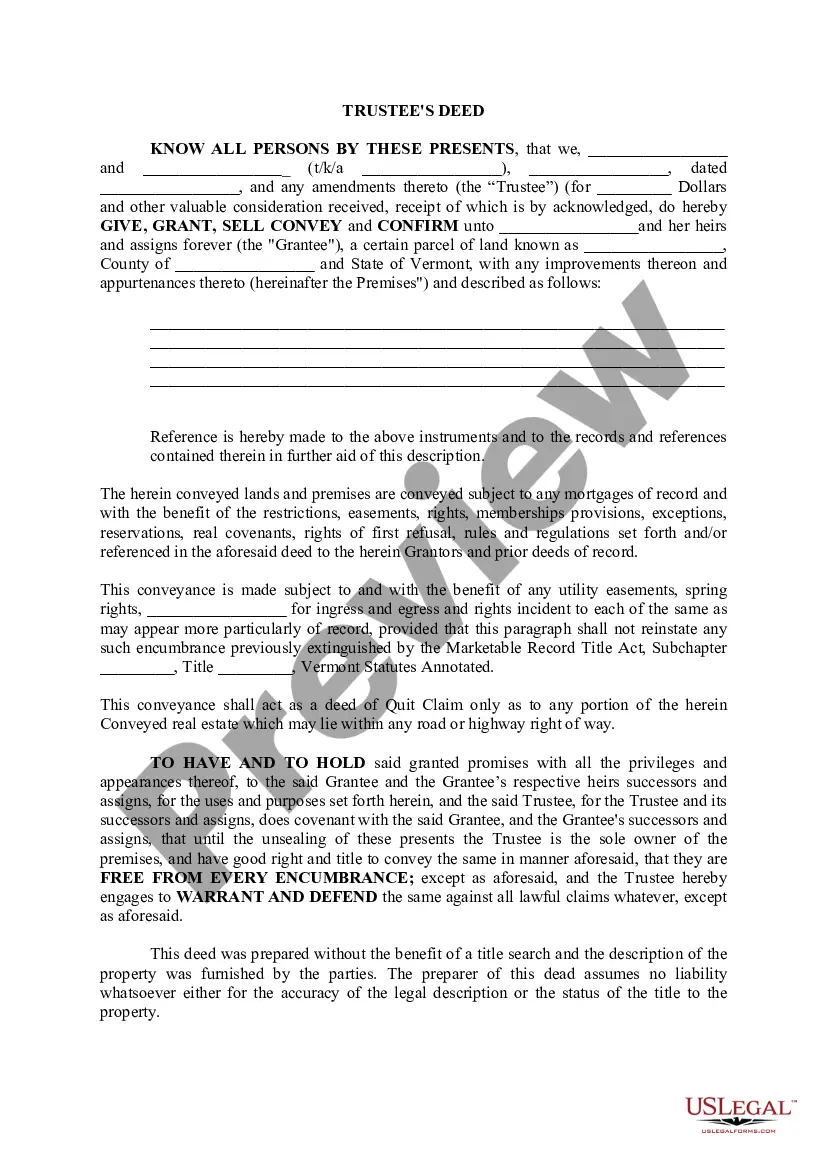
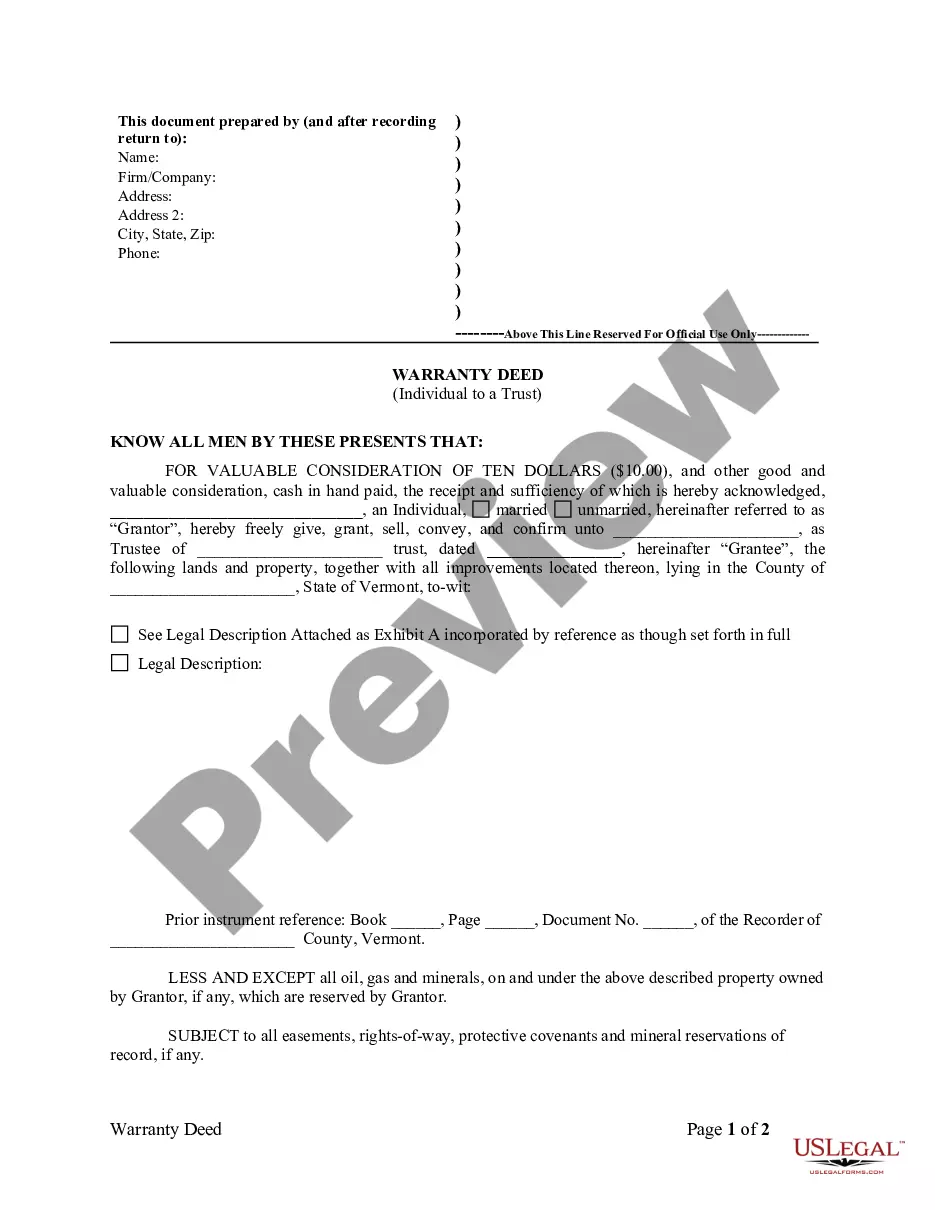
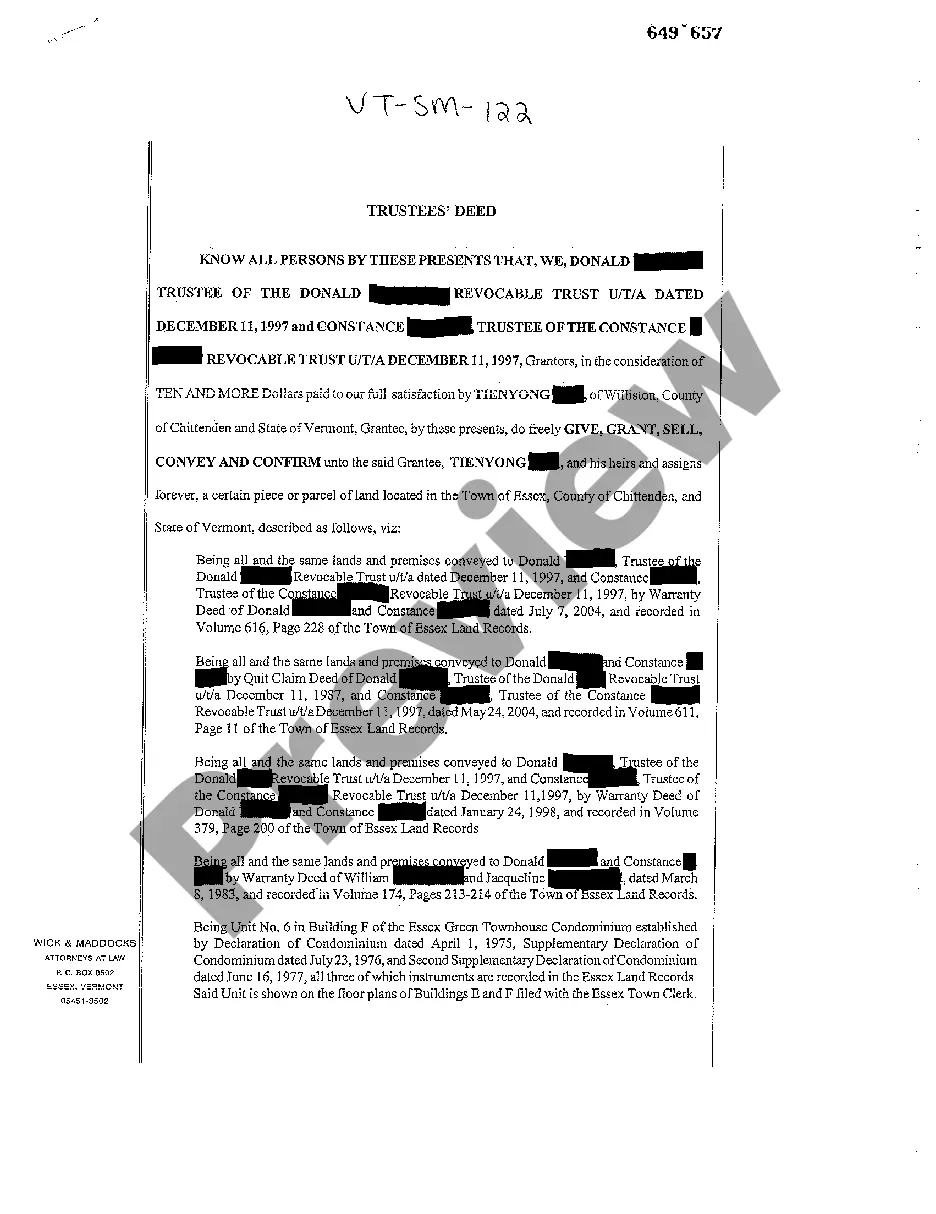
The Trustee's Deed is a legal document used to transfer real estate out of a trust. In this context, the trustee acts on behalf of the trust's beneficiary, holding the title to the property until it is formally conveyed to the new owner. This deed differs from other property transfer forms by specifically designating the trustee as the grantor, highlighting the fiduciary relationship inherent in trust management.
Key parts of this document
- Names of the trustee(s): Identifies the individuals authorized to execute the deed.
- Consideration amount: States the value exchanged for the property transfer.
- Grantee information: Specifies the new owner or beneficiaries receiving the property.
- Description of the property: Includes detailed legal description and location of the conveyed land.
- Covenants and warranties: Outlines assurances made by the trustee regarding ownership and encumbrances.
- Notary section: Provides a space for notarization to authenticate the deed.


When to use this document
You would typically use the Trustee's Deed when a property held in a trust needs to be sold or transferred to a beneficiary or third party. This situation may arise in cases of estate planning, asset distribution following a trust's termination, or liquidation of trust assets. The form is crucial for ensuring that the legal transfer is properly documented and recognized by local authorities.
Who should use this form
- Trustees managing a trust who are required to transfer property.
- Beneficiaries of a trust seeking to receive their inheritance.
- Real estate professionals involved in transactions involving trust property.
- Legal representatives handling matters of real estate inherited through a trust.
How to complete this form
- Identify the trustee(s) by filling in their names and title.
- State the amount of consideration being received for the property.
- Enter the name of the grantee who will hold the title to the property.
- Provide a detailed description of the property being conveyed, including its location.
- Sign the form in the presence of a notary public to validate the deed.
Does this document require notarization?
Yes, this form must be notarized to be legally valid. The notarization process helps ensure the authenticity of the signatures and the voluntary nature of the transaction. US Legal Forms offers integrated online notarization services that are available 24/7 via secure video calls, providing convenience and reliability for completing legal documents.
Get your form ready online
Our built-in tools help you complete, sign, share, and store your documents in one place.
Make edits, fill in missing information, and update formatting in US Legal Forms—just like you would in MS Word.
Download a copy, print it, send it by email, or mail it via USPS—whatever works best for your next step.
Sign and collect signatures with our SignNow integration. Send to multiple recipients, set reminders, and more. Go Premium to unlock E-Sign.
If this form requires notarization, complete it online through a secure video call—no need to meet a notary in person or wait for an appointment.
We protect your documents and personal data by following strict security and privacy standards.

Make edits, fill in missing information, and update formatting in US Legal Forms—just like you would in MS Word.

Download a copy, print it, send it by email, or mail it via USPS—whatever works best for your next step.

Sign and collect signatures with our SignNow integration. Send to multiple recipients, set reminders, and more. Go Premium to unlock E-Sign.

If this form requires notarization, complete it online through a secure video call—no need to meet a notary in person or wait for an appointment.

We protect your documents and personal data by following strict security and privacy standards.
Typical mistakes to avoid
- Failing to accurately describe the property being transferred, leading to potential disputes.
- Not obtaining the required signatures from all trustees involved, making the deed invalid.
- Overlooking the need for notarization, which can invalidate the legal effectiveness of the deed.
- Not including the consideration amount, which is essential for demonstrating the transaction's legitimacy.
Legal use & context
- The Trustee's Deed is legally binding once executed and notarized.
- It transfers ownership of the property from the trust to the specified grantee.
- Potential legal disputes can arise if the deed is not properly executed or if the property description is inaccurate.
- This form is essential for ensuring clear title transfer and safeguarding against future claims by other parties.
Summary of main points
- The Trustee's Deed facilitates the transfer of real estate from a trust.
- Accurate completion and notarization are vital for legal validity.
- This form is crucial for trustees and beneficiaries involved in real estate transactions.
- Always refer to state-specific requirements to ensure compliance with local laws.
Looking for another form?


Form popularity
FAQ
Quitclaim Deed. Deed of Trust. Warranty Deed. Grant Deed. Bargain and Sale Deed. Mortgage Deed.
Like all deeds, these two legal documents are both used to transfer titles from one owner to another. A warranty deed protects property owners from future claims that someone else actually owns a portion (or all) of their property, while trustee deeds protect lenders when borrowers default on their mortgage loans.
A trustee deedsometimes called a deed of trust or a trust deedis a legal document created when someone purchases real estate in a trust deed state, such as California (check your local laws to see what is required in your state). A trust deed is used in place of a mortgage.
Three basic types of deeds commonly used are the grant deed, the quitclaim deed, and the warranty deed. A sample grant deed. the property he or she is transferring is implied from such language.
A Trustee's Deed Upon Sale, also known as a Trustee's Deed Under Sale or a Trustee's Deed is a deed of foreclosure. This deed is prepared after a property's foreclosure sale and recorded in the county were the property is located.The property may be in default on taxes, have mechanic's liens and/or other encumbrances.
Trustee's deeds convey real estate out of a trust.This type of conveyance is named for the person using the form the trustee who stands in for the beneficiary of the trust and holds title to the property.
A trustee manages property that is held in trust.A trust is an arrangement in which one person holds the property of another for the benefit of a third party, called the beneficiary. The beneficiary is usually the owner of the property or a person designated as the beneficiary by the owner of the property.
A warranty deed protects property owners from future claims that someone else actually owns a portion (or all) of their property, while trustee deeds protect lenders when borrowers default on their mortgage loans.