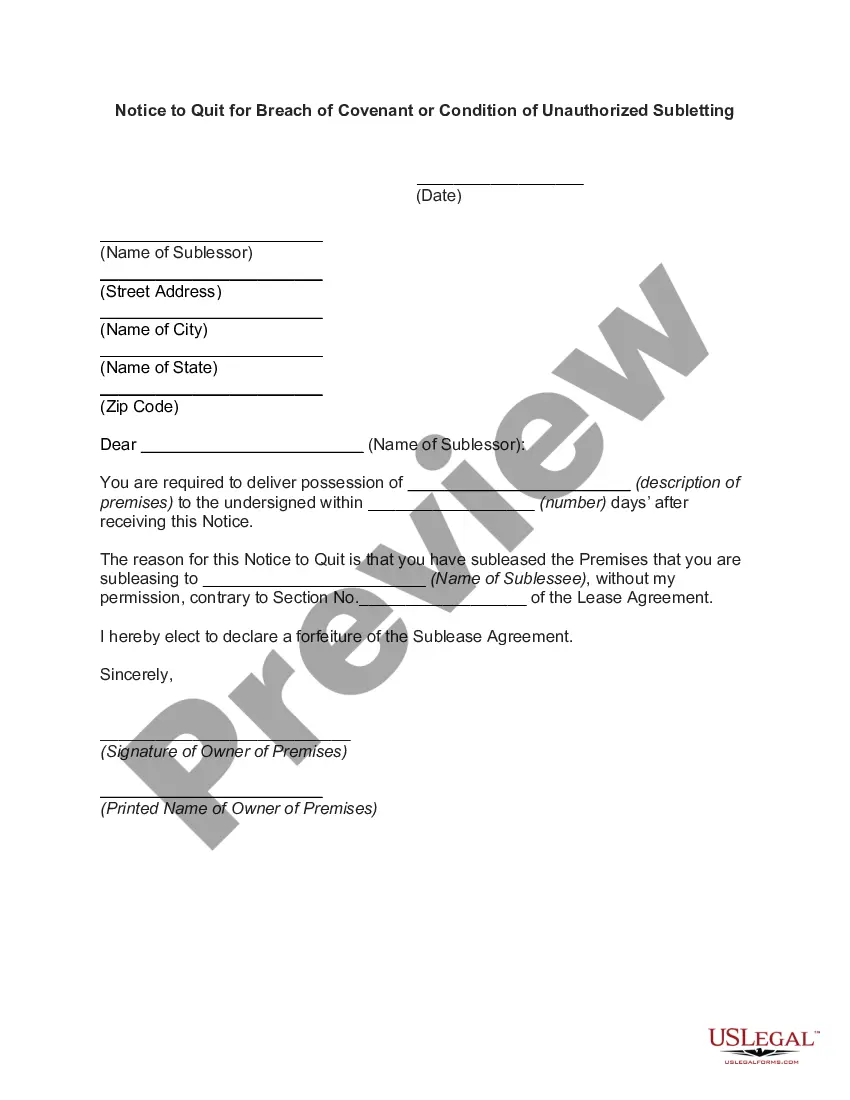
Virginia Notice to Quit for Breach of Covenant or Condition of Unauthorized Subletting
Description
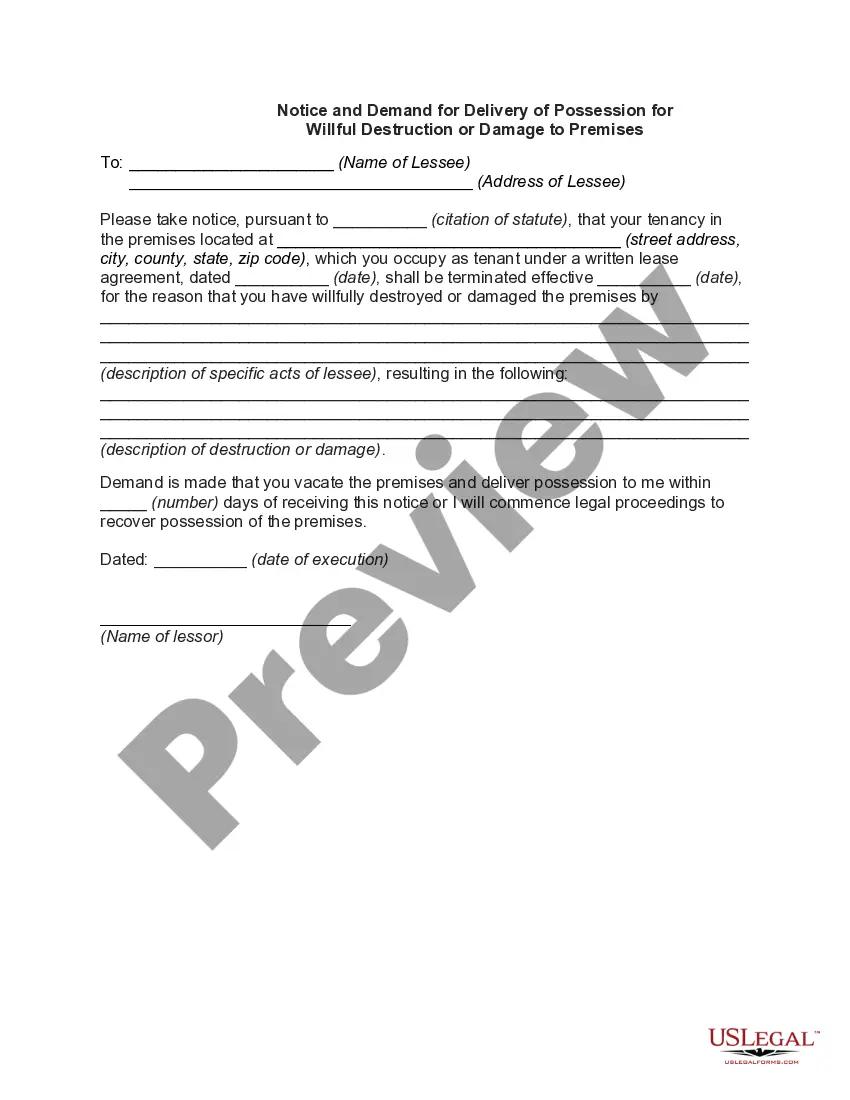
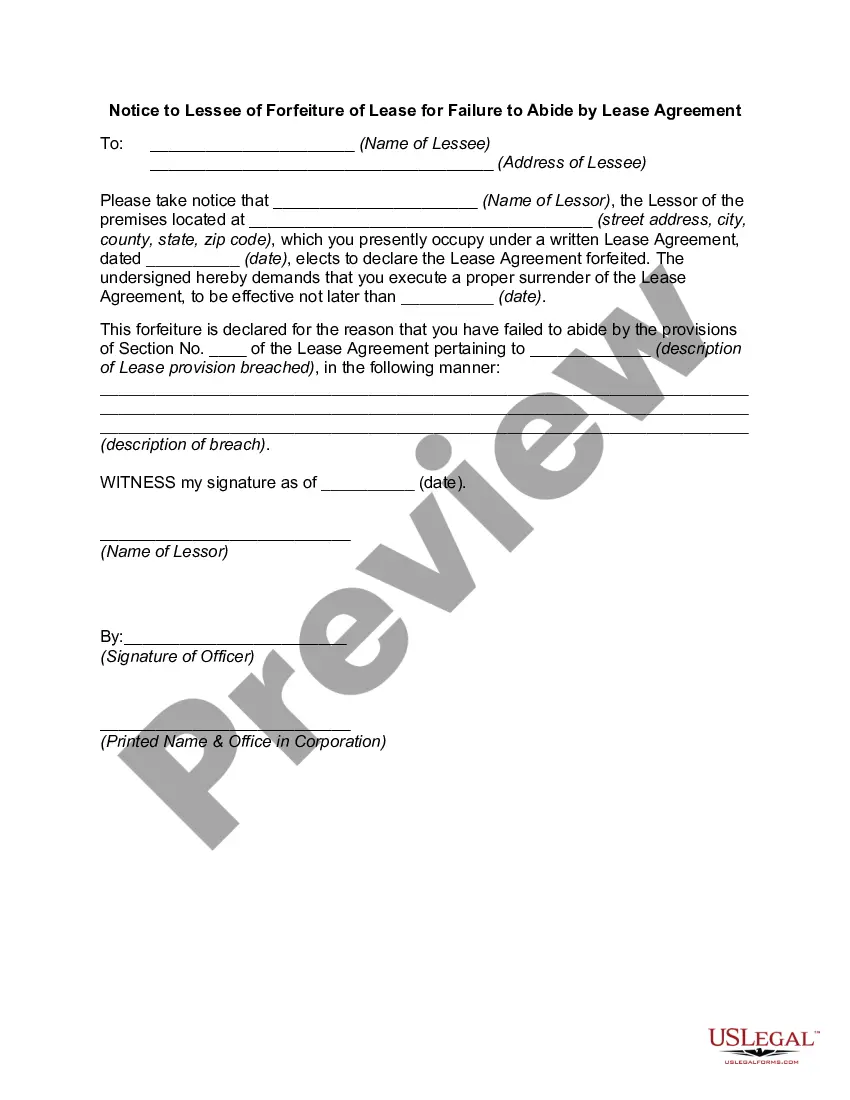

How to fill out Notice To Quit For Breach Of Covenant Or Condition Of Unauthorized Subletting?
If you need to be thorough, download, or create valid document templates, utilize US Legal Forms, the largest selection of legal forms available online.
Take advantage of the site’s user-friendly and convenient search to acquire the documents you require.
Various templates for business and personal purposes are categorized by types and states, or keywords.
Step 4. Once you have located the form you need, select the Buy now option. Choose the pricing plan you prefer and enter your details to register for an account.
Step 5. Complete the transaction. You can use your credit card or PayPal account to finalize the purchase.
- Use US Legal Forms to acquire the Virginia Notice to Quit for Breach of Covenant or Condition of Unauthorized Subletting in just a few clicks.
- If you are already a US Legal Forms customer, Log In to your account and click the Download option to receive the Virginia Notice to Quit for Breach of Covenant or Condition of Unauthorized Subletting.
- You can also find forms you previously obtained in the My documents tab of your account.
- If you are using US Legal Forms for the first time, follow the steps below.
- Step 1. Ensure you have selected the form for the correct city/state.
- Step 2. Utilize the Review option to examine the form’s content. Remember to read through the description.
- Step 3. If you are not satisfied with the form, make use of the Search area at the top of the screen to find other versions of the legal form template.
Form popularity
FAQ
IMPORTANT TIP: Under Virginia law you are considered a tenant at sufferance if you do not have a lease or pay rent. This means that you can be evicted for any reason at all, at any time and no particular notice needs to be given to you.
In Virginia, landlords can evict tenants for a lease violation. The landlord must give tenants a 30-Day Notice to Comply, which provides them with 21 days to fix the issue. Should the tenant be unable to resolve the issue within 21 days, the tenant has the remaining 9 days to vacate the rental property.
To start the eviction, a sheriff will come and post a 72 hour eviction notice on the door of the property. When 72 hours is up, if the family member has not vacated voluntarily, the Sheriff will arrive and conduct the eviction. So if a guest, friend, relative, or family member is refusing to leave, don't despair.
If a tenant breaches a tenancy agreement it is possible that their landlord will try and evict them from the property. The sort of breaches of tenancy which result in a landlord seeking a court order for possession include: Anti-social behaviour (eg noise, graffiti, abusive behaviour)
For the landlord to forfeit, the lease must first contain a forfeiture clause. This allows the landlord to terminate the tenancy upon the tenant failing to pay the rent (usually after a period of grace of between 14-28 days) or in the event of any other specified breach of covenant.
A tenant has the right to quiet enjoyment of the property without interference by the landlord. This is called the covenant of quiet enjoyment. It exists in every lease.
Possession and breach of covenant claims are breaches by the tenant (usually) or the landlord of their obligations contained in the lease. Tenants' breaches commonly include; failure to pay the rent, sub-letting without permission, carrying out unauthorised alterations, failure to repair or becoming insolvent.
NOTE: Under Virginia law, if you do not have a lease, and you do not pay rent, you are considered a tenant at sufferance. This means you can be evicted for any reason at all, at any time, and no notice needs to be given to you. Under this circumstance you can go from tenant to trespasser very quickly.
In the past, a landlord may have waived their right to forfeiture if a tenant breached a covenant because that tenant was a 'good payer'. Now this tenant may be not meeting their rent obligations and continuing to breach covenants.
In the covenant of quiet enjoyment, the landlord promises that during the term of the tenancy no one will disturb the tenant in the tenant's use and enjoyment of the premises.