Virginia Newly Divorced Individuals Package
What this form package covers
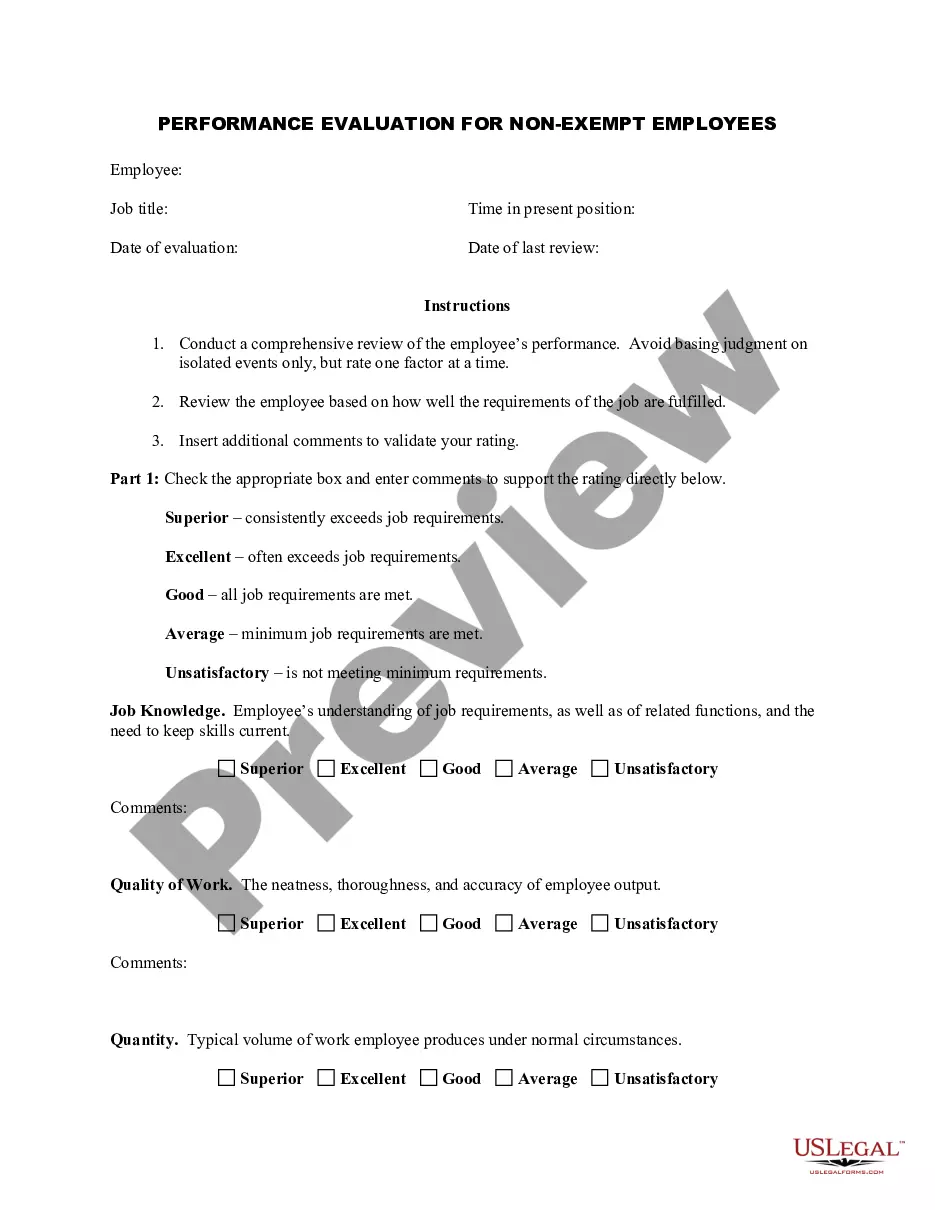
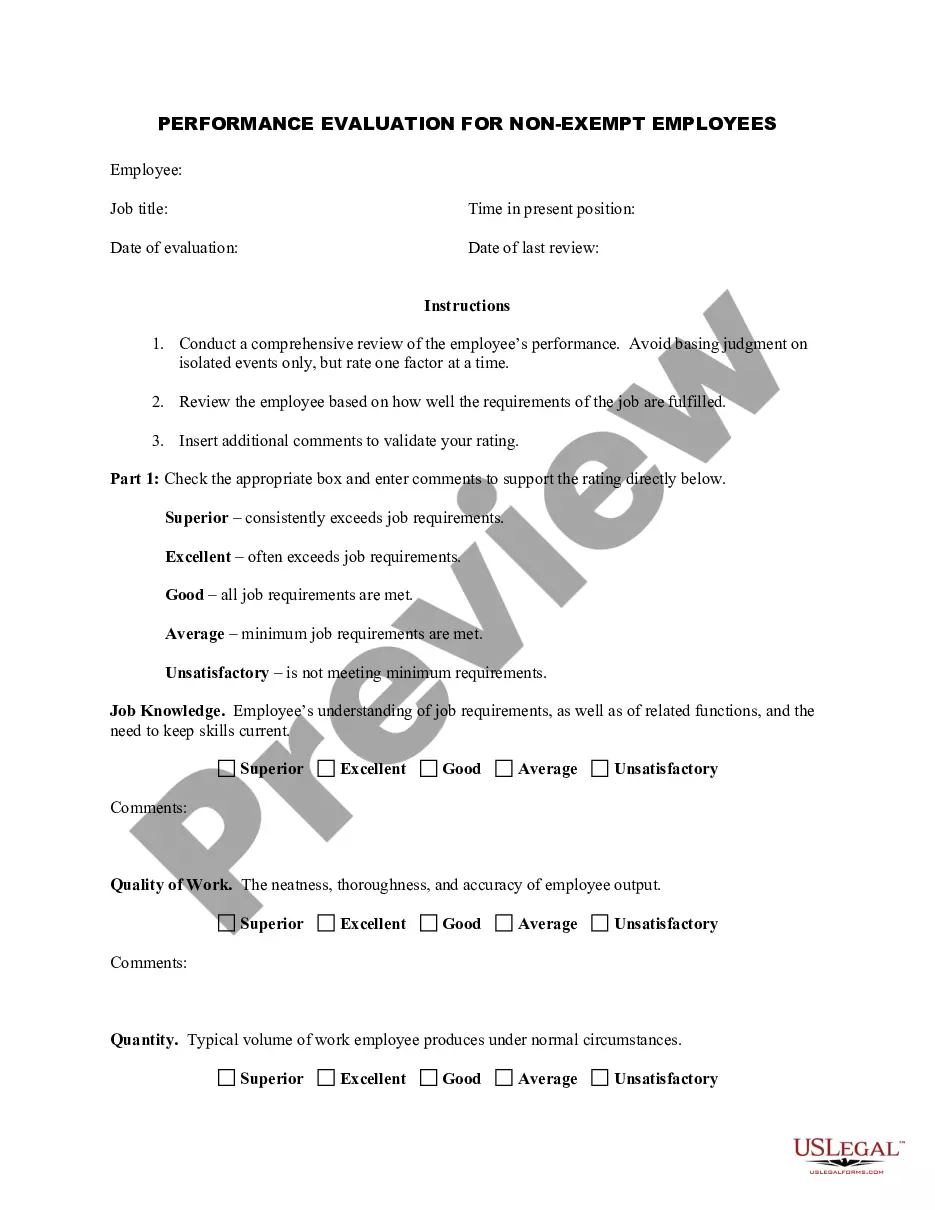
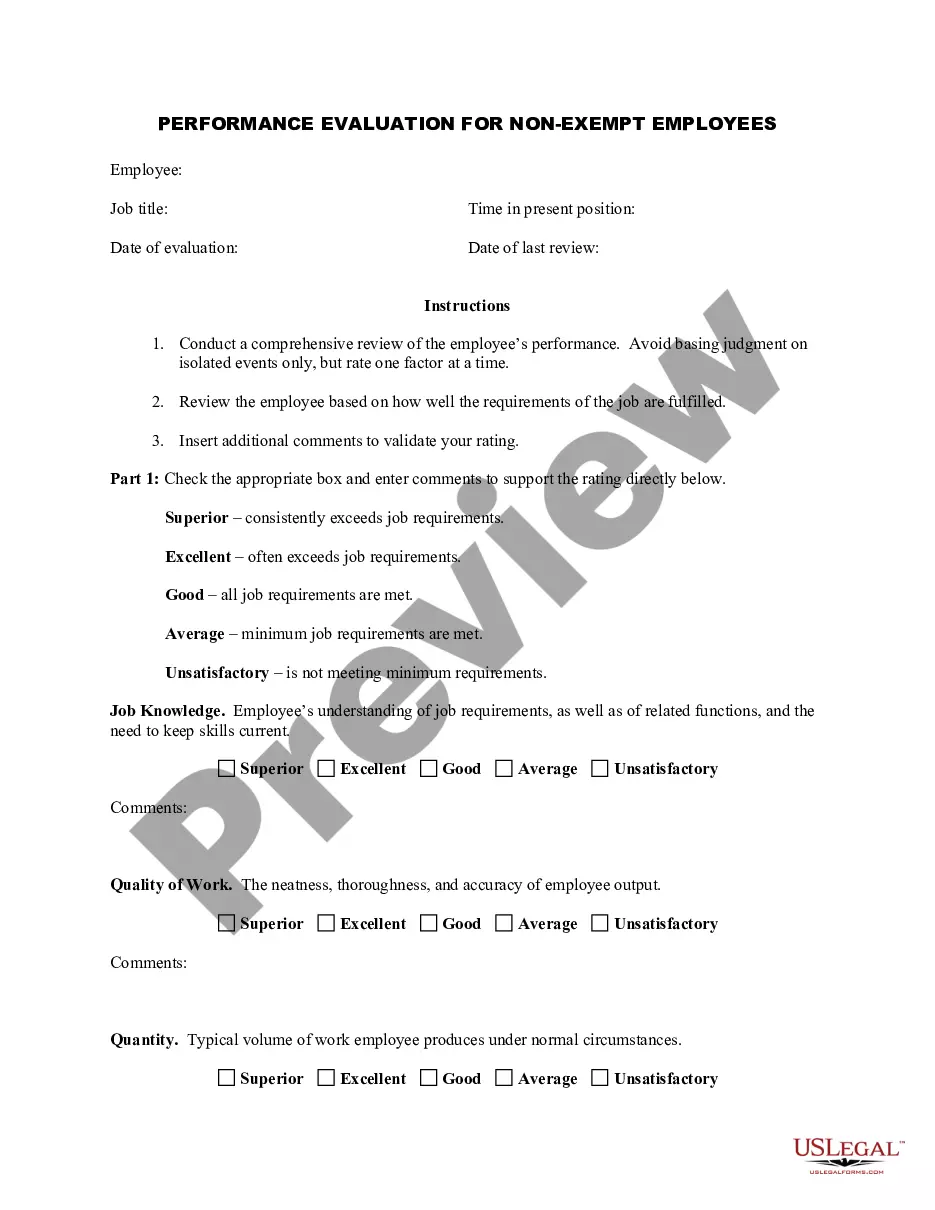
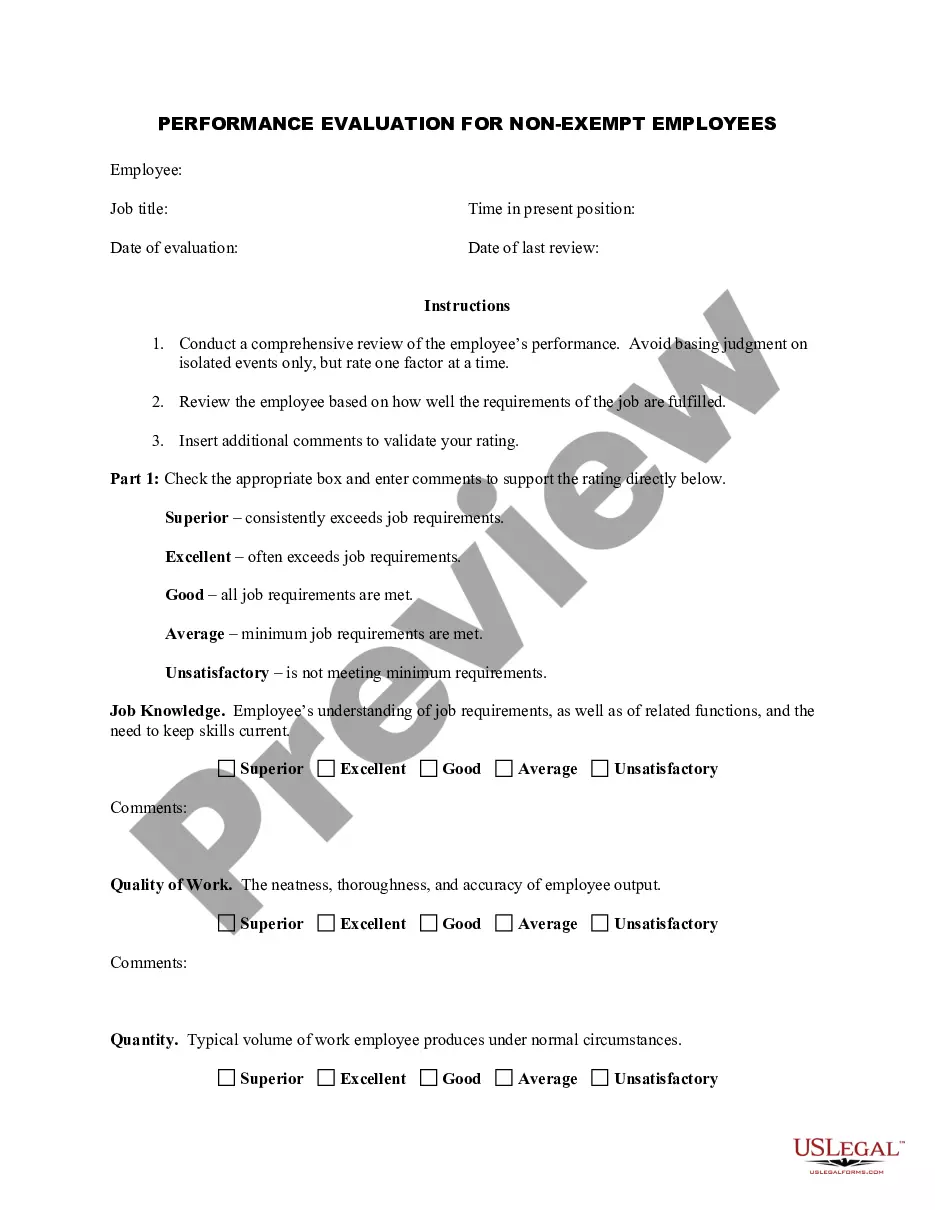
The Virginia Newly Divorced Individuals Package contains essential legal documents specifically designed for individuals who have recently gone through a divorce. This package helps you take control of your legal affairs and provides the necessary forms to manage your rights and responsibilities effectively. Unlike generic legal packages, the documents in this set are tailored to comply with Virginia state laws, ensuring they meet your specific needs.
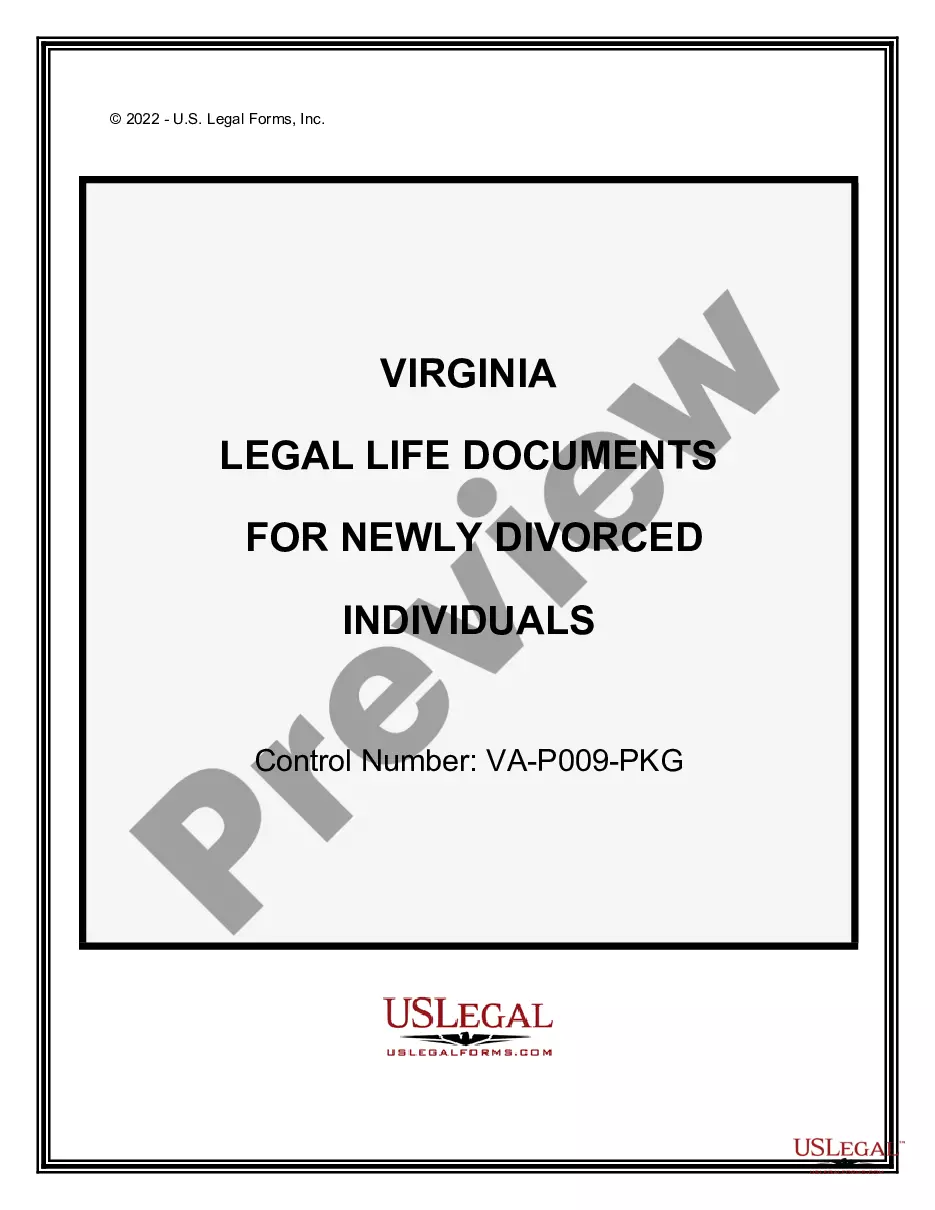
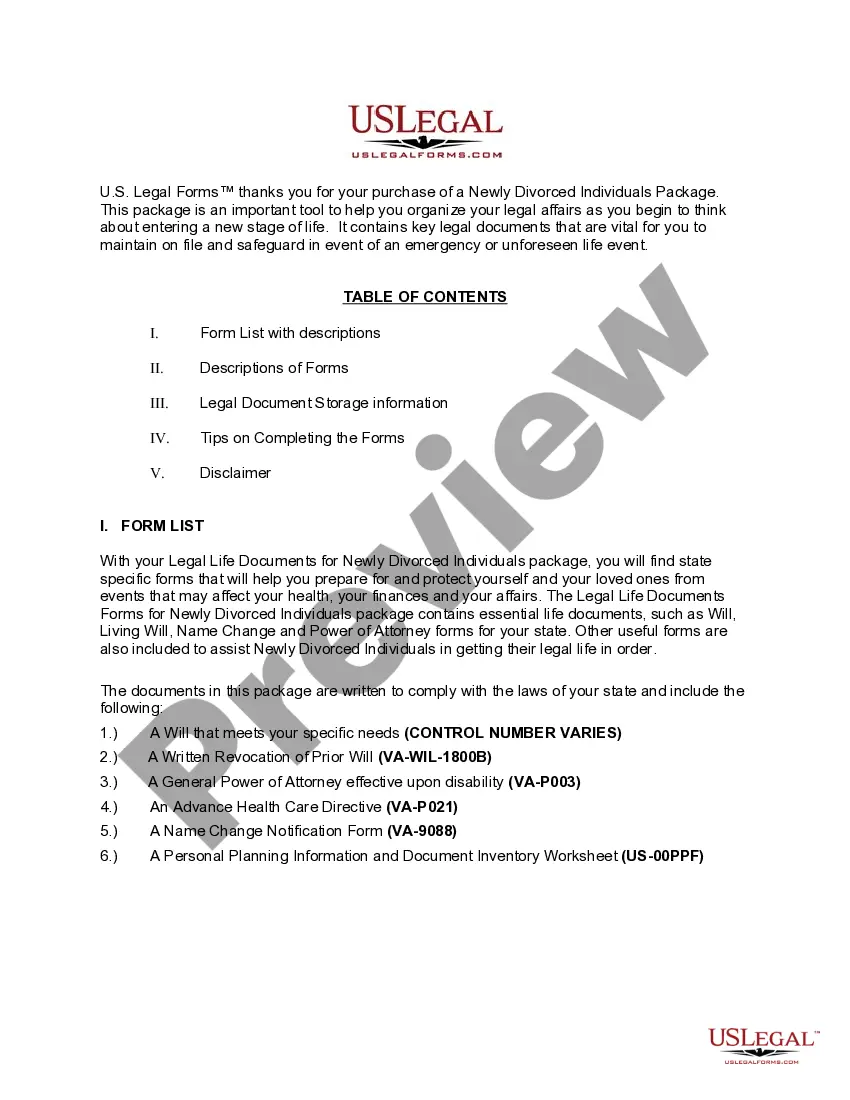
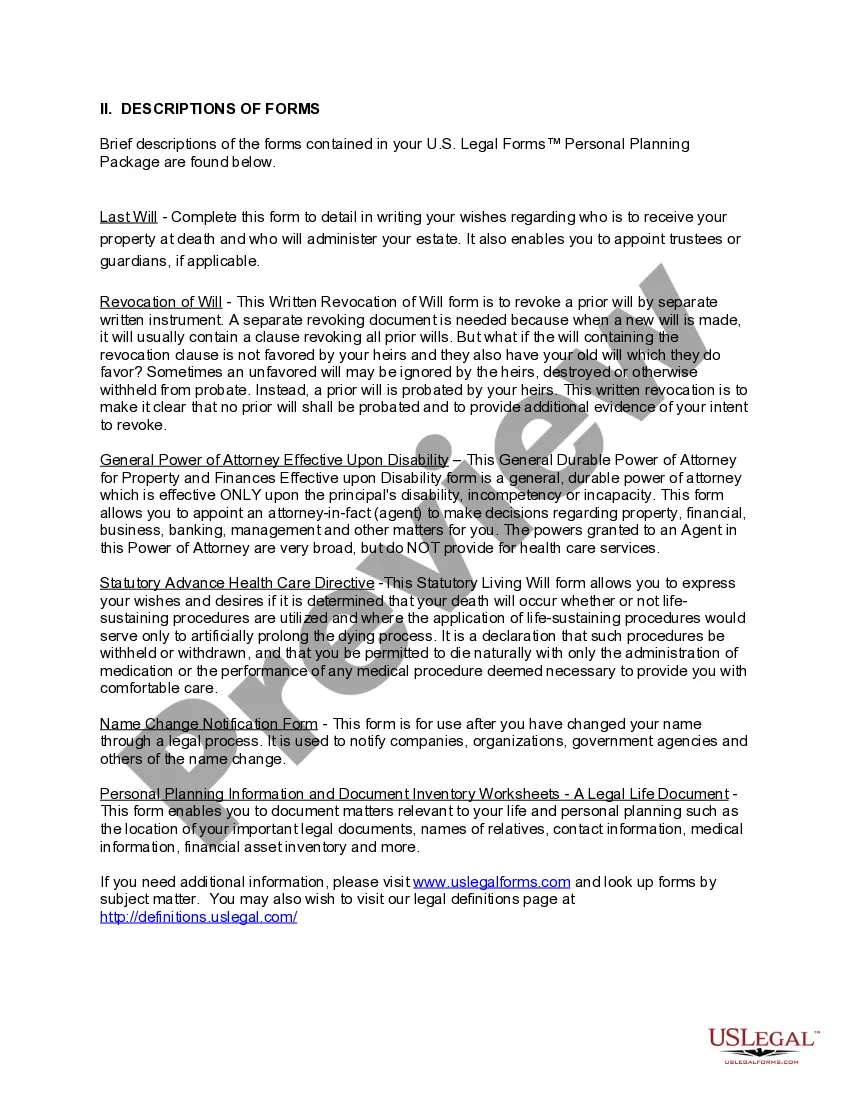
Forms provided in this package
- Last Will and Testament
- Name Change Notification Form
- General Durable Power of Attorney for Property and Finances or Financial Effective upon Disability
- Health Care Directive - Advance Medical Directive - includes Living Will and Health Care Decisions
- Written Revocation of Will
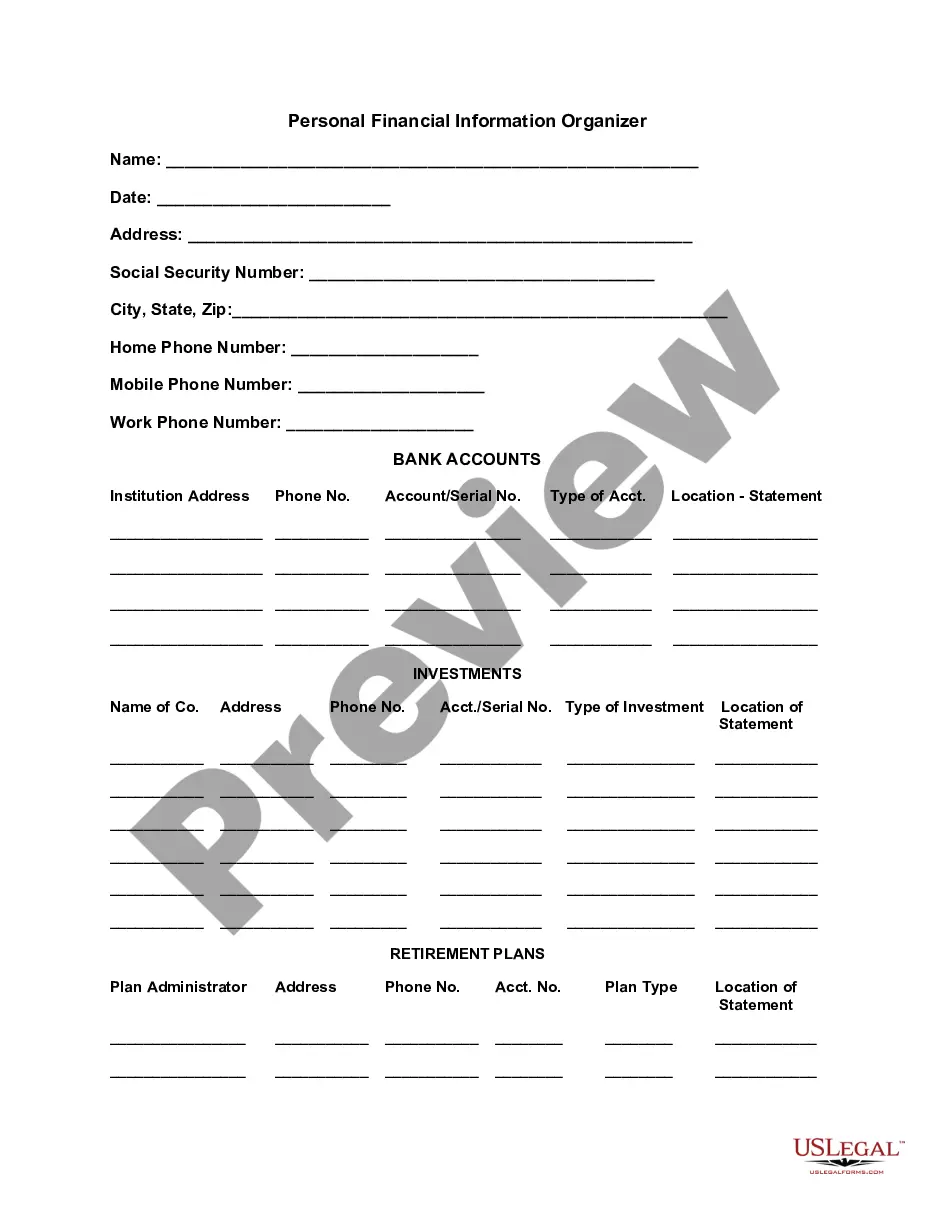
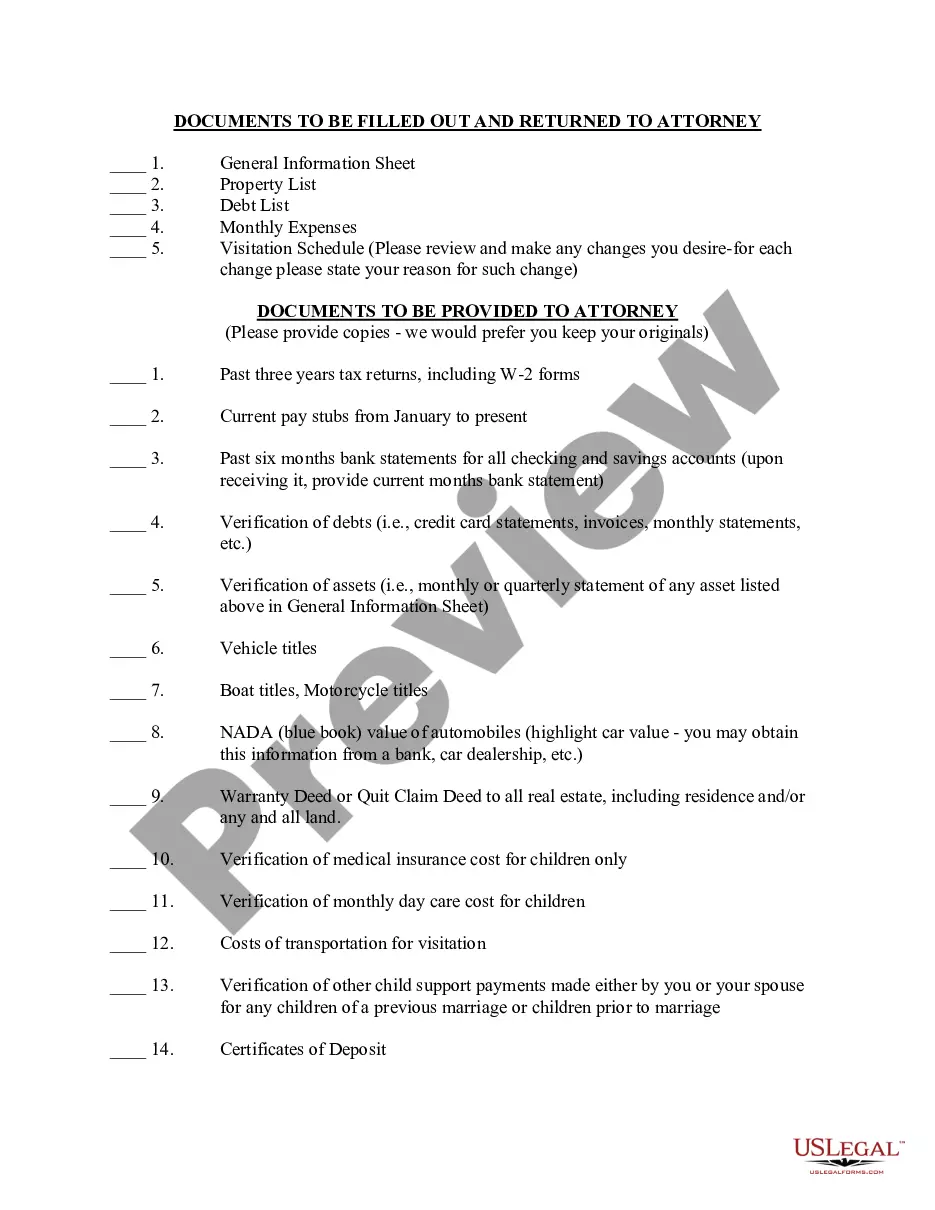
- Personal Planning Information and Document Inventory Worksheets - A Legal Life Document


When to use this form package
This form package is relevant in various scenarios, including:
- After obtaining a divorce and needing to update your will and other legal documents.
- When you want to revoke a prior will to reflect your current wishes.
- If you require health care directives in the event of disability.
- When planning to change your name post-divorce.
Who can use this document
- Individuals who have recently finalized their divorce.
- Those seeking to reorganize their legal documentation and estate planning.
- Anyone wishing to ensure that their health care and financial decisions are clearly defined and legally recognized.
Completing these forms step by step
- Review the included forms to understand each document's purpose and requirements.
- Gather necessary personal information, including details of assets and any medical directives.
- Fill out the forms using a computer or by hand, ensuring all information is accurate.
- Sign the forms in the presence of a witness or notary if required.
- Store the completed documents securely and inform a trusted individual of their location.
Do documents in this package require notarization?
Some forms in this package require notarization to be legally valid. US Legal Forms provides secure online notarization powered by Notarize, allowing you to complete the process through a verified video call, available 24/7.
Get your form ready online
Our built-in tools help you complete, sign, share, and store your documents in one place.
Make edits, fill in missing information, and update formatting in US Legal Forms—just like you would in MS Word.
Download a copy, print it, send it by email, or mail it via USPS—whatever works best for your next step.
Sign and collect signatures with our SignNow integration. Send to multiple recipients, set reminders, and more. Go Premium to unlock E-Sign.
If this form requires notarization, complete it online through a secure video call—no need to meet a notary in person or wait for an appointment.
We protect your documents and personal data by following strict security and privacy standards.

Make edits, fill in missing information, and update formatting in US Legal Forms—just like you would in MS Word.

Download a copy, print it, send it by email, or mail it via USPS—whatever works best for your next step.

Sign and collect signatures with our SignNow integration. Send to multiple recipients, set reminders, and more. Go Premium to unlock E-Sign.

If this form requires notarization, complete it online through a secure video call—no need to meet a notary in person or wait for an appointment.

We protect your documents and personal data by following strict security and privacy standards.
Avoid these common issues
- Failing to update beneficiary information in your will after a divorce.
- Not signing the documents as required, which may render them invalid.
- Overlooking the requirement for witnesses or notarization on specific forms.
- Not keeping copies of completed documents in a safe location.
Benefits of completing this package online
- Convenience of downloading and completing documents at your own pace.
- Access to legal forms drafted by licensed attorneys to ensure compliance.
- Editability of forms to easily update your information as needed.
- Immediate availability, allowing you to manage your legal documents quickly following your divorce.
Looking for another form?

Form popularity
FAQ
In a divorce, the distribution of property depends on which property belongs to the marriagemarital propertyand which property belongs to each of the two spousesseparate property. Generally, marital property is property either spouse acquired or earned during the marriage. (Va.
The state of Virginia uses the equitable distribution system to divide marital assets in a divorce.Equitable distribution is not necessarily the same as a 50/50 distribution. It means dividing assets in a way that accounts for each party's earning ability, separate assets, and role in the marriage.
Virginia divorce laws allow any spouse to request spousal support from the other to prevent financial hardship. The court will determine whether alimony is just by considering the needs and economic conditions of both parties involved.
Family law attorneys are frequently asked if there is an advantage to filing first. Whether it is for divorce, support or child custody, the answer is both yes, there is an advantage, and no, there is no advantage to filing your complaint first.
At divorce, community property is generally divided equally between the spouses, while each spouse keeps his or her separate property. Equitable distribution. In all other states, assets and earnings accumulated during marriage are divided equitably (fairly), but not necessarily equally.
Petitioners must pay a fee upon filing the initial paperwork for a divorce. In California, the first paper fee is $435. Petitioners will pay this fee when they file, and respondents will pay the same fee when they file the response.
Effective July 1, 2020, the pendente lite spousal support guidelines in Virginia are: Cases With Minor Children: 26% x Payor's Income 58% x Payee's Income. Cases With No Minor Children: 27% x Payor's Income 50% x Payee's Income.
One of the main legal advantages that a person gains by filing the divorce petition before his or her spouse does is that the filer can request a Standing Order from the court when filing the petition.If the matter should go to a hearing, the person who files the petition usually presents his or her case first.