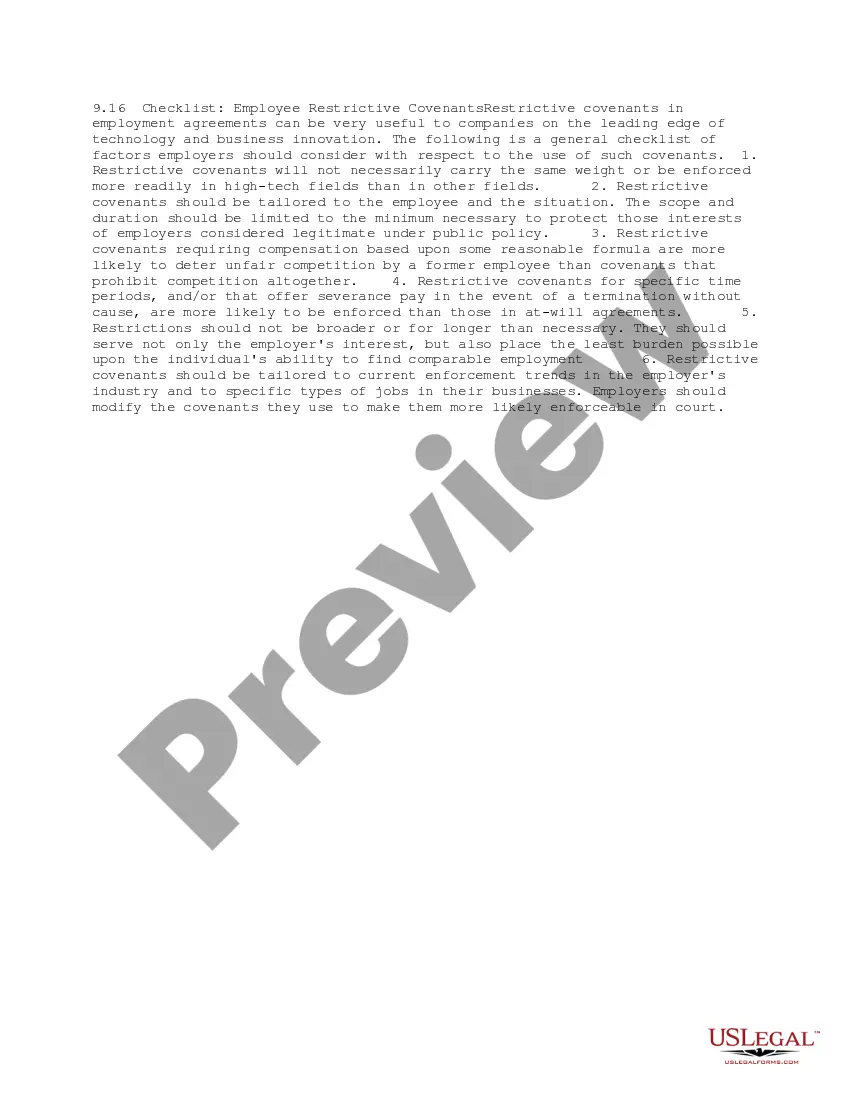
Employee Restrictive Covenants
Understanding this form
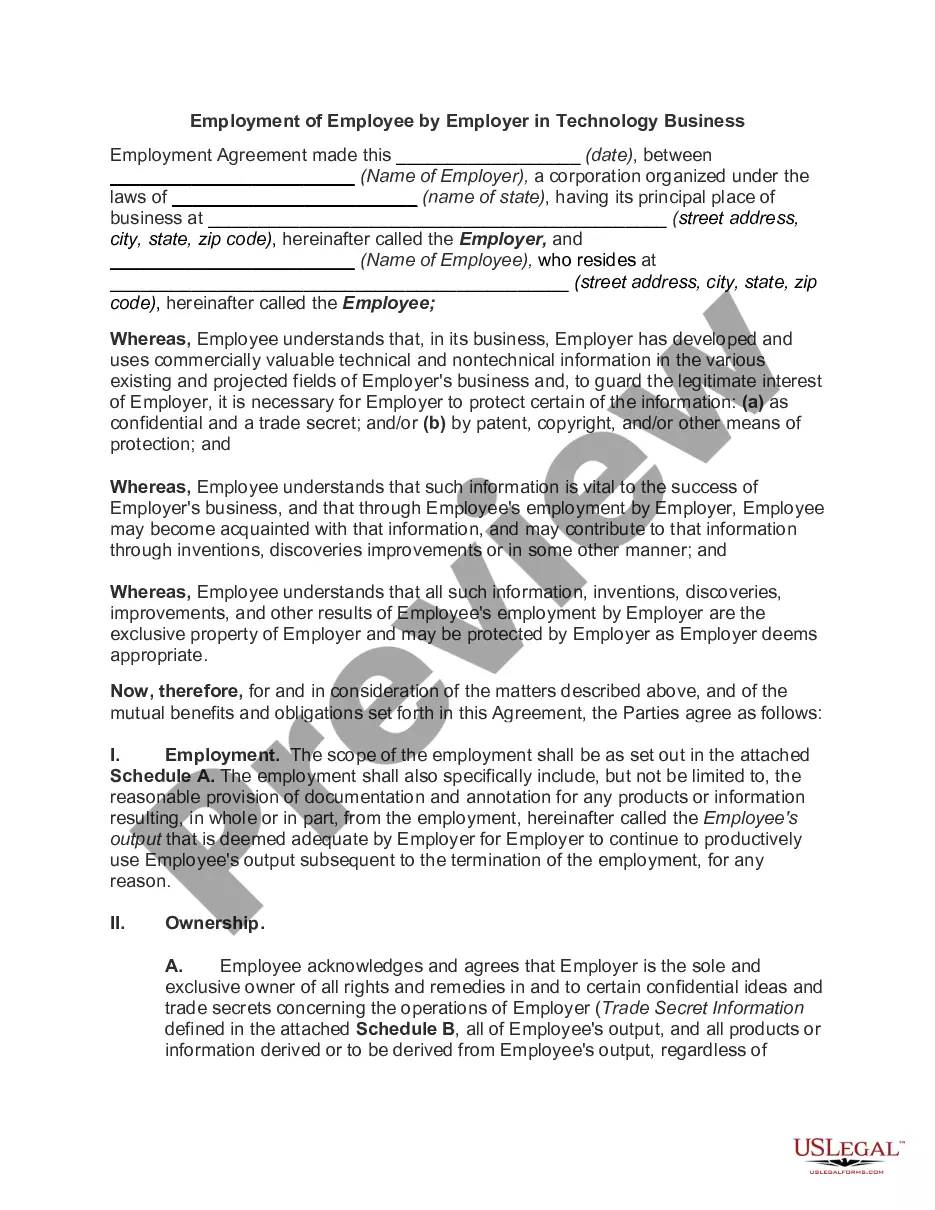
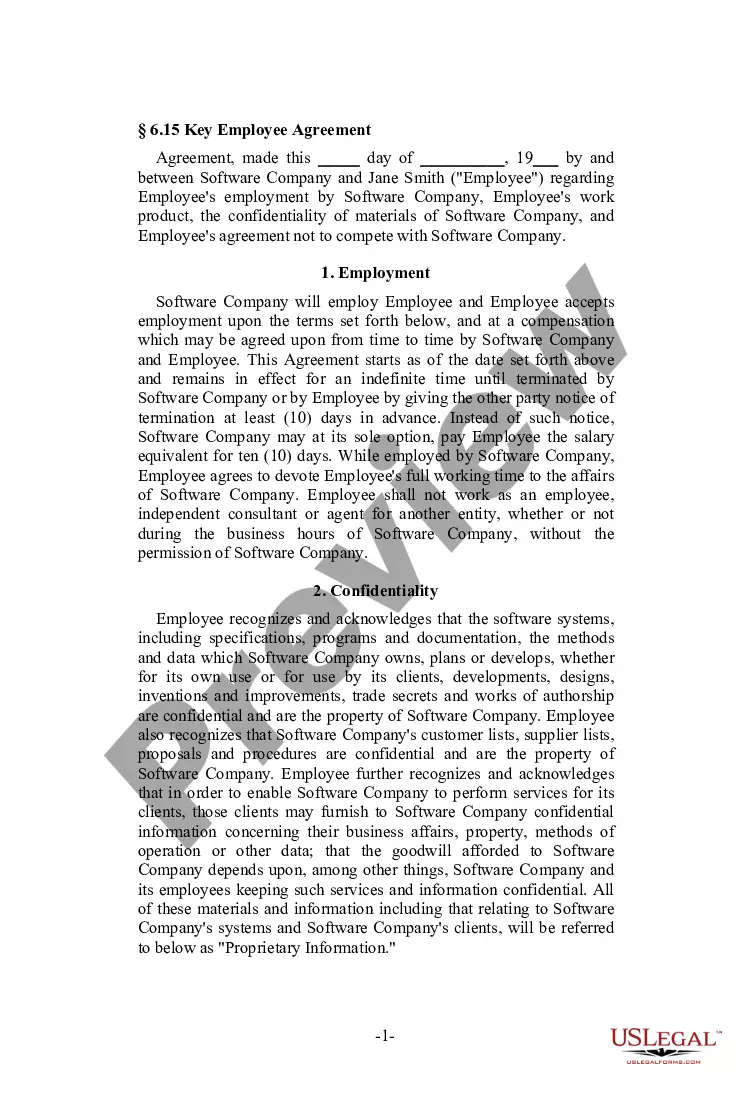
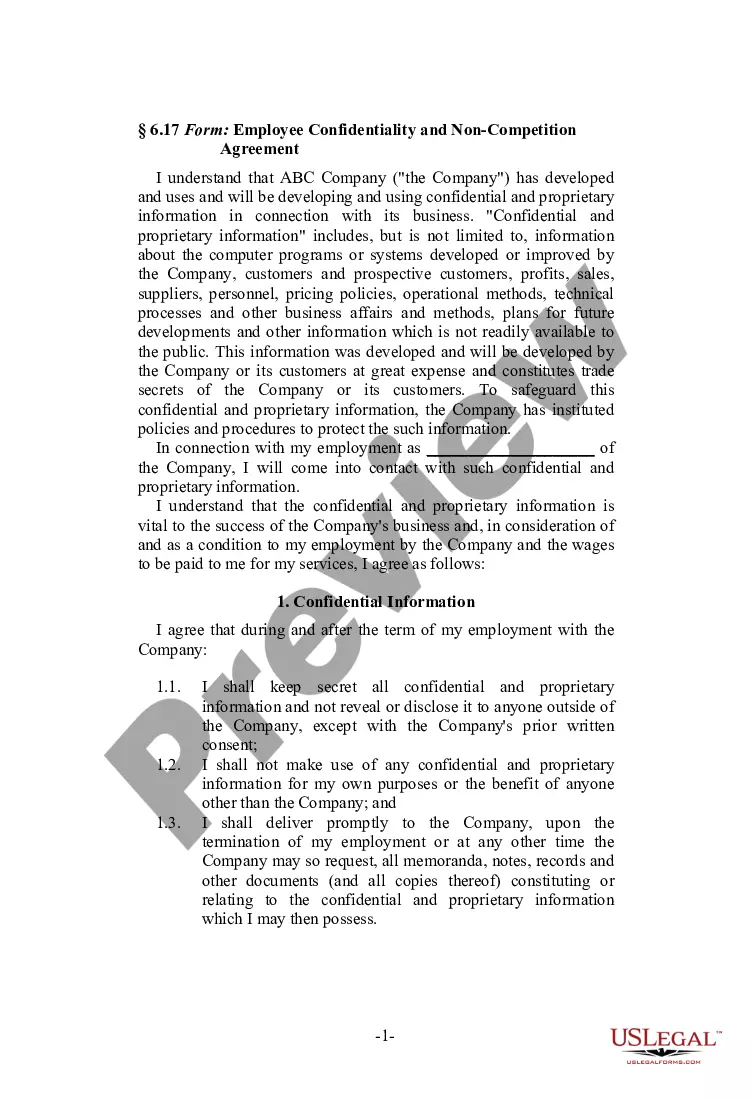
The Employee Restrictive Covenants form is a legal document that outlines specific agreements between employers and employees regarding certain restrictions on the employee's future activities. This form helps ensure that businesses, especially those in innovative fields, protect their interests by preventing unfair competition while balancing the employee's right to seek employment opportunities. Unlike other employment agreements, this form specifically focuses on enforceable clauses that limit an employee's ability to work for competitors or start similar ventures after leaving the company.
Main sections of this form
- Definitions of restrictive covenants applicable to the employment relationship.
- Specific terms regarding the scope and duration of the restrictions.
- Considerations for compensating the employee during the restriction period.
- Conditions under which the covenants may be enforced, including severance pay clauses.
- Customization options tailored to the employee's role and industry trends.
Common use cases
This form should be used when an employer wants to protect their business from potential competition by a former employee. You may find it necessary in situations such as hiring key personnel in a competitive industry, wanting to safeguard proprietary information, or setting clear boundaries for employees regarding post-employment competition. It is particularly relevant for businesses engaged in high-tech, research, or proprietary fields.
Who can use this document
- Employers looking to establish clear expectations with employees regarding post-employment activities.
- Business owners aiming to protect their proprietary interests and reduce the risk of unfair competition.
- Human resources professionals in companies that operate in competitive and innovative markets.
- Legal representatives advising businesses on effective employment agreements.
Steps to complete this form
- Identify and enter the parties to the agreement, including the employer and employee's full names.
- Specify the scope of the restrictive covenants relevant to the employee's position.
- Determine and document the duration of the restrictions, ensuring it is reasonable.
- Include compensation details if applicable, to reinforce the enforceability of the agreement.
- Review the covenants with legal counsel to ensure they align with current industry practices and legal standards.
Notarization requirements for this form
Notarization is generally not required for this form. However, certain states or situations might demand it. You can complete notarization online through US Legal Forms, powered by Notarize, using a verified video call available anytime.
Get your form ready online
Our built-in tools help you complete, sign, share, and store your documents in one place.
Make edits, fill in missing information, and update formatting in US Legal Forms—just like you would in MS Word.
Download a copy, print it, send it by email, or mail it via USPS—whatever works best for your next step.
Sign and collect signatures with our SignNow integration. Send to multiple recipients, set reminders, and more. Go Premium to unlock E-Sign.
If this form requires notarization, complete it online through a secure video call—no need to meet a notary in person or wait for an appointment.
We protect your documents and personal data by following strict security and privacy standards.

Make edits, fill in missing information, and update formatting in US Legal Forms—just like you would in MS Word.

Download a copy, print it, send it by email, or mail it via USPS—whatever works best for your next step.

Sign and collect signatures with our SignNow integration. Send to multiple recipients, set reminders, and more. Go Premium to unlock E-Sign.

If this form requires notarization, complete it online through a secure video call—no need to meet a notary in person or wait for an appointment.

We protect your documents and personal data by following strict security and privacy standards.
Avoid these common issues
- Using overly broad restrictions that may not be enforceable in court.
- Failing to provide adequate compensation during the restriction period.
- Neglecting to tailor the covenants to the specific role and industry.
- Omitting to seek legal advice to ensure compliance with local laws.
Benefits of using this form online
- Convenient access to a legally sound document tailored for your needs.
- Editability allows you to customize the form easily.
- Reliable templates drafted by licensed attorneys to enhance legal security.
- Quick download and easy implementation into your employment processes.
Legal use & context
- Employee restrictive covenants must comply with state laws regarding enforceability.
- Restrictions should be designed to be reasonable and necessary to protect legitimate business interests.
- Covenants that are too broad may be deemed unenforceable by courts, so careful drafting is essential.
Summary of main points
- Employee Restrictive Covenants are crucial for protecting business interests.
- Each covenant should be tailored to the specific employee and situation.
- Consult legal experts to ensure compliance with state-specific requirements.
Looking for another form?

Form popularity
FAQ
What happens if I breach a restrictive covenant? If you own a property and unknowingly (or otherwise) breach a restrictive covenant then you could be forced to undo any offending work (such as having to pull down an extension), pay a fee (often running into thousands of pounds) or even face legal action.
Certain restrictive covenants will be enforceable, if you are able to prove that they are: reasonable. necessary to protect legitimate business interests; and. of a duration no longer than is necessary to protect those interests.
Restrictive covenants can be utilised in employment contracts; however it is vital that any employer looking to protect their business by these measures ensure such restrictions are reasonable in order for them to be enforceable through the Courts.
Limitations On Home Color. Rent And Lease Restrictions. Restrictions On Business Usage. Limitations On Permissible Pets. Requirements For Exterior Maintenance. Restrictions On Exterior Constructions.
The covenant must be negative (restrictive). There must be a benefited and a burdened land and the two must be reasonably close together close enough for the benefited land to be genuinely adversely affected by a breach. The covenant must actually benefit the benefiting land.
If there is a restrictive covenant on your property you may be able to remove it. The first step would be to negotiate with the original developer or landowner to enter into a formal agreement to remove the covenants from the title.
Certain restrictive covenants will be enforceable, if you are able to prove that they are: reasonable. necessary to protect legitimate business interests; and. of a duration no longer than is necessary to protect those interests.
In other words, you may be able to remove your restrictive covenant- but there are no guarantees.If you can agree to have the covenant removed, a 'Deed of Release of Restrictive Covenant' should be drawn up and signed by the dominant and servient owners.