Continuing Negotiations
Understanding this form
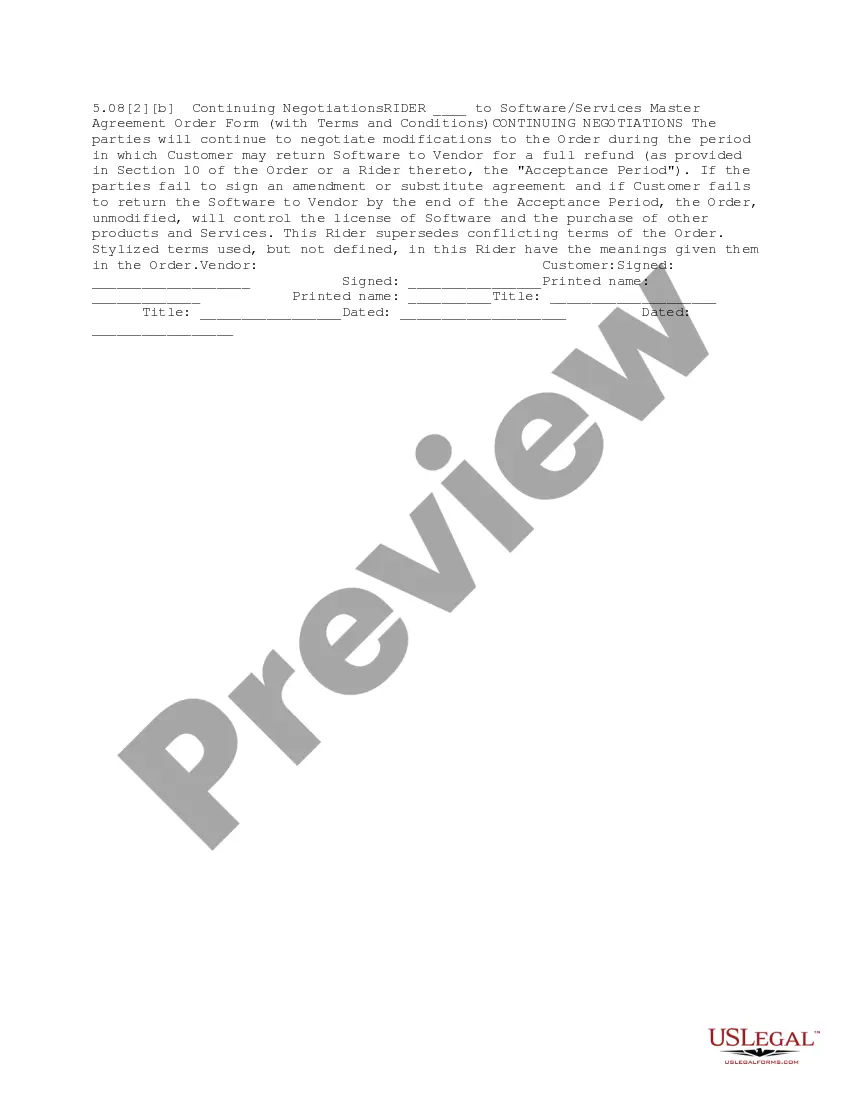
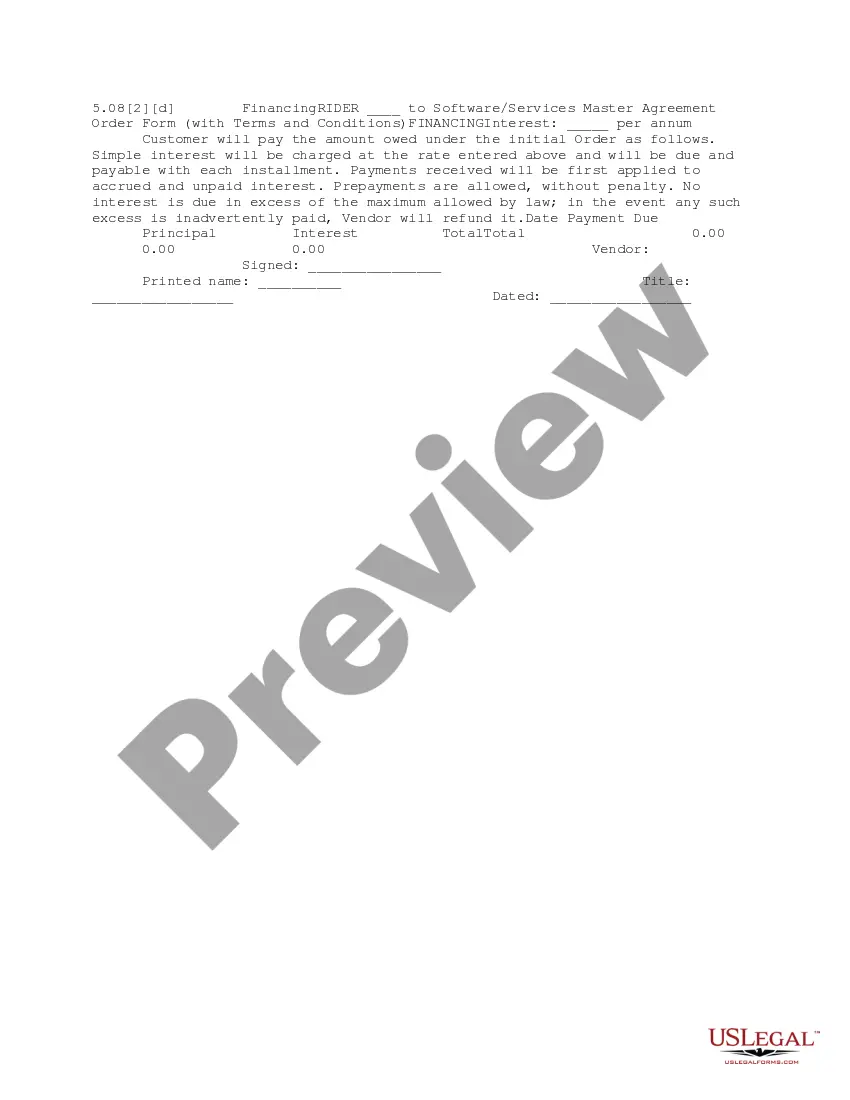
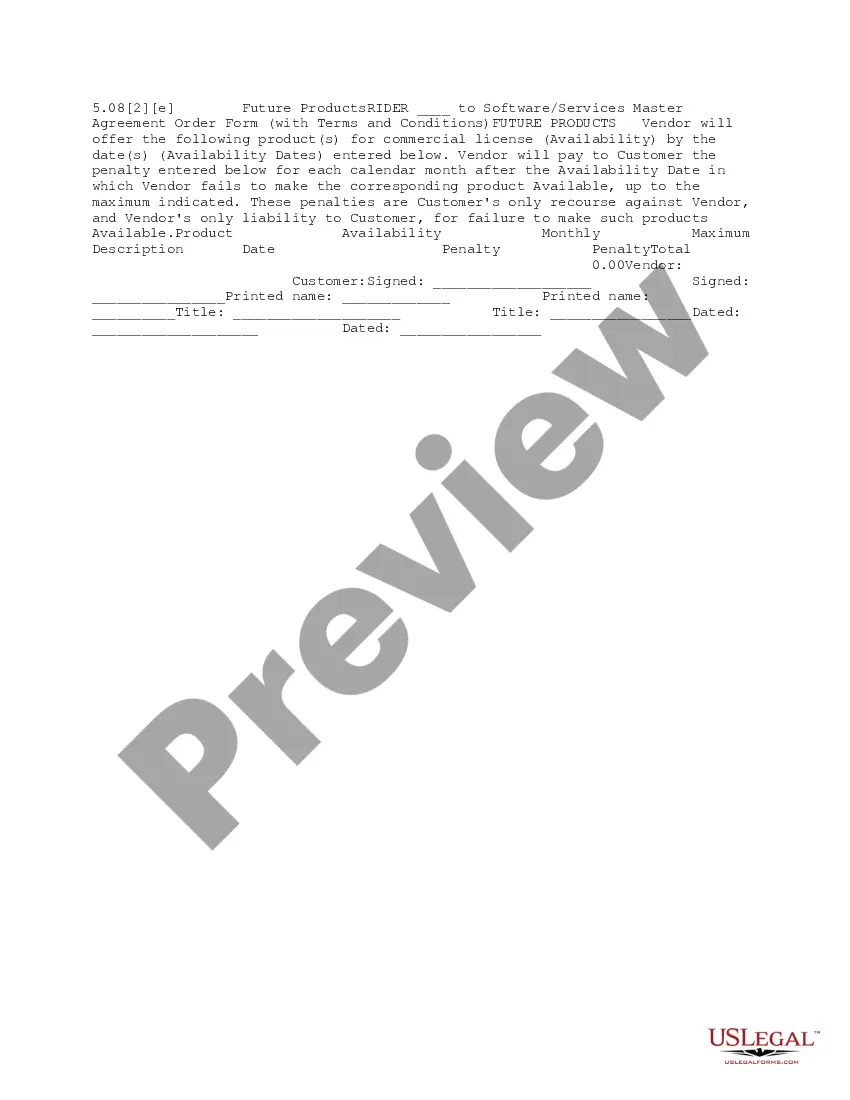
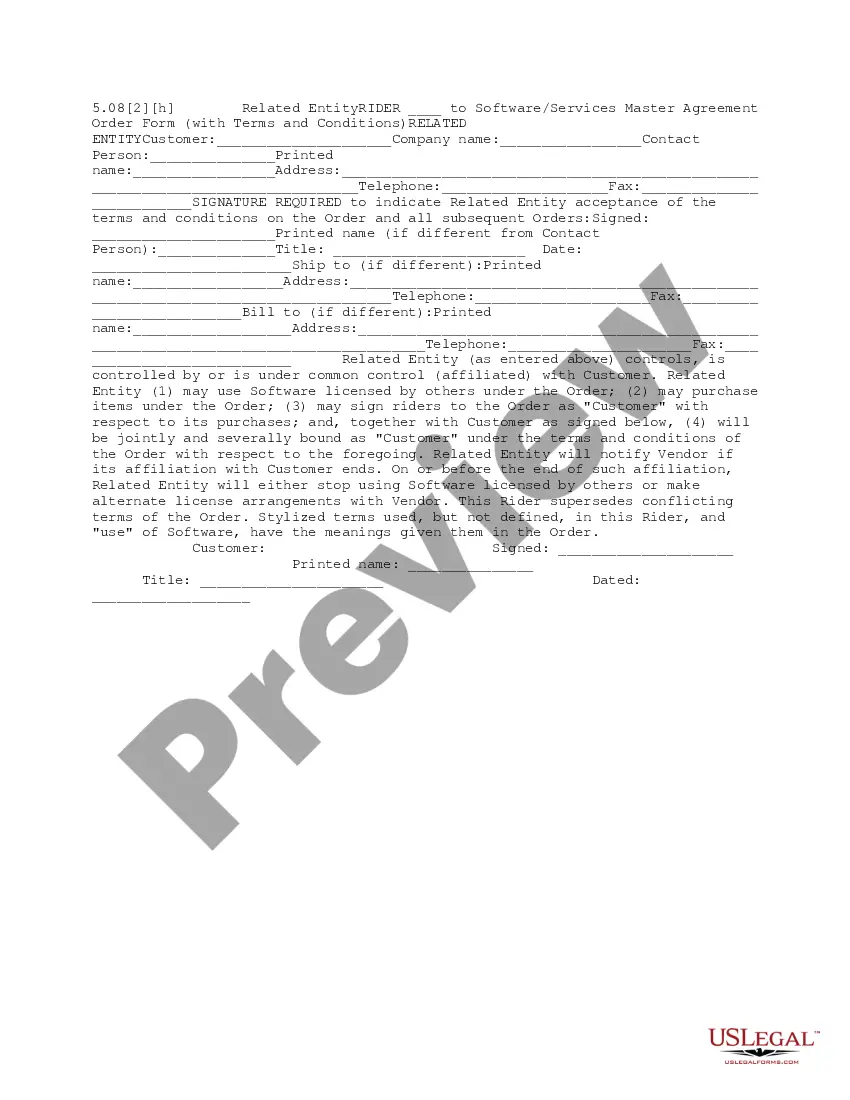
The Continuing Negotiations form is an addendum to a software or services master agreement order form. Its primary purpose is to allow parties to negotiate modifications to the order while the customer has the option to return the software for a full refund. This form clarifies the terms under which negotiations can continue and what happens if no agreement is reached before the return period ends, distinguishing it from standard agreements that do not incorporate negotiation clauses.
Key parts of this document
- Identification of parties involved in the agreement.
- Confirmation of the ongoing negotiation period.
- Reference to the Acceptance Period for software returns.
- Clause stating that the original order will control if no new agreement is reached.
- Section outlining how this rider supersedes conflicting terms in the original order.
- Signature fields for both vendor and customer representatives.
Situations where this form applies
This form should be used when both parties are in discussions regarding changes to a software or services order and need a formal agreement to continue negotiations. It is especially useful during the period when the customer may return the software for a full refund, ensuring that both parties understand their rights and obligations if negotiations do not lead to a final agreement.
Who needs this form
This form is suitable for:
- Businesses entering into software or service agreements with vendors.
- Customers who wish to maintain negotiation flexibility while evaluating the software.
- Legal representatives drafting or reviewing software agreements.
Steps to complete this form
- Identify and enter the names of the vendor and customer.
- Specify the effective dates for the continuing negotiations.
- Clearly outline the terms of the return period for the software.
- Fill in the signature fields, including printed names and titles.
- Record the date of signing to confirm the agreement's execution.
Is notarization required?
In most cases, this form does not require notarization. However, some jurisdictions or signing circumstances might. US Legal Forms offers online notarization powered by Notarize, accessible 24/7 for a quick, remote process.
Get your form ready online
Our built-in tools help you complete, sign, share, and store your documents in one place.
Make edits, fill in missing information, and update formatting in US Legal Forms—just like you would in MS Word.
Download a copy, print it, send it by email, or mail it via USPS—whatever works best for your next step.
Sign and collect signatures with our SignNow integration. Send to multiple recipients, set reminders, and more. Go Premium to unlock E-Sign.
If this form requires notarization, complete it online through a secure video call—no need to meet a notary in person or wait for an appointment.
We protect your documents and personal data by following strict security and privacy standards.

Make edits, fill in missing information, and update formatting in US Legal Forms—just like you would in MS Word.

Download a copy, print it, send it by email, or mail it via USPS—whatever works best for your next step.

Sign and collect signatures with our SignNow integration. Send to multiple recipients, set reminders, and more. Go Premium to unlock E-Sign.

If this form requires notarization, complete it online through a secure video call—no need to meet a notary in person or wait for an appointment.

We protect your documents and personal data by following strict security and privacy standards.
Typical mistakes to avoid
- Failing to specify the negotiation period or return period clearly.
- Not obtaining signatures from both parties.
- Overlooking to include the printed names and titles of signers.
- Assuming the form automatically cancels previous agreements without clear terms.
Advantages of online completion
- Immediate access to a professionally drafted legal document.
- Easy editing to customize the form to your specific needs.
- Secure storage options for your completed documents.
- Convenient downloading and printing directly from your device.
Legal use & context
- This form establishes a clear understanding between parties during negotiations, helping to prevent disputes.
- Confirms the rights of the customer to return the software for a refund.
- Helps ensure that any modifications to the initial agreement are documented and agreed upon in writing.
What to keep in mind
- The Continuing Negotiations form allows ongoing discussions on existing agreements while maintaining original terms.
- It's essential for parties to complete the form accurately to avoid misunderstandings.
- Understanding the acceptance period is crucial to exercising the right to return software.
Looking for another form?
Form popularity
FAQ
Preparation. Discussion. Clarification of goals. Negotiate towards a Win-Win outcome. Agreement. Implementation of a course of action.
Gather Background Information: Assess your arsenal of negotiation tactics and strategies: Create Your Negotiation Plan: Engage in the Negotiation Process: Closing the Negotiation: Conduct a Postmortem: Create Negotiation Archive:
Stage 1 Statement of Intent. Stage 2 Preparation for Negotiations. Stage 3 Negotiation of a Framework Agreement. Stage 4 Negotiation of an Agreement in Principle (AIP) Stage 5 Negotiation to Finalize a Treaty. Stage 6 Implementation of a Treaty.
There are five collaborative stages of the negotiation process: Prepare, Information Exchange, Bargain, Conclude, Execute. There is no shortcut to negotiation preparation. Building trust in negotiations is key. Communication skills are critical during bargaining.
Step 1: Work Out What You Want. First, you need to work out what it is that you are actually after. Step 2: Establish What You're Prepared to Give Up. Think about what concessions you are prepared to make. Step 3: Clarify Authority Limits. Step 4: Do Your Homework. Step 5: Decide On What Techniques to Use.
The first, and often the most important step toward successful negotiation is planning and preparation. According to Thompson (2009), about 80% of negotiators' efforts should go toward the preparation stage. However, planning and preparation go beyond what negotiators should do before negotiation.
Rule #1. Always tell the truth. Rule #2. Use Cash when making purchases. Rule #3. Use walk-away power. Don't get emotionally attached to the item. Rule #4. Shut up. Rule #5. Use the phrase: "That isn't good enough" Rule #6. Go to the authority. Rule #7. Use the "If I were to" technique. "
Be Prepared. Preparation is the first step to negotiating successfully. Your Goals. Consider Alternatives. Don't Sell Yourself Short. Take Your Time. Communication is Key. Listen Carefully. Explore Other Possibilities.
You gain power in negotiations when you have more alternatives at your disposal than your opponent does. You are at a tremendous disadvantage when you have no alternatives and absolutely need to make a deal with your opponent. The experts talk about your BATNA (Best Alternative to a Negotiating Agreement).