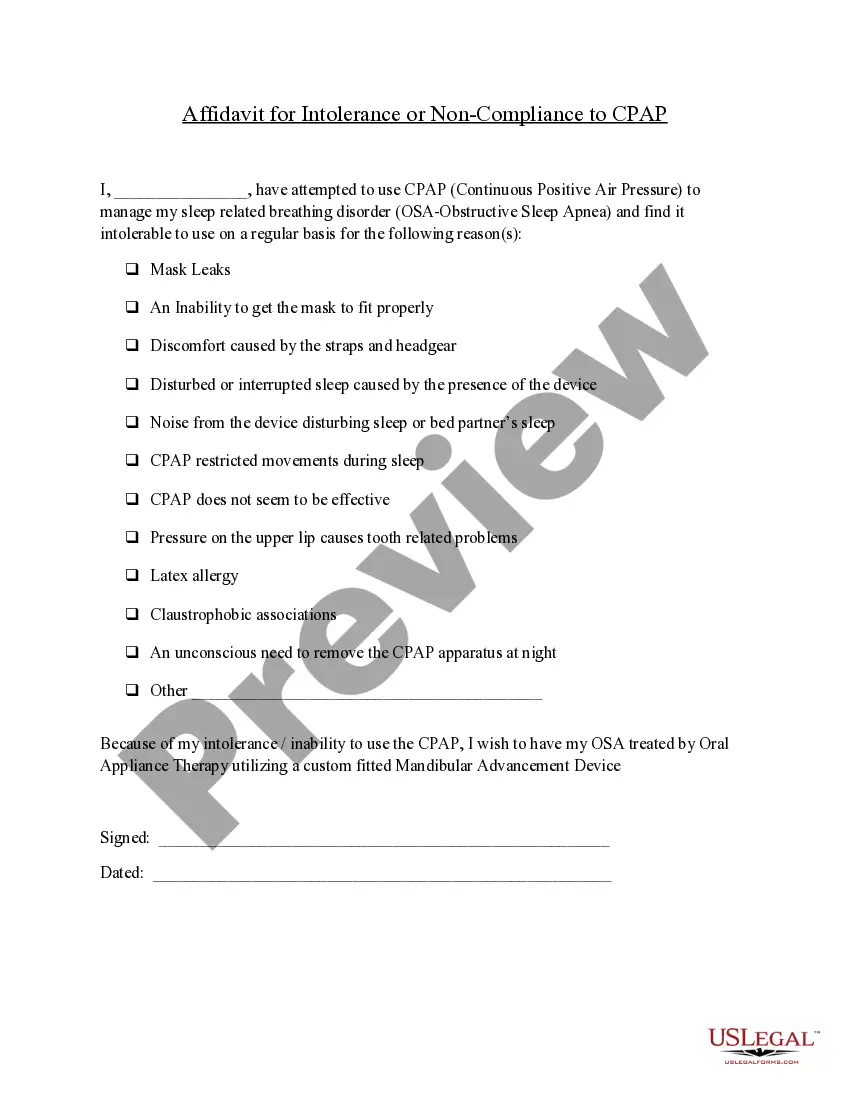
Affidavit for Intolerance or Non-Compliance to CPAP
About this form
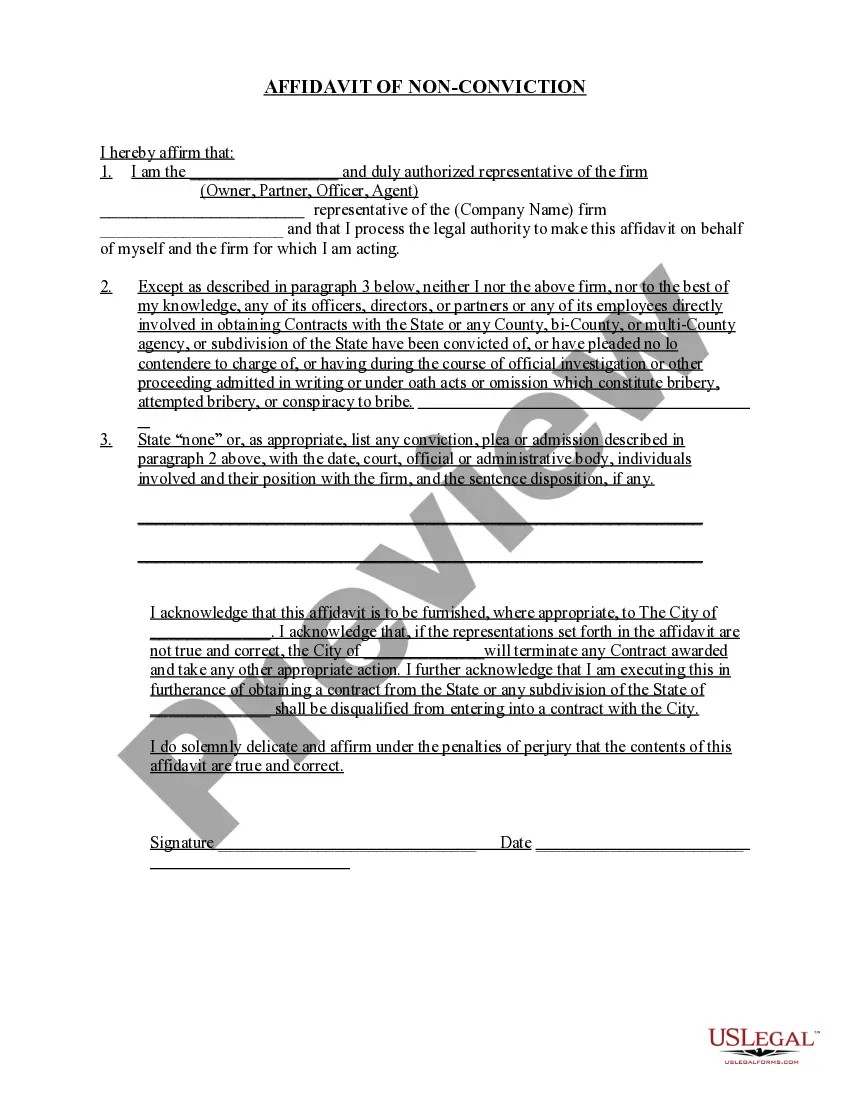
The Affidavit for Intolerance or Non-Compliance to CPAP is a legal document used by individuals who have been prescribed continuous positive airway pressure (CPAP) therapy for obstructive sleep apnea (OSA) but have found it intolerable. This form serves to formally state the reasons for the patient's inability to use CPAP and to express the wish to pursue alternative treatment options, such as Oral Appliance Therapy with a custom-fitted Mandibular Advancement Device. Unlike other medical affidavits, this form specifically addresses the challenges faced with CPAP therapy and the patient's intent to seek a different treatment methodology.
Key components of this form
- Identification: Name of the individual filing the affidavit.
- Declaration of Attempts: A personal statement regarding the attempts to use CPAP.
- List of Reasons: Specific reasons detailing intolerance or non-compliance with CPAP therapy.
- Request for Alternative Treatment: Statement expressing the desire for Oral Appliance Therapy.
- Signature and Date: A section for the individual's signature and the date of signing.
When to use this form
This form should be used when a patient has been prescribed CPAP therapy for sleep apnea but experiences significant discomfort or issues that prevent the consistent use of the device. It is particularly useful for individuals seeking an alternative treatment option, allowing them to document their difficulties and formally propose the use of a Mandibular Advancement Device instead.
Intended users of this form
- Patients diagnosed with obstructive sleep apnea (OSA) who have been prescribed CPAP therapy.
- Individuals experiencing discomfort or intolerance with CPAP devices.
- Patients looking for alternative treatment methods for OSA.
- Anyone needing to formally document their non-compliance with CPAP treatment.
How to complete this form
- Enter your full name at the beginning of the affidavit.
- Provide a detailed account of your experiences with CPAP therapy in the designated section.
- List all reasons for your intolerance or inability to use the CPAP properly.
- Clearly express your desire to switch to Oral Appliance Therapy in the relevant section.
- Sign and date the affidavit to finalize it.
Notarization guidance
This form does not typically require notarization unless specified by local law. However, it is advisable to check with your healthcare provider or legal advisor to ensure compliance with any specific requirements in your jurisdiction.
Get your form ready online
Our built-in tools help you complete, sign, share, and store your documents in one place.
Make edits, fill in missing information, and update formatting in US Legal Forms—just like you would in MS Word.
Download a copy, print it, send it by email, or mail it via USPS—whatever works best for your next step.
Sign and collect signatures with our SignNow integration. Send to multiple recipients, set reminders, and more. Go Premium to unlock E-Sign.
If this form requires notarization, complete it online through a secure video call—no need to meet a notary in person or wait for an appointment.
We protect your documents and personal data by following strict security and privacy standards.

Make edits, fill in missing information, and update formatting in US Legal Forms—just like you would in MS Word.

Download a copy, print it, send it by email, or mail it via USPS—whatever works best for your next step.

Sign and collect signatures with our SignNow integration. Send to multiple recipients, set reminders, and more. Go Premium to unlock E-Sign.

If this form requires notarization, complete it online through a secure video call—no need to meet a notary in person or wait for an appointment.

We protect your documents and personal data by following strict security and privacy standards.
Avoid these common issues
- Failing to provide a complete list of intolerance reasons.
- Not signing or dating the document.
- Using vague language instead of specific and clear descriptions of issues faced with CPAP.
Why complete this form online
- Convenient access to downloadable legal form templates.
- Editable form that allows you to customize content to reflect your specific situation.
- Reliable delivery of legal documents that can be utilized in various legal matters.
Looking for another form?



Form popularity
FAQ
CPAP compliance reports are used to measure how effective your CPAP is and note how many hours a night you sleep with your CPAP machine. By letting us look with you at your report, we can understand how effective the therapy is for you.
The number of nights with 4+ hours of usage divided by the total number of nights used will give you that percentage on your CPAP Report. For Instance: if you had 21 nights of 4+ hours usage out of a total of 30 nights, then your compliance percentage will be at 70%.
Medicare guidelines for CPAP Patients must have a face-to-face evaluation with a physician of their choice and obtain: Documentation of obstructive sleep apnea (OSA) symptoms through a baseline sleep study. Completed Epworth Sleepiness Scale. BMI (body mass index)
CPAP compliance is a pretty simple formula. In order for a day/night to be considered compliant you must use the CPAP for at least 4 hours in a 24-hour period. Those 4 hours do not need to be consecutive, but it is important to remember that most CPAPs split the day at 12 noon.
Requirements for CPAP users A DOT driver must show he/she is able to wear his/her machine for 4 hours or more per night, at least 70% of the time. Usually a doctor can review the download and send a letter to your DOT physician stating you are compliant. The DOT physician will issue a certificate based on compliance.
Objectives. Continuous positive airway pressure (CPAP) compliance of > 4 hours per night has been considered acceptable to achieve clinical improvements in patients with obstructive sleep apnea (OSA).
Despite numerous advances in machine dynamics including quieter pumps, softer masks, and improved portability, adherence to CPAP continues to be a problem frequently encountered in clinician's offices, with adherence rates generally ranging from 30 to 60 % 7, 8.
The diagnosis of OSA requires documentation of at least 30 episodes of apnea, each lasting a minimum of 10 seconds, during 6-7 hours of recorded sleep.